
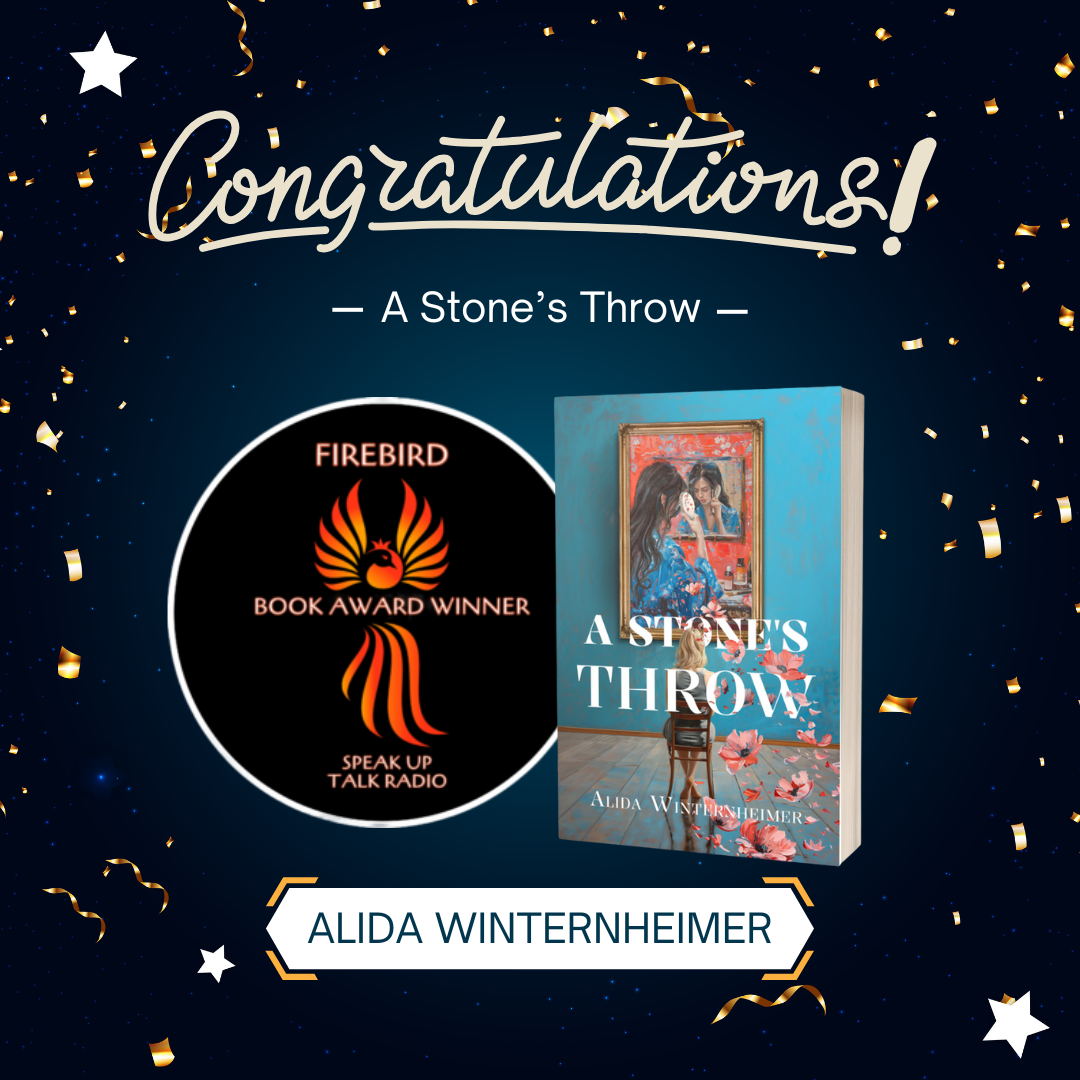
We’re pleased to announce that Alida’s novel, A Stone’s Throw, has won the Firebird Book Award!
Two women who never meet, a motherless child and childless mother, are brought together to discover the real magic of creation.
Simona and Gemma live an ocean apart, yet their lives become forever entwined when the women Simona is painting come to life, stepping out of their portraits. They arrive with a purpose: to nurture a broken heart…or two. Simona and Gemma learn about art-making, love, grief, and motherhood when they are magically welcomed into a lineage of women who share their lives’ joys and sorrows during the most creative time of these women’s lives.
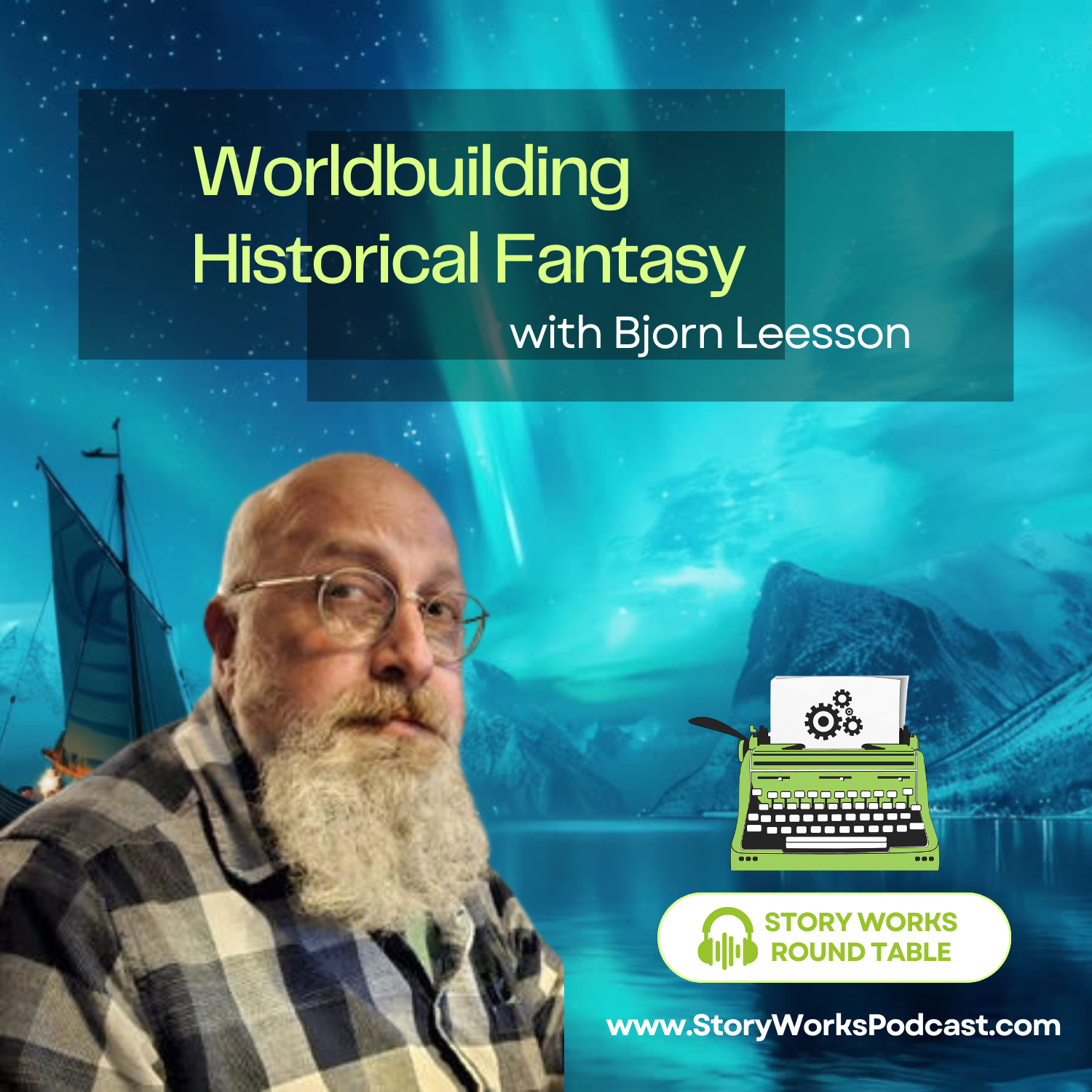
In this week’s episode of the Story Works Round Table, we welcome Bjorn Leesson, an author whose passion for history and the supernatural has culminated in his captivating series, Outside the Thalsparr. Join us as we explore the unique blend of Viking history and time travel, uncovering the fascinating role of women in Viking culture and the intricate world-building that brings Bjorn’s characters to life. Discover how Bjorn weaves historical facts with fantasy elements, creating a narrative that spans 1200 years. This episode is a must-listen for fans of historical fiction and fantasy alike!
“You have to have the passion for it. If you’re going to write historical fiction fantasy, but you’re not a fan of history, don’t do it.” – Bjorn Leesson
AUDIO
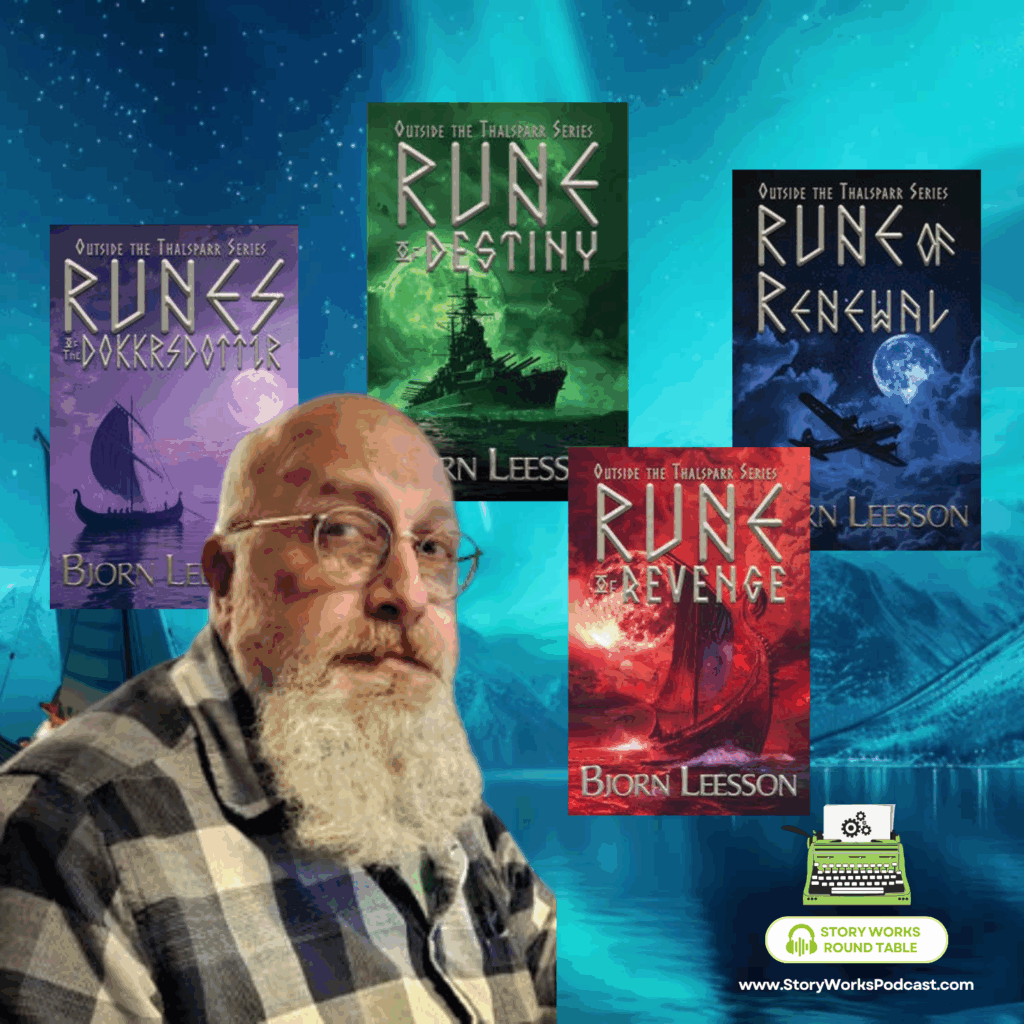
Bjorn Leesson has always been fascinated with many topics to include history, the supernatural, and writing. These interests combined led to the Outside the Thalsparr series, with the first book in the series, “Runes of the Dokkrsdottir.” Bjorn was not formally trained as a writer and has worked in the industrial manufacturing field his entire life. Bjorn was born in the Lowcountry of South Carolina a long, long time ago. He has worked in manufacturing all my working life to feed himself but has nourished his mind with the study of many topics; history of all eras, the paranormal, astronomy, writing of different types, photography, archeology, genealogy, vexillology, some other -ologies, even stock car racing for a couple of years, and on and on. Bjorn finds just about everything fascinating in some way and has been accused of being too easily entertained. A blend of a few of his interests led to the creation of the Thalsparr Universe. The first three installments of the series, “Runes of the Dokkrsdottir,” “Rune of Renewal,” and “Rune of Destiny” are out now with several more installments coming soon. Bjorn currently lives in the Midlands of South Carolina with his wife of 25 years on their hobby farm.
TRANSCRIPT
This transcript is AI generated. If you notice any inconsistencies or errors, blame the bot.
Alida Winternheimer: Hello and welcome to this week’s StoryWorks roundtable. Today, Caatherine and I are delighted to be joined by Bjorn Leeson. Bjorn has always been fascinated with many topics, including history, the supernatural and writing. These interests combined led to the outside the Thalsbar series with the first book, Runes of Docker’daughter. Bjorn was born in the low country of South Carolina a long, long time ago and finds just about everything fascinating in some way. He’s even been accused of being too easily entertained. Bjorn currently lives in the midlands of South Carolina with his wife of 25 years on their hobby farm. Well, welcome Bjorn. It’s good to have you here with us.
Bjorn Leeson: Thank you very much for having me.
Alida Winternheimer: So you’ve got an interesting series blending Viking history with time travel, correct?
Bjorn Leeson: Oh yeah, yeah. It’s pretty expansive. It dips into a couple different timefraames. All historical timefraames by our standards, but yeah, but it starts in the Viking age and some of it, a good bit of it takes place in the Viking age, but it’s dips a little bit of everything.
Alida Winternheimer: M so let’s talk about, blending historical fiction with fantasy. Why don’t you set us up with the premise of the series? Why do we have Vikings and time travel in these novels?
Bjorn Leeson: Well, I actually it wasn’t intentional originally. I’ve always been in the history that’s I have like, it’s like you just said, I have many, many, many, many interests. But my favorite has always been history. I just love history. Don’t know why, it’s just something that’s in me. U and I stumbled on to some interesting tidbits about the Viking era which a lot of my ancestry is northse, so it kind of struck a chord with me. But it was the bit I found was interesting because it talks about a Viking burial mound found in England in the 60s 60s or 70s. And of course at that time they just assumed it was a male Viking chieftain and they moved on. But in the last 10 years they went back and ree examined and remains to find out it was not a man, it was a woman. So that started the process of us realizing, across all cultures, I’m sure. But we’re starting to see that we always assumed the women were just support mechanisms at home and they didn’t participate in battles, they weren’t leaders, that sort of thing. Except for a few exceptions. Specifically qu the Vikings, they discovered that women played a very huge role. They did almost everything the men did. I Mean, they led. They owned land, they were chiefs, they led battles. They did all that stuff. And that’s the stuff that we’re starting to see now that start to come out. But at the time, it was just starting to. That thought was just starting to transpire. And me being me, you know, I was fascinated with the idea of this. This Viking woman they found in England. Imagine the story she has. So I started putting my own story down. Just, a little fictional story. Let’s see you make a little short story out this, just to satisfy myself. And as it went, it just grew and expanded and grew and expanded. But I started throwing another interest in, the paranormal. Of course, she has a supernatural power within her. So I had to throw that in there. And then it led the development of all these other characters and it just exploded into this. Unintentionally exploded into this whole series that encompasses, 1200 years of history. Not every second, of course, but over the span of 1200 years and dozens and dozens and dozens of characters. It became just a obsession for a while. I mean, two years writing almost every day on the series, and it just was awesome. But my two favorites of course, History and u. The Supernatural. Those two were first and second on my list. So those blended together to create Mariel and her Mary band of warriors that travel through time. But she does. She’s the one that travels through time to protagonist Mariel Docer’s daughter. but the other characters, I don’t want to give too much away as we talk about it, but the other characters don’t stay contained in the Viking era as we know it. It ends up, a blending. A blending of time. Frme I guess I can put it. And it’s not just in the living world. It’s in the other world as well. So it’s pretty complicated story, but I think it came together a pretty awesome. I hope readers think so.
Kathryn: So said 1200 years of history. What timeraames. What parts of history or do you touch on throughout the series? So you’ve got Vikings.
Bjorn Leeson: Yep, yep. That’s where.
Kathryn: What else?
Bjorn Leeson: Yeah, it begins in the Viking era. 800s with Mariel’s birth. it skips forward to 1891, Montana. Believe it or not, that’s at the end of the first or towards the end of the first book. it’s takes her to 18, 1891, Montana. She meets her own descendants. So she’s got, you know, she meets her own 38th, you know, 39th, 40th great grandchildren. And I did that on purpose because genealogy is also one of my interest. it, if you go back far, science says if you go back far enough, we’re all related. Of course we’re all related, you know, either scientifically or if you’re believe in the Bible. Either way you’re related to everybody else. And science says you’re not more distantly related in 32nd cousins. So everybody you meet in the world, you are related to them. So that, that kind of is the thought where I brought in these interesting descendants of hers because they’re not, they’re not all the same race or creed. You know, you’ve got Native Americans that are her descendants. You’ve got black people that are descendants, white people. You’ve got all these people from Europe. So it blends in the notion that the world, the world is scattered out, but it’s still connected, you know. And I wanted to kind of weave that into the story and that was a way to do it. I got off track. I’m sorry. But back to that, your question. after she accomplishes what she needs to in 1891, she jumps again and she’s in World War II. And this is the. The climax of what her. Her purpose is.
Alida Winternheimer: So when you were approaching world building for this series, how important was it to you to stay true to historical fact?
Bjorn Leeson: Excellent question, excellent question. Because, there’s kind of two philosophies on this. I come from a. My original writing background is technical writing and nonfiction. you know, historical nonfiction. There’s not. There’s not a lot of creativity involved. You can’t. You can’t because it’s. It’s fact. You can’t. You can’t play, you know, you can’t play with it, be true to the genre. So I had to walk a little bit of a line because I do have that background, and I do see the importance of leaving history intact. But there are plenty of gaps where you can interject your own fantasy thoughts into factual history. There’s a lot of gaps in our historical knowledge. A lot of things we think we know, we don’t. I mean, just look at it over time. the. You know, the burial mound in England, perfect example. It’s a. It’s a male chieftain that from Norway and he ended up here and got killed. You know that, that wasn’t the true story. Right. But for decades that’s what we thought. So there is some wiggle room to, we’ll say play with the facts a little bit. But it’s a, it’s a, it’s a tightrope. Because when you’re writing in historical and historical based background, unless you’re doing some alternate universe kind of stuff, which isn’t what I’m doing, you do still have to be true to 90% of the history because you don’t want to lose people.
Alida Winternheimer: What else have you uncovered in your research that has, that might surprise readers when they encounter it in your books?
Bjorn Leeson: most of it’pretty well known knowledge. but there’s one thing, I’m trying not to give away too much of the story as we talk, but I do feel like this should be brought up especially as we just spoke of it. There’s been a lot of accounts of the, the, the settlement in England. The, I don’t know, you know, how many you, if you guys or your viewers have seen the TV show Vikings. But there’s a north settlement that they settle on England or in Britain, you know, what knows England then? But the Saxon lands, the Saxons intentionally invited them to come settle after they’ve already been raided by the Vikings. Mind you, they invited them to settle because the thought was if your people are here as part of a settlement on our lands, then they won’t raid because they’re not going to come attack their own people. And if they do come attack, you know, come to attack. The Vikings are, their, their culture is violent. You know, let’s just admit that part. Their culture is pretty, it’s based on honorable violence for the most part. So if they do attack, the settlers that are there will fight them because they’re attacking their land. Now you see, so it’s an interesting story and, and, and the settlement does get wiped out, but there’s a lot of different accounts of how. When that happened and how it happened. Exactly. I did interject that into my story.
Alida Winternheimer: Yeah. What advice do you have for writers who might be attracted to this kind of genre, this fantasy with a base in history? Who, thinking about world building and how much detail about daily life or clothing or other necessities do you put into this fantasy narrative so that people feel connected to the history and can recognize that there is this body of fact supporting the fantasy?
Bjorn Leeson: Oh, absolutely. first of all, you have to have the passion for it. So if, if, if you’re going to write an historical fiction fantasy, but you’re not a fan of history, don’t do it because the readers will see through it. Right. I mean, you got it. You got to have a passion for it to begin with. And once you do, you kind of have a feel for how much to throw in you. If, you know, as an accomplished writer, you know that you can’t flood them with just, you know, pages and pages of mundane facts about the history they’re living because you lose them. You know, it becomes a history lesson instead of a story. So you got toa find that balance. I focus on food, but I’m a fat guy and fat guys love food, so. But I do focus a lot on what food they’re eating. And I’ve even been called out a time or two to say tacos, for example. Tacos didn’t exist yet. Oh, no, I looked it up. Yes, they did. They did exist. Don’t you know, I made sure that. Hang on.
Alida Winternheimer: The n. Vikings had tacos.
Bjorn Leeson: No, no, no, no, no, no, no, no, no.
Kathryn: This is 1891 Montana.
Bjorn Leeson: This is later the story during the World War II era. But. O. No, but you bring a good point. You know, you can’t. When you re. When you are doing these things, you can’t. You can’t stray too far from the path and throw in just wild stuff that, you know, couldn’t happen because that’that just pushes your readers away. But I, you know, put pretty much when you’re doing it, at least I think this is what I tried to do. I put myself in the frame of mind of my reader, of what do I see every day that leads me to believe that this, this story takes place in the past. What’s different about it? You Know, in some future books that haven’t come out yet in the same series, it takes place in late, 1800s, early 1900s, in, the. In the desert states, but also in New York City. And I, I interjected the development of the automobile. So it just, it gives you that tr. That, that contrast you want in your story to show that it is a different era, but not so foreign that the reader can’t relate to it. I’m not sure I made my point there, but I think you understand what I’m saying.
Alida Winternheimer: Yeah, definitely. Catherine, you write fantasy, so when you’re thinking about world building, how much fact or, you know, what do you bring into your fantasy? World building.
Kathryn: Yeah. I feel like it gives you a good starting point. Right. Even if you’re not going to use it, like you said you could, like, take it and make an alternative history or, you know, other things. You can really play with how much fact you want to keep in there. I like that you’re really. You’re kind of on this. This side of the spectrum. Right. It’s like mostly fact with magic thrown in.
Bjorn Leeson: Right.
Kathryn: Right. I probably land more in the Middle, where my facts are maybe not 100% recognizable, but I’m using it as a baseline to establish my world so that I don’t have to come up with geography and all of the political systems and all of the, you know, all by myself. U. because that is not 100% my passion. I like the characters and the story that goes with it a little bit more. So, and think.
Bjorn Leeson: And I think readers forgive you for that, though. If the story is good and they’re really enjoying it, they’re. They’re going to look past some of that. I mean, you can’t do it crazy a lot, but. But yeah, they forgive a little bit of, let’s say, fudging the facts, I guess you could call it.
Kathryn: Well, yeah, and I feel like that’s where that fantasy tag kind of gives you a little bit more of that leeway. Right. Where you get to say, yes, it’s historical fiction, but it’s also fantasy. So we’re going to play fast and loose with certain things, like you said, like having the supernatural world, the paranormal, the magic, allows you to say, oh, this actually wasn’t like this because of that. It was like this because of these interplay between light and dark or interplay between the magical entities.
Bjorn Leeson: So some light redefining, but not. Well, I mean, for. For my story. Yeah. I mean, yeah, there’s, you know, you could go from one end into the spectrum. The other, of course, you say you’re somewhere in the middle. I’m kind of on this side. Then there’s going to be inevitably somebody on this side that almost none of it’s factual. It’s just completely made up, you know, so, yeah, absolutely. It gives you a lot of range, for sure.
Kathryn: Yeah. So is there a reason you wanted to do the fantasy element and not just stick with a pure historical fiction? Because it feels very much like you care a lot about the historical aspects of it. So why. Why include the fantasy?
Bjorn Leeson: I just like paranormal stuff because it’s fun. I had to throw it in. I think when I first started developing the protagonist Mariel, I threw into. I like, okay. All she does, she’s got all these quirks and interesting little ticks about her. And she’s, unusual to begin with because she’s a Viking female. That’s not what you would. Normal. You know, her appearance is not normal for a Viking. And what else can I do to make her more interesting? I said, well, put some magical powers in her. You know, all su. I just started messing with that. And it just took a life of its own. And I rolled with it. But yeah, I mean, I could very easily have just gone strict, strict, historically based. But for whatever reason, when I started messing with the paranormal end of it, I said, okay, I’ve got to make this work, because this is. This is fun.
Kathryn: And then you turned it into time travel. So then was that an opportunity for you to explore other areas of history that you were particularly interested in, or did that all sort of happen, like, because you had Mariel the way she was, you just were like, oh, let’s just take it this direction.
Bjorn Leeson: I think it was more the first. I think I wanted to be able to go into these other timeframe as well. But I. But I loved the way Mariel built and developed. I love. I couldn’t just make her story end in the Viking age and say, okay, we’re done with her. Let’s move on. She’s got to have more. So I. I had to find a way to pull her into these future timefraamess.
Alida Winternheimer: So are you finding it, hard to categoriz or find readers when you’re writing across these genres of historical and fantasy? And I wonder if a reader might see your first books cover, especially with the Viking ship on it, and expect historical fiction or Norse mythology and the pantheon of gods and goddesses, and then they discover something entirely different. So are you finding Any challenges in regard to that?
Bjorn Leeson: Absolutely. For the longest I couldn’t even decide what to what genre this even is because it just, it spills into everything and it’s all these times and places.
Kathryn: Feel like a fantasy reader, like somebody who’s expect, who lives in that world would have no issue. Right. Like they’re gonna pick up your book and be like, oh, okay, it starts in the Viking era. Sure. Like I, I can go with that. But because you know, as a fantasy reader is expecting the unexpected. They want to be thrown into the wonder and the. Oh my gosh, the plain existence and the time.
Bjorn Leeson: Trav. Yeah, so no, you’re absolutely. That’s a good shout because I’ve had very few objections to it from the ones who, you know that I’ve heard feedback from the readers. There’s been one or two that say I feel like this went direction I didn’t want. I’m like, well, I understand, but this is the story. So just, you know, either you like it, you don’t like it, but
Kathryn: Try to flag in your description and stuff. Do you try to flag it for people to understand what it is?
Bjorn Leeson: U me myself and I. Yes. The the back matter on the book doesn’t really do that because I didn’t want to give a lot of way, you know, so I tried to, I didn’t say time. I think on the COVID on the back cover it does say times of places outside of our normal. but I, I I bank on the characters in and the backdrop and, and the multiple stories that overlap that will suck the reader in. And it seems like it has, I mean I’VERY like I say, very little fe bad feedback about the jumps and changes. In fact, most people really liked it, which is of course the objective.
Alida Winternheimer: What else would you recommend people think about going into world building or historical fiction where you’re drawing on a lot of facts and references to tell your story?
Bjorn Leeson: one thing that I found useful is working into the dialogue. Whatever you’re trying to, whatever you’re trying to, set the scene in the reader’s mind about where you’re at and the timerame you’re in and in place too. Of course, you know, because it’s going to be different depending on your location. Working into the dialogue more than making it a narrative. Because when you’re, when you make it a narrative entirely too much it just sounds like a history book. And that’s not really what you’re shooting for with the fantasy story. Of course right now mine does have a lot of narrative in it, but it has a lot, a lot of dialogue as well. And I tried to draw out as much of that scene building into the dialogue as possible. Make it, make it part of the story that they explain to you where they are and what they’re doing, you know, and where they’re located at.
Alida Winternheimer: Do you aim for dialect? Do you have sort of a Viking manner of speaking or an approximation of it obviously for those scenes and those characters and then shift to, we’ll just call it the wild west Montana in the 1890s. Or whatever. you know. So as you’re using dialogue to shape a sense of time and place for the reader, are you shifting dialect?
Bjorn Leeson: Absolutely. Yes. I think that’s a huge part of character development. in mine alone, the way I tried to set the Saxons and the Viking ancient, you know, ancient Saxons and the Vikings apart from what? In order to make it seem as though they’re foreign. But you’re still reading English, right? I think I’ve explained that. Right.
Alida Winternheimer: Yeah.
Bjorn Leeson: As an example, in a movie, every time we have a foreign individual in. Especially in older movies, all of them have English accents. Why do they do that? Because we could still understand it. It’s. It’s, It’s still English, but it lets you know they’re not from here, you know, if it’s an American movie. So same thing with dialect in a book. Right. what I did with the Vikings and the, Saxons is I eliminated contractions. No contractions. So they say do not instead of don’t, you know, is not instead of is, you know, or isn’t instead of is not. Because it’s not normal casual speech. So when you’re reading it, you’re okay, this is different than my normal. And it sets them apart from somebody else who doesn’t speak that way. and later in the story, in 1891, where she first appears as a character named Rosie Mitchell, she is a descendant of Mariel as well, but she is a freed slave from the American South. Her parents were slaves in Georgia, and she was freed as a young girl. And she ends up on, you know, Mariel’s team at some point. But. But she still has a little bit of a southern slave dialect, if you want to call it Geechee, you know, that’s what we call it here. South Carolina Geechee dialect
another character is, his name’s Bren. He’s Welsh. But I gave him more British, British slang and British, way of speaking to set him apart because he’s Welsh, some examples. I just gave a lot of ways to set them apart and to also set the scene, you know, you need to know where you are and what timeraame you’re in. So you can use u, words of the time, you know, of the era, you know, dadd o. You don. Know. No one uses that now. But in the 50s, you know that was a word so that you know you do little things like that to clue in the reader. Mm
Alida Winternheimer: Definitely.
Good. Well any final thoughts or questions Catherine?
Kathryn: No, this was great.
Alida Winternheimer: Yeah, this has been fun. Thank you so much for joining us Bjorn. Where can listeners find you and your books?
Bjorn Leeson: the best place to go is on the hub website. I call it the website bspar.com t h l s p a r r.com and adult. Take you to all the links, other information I have out there to kind of explain more about the story. U, the books, the descriptions, where you can go get them, what’s out, what’s coming, all that good stuff. That’s the best place to go.
Alida Winternheimer: All right, well thank you very much and good luck with your series.
Bjorn Leeson: Absolutely. Thank you very much for having me and putting that with my ramblings.
Alida Winternheimer: Our Pleasure.
About Your Hosts
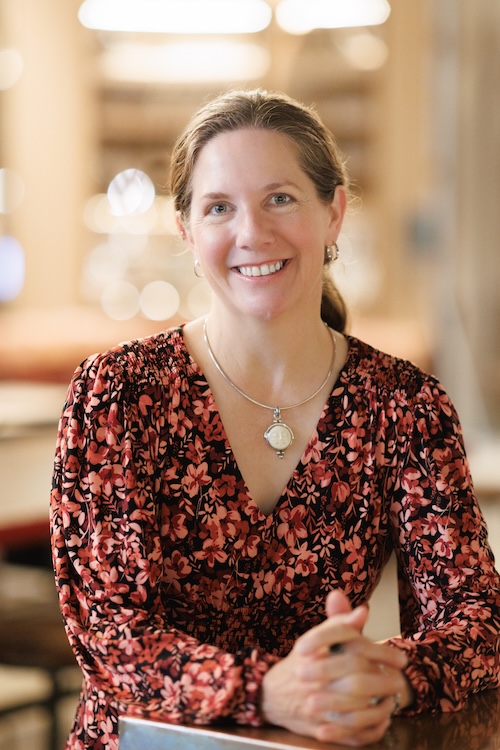
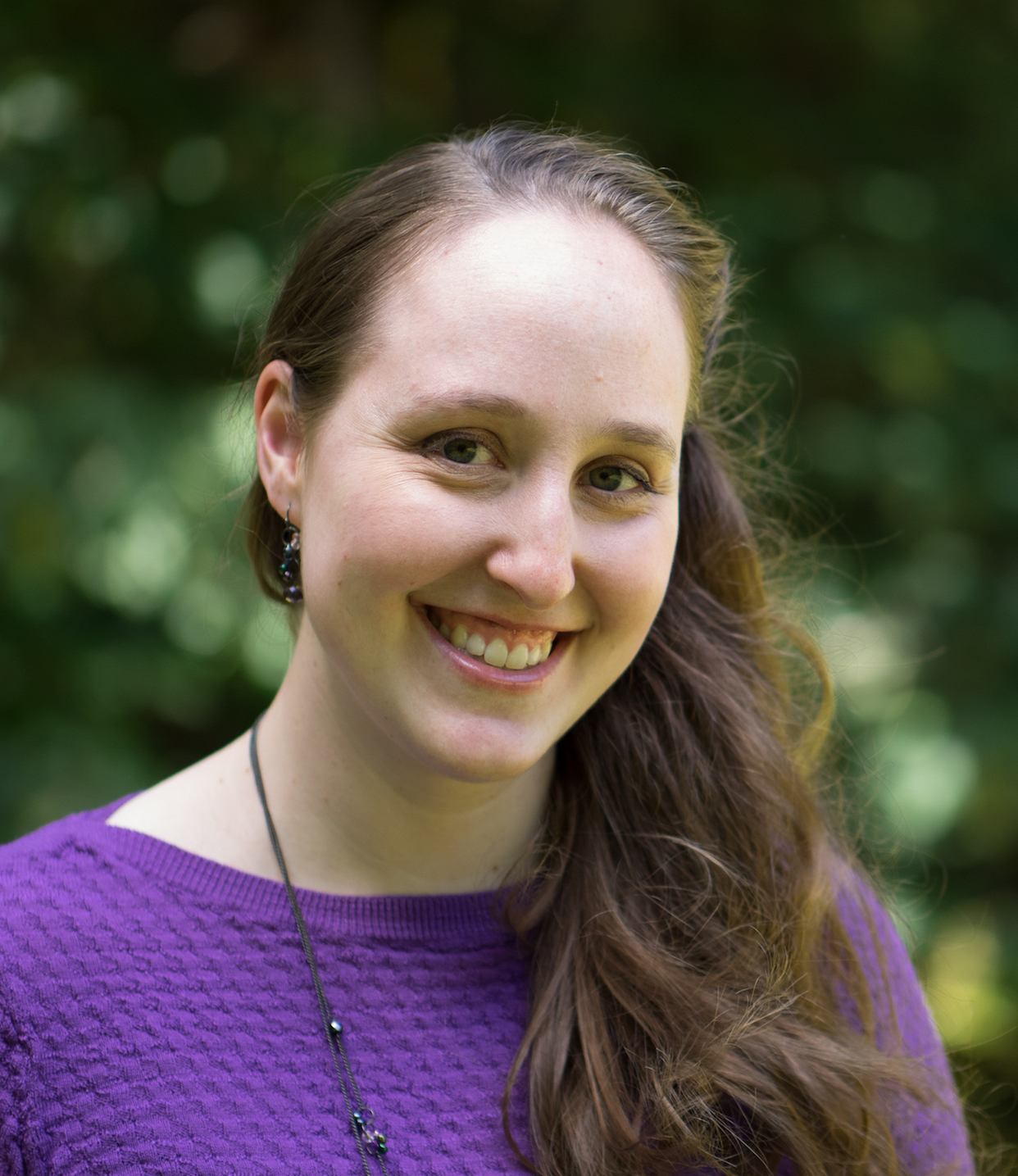
Kathryn Arnold writes fantasy and anything else that sparks her creativity from her home in Kingston, Washington. She currently earns her living as an insurance underwriting assistant, where she also creates marketing and web copy. When not writing, she plays (and teaches) piano and keyboard in a band (or two), and is working on starting a ministry team with her husband. You can find Kathryn at www.skyfirewords.com.