

We’re pleased to announce that Alida’s novel, A Stone’s Throw, has won the Firebird Book Award!
Two women who never meet, a motherless child and childless mother, are brought together to discover the real magic of creation.
Simona and Gemma live an ocean apart, yet their lives become forever entwined when the women Simona is painting come to life, stepping out of their portraits. They arrive with a purpose: to nurture a broken heart…or two. Simona and Gemma learn about art-making, love, grief, and motherhood when they are magically welcomed into a lineage of women who share their lives’ joys and sorrows during the most creative time of these women’s lives.
In this episode of the Story Works Round Table, Alida and Kathryn sit down with J.E. Weiner, the author of the captivating novel The Wretched and Undone. This Southern Gothic tale, set in the Texas Hill Country, intertwines history and supernatural elements as it explores the immigrant experience during the American Civil War. Join us for a deep dive into the book’s rich characters, the haunting themes of faith and family, and the fascinating historical research that brought this story to life. Whether you’re a lover of historical fiction or simply curious about the creative process, this conversation is not to be missed!
AUDIO
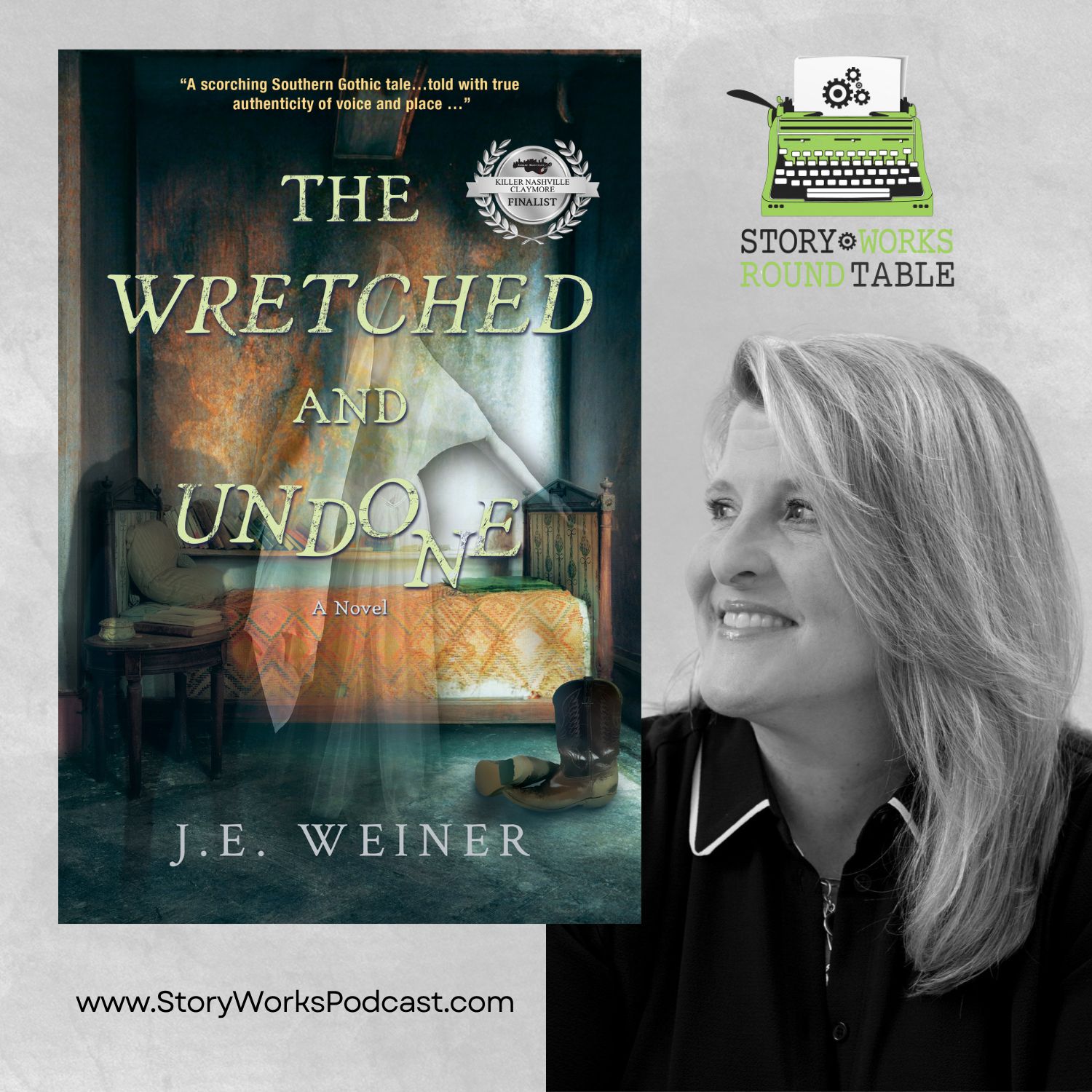
J. E. Weiner is a writer and novelist based in Northern California. Her debut novel, “The Wretched and Undone”, is a searing and genre-bending Southern Gothic tale set in the heart of the Texas Hill Country and inspired by real people and actual events. The book manuscript was named a Killer Nashville Top Pick for 2024 and a Claymore Award Finalist for Best Southern Gothic.
Weiner’s previous work has appeared in the literary journals Madcap Review, Five Minutes, HerStry, and Chicago Story Press, as well as the recent grit-lit anthology “Red-Headed Writing” (Cowboy Jamboree Press, 2024). Weiner is a founding member of the Pacific Coast Writers Collective, and while living and writing in blissful exile on the West Coast, her heart remains bound to her childhood home, the Great State of Texas.
TRANSCRIPT
This transcript is AI generated. If you notice any inconsistencies or errors, blame the bot.
Alida Winternheimer: Todays conversation is with JE Weiner, author of the Wretched and Undone and its one of those unusual times when Catherine and I received an arc and had the opportunity to read the book before having Julia on the podcast. Which always makes for a deeper, special conversation, you know. And it’not it’s not that our conversations when we haven’t read the book aren’t amazing because you know, they are, right? But there’s just a little extra to those these conversations and I think you’re really going to enjoy this one. Whether you write historical fiction or not, this book has so much going on with it. There are ghosts and curses and it spans generations in the setting, the Texas Hill country is alive and well in u in this story we had so much fun talking about Civil War camel wranglers. Yes, that really was a thing and weaving fact into our fictions. As you know, I write historical fiction. So I got to u groove with Julia during this conversation. And yeah, we had a lot of fun so I think you will to check it out.
Alida Winternheimer: Hello and welcome to this week’s StoryWorks Roundtable. Today, Catherine and I are delighted to be joined by JE Weiner Julias debut novel, the Wretched and Undone is a sweeping Southern Gothic tale set in the Texas Hill country and inspired by real people and actual events. The book manuscript was named a Killer Nashville top pick for 2024 and a Claymore Award finalist for Best Southern Gothic. Julias previous work has appeared in the literary journals Madcap, Review, Five Minutes, and Herstry, as well as the recent gritletit anthology Red Headed Writing. While living in blissful exile on the west coast, her heart remains bound to her childhood home, the great state of Texas. Welcome, Julia.
JE Weiner: Thank you. I glad to be here.
Alida Winternheimer: M so you mention in your bio that the story has roots. Well, before we before I ask you a question about the story, why don’t you tell our listeners the premise? What is the Breetched and Undone about?
JE Weiner: Sure. Well The Wretcheded Undone is a story about a family in Bandera, Texas. Bandera is self proclaimed the cowboy capital of the world. So that already was intriguing to me. it is the story of Martin. and Aggnzka Anderwald, who arrive on the eve of the American Civil War from. Poland, as new arrivals seeking a new life in a land of fertile soil and freedom. And they arrive to something wholly different. They arrive to a world on the verge of cataclysm. They arrive to a place of, nothing. Must build their lives out of nothing. And violence in every direction. And they are quite stunned and, find themselves seeking refuge, in their. Faith, refuge in their family. Only to have that completely upended by. Marians being called to a, by the Confederate army to a small outpost called Camp Verde, where he is separated, from his family and encounters a dark, specter, who he antagonizes. And who pledges to curse the family. For generations to come. And that actually manifests. And so it’s the story of this family. It’s an immigrant story of, of people fleeing oppression in their home countries. It’s a story of pioneers forging the American frontier, really at their own. Peril, trying to build a new life. And a new land. And it’s also a story about faith. And family and the challenges that one. Encounters on both fronts over the course of our lives, that are tormented by forces beyond their control. And so this really is, Not only a, Bandera story, it’s a Texas story, but it’s also a. Quintessential American story in many ways too.
Alida Winternheimer: Yeah, great job too. That was very, engaging and concise, and I struggle to, to give that verbal synopsis of my own writing. So just a little sidebar there. I’m impressed. Now to get to that first question, you mentioned in the bio that the story is inspired by real people in actual events. And in your acknowledgments, you mentioned that you and your sister are both ghost magnets. So I would love to hear the backstory behind this story.
JE Weiner: So it really started when we were little girls and we visited our grandmother on her farm in Pennsylvania Dutch country. So just right near Gettysburg. It is, a part of the world that has many, many ghost stories associated with it. But we as children, along with our. Cousins, witnessed many mysterious things on this ranch over the course of our lives. It continued episodically over our lives. And we came to find out that, our grandmother experienced all these things too. She Just didn’t talk about them. She’s the most rational person I’ve ever met in my life. Very focused, raised during the depression, you know, very practical. but she completely believed in ghosts. And she completely validated all the things. That we finally got the courage to, to tell her about. U. and then fast forward to being young adults with young families. My, one of my sisters bought, a ranch in the Texas hill country along the Medina River. And soon after moving in, and this. Place is kind of out in the middle of nowhere, soon after moving in, she witnessed a, figure walking past. At one night, walking past the kitchen window, encountered this same figure bringing groceries in from her car into the house. And she said, well, twice is no longer a coincidence. Something’s going on here. And then her husband, sometime later, also saw this same figure. It was a woman in white, dressed. In sort of turn of the century, 1800s flowy dress. And then a little while later, their nanny awoke to this figure standing over. Her in her bed holding out papers. so they couldn’t ignore it any longer, Started asking around in town and. Found out that this woman was no. Stranger to most of the people in town. They had heard this story and there. Had been a murder suicide at the turn of the 20th century on this property. and we suspect that that’s who she was. So that’s sort of the fast forward. To sort of how I got anchored on ghosts in Bandera on a ranch on the Medina River. That was the sui generos of the story, but it built from there.
Alida Winternheimer: Right. So interesting. So the woman in white, the murder suicide is not, I’m not going to pronounce her name properly, but Agnis, not Agnieska.
JE Weiner: No. You know, that story was very tragic. But it had been told. It was part of sort of Bandera ghost story lore. And you don’t have to go too far and too, fast to find ghost stories in every tiny little town in Texas, particularly this part of Texas. and so it had been told. And so I really also, started to think about, well, how did she get here? Where did she come from? And I almost wrote the book in reverse, trying to unpack, well, where did she come from? And then where did the people for her come from? And uncoileed this unbelievable history that really had never been told about Bandera and its Polish immigrant community. And, so the story veered. It veered from the true story and became the book.
Alida Winternheimer: Nice. So the, the history that is woven into this story, did that come then from your research about Bandera and the immigrants in the region as opposed to this ghostly origin that inspired the book.
JE Weiner: Well, that got me talking and certainly we always love a good ghost story in my family since we have a lot of them. but we were also, I was traveling there quite a bit. It was coming every holiday season, coming every summer with my kids and you. Know, staying up late at night around. The fire or the fire pit as it were. and just chatting and getting to know the town. we stumbled into this little museum called the Frontier Times Museum, which is just a small little house just off the main drag in Banddera. And it is chock full of unbelievable photos and memorabilia and implements from the ranches around town, the brands from the ranches around town and this unbelievable assemblage of taxidermy, like weird taxidermy that you’ve ever seen. Everything from like wombats to you know, five point bucks to bears to, you know, it just all of it stuffed. And it takes up like half the museum. One in particular is in the prologue to the book, is a two headed, two faced goat that they had stuffed. And it had come from a fair about 30 years prior, but it was sort of anchored in the center of this taxiderm exhibit. So I started looking at the pictures. Of all these early settlers and they’re very stern faced, very rugged. You know, some of these women in. These pictures are probably 25 years old and they look 80. Just really hard life. And so I started to wonder and stumbled upon, there’s a church in town, there’s a strong Catholic population there, the Polish immigrant population was Catholic. And they have a beautiful old church, called Sa Stanislaus. And outside there’s a monument to the families who came over on a boat in 1854. And so I started just reading about this boat trip and people coming to the area. And little did I know the port of Galveston was as busy as Ellis, island at times in bringing, mostly Polish and German, settlers to Texas. It was a really very active immigrant pipeline. So that’s where it started. And then when I really got the idea for the book, again I’m a historian by training and so I wanted. It to be authentic. My natural proclivity is towards historical fiction and I didn’t want to make it up and have the people in town say, you got it wrong. So I started reading the newspapers and everything from ads to obituaries to birth notices, to articles about who got locked up in jail over the weekend and you know, went back in time. So that’s really how I so of it started to unfold and come together.
Alida Winternheimer: Yeah. So I love that. And I write historical fiction as well, so I understand everything you’re saying there about this, this journey of discovery. We go on doing the research, So talk a little bit about how you wove fact into fiction and brought those historical details that ensure you got it right for Banddera. Right. Bandera Tees into this fictional story that you were creating.
JE Weiner: Right. Well, I basically created a family tree and I made sure that the points in time were anchored against moments in that historical timeline that I had discovered. So the arrival from Poland, 1854, the start of the American Civil War, 1861, the US Camel Corps, which features very prominently, which is a quirky part of the history that I uncovered or discovered for myself. Anyway, how that played out over time, the role that this region played, in preparing for World War I and the sort of turmoil that came about there and then sort of into World War II and post war. So I anchored the family, tree around those events and then I began to tell the story I wanted to tell about the family. They are all amalgams of people I’ve. Read about, learned about, certainly people in my own family. There are amalgams of people I’ve loved. And lost and people I’ve read about. In, in the literature, and kind of got the characters down and then how they interacted with that timeline and those sequence events. I really want to make sure I got that right. And so it was layered, I guess is the best way to describe it is really layering it against timeline, family tree, character, and then making sure that the events surrounding them help, drive a narrative.
Alida Winternheimer: Yeah. So the camels, that was something I was going to ask you about. Camels and peacocks, because they’re just so, such a quirky addition to this setting. I dont t know if I have a real specific question. I just wanted to hear more about some of the research. What was maybe the most surprising thing you discovered in your research, that went into this story that made it into the narrative?
JE Weiner: True. Well, so in addition to taking our little kids to the Frontier Times Museum to see the stuffed bears and the stuffed wombats, another tourist ah, attraction in the area is Camp Verde, which is now the original camp is on someone’s private property, but they have sort of a museum to the camel corps there. And they’re camels on all kinds of Signs and you can go. And occasionally, I think you can. Get camel rides or you used to. Be able to get camel rides. and the story of these camels that came. And it’s interesting, that. But the first talk of these camels. Was in the 1830s, 1840s, when we. Were really moving westward as a country, and mules and oxen and horses just. Didn’T have enough stamina to get across. The American desert and forging west. And so they were looking for pack animals that could really help both expand the military, but also open trade routes further west into the United States. This idea of bringing camels from what. Was then called Arabia was laughed out of Congress a bunch of times. One time, including when, in the early 1850s, when the Secretary of War who would go on to be the President of the Confederacy, was. Jefferson Davis, was, advocating saying, this is a really great idea, finally was appointed Secretary of War. So he had some control over money and resources. And so he sent an expedition and they went to Greece, Tunis, I believe they stopped also in Turkey, picked up all different kinds of camels, also picked up camel wranglers because no one knew how to take them, and. Brought them over on these ships that. Were especially outfitted for the animals and their humps, like, they cut holes in the. In the floor of the deck to allow for the humps, brought all these camels over. And they were a US army outfit for a while. And then when the Civil War started, they. The Union was there first, and then. The Confederacy took over and took over the camels. And, they became part of Civil War lore. They were used as pack animals. They didn’t test runs out all the. Way to California with half the herd. And the other half stayed in Texas. At the end of the Civil War, though, they. So they are really gross animals, quite frankly. And there are all kinds of tales about the soldiers don’t want to work with them because they’re either getting spit on or on, just out of nowhere. They really just defecate everywhere, unexpectedly. And the soldiers hated working with them. So the first opportunity they had just to send them out into the desert if they did. And there were these go. These, camels that floated around in the American Southwest. Last sighting was about 1941. That’s. That’s how the camels came to be. I couldn’t resist. And I also couldn’t resist riding some of the Arab camel wranglers into the story. Sidebar. I traveled to Israel quite a bit and so the thought of kind of. Bringing a little bit of that world. Into this story and have it be historically accurate and not something I just made up, was also really compelling to me. Have, family in Israel, so u, that was really interesting. The peacocks, I will tell you, come from. So I went to a prep school in Dallas, Texas, where I grew up. Peacocks just were everywhere. And so I always have loved peacocks. And I stumbled upon this note that a lot of ranches have peacocks because. They, they chase bugs, they chase rats. They chase snakes, and they also are, they also sound alarms. Like when coyotes come or, mountain. Lions come, they sound alarms. And I thought, well, they have to be in the book too. So that’s how they got in there.
Alida Winternheimer: They’re so fun. I love the, the camels and the peacocks on the ranch. And the peacocks definitely play that role of sounding alarms. Yeah, you know, they are the, the alert system there. Khalil and the camel wranglers are also interesting characters. Did you face any challenges or did you have any sort of feel any, beyond historical accuracy? What sort of responsibility did you feel around incorporating such unusual characters in te your story and developing that relationship between these. Well, they were all kind of foreigners, but, you know, in the 19th century, relations werent what they are today, and attitudes were certainly very different. And so youve got Khal Aln Ahmad living on the ranch with the Anderwald family and really becoming family, becoming part of their, inner circle. Their family.
JE Weiner: Sure.
Alida Winternheimer: Yeah.
JE Weiner: Well, in researching, absolutely. This is a fantastic question, and I’m so happy to be able to offer my answer to that. so when I was researching these camel wranglers who are, ah, obliquely referred to in various sources, I came to find out that while people knew their names and where they came from. They never really recorded them, with the. Exception of one man who became almost a campy character in a lot of early 20th century Westerns. His name, they referred him as High Jolly. He was in a number of sort of, you know, Hollywood, West or spaghetti Western kind of things. And he was very much a stereotype and not necessarily a positive stereotype. And the reason he was known as. Hy Jolly is because his name was Hu. And the people at the time just. Couldn’T be bothered to pronounce his name correctly. So they just gave him a nickname and called him hi Jolly. he went on, there’s like a whole. His. His grave, there’s a monument to him in Arizona. He became kind of a person in history. he ran, he took the camels out to California and he created a kind of a pack trail running mail. Between a couple of forts out on. The, on the west coast and then came back to Arizona where he died. but the thought that they just. No one could be bothered to really. Record the details of these people’s histories. These were folks who were ripped from their homes, brought here with promises of you know, riches and being taken care of. And the one thing I did learn. Is that they were very often not paid. They were just sort of left to their own devices once the camel corps was over, no one saw fit to make sure that they were okay. And they certainly didn’t have any resources to get home. So the notion of this stranded couple of brothers who befriend March ah at Camp Verde and actually help him, and this other wounded warrior, Sergeant Kirby. That these unusual suspects came together, banded together as others and became a family, became kin, I thought was really special. We also add the character Zee, who is a ah, woman who joins this as Khalil’s wife later in the story who is half Native American, half black. and so bringing these folks together was not to create a sort of token myriad. It really was about familyies found so often, particularly in moments of distress stress. these were all people with sights on their backs for various reasons, whether it was religious prejudice or just racial prejudice or all kinds of being, being different at that time, not speaking the language. and so that was really kind. Of a way to sort of bring these folks back into the history and. Give them names is sort of how I thought about it because they were. Real people that really did exist. Most of the midwives at the time, this is the Z character. Most of the midwives at the time. Were not the white male doctors. They were women, you know, who had either women in the communities or women from other areas that came in. And they were really important in the world at that time but they don’t get any recognition. So this is not their story. They are not the main characters, but they are part of the assembly, the cast as it were, around Theerwalsts.
Alida Winternheimer: Right. Yeah. I think it’s so important for writers in the historical genre to do that work of really discovering who the people were in these communities and expanding the focus of the narrative of the setting of our characters worlds to reflect reality as the historical records. You show it to us. Right. So we are Being honest and factual and not creating a utopic version of the past and while honoring, the people who did exist. Right. Not neglecting them and assuming everything was well.
JE Weiner: And I do see a difference between. Pretending to speak for a community of which I do not belong, in which I do not belong, but being able to lift their story up, perhaps for others to take and tell from there. and it’s a tension point, right, because you want to be true to the historical facts. And they were marginalized. They weren’t part of the mainstream. They weren’t, written about or spoken about. But to go back and try to. Create, to your point, history that’s not there. The historical fiction writer in me that really became the guardrail that I thought about. I went as far as I could, without rewriting history. the other thing is, is that I did not shy away from the. Brutal truths of the time. I mean, there were words used and sentiments held and actions taken that were venal and awful and would, would not be tolerated today, obviously. But I’m not using a 20th or 21st century lens to judge people for. What they did or didn’t do.
Alida Winternheimer: Right. So, yeah, yeah, I really appreciate that. I share your attitude or stance on that issue. In my own historical writing, using the language of the period as much as I can. You know, being a 20th century raised 21st century person, using sources to discover this language. Right.
Alida Winternheimer: Yes.
Alida Winternheimer: It s, Civil War chall.
JE Weiner: Yeah. And in the Civil War south, you. Have to thread a needle. And I think from a craft perspective. This was something that I learned. Even though my narrator is of that time. Right. Of that time, speaks in the language of the day, I made the choice to not include, not include some of the ways in which people would have referred to others in the narration and keep it to dialogue because that’s. It’s dialogue. It’s a character who’s speaking. And that was the one sort of. Threading of a needle that I did. just from a craft perspective do. And that was because that’s where my heart was. And I didn’t want to perpetuate in narration and blur because so often the narrator is blurred with the author. And I wanted to make sure that this was of a place and a time and of a character in a certain place and time speaking. And so that was one way to address some of that.
Alida Winternheimer: Right.
Kathryn: When you utilized an outsider, u. you know, bringing in the Polish immigrants to kind of like shed light on the culture at the Time differently than you would have if you were dealing with somebody who’d been raised exclusively in that Texas environment. So you, you kind of had an outside perspective looking at it already, which was fascinating. way it kind of injected a different level of compassion and you know, cultural difference and things where he could see things and judge them and not feel like it was judgment coming from you, the author, but more just like his true reaction to the situation that was happening. especially in the Confederate camp in the when he’s dealing with all of that like you really genuinely get his discomfort and you understand the discomfort without it feeling like it’s your judgment as the author of the situation at hand. U so using that kind of outsider perspective I think was really kind of a neat way of digging into all the different cultural things that were going on.
JE Weiner: Thank you.
Alida Winternheimer: Yeah, that’s an interesting movement in the story as well because you know, as Catherine points out, there’s that outsider’s perspective. So we’ve got Marshin, the main character there who’s taken from his home by the Confederate army by kind of recruited to build trailers for camels and he’s taken to camperty and then that’s where he meets the camel wranglers. And so we’ve got Martian is already an outsider outside of the soldiers culture, outside of their community and their rules and the way they function in the camp there. So there’s sort of an outsider looking at outsiders and yeah, it creates a sort of interesting double lens on that piece of history.
JE Weiner: Yeah. It was not a great time to be a Catholic. It wasn’t a great time to be a Mormon. It was not a great time to be a northerner. It was not a great time to be aancchee. It was not. You know, there were very few winners in that time.
Alida Winternheimer: It was hard.
JE Weiner: It was really, really hard.
Alida Winternheimer: Yeah, so the story the Wretched and Undone covers four generations of the Anderwald family. So why choose to cover such a long span of history and so many family members and to pac kind of stories over time within stories, talk about the. The choice to do that, the inspiration, the creative drive to do it, and then any challenges that you faced writing it.
JE Weiner: Yeah, well, thank goodness I did that historical timeline in that family tree, because I had. I mean, it was on my wall for two years, to continue to go back. You know, I think because I wrote the story in reverse. And I’ll be honest with you, there. Were more characters, and there was a whole other part that was even further forward in time, that captured the fourth generation in earnest as a standalone heart. That was an untenable length of book. And once, you know, you get into the editing process, you do have to make some creative choices. but I wanted. I still was so anchored on the. Story that inspired this. I wanted to at least get proximate to that. And by the time it got back to the good, like, well, how did. They get here and why did they stay? I really did have to go back. To 1854 to sort of tell this story of this land at this time. but it was hard, and I had to make choices about what I focused on. And there are places where this really leapfrogs.
Alida Winternheimer: Right? You leapfrog. You start with. And, you know, in part three, With John Marin as a young boy.
JE Weiner: And then next thing you know, he’s. He’s on the Mexican border and. And headed off to. To war, World War I. So there were some skips and jumps, and I tried to have the narrator, who, again, that may be one spoiler I wouldn’t want to talk about, but the narrator has at least been adjacent to this whole story, so have them. Fill in the gaps. but I was just so compelled with the arc of the story in history and the cool stuff that I didn’t want to leave out, that it really came through.It was also really important to me because this is a story about a family who. The first generation. It is a struggle with faith and an actual, realization that God might not be benevolent. Right. Maybe messing with us. Right. And this is unfathomable to this very pious, super religious, family. And that there are forces out there and. And they think it’s the devil. Right. And so that good and evil, and. Then the conflicts they have with their. Own moral compasses and things that they’re forced to do or not do, it. Upends, you know, what is sin, what is salvation, what is good, what is. Evil, what is faith? What are the stakes of loss of faith? And then you get to the next. Generation where they’re not questioning whether God is benevolent or not. They know God is not benevolent or at least Zaharius suspects he is not and that this is kind of a breaking with that. That and that sort of moral code. and then you get to the. Third generation, they don’t even go to church. They don’t. It’s not really. So there’s that religious arc that I think is really important. And so I wanted to see that over time. that was also part of this as well.
Kathryn: So that multi generational thing I was. As I was reading it kind of. It brought me back to reading A Hundred Years of Solitude. I don’t know if you’ve ever read that book where it’s that. That huge multi generational and I. How did you tackle that? Where you really made it cohesive where people attach to the next generation so they weren’t like sad. They were losing the old generation. They had already reattached to the next generation to continue the flow through the narrative the of the book.
JE Weiner: Sure. Well, so I think there’s tethering with. The Arab camel wranglers who live through. Most of the lives of. As does Z lives through most of the lives. Marin lives at least a book and a half. I won’t tell you where fall off. And then Zaharis lives kind of almost a book and a half. So there’s this overlapping ar arc of characters who kind of keep it connected. I think that was one way. One way to do it. and then I think of this very much. You know, an inspiration for this book is the book of Luke in the New Testament. And there’s a. And the narrator was inspired by the. Way the narrator speaks in that book. And it’s, you know, Marin who bet Zaharius who begt. So there’s these moments where you kind. Of circle back and are reminded to who begat whom. and I think that was And people named for the previous generation also helped kind of keep that together. So those are just some of the ways I tried.
Kathryn: Yeah. Because it didn’t feel like. It didn’t feel like a different story. You know. But we were definitely changing who our focus was on. And you did that prior to the previous generation dying. Right. So Marcine doesn’t, you know, you get his son before he’s gone. And. And. But you’re already so solidly in. How do you pronounce his name?
JE Weiner: Zarius.
Kathryn: That is not how I was reading it, but it works. you know, you. I was already so invested in his story by the time, you know, so I was thinking. I also, I like how you talk about the narrator being separate because you do get that consistency and voice of narration to be able to bridge the gap of that character changeover where we’re really seeing that change in main character and main perspective.
JE Weiner: Yeah. Oh, good. Get to hear.
Kathryn: It’s important if you’re going to write something that’s this spanning, you know, you do have to think about that. How am I reattaching my reader? How are they not just going to put the story down when. When the sun comes and all of a sudden they’re like, oh, I’m not as interested in this. Or maybe there re. You got toa have that reattachment moment. So it’s a. It’s a good. Yeah, a good tip.
Alida Winternheimer: on the back cover, your back cover copy asks us little teaser. Will the Andanderwald break free or remain forever wretched and undone? Which begs the question, are you writing a tragedy? Do you consider this story to be a tragedy?
JE Weiner: No. Because while the book is called the Wretched and Undone, I do think it is a story of hope. but it is a story of hope in the. The. In the sum of things, right? Not everybody wins, not everybody makes it. But the notion that terrible things can happen to us, we can lose people we love, we can love people we hate, we can have all of these conflicts in our lives. but there are through lines, faith, family, community, that keep us moving forward. Because I do think in times of tragedy, you kind of have to passs. You can become a puddle and just sort of surrender to the grief, or you can pick yourself up and just keep moving forward as best you can and rise from the ashes. And so this really is a story about the resiliency of the human spirit.That is not flawless. Right. We all. We all have our demons. We all need our angels in our lives. sometimes the demons win, sometimes the angels win. But in the net, we persevere and we carry on and we find a reason to get up every day and move forward. And so I think there is this sense that it can get really, really bad and there are going to be things that happen that we have no control over and we just have to. Do the best that we can do. And find the peace and find the the sort of solace that ah, we can. Where we are in the moment. because if you give up, then you really are wretched and undone. but if you don’t, then maybe you have a shot of making it. That’s sort of how I think about it.
Alida Winternheimer: Yeah, it’s a good answer. having. Having read the book, I am satisfied with your answer. That’s what I mean by right. Leave your reader satisfied. You don’t always have to leave the reader happy at the end of a novel, but the reader has to be satisfied and think, this was worth, worth the read and I’m glad I did it. something Catherine and I talk about fairely often on the show. So speaking of being wretched and undone, you said at the very beginning when you were describing the book, that Martian antagonizes a dark specter. And I want to talk a little bit about this figure, this young, brutish confederate soldier who doesn’t only cross Martian’s pond_h but passes through the ranch. Right. So he crosses the family’s path at the beginning of the book. So was he haunted? Was he possessed or haunted by a dark specter by some evil force before we meet him? Or is it that when he died his go started haunting them? I feel like the family was cursed by him through this encounter. So I’d love to hear more about what this specter means in the story, the premise of it, what you were working with as a writer, you know.
JE Weiner: Sure. So I think of both ghosts. So there’s the shadow and then there’s the woman in white. Those are the yin and yang. Those are the good and evil. Those are the portders, ah, of sin and salvation. And so they are vehicles for this sort of more philosophical conversation. I see Brewer as someone who, you know, I added some backstory for him. He’s a damaged and he damaged child. I mean he’s barely 18 when, when he does these horrible things. He’s been sucked into this world of violence.He himself has been a victim of violence and been, you know, left in an orphanage by his drunken father and his mother who died when he was a baby. and sort of taken in with these ruffians on the. And there really was not a lot. Of military discipline that far west at that time among the Confederacy for sure, but also among the Union troops. And he, he just thrived on this viol. It just fed this, this violence within his soul. It just sort of, it connected with him. And I see him in Some ways not as a portal, like paranoid paranormal caught on camera portal. I mean, just like, you know, he is a portal for perhaps the devil. To come and to challenge a man. Like Marin who is befuddled by the way the prisoners are being treated, who. Doesn’T understand why this violence with the Comanche is happening. Who, doesn’t, understand why he’s there. But yet encountering this man experiences hatred for his. For the first time, he hates this man for the way he acts and treats other human beings. And he prays for his demise. He prays for vengeance. And Marcin is not a vengeful person. And he’s so taken aback by his. Reaction to that that I also think this creates the vacuum. This creates the vacuum into which, the. The dark shadow through Brewer’ghost continues to antagonize and poke at that core of who Martin is and tr. To destroy him. So that’s really the symbolism, Mare. oman in was is doing everything she can to protect her family as best she can. But there again, you don’t always win. and so that’s how I see, Brewer and’s. He’s a tragic figure in and of himself. I mean, he. He’s been possessed by this force. He’s miserable. He’s walking the earth as a demon and as a demonic specter. And, you know, no good has come to this young man. And so I hope people don’t hate him outright with no sense of empathy at all for sort of how he got there. I understand why they might, but I, also think he’s just a someone who got sucked into the vortex of. Of evil too. M. That’s how.
Kathryn: So you’ve got Ian and Yang in Dark and light here. And what was the decision to include this sort of supernatural, paranormal aspect of this ghost story versus rather than just telling the historical story of this family?
JE Weiner: Yeah. Well, then this would have been a kind of a western or straight up historical fiction. given my family experiences slight obsession with, the supernatural. Just more curiosity than obsession, I would say. kind of considering. I just. I’ve always loved a good ghost story. I’ve always loved a go mess with you kind of story from beyond. and I wanted this to be something where, no one was in control. Right. Nobody was in control. And, I’ve just always loved ghost stories. So there you go. I couldn’t resist. I guess that’s the answer to your question.
Alida Winternheimer: I couldn’t Resist something else we have in common. So this brings up an interesting thought about the antagonist or antagonistic force which here I think really is that curse which manifests as the shadow. But the shadows role in the family is. It’s just sort of. It’s lurking. It’s an ominous presence whenever something horrible is happening. So if someone say, didn’t believe in, in the shadow and ghosts or in curses, this would be a family that just had terrible luck who kept encountering unfortunate circumstances. did you think about your antagonist or the role of the antagonist as you were writing this story and crafting the plot, the series of events that that happened to and around this family?
JE Weiner: So there are both earthbound antagonists and, and sort of non earthbound antagonists and, and that really. And they, they play off of each other throughout. So even if there hadn’t been a. Ghost or a demon in this story. There would have been the, it would have been the gain character and there would have been that sort of storyline. And reality is even scarier than. What I made up on the page. I mean what was happening at this. Time with vigilance committee committees is what they called themselves and they ran roughshod over the back, back roads of the American South. They lynched people for anything. Just a thought through your head, you could be lynched. There was no justice. there was no rule of law. And so like reality was almost scarier than a demonic ghost following you around. I mean they still would have had a really rough time of it. So, I think it was also that calling into, I guess stark contrast the more difficult history of the time. And not giving it an excuse like. Oh, it was the devil made me do it, that the devil and man were equally bad. so it wasn’t. There’s no getting out of it. It was and just like the ghost and then humans who become angels. Right. So they’they’re. Devils that are both earthbound and non. And angels that are earthbounded on. And so that was sort of how I thought about it. But you know, it’s interesting. You keep saying, did you think about. And I don’t know how this happens in your own writing, but you tell your story and you shape your story and then you kind of look. Back and just like writing in genre. Unless you are, you know, if you’ve written one cozy mystery and then you have a formula and you write more cozy mysteries, if you have. There are other genres that have formulas or romance novel and then you write your romance novel, you’re writing intentionally. After that first piece to genre, I just wrote the story I wanted. To tell and then I figured out what it was. and when I figured out what it was, I went back and fixed all the stuff that didn’t work in what I wanted it to be. So there was, there was some intentionality, but only in retrospect. I think I kind of just got. It out on the page and then I went back and found those moments. And make clearer what I was trying to say.
Kathryn: So yeah, in a lot of this I feel like, you know, your family, your characters are their own worst enemies in, in a lot of ways. So yeah, you have multiple layers of antagonist and antagonistic forces that really create that whole scenario.
Alida Winternheimer: Mm H. Yeah. And I think going back to what you said a bit ago, Catherine, about those transitions through the parts and the generations, having the specter, the shadow and the woman in white as well creates a sense of continuity as we’re moving from like the that the Barrow character to the gain character, you know, and such. Yeah, so vengeance seems to be a very prominent theme here. I mean you’ve already addressed the more positive, uplifting themes like faith and family and resilience and such, but on the antagonistic side of the story, vengeance is carried through. Were you aiming to write a tale of vengeance? Is that something that interested you as you were exploring this history in these characters lives?
JE Weiner: Yeah, so. So, you know, I think that many of us are well versed in the sort of stages of grief and I think this family encounters a lot of tragedy and they experience a lot of grief and there are those sort of denial, anger, et cetera, et cetera. But what a lot of people don’t talk about because it’s not really pleasant, is that when you experience grief, you actually experience a phase of vengeance and wanting to seek, seek justice for whatever reason, for whatever reason. You have felt downtrodden in your life. You can be called by higher powers to pray it away. Some people, not particularly me, you can analyze it away, you can therapy it away. But it’s the. I would be hard charged to find a person who didn’t, at least for. A spark of a moment, want reven on whatever has befallen you. It’s just, I think it’s part of human nature. It’s just not an attractive part of human nature. And so I do think struggling with that and succumbing to that and figuring out how to lift your Head up and look for, grace in the world is, something that I wanted to explore in this as well.
Alida Winternheimer: Does the shadow affect the men and the women in this story differently?
JE Weiner: So it’s interesting. I will tell you that this book was probably a third longer than it is currently, and you had more of in each generation, you had an Agnshka voice, you had a Liza voice, you had an Anna voice. I had to make a choice. And so, I. That will be. Maybe if I write a sequel, they may go back and tell it from their perspectives. I made a choice because it was a story of the men and their sons. So that was just a choice that I made. And it wasn’t saying one story was more legitimate than the other. but because those are the primary characters, it falls more on. On the men. But I think the women are also. collateral damage in this haunting, and in this curse in a way that reflects, relative aspects of agency. Right? So, you know, in Agnshka’s world, you followed your husband. You were a wife, you tended the garden, and you raised the children, and you might have ideas and you might. Have your own feelings, but you just stuffed them down and you didn’t say. Anything about it because you didn’t have enough time to be, self reflective. You were trying to make sure your kids didn’t die or you didn’t starve to death. Right? So, you know, self reflection and inner thoughts, those are a luxury at that time and place, and maybe still are. But anyway, then you come to Liza, who has. Who’s an artist, and she makes her. Way, and she’s a very strong character, but she’s still a very traditional woman. At that time, but she’s strong in her own way. And I think that, you know, I feel like Agnshka just sort of succumbs. Liza fights like hell. I mean, who loses that many kids and then keeps trying to have kids. And then, you know, and. Then become so devoted to her son. And that, like, she just is like. To hell with you. You’re notnna destroy me. And so she has a strength, and. Then she has a, you know, her life and her art, you know, go on beyond the bounds of her story. and she also saves Anna in a way. I mean, she takes Anna in, she. Saves Anna, she protects the next generation. Now, Anna’s got all kinds of problem. And she is a complicated person, but she makes the selfless choice to get out and to, not bring everybody down with her. And so there’s, you know, an uptick of agency in the women. And they as, they’re as much affected by what’s going on. But they’more collateral damage in. In the book. But I think that there’s a way that I try to address that through. Agency to kind of make sure that. They still have a voice.
Alida Winternheimer: Yeah. Do you think you will write a sequel to this story?
JE Weiner: I don’t know. A sequel to this story. I stumbled upon a still unsolved murder mystery. I’m not done with Bandera, let’s just put it that way. it happened in the wake of the Civil War and it. There wasn’t a place for it in this book. but there was a murderer of eight, men. There were nine men in the party. One escaped, eight were all hung with the same rope and the perpetrators got away. And so I’m goingna write a book about, well, who got away, where’d they go and what happened to the perpetrators. So that’s story, but it takes place in Bandera. I may have some characters from this. Book visit that book, but I’m just getting started on that.
Alida Winternheimer: Have fun. Yeah.
Kathryn: The Banderro series, that’s the benefit of digging in and doing all that historical research. Right. Is that you can’t include all of it. It’s physically impossible. So there’s all these pieces.
JE Weiner: Yeah, yeah. It really, There’s just a wealth of stuff I could write about for a place that very few people know exists.
Alida Winternheimer: Right.
JE Weiner: I mean, that’s also. That was also kind of fun. You know, this is a place that was a node on the Chisholm Trail. It was a really big part of the cattle economy, in the 1800s. And But it’s a town the highways went. Around and the railroads went around, and, But yet here it is with an incredible sense of self, a credible sense of its place in the world as the cowboy capital of the world. It’s a, it’s a stop on every rising country. In Americana music. Artists, rise and then they come back and they play, at this little honky tonk, which is the bar in the book, still exists today. you know, it’s, it’s. It’s a really. And it’s a really. It’s a beautiful place too. It’s also a really kind of unexpectedly beautiful place.
Alida Winternheimer: Isn’t there a song? That Green Eyed Girl from Banara, Texas, Jim, do you know the song?
JE Weiner: I know of the song. Yeah, yeah.
Alida Winternheimer: yeah, yeah. It’s a good song. Yeah So would you like to read from the Wretched and the the Wretched and Undone.
JE Weiner: I would love to. I would love to just to kind of get it started. Perhaps maybe the prologue and a line. Or two from the first chapter. Just to leave people hanging who haven’t. Read the book yet. So perhaps. All right. The Wretched and Undone Prologue Banddera, Texis. 1987 the crunch of gravel in the. Thump of a car door alerted the proprietor of the Frontier Times Museum that he had. He poked a gnarled index finger between the slats of the wood blinds he’d been dusting, widening the space between them, and peered outside. A rusted pickup slowed along 13th street, the driver’s attention attracted no doubt by the shiny black Cadillac parked out front. The bells atop the entrance tinkled and sunlight flooded into the museum’s dim interior. An elegant woman slipped over the threshold, letting the heavy cedar door slam behind her. The star shaped window carved into the doors center panel framed her face like a halo. The visitor who had come to call was most unexpected. Truth be told, any visitors to the Frontier Times were a rarity of late. The proprietor, also the museums self appointed curator, did not know the woman, but she seemed familiar. He searched his brain, sorting the detritus of memories from a life lived well past the age of nine.
Hello? She called out. The curator continued to observe the stranger from behind a display cabinet containing a stuffed two faced four eyed baby goat that had come to the museum’s collection after a run at the county fair 50 years prior. He wanted another moment to recall where he had seen this woman before his visitor wound her way through the teetering and wobbling exhibits, which were equal parts tribute to Bandderas’s legacy as the cowboy capital of the world world and the long standing local obsession with taxidermy. She wore less makeup than was the fashion of the times, and soft freckles kissed the bridge of her aquiline nose. The curator’s breath began to fog the cabinet’s glass, which caught the woman’s attention. He shuffled behind the counter as if he popped in from the back room. Can I help you? He asked, stuffing his feather duster into a bucket on the floor. The visitor stepped closer and bent over the glass countertop, surveying the artifacts on display beneath. Wisps of raven hair fell across her cheeks and she instinctively tucked them behind her ears. She straightened and smiled. A spark of recognition bridged the man’s shriveled synapses. He realized he’d seen that face splashed across the newspapers s front pages and flashed across his television screen. Over the years there’d been a buzz across the country for weeks that some country music starlet had bought the old Anderwald place, seeking refuge from the melee of infamy. But something else tugged at the curator’memory a flutter beyond his cognitive grasp. Yes, I hope you can, the woman said. I bought a ranch near here a few months ago. Its out on Highway 16M.
The man nodded. The thing is. The stranger hesitated. Shoot, youre going to think Im crazy. She laughed. Nervous. Youd be surprised, maam. My bar for crazy has always been pretty darn high. The curator grinned, hoping to put his visitor at ease. I think it might be haunted, she said, leaning in close like she feared being overheard.
Ah, yes. Peacock Bend. Out on the old Banddera Road. Yep, I know, the man said. Suspicion sparked in the womans eyes. You know I bought it, or you know its haunte? The man shrugged. Bandera is a small place. Youll need to get used to a fair bit of gum flapping around here. Or, he thought to himself, the petty impulses of those who relish any chance to sit in sanctimonious judgment of their fellow man. I, see, she said, still wary. Maybe you can tell me something about the family who used to own the place. All those graves on the hilltop. The curator pursed his list lip. Where to begin, he wondered. As a general matter, the intrepid pioneers who built this town didn’t last long. In those early days. But the poor souls of Peacock Bend had a disproportionate share of loss over the four generations that lived out there, that’s for sure. The visitor began to say something else, but was distracted. Her gaze fell upon two ragged photographs hanging askew on the wall beside the counter. May I? She asked, pointing at the splintered frame, cobwebs draped at their corners. Be my guest, the curator said. The woman lifted the first photo from its hook and brushed it off with. The sleeve of her jacket.
A pair of wild eyed Arabian men and a grubby Confederate soldier were poised astride camels, grimacing into the lens. Would you look at that, she muttered, and replaced the frame on the wall. The mysterious collar took the second photo from the wall and gently blew the dust from its surface. She began to cough and sputter. A stern young woman who appeared to be in her early 20s stood on a riverbank, staring out. For many lifetimes ago, the image was degraded at the edges, leaving the impression that the subject was floating across the water. A name and date were etched on the bottom of the picture. Ogka, Novak Andwald, 1861. The visitor gingerly ran her finger over the figure’s light colored hair and round face, the detail about the eyes beginning to dissolve. I know you, she whispered. The curator cupped a hand around his ear. Im sorry, I didnt hear what you said. Ive seen her. The visitor spoke up, but her voice was thin and her hands trembled at the ranch. And Ive also seen that thing, she said, pointing at a dark shadow hovering in the photographs background. A, chill raced along the curator spine. Now I see why you have come, he said. We all figured the curse of the Anderwals had lifted after the last of them died out. But maybe not a curse. You’re not serious? The woman scoffed.
I may have spun a yarn or. Two in my day, but when it. Comes to the Anderwald family, I never waver in my faithful commitment to the facts, the curator insisted. I’m sorry. I just, A curse? The visitor raised an eyebrow.
I will do my best to explain, ma’am, but as is true of all the best stories, folks don’t always agree on the who, what, where, and when. That said, I’m probably the only person left alive who can make any sense of it all for you. Please tell me everything, the woman said with a note of urgency. I need to know. The curator pulled a stool from behind. The counter and patted the seat.
After all these years, he relished the chance to set the record straight and lift the burden from his hard why don’t you sit down, he said. I’ll get us some coffee. Chapter one in the Beginning the first whiff of trouble for the Andervald family swirled on a sweltering Sunday in July 1860, when a rattlesnake dropped out of the rafters during Mass at St. Stanislau’s Catholic Church.
JE Weiner: I’ll leave it there.
Alida Winternheimer: Thank you. That was wonderful. Thank You letting me read. Yeah, who’s not going to want to go pick up the book after, that. Right? Also Definitely. Well tell our listeners where they can find you and your book.
JE Weiner: Wonderful. Well, everything is all in one place on my website@ www.jeweiner.com. Ah, the book is now available on. Amazon, on Barnes and noble, on. Bookshop.Org wherever you like to purchase your books. And, or at your local bookstores. You can always go buy and ask them if they have it. That would be wonderful.
Alida Winternheimer: Thank you, Julia. It’s been so much fun talking with you today.
Alida Winternheimer: Absolutely.
JE Weiner: This is wonderful. Thanks so much.
About Your Hosts
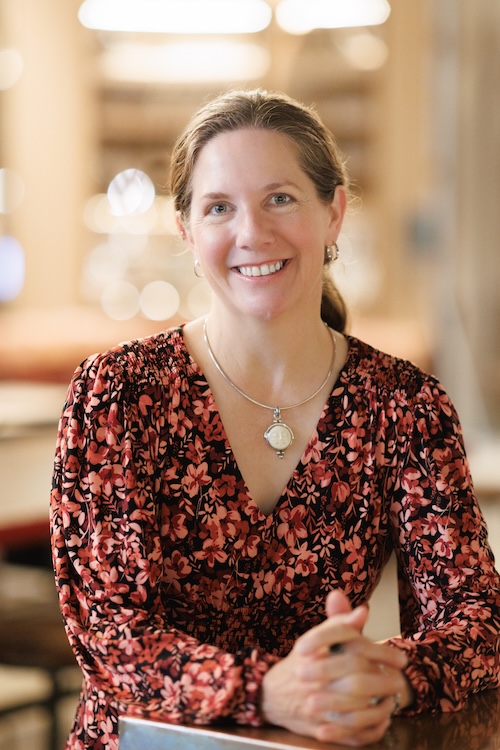
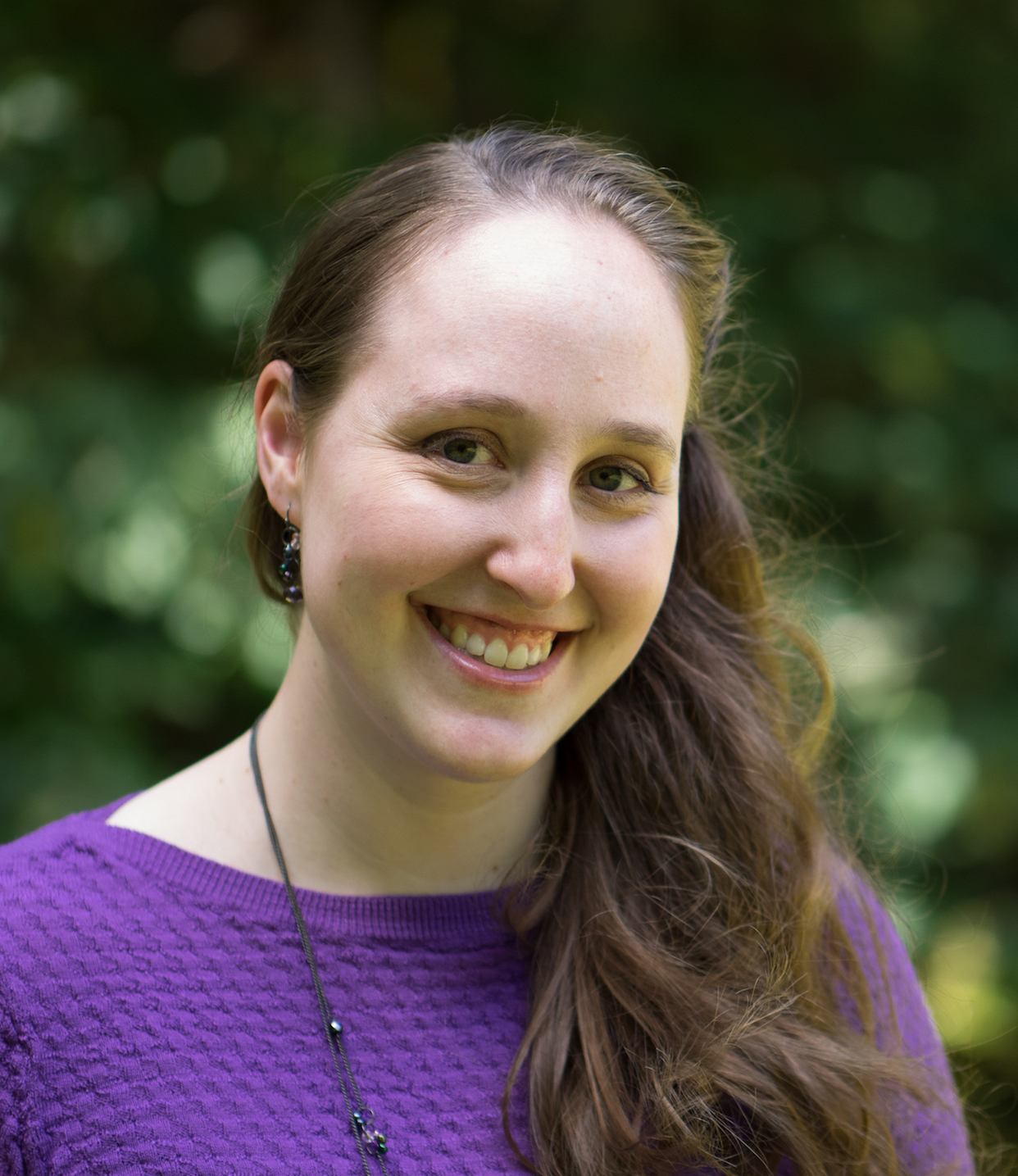
Kathryn Arnold writes fantasy and anything else that sparks her creativity from her home in Kingston, Washington. She currently earns her living as an insurance underwriting assistant, where she also creates marketing and web copy. When not writing, she plays (and teaches) piano and keyboard in a band (or two), and is working on starting a ministry team with her husband. You can find Kathryn at www.skyfirewords.com.