

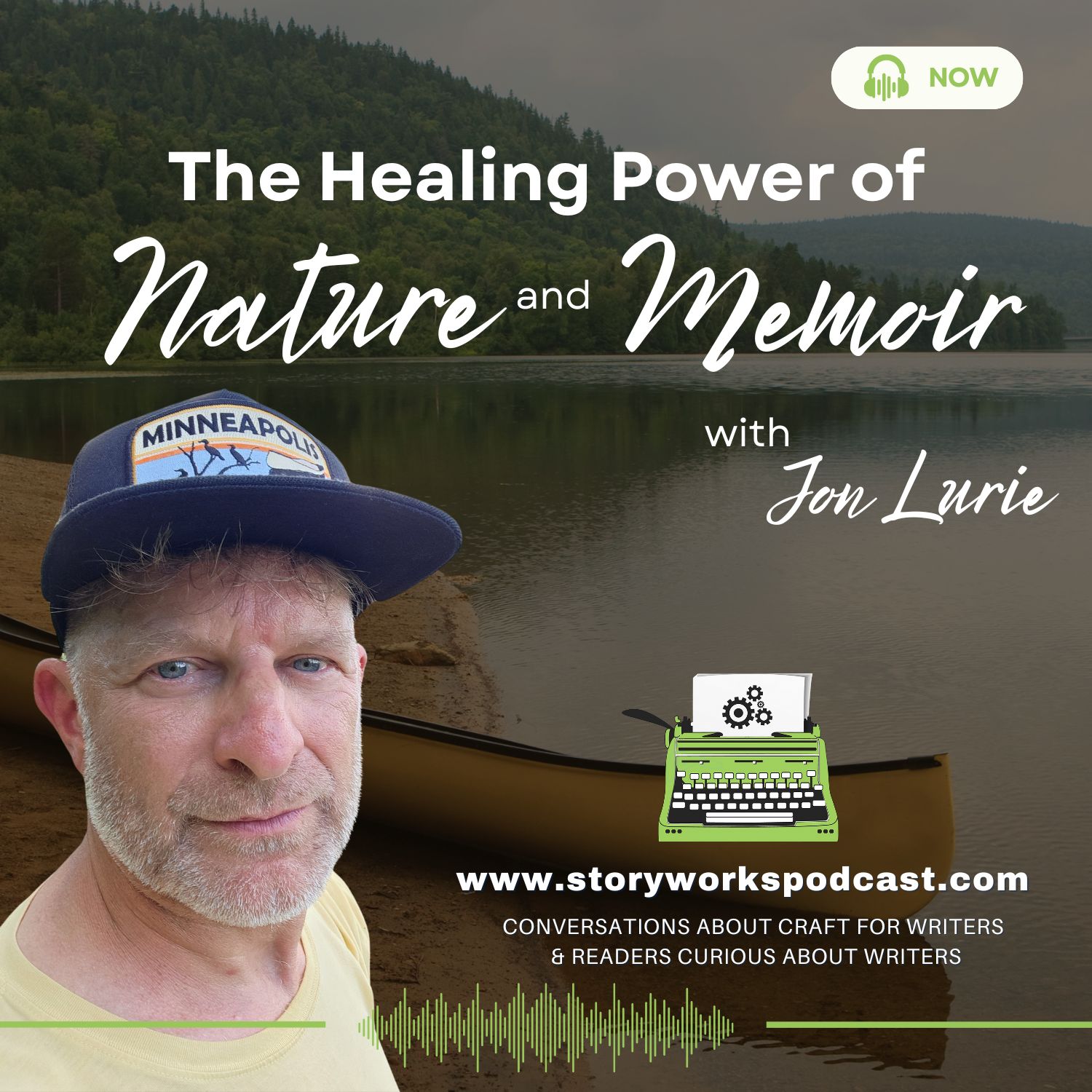
In this episode, Alida engages in a profound conversation with Jon Lurie as we explore the healing power of nature and the intricate journey of memoir writing. Jon shares insights from his two memoirs, including his epic canoe trip along the Red River with a young man named Jose, highlighting themes of personal growth, cultural identity, and the transformative experience of connecting with the natural world. Then he speaks to the healing power of nature in his own health journey. Join us for an inspiring discussion filled with adventure, reflection, and the importance of storytelling.
“Nature is a conduit to personal growth.” – Jon Lurie
AUDIO
Jon Lurie is the author of the memoir Canoeing with Jose and, with Clyde Bellecourt, The Thunder Before the Storm, a Minnesota Book Award finalist. He has worked as a journalist, wilderness guide, and as a teen adviser at a Native American journalism program. He serves as director of the Mother of Waters Project, a cultural outreach program that combines experiential learning with arts education.

TRANSCRIPT
This transcript is AI generated. If you notice any inconsistencies or errors, blame the bot.
Alida Winternheimer: If you’re listening to this right when it comes out, you might like to catch me and Jon Lurie live in conversation in Minneapolis. It’s this Saturday, June 7, at GI’s Cafe. We’re going to be talking about the healing power of nature. So whether you’re a writer, a book lover, an outdoors person, or somebody who’s interested in epic journeys, you’re going to be glad you caught this author’s talk. And of course, if you can’t make it live, keep listening because Jonis today’s guest at the StoryWorks Roundtable. Joncanned up the Red river along the Minnesota North Dakota border all the way through Canada to Hudson Bay, which is the subject of his first memoir. His second memoir and current work in progress is about his epic journey through heart failure and heart transplant. So lots of fascinating topics nested together here in John’s story. I’m going to be presenting a workshop in July at the Contemporary Romance Writers Virtual Conference. I’m going to teach about the power of subtext in dialogue. If you’re attending that conference, I would love to see you in my session. And in August I’m teaching a workshop at the London Writers Salon, also virtual. I’m really sad to say I won’t be hopping a plane to London, but maybe in the future I’m going to teach writing to your through line, especially the power of theme in our stories. So if you’re part of that community, watch the calendar and join me in the workshop. Lastly, Caatherine and I are busy putting together some free webinars for you. My audience. They’re going to be coming up in July and August. Check out wordessential.com events. I’ll post all the details and links to sign up for stuff as soon as I have them. It’s going to be easy to track me down all in one place and you can always find links in the show notes for today’s episode. Now keep listening for my conversation with JonLori and make sure to share this episode with your non writing friends. Because we cover so many topics of interest and importance to so many different people. I think you’re going to love it. I know I do. If you enjoy this podcast, we would love it if you would show your support wherever you’re listening to this, click like and subscribe. And if you’ve got just an extra minute in your day, that’s all it takes, I promise. Give us a rating and a, review. It really helps the show and increases our discoverability. Thanks for listening and now enjoy this conversation at the StoryWorks Round Table. Hello and welcome to this week’s StoryWorks Roundtable. Today I am truly delighted to have Jon Lurie here with me. Jonis the co. author with Clyde Belacourt of the Thunder before the Storm. He’s worked as a wilderness guide and teen advisor at a Native American journalism program, as an editor at the Anchorage Press and the Rake. His journalism has been published widely. He’s taught creative writing in universities and currently teaches experiential learning. He lives on an island in the Mississippi river in Minneapolis, Minnesota. And we are going to talk about the healing power of nature and memoir. You’ve got two memoirs, Canoeing with Jose, which came out in 2017. a milkweed Editions book. And then you’ve got to work in progress, another memoir. So I have to say, Im’m so excited to have this conversation. You are one of those special guests who I can actually say I’ve met in person.
Jon Lurie: Thank you so much for having me. Yeah, it’s good to be here. It’s good to see you.
Alida Winternheimer: Yeah. so we met at our sea Kayaking clubs picnic last fall. You were giving a presentation about the history and spiritual significance of waterways in Minnesota. And I believe this is a theme in your memoirs, both in Canoeing with Jose and in your forthcoming memoir about your personal journey as a heart transplant recipient.
Alida Winternheimer: Yeah. Something near and dear to your heart.
Jon Lurie: You know, as a first generation American, first generation Minnesotan, and somebody who grew up canoeing, as I would say, a form of escape, a form of personal growth, I just started asking a lot of questions when I was seeing the land from the water. So it’s kind of flipping my environment, on its face. And some of those questions have led me to the lifelong pursuit of just trying to figure out not only how indigenous people, in the past navigated the land by water, but literally where the hell I am and who the hell I am in relation to this landscape. Because as a first generation American, I could ask my parents or my relatives, hey, what’s the significance of that creek? What’s the significance of, that lake or that hill? What does Minnetonka mean? What does Minnesota mean? And from a very early age, these questions were on my mind and literally have become a lifelong theme for me and have driven all of my most important work beyond my writing, my youth work. I’ve been able to sort of re. I’m not going to say discover, but to re, acnowledge the importance of certain areas the way that they were used by indigenous people. And I’ve had the privilege to be able to teach these things to native youth, thus kind of restoring their sense of who they are and where they are. just it’s been a very rich, thread throughout my life.
Alida Winternheimer: Yeah. So for people who aren’t familiar with your books, tell us a little bit about your first book with Clyde Belacourt. And then we’re going to talk specifically about canoeing with Jose today. So you know, give us the synopsis of that if you would, kind of set up the conversation.
Jon Lurie: So, I guess my journey to meeting Clyde began when I was 18, 19 years old and I enrolled in a Native American studies course at the University of Minnesota. And that led to me meeting a woman who became the future mother of my children. She had a child already, who was Dakota. And as the relationship got more serious and I became apparent to Allison, her mother and I realized that we were now two white people raising a native child. And that ah, was not something either of us wanted to be. Knowing the history of genocide against Dakota people in Minnesota, we didn’t want to be contributing to our daughters alienation from her culture. So we decided to move to the Rosebud reservation in South Dakota in order to allow Allison to grow up with her culture. And while at Rosebud, I began a journalism career due to the fact that there was so much injustice happening right outside our front door and the media wasn’t covering anything going on on the reservation. And I saw not only an opportunity to promote justice on the reservation, but also to start a journalism career. I hadn’t been successful at sticking around at anyone college. my ideas at the time were way too fluid in terms of what I wanted to do with my life. And I felt like staying in school was just too mainstream and two status quo for me. I wanted to be out fighting and in fact I wanted to be fighting with native people because it seemed like everything that they were fighting for was something that was important to my personal values and my family’s history. My mother was a Holocaust survivor and my grandmother was a member of the French resistance against the Nazis who was literally out in the streets, fighting Nazis in Paris and in other areas around France. So it’s a heritage that I sought to continue. And I saw native people as being natural allies in that fight. I was going to join their fight in this case. And so I got an opportunity to do that, but without a gun, with a pen and start writing article. And pretty soon I wasiting for all these different, I was giving them stories that, they otherwise wouldn’t have had access to. And I did that for many, many years. And along the way, along the way, I was asked to go to Wounded knee for the 25th anniversary of the 1973 occupation of wounded Knee, by some members of the Pine Ridge, tribal government who knew my work and asked me to come and cover it and also to be their liaison with the incoming international press. So I felt like that was a great honor and, of course was going to fulfill that honor. And while there, all of the big AIM leaders came in. The American Indian Movement leaders came in and Clyde Belcourt, Dennis Banks, Russell Means, JonTrudel. And there I was, this 20 something year old white guy from Minneapolis who had read about all of these characters and admired them greatly. And I was in a room with them, working with them, and it was so exciting. And the event was great and moving and beautiful and powerful. And, when it was over, I was driving out of town and I stopped at a convenience store on the reservation and Clyde Belcourt came in. Now, for those of you who don’t remember Clyde, he was one of the big original founders of the American Indian Movement. And he was an activist out of Minneapolis for many, many years, actually decades following the glory years of aim, which were the 1970s did a lot of good for the city of Minneapolis and for native people, worldwide, actually. And Clyde, of course, was suspicious of this new white guy on the scene, and running into me in that convenience store gave him an opportunity to question me. So he worked with me all weekend, but now it was time to see who I really was, right? And he kind of pushed me up against like, the potato chips in the, convenience store and had me cornered in the back of the store. And he did what I call, smoked me out. He asked me a bunch of questions who I was, where I got my background, how I knew what I knew. And, you know, after a couple of minutes, he was satisfied that I was who I said I was. And we developed a working relationship. And since we both lived in Minneapolis, I had the opportunity over the years to interview him many, many times for different articles I was working on. And we became acquainted and we developed a trust with each other. I mean, I trusted him, but of course it was going to take him longer to trust me. years later, fast forwarding 20, 25 years, Clyde and I were talking and he said, you know, everybody’s telling me I need to write a book before I go, he was getting older, he wasn’t in good health, and he asked me if I would be willing to write his autobiography, with him. And again, it was one of the biggest honors of my life to be asked by Clyde to do this. And I gladly accepted. And in 2017, I believe the Thunder before the Storm, the title of the book came out. that’s also his, native name. His Ojibwe name was the Thunder before the Storm. And, so that book is now out and available. And Clyde passed away two or three years ago, but his legacy lives on through literature, which is something that I’m very proud of.
Alida Winternheimer: Wow, that’s amazing. It always fascinates me to look at the steps, the twists and turns a, life takes. You know, you start with something like, well, here you are, this moment in time, writing a book that is the autobiography of Clyde Belacourt. And then you look backwards at all of the things that had to happen, all of the connections that had to be made, all of the synchronicities and alignments that brought you into that moment with him, you know? yeah, it’s fascinating.
Jon Lurie: Oh, yeah, yeah. Thank you. And even for me, looking back, I feel in many ways that I’ve been divinely guided in a lot of the work that I’ve done, that it’s not just hasn’t been random or happenstance. and that, of course, is easier to feel looking back. But while things have progressed in my career in the moment, and it was just one small moment by one small moment, and the next thing you know, you’re writing the autobiography of your hero alongside with your hero. yeah, it’s pretty amazing stuff.
Alida Winternheimer: Yeah. Yeah, it is. Wow. We could talk just about that journey and your background and your life story for hours, I’m sure. But that’s not why we got together today. So let’s move ahead from that to canoeing with Jose. Why don’t you set up the conversation by telling us what this memoir is about?
Jon Lurie: Sure. this memoir is about a trip, a canoe trip that followed Eric Sed’s famous 1930 journey, that he chronicled in the book Canoeing with the Creree, which remains a really good seller to this day. Eric Severvai was from Minneapolis, became a very famous journalist, especially during World War II and the years thereafter. but as a 18 year old, he undertook this massive canoe trip from Minneapolis all the way to Hudson Bay on the north coast of Canada, a 2,300mile journey. And when I first learned of this Trip. It was something that I intended to do. I was so excited to learn that this was possible and that somebody had done it. And maybe weeks after that determination to do this, I met that future mother of my children and became a family man at a very young age. And it was only when I was going through a divorce 15 years later and in a great deal of emotional pain that I remembered my determination to take that canoe trip. And I knew that it would be more than a distraction, it would be a way of healing my, basically the mental illness that happens to us when we’re deeply grieving. And so I determined to take the trip at that time. And this was 2006, but I didn’t have anyone to go with. I was 38 years old and my friends were all, you know, in their serious careers in quotes, and they had kids and ah, you know, they were all experienced canoeists as I was, but none of them were interested in going. And I was mentoring a young man named Jose Perez, who was, at the time a 19 year old Dakota, child who had been getting into trouble in the streets of St. Paul. And Jose and I had met three years earlier at this Native American journalism program for teens. And we became good friends. But Jose was rough around the edges, to say the least. He had grown up in a family where both of his parents were gang members. he grew up probably in the most difficult of circumstances of any child I’ve ever worked with in terms of having to deal with like a drug addicted mother, extreme poverty, trying to feed his six brothers and sisters. So Jose had it really, really rough. But on a level we clicked very deeply because we shared a sense of humor. And one day Jose, came to my door and he had gotten into some street violence with a very dangerous drug dealer. And he was sweating and he was scared and he told me what had happened. And I knew that if Jose stuck around that summer, he wouldn’t have made it. He would have been killed for sure. Or he would have ended up having to defend himself and ended up in prison. So I said, this kid knows nothing about canoeing. He knows nothing about the outdoors. But he is my ideal partner. Because I needed a partner more than anything. And I wanted to, you know. And now that the trip could be about more than just me and my personal pain meant the trip was now meaningful to me in a new way. And it gave me further, determination, to take the trip and to do some good for somebody else.
Alida Winternheimer: Right. Wow. Did you know before you set out on this Trip that you were going to write a book, or is it something you realized after you got home and looked at all the material you had in journals and memories and such?
Jon Lurie: Yeah. So as somebody who had written three children’s books, probably a couple of hundred published articles, writing an actual adult novel length work was something that was, you know, on my future checklist. I had just completed an MFA program in creative writing at the University of Minnesota, so obviously writing a book was on my radar. but I have a rule, when I’m going to do anything, which is never do anything for the sake of writing about it. Unless you’re completely clear in advance about all of your boundaries and parameters. Because on a dangerous canoe trip like this, if you’re telling yourself in advance, I’m doing this in order to write a book, you’re going to make certain decisions that are going to be reflective of the narrative that you’re hoping for and that can lead to very dangerous situations. For example, we’re just going to run these rapids because it’ll make a great story whether we get through unscathed or whether we both. You break bones in our face. Right, right. So I don’t want to influence real life events, in order to write a book. I told myself, if the story is interesting after we’ve done it, then perhaps I’ll write a book. But I’m going to wait until we get home to decide.
Alida Winternheimer: That’s very wise of you. That was good thinking.
Jon Lurie: Yeah, I don’t like breaking bones in my face right now.
Alida Winternheimer: It’d be really easy to get into trouble and, you know, to let your ego get in the way of what you’re doing there. yeah. So I have to say I really enjoyed reading Canoeing with Jose and some of the things. Yeah, some of the things I think it’s about and then I want to hear you if you agree. And what else it’s about what I’ve missed. U. well, on one level, it’s a wilderness adventure story. Right. And that’s the main action. The main plot of the story is two men take an epic canoe journey, 2, 300 miles. And then there’s nature writing and this journalistic reporting aspect. I think your background in journalism comes through. It feels like part travelogue, part history, part cultural observations, you know, blended with that history. But then we’ve also got a theme of suffering, heartache, great loss, and needing to find a way back to yourself, which both you and Jose are doing by striking out into the wilds of North America. yeah. What do you think? Did I miss anything? Is there anything else? This is.
Jon Lurie: Ye. You know what, that’s one of my curses, is that every story that I want to tell is so multi layered that it can really get away from you quickly in terms of, the reader being able to follow along, connect all of the different threads. But, well, I don’t.
Alida Winternheimer: This story gets away from the reader. I think it’s eloquent and the threads are present and working together to support each other. yeah, I think, think it made strength.
Jon Lurie: Yeah. And I mean, I would agree it’s just my challenge. Right. And because it was a travel log. Travel logs tend to be the easiest kind of nonfiction books to write because they’re linear. And so you don’t have to really worry about the structure too much. You just kind of worry about telling what happened in more or less linear fashion, which for another kind of book would be not as satisfying for the reader. so in this book, yes, there are many different threads and layers. And I think maybe one of the threads that gets overlooked is the thread of Jo traveling through his native land, his Minnesota homelands, in the front seat of a canoe, which is the authentic way that Dakota people have traveled across this landscape for literally hundreds of years. And he’s a city kid who knows very little about his heritage, except that he’s proud of it and he’ll fight anybody who says something against it, but he doesn’t really know much about it. He, comes from a family that includes medicine people, like really bona fide, respected people, in their communities. but because of the recent history and the way Jose grew up, he wasn’t well connected to that. So this trip gave Jose the opportunity not only to grow up and become a man, but to become a man while surveying his native lands firsthand from the front seat of a canoe and having the same experience that his ancestors had. And I, think for me that’s one of the most satisfying aspects of remembering what we did. but also that it’s there in the book is something I’m very proud of.
Alida Winternheimer: Yes. Yeah. And I think so. It’s been, a while since I read it. Right. So I was making these notes, preparing for interview, and now that you say this, I’m thinking, oh, it’s so interesting that that wasn’t on my list because as I listen to you speak about it, all these moments in your narrative and all of these scenes are coming to mind and I’m like, of Course, of course there’s, you know, Jose with his colorful language, defending his heritage and, yeah, it definitely is in there. And as a memoirist, the eye is always the protagonist. Right? It’s a personal journey. And yet, you are sharing your narrative and sharing this journey. The experience the reader gets to take is yours. But there’s also this sort of companion journey of your, you know, actual companion on in the Canoe. Jose.
Jon Lurie: yeah. I mean, as a point of view, it was a natural for me to write about Jose because I was literally looking at him all day, every day for 10 weeks. And so was his evolution was really the majority of my experience was watching him grow into the role of an outdoors person, of a paddler, of somebody who’s embracing nature, embracing the challenges that came up along the way, literally changing his clothes to match, the appropriate gear that you want to wear for an outdoor adventure. when we left St. Paul, he showed up with a bag from Walmart with three T shirts and three pairs of underwear in it. And I said, dude, where’s all that gear? You know, I gave you a list, said, I’ll be fine. I’ve got what I need. And so on the way to our launch, we stopped at a store and, you know, we got him some things and some friends of mine came and gave them some of their stuff to take. We got him outfitted for the trip, but he had no idea what he was in for, you know, before we left. So by the end of the trip, we went from him listening to loud rap music all day, every day in the canoe, which was really lonely and frustrating for me because I had no one to talk to and I had to listen to him rap. And it was just horrendous. He’s no offense to Jose, but he’s not the most talented rapper in the world, especially while wearing headphones. together and working as a team, and literally we became such a tight knit unit that by the time the trip was over, knowing that I had all of these friends that had a lifetime of experie experience in canoes, there was nobody I would have turned to for another serious outdoor adventure. I would turn to Jose before I would turn to anybody else in my life. Because he adapted so quickly and so effectively to the needs of the trip that he became the outdoorsman that I would have liked to have had on the trip from the beginning.
Alida Winternheimer: Wow. Yeah, that’s amazing. so your. When you were writing this, how did you approach telling not only your story, but his story to the extent you can and is fair. Right. including him in this memoir, the extent that you did. Just. Yeah, I’d like to go a little bit more crafty and get your thoughts as a memoirist on, this kind of deep inclusion of another person.
Jon Lurie: Well, so, and this may sound a little bit crass to some of the listeners, but it is what it is. I went to Jose and I said, look, I’m starting work on this memoir and of course you’re going to be, you know, a big part of it. Do you have any concerns? Do you want me to get your permission for any information I use about you or whatever? And he just said to me and said, look, I trust you. Write whatever you want, just don’t make me look like a bitch. So said, I said, okay, that works. I can work within those parameters. And you know, I think what he was saying was basically, I want, I don’t mind you representing me in writing. I just want this to be something I can be proud of too.
Alida Winternheimer: Yeah, yeah. So did you give him any kind of right of refusal or you know, editorial commentary power before you published?
Jon Lurie: I gave him the option. And he wasn’t interested? Well, yeah, he just said, I trust you write the story as you want. And that was his only one request was what I said earlier and.
Jon Lurie: He really wasn’t interested in interjecting. He just want, he wanted me to write my story and his.
Jon Lurie: And he’s never looked back. He’s always been proud of the book. Ah. It’s something that’s really like a cornerstonone of his life because it chronicles him in a way that he can really be proud of saying, look at this record of evidence of what I did and what I learned and what I became. And it’s one of the proudest things in his life.
Alida Winternheimer: Yeah, yeah, I can see that. I can imagine it based on reading the story and taking this journey with you and Jose as the characters in this memoir. yeah. And the COVID image is just fantastic. It’the back of him sitting in the bow of the canoe, holding up his paddle so that he can make a wind sail. And I don’t know, I forget what’s on the paddle. Some kind of is a tent or a tarp.
Jon Lurie: So we had a cover for our canoe. So it kind of turned the canoe into a kayak because some of the rapids that we were running had such big waves that the waves would have gotten into the boat and destabilized it. And so we ran much of the trip With a cover over the entire canoe and it separated in the middle. It was held together by Velcro in the middle of the boat. So if you took off the front, which is what he was using as a sail, the front half of the boat cover, he wrapped it in his, paddle and held up the boat cover and used that as a sail. And we were on a very large lake in northern Manitoba that day, and with a nice tailwind and it got us very, very far. But unfortunately, poor Jose’s arms were wrecked by the end of the day. Because that takes a lot of effort to hold up a sail with your arms, right?
Alida Winternheimer: Yes. And his arms are thin. You know, thinking about canoeing 2300 miles across so much of North America, just two people in this manpowered vessel, and what that would take physically, the amount of endurance and calories you would burn every single day. yeah, it’s a very striking image. And I can’t imagine my arms lasting more than a few minutes up there. And I’d be shaking him out.
Jon Lurie: Yeah, Yeaheah.
Alida Winternheimer: So did you feel any kind of push pull while you were writing this? Between, the kind of story you wanted to tell, the kind of story you thought the world might want or your publisher might want, I can imagine, having to think about, is this a wilderness adventure story? Is this a journey of overcoming grief? Can it be all of those things, you know?
Jon Lurie: Yeah.
Alida Winternheimer: yeah, I would love to hear your thoughts.
Jon Lurie: Sure. Well, you know, let me point out that this exact route has been undertaken, and successfully so, by a number of parties over the years. So our trip is not unique in the sense that nobody else other than Eric Severai had ever done it before. Other people had done it and other parties have done it since. Jose and I have done it and it’s not an easy trip. I’ve done a lot of outdoor adventure and this is one of the most challenging trips, not just because of the length, but because the Red river is held a paddle. And these 500 miles of rapids that we were dealing with up in Northern Manitoba, were a daily day after, day after day, challenge that was scary. And I think at some point Jose and I both developed some PTSD from dealing with the fear and the exhilaration of taking these things on day after day after day. But to answer your question, our trip was unique because of who we were and the perspective, particularly that Jose brought as a young native person and that I bought as a non native person who’s very knowledgeable about Jose’s people. And had a lot of canoe experience versus his no experience. We were kind of this odd couple. And it really lent itself to being a multi layered travelog. But it never would have been published as all it was was two guys in a boat recreating Eric Severd’s journey. There was. That’s. I mean, unless you think that just purely listening to or reading about traveling rapids and being bitten by mosquitoes, it’s interesting. This book probably wouldn’t have seen the light of day if that’s all it was. So the fact that we brought other dimensions to the adventure was really the value of the book.
Alida Winternheimer: M absolutely. Yeah. Yeah. I think there’s a great takeaway in there for writers who are listening as well to think about if someone’thinking okay, I want to take my year to travel the globe or whatever. I want to be a travel writer. Unless you’re writing a guidebook, that kind of travel star, you really do need to layer in something of the human experience. Right? Something that you can own, that nobody else can bring to the narrative.
Jon Lurie: Yeah, I mean, if you want to write a guidebook, you know, the Hitchhiker’s Guide to Greece or whatever, then you can be anonymous and just write about places and prices and cool things to do. But if you want to tell a story, telling a story about traveling in anywhere is only interesting if you bring something unique to the table. Your perspective, your story, the human experience. We’re not reading books because we want to learn about, what it’s like to take a tour of the Parthenon. We want to read a book because the person who took the tour of the Parthenon is, ridden with guilt for having traveled to Greece and is having an affair with, you know what I mean? There has to be human interest, otherwise there’s nothing there. Except for a guidebook.
Alida Winternheimer: M. Mmm. Absolutely. Well, would you like to read a passage from Canoeing with Jose before we talk about your new memoir?
Jon Lurie: That sounds lovely. I’d love to. So we were on a ginormous lake in northern Manitoba called N Lake. for any readers who are familiar with, say, Lake Minnetonka, which is the 10th biggest lake in Minnesota. D Lake was about five of those, end to end to end to end, a bunch of different lakes basically connected by channels. And, we were invited to, have dinner at this lodge by some fishermen we ran into out there. So, at night I, went to the lodge itself to get some water. and here’s what happened as Jose was sleeping the tent and I was alone late at night in this lodge. As I read Severide’s description of this dramatic section of the boy’s journey, I looked up and my spine froze from the base of my brain to my tailbone. A flesh and blood phantom sat in the dim corner of the dining hall at a table beneath a ferocious mounted walleye. His head rested on his forearm, his eyes were open, and his face resembled the tortured surface of Mars, a chaotic mess of channels and canyons left behind when the waters ceased to flow. When he realized that I had noticed him, the spectter leapt to his feet, pushing over the heavy wooden bench upon which he had been sitting. He was a young man, around 20 years old, with unruly blonde locks flowing down his neck from under a baseball hat, bearing the logo of the Neee Lake resort, and whether he had been asleep with his eyes open or frozen by catatonic depression. When our eyes met, he too responded as if he’d seen a goes. We faced each other across the landscape of lacquered knottty pine, our lungs heaving motionless for what felt like an eternity before we both broke out laughing and embarrassment. The young man, who would later introduce himself as Chad, looked at the clock above the kitchen entrance. Jesus Christ, he sighed, rubbing his eyes. Is it really that late already? I have to be up in three hours getting the tackle ready. He explained that he’d been lying restless in bed and decided to come up the hill for a cup of hot tea, apparently more interested in bending a sympathetic ear than in returning to his bed of nails. Chad refilled his mug with steaming water and a fresh tea bag and walked over to join me. He was tan, lean, and healthy looking in every respect, but the tortured look in his eyes suggested a rough recent past. Her name was Jen, he said, and she was the most beautiful girl he’d ever seen. They met on his first day at N Lake, and while they were apart during the day he working on the water and she in the kitchen. They spent their nights together. She was like a dream come true, he said. A dream within a dream. Chad was from Kitchener, Ontario, a city of nearly half a million residents located some 70 miles east of Toronto. After high school, he continued living with his parents while he went to the University of Gulf, an elite private school. He studied marine biology, but his ultimate goal was to become a fishing guide. He met a friend of the resort owner while guiding on lakes north of Toronto. The friend was impressed with his fishing abilities and recommended him to Neee Lake. These jobs are rare, Chad explained. The guys who score them have been fishing for years. They’re the best of the best, and they keep up forever. He was the youngest guide in the history of D Lake resort, he said, which inspired anger and jealousy in the local Creess, who felt they knew these waters best and deserved to work in their own territory. Chad sympathized with this point of view, but he would not relinquish his dream job. Jen, on the other hand, had decided the north wasn’t her thing after spending no more than a month there. According to Chad, she quit her job the day before Jose and I arrived. Said she felt isolated and bored and caught the next floatplane to Winnipeg. He was caught completely off guard. What should I do? He asked. I need her. I feel like I have to go after her, like that’s what she wants me to do, like this is some kind of test. You don’t need her, I advised. You survived for 21 years without her. Just stay at Nee Lake. Build your reputation as a guide, and with time, the pain will pass. Then you will be a man who has built a real life for himself.
Alida Winternheimer: Thank you. That was wonderful. Want to keep up with my latest thoughts on writing life and the writing life? Join me in a room full of books and pencils. My newsletter on substack, where I share craft insights behind the scenes, peaks at my own creative process, upcoming workshops, coaching opportunities, and book news. If you’re enjoying StoryWorks Roundtable, this is the best way to stay connected and make sure you never miss what’s coming next. Just search a room full of books and pencils on substack or follow the link in the show notes. So would you tell us a little bit about your new memoir? The work in progress?
Jon Lurie: Sure. Okay. so let’s go back, in a way, as a nonfiction writer. As a memoir writer, every book that you write is either a prequel, or it’s the next book in the series of something you’already written. So in this way, my new book is a sequel to Canoeing with Jose. And just in the fact that this is what came next in my life, which was a year or two after I got back from the trip, I developed an autoimmune disease that was very serious. It was called sarcoidosis. And, I can’t tell you exactly how I got it, but it was probably, in my estimation, a byproduct of the morning I had gone through as a result of the breakup of my marriage. Only seeing my kids half time, I was in a Subsequent relationship, after my marriage that ended in heartbreak. And I had heartbreak as a child in my relationships with my parents. And, one of my sisters in particular, who ran away from home at a young age. And I never really reconnect with her and she was my best friend. So, I was never very good at dealing with grief and heartache, and it made me sick. And this autoimmune disease got into my lungs at first, and then, which is very, very rare, and then it found its way into my heart and caused heart failure. So within four or five years of coming home from the journey with Jose, I had been diagnosed with heart failure and I was put on a heart transplant waiting list. the experience of waiting. The experience of living in Rochester for four and a half months, while in critical condition and waiting there in a hospital bed. The experience of receiving a heart. Everything that I just listed has some element to it which not only has lessons for life, but opened up for me spiritual realms of understanding spiritual ways of being that was akin to a spiritual awakening. So through a scientific medical process, I experienced a very profound spiritual awakening. And the, book kind of tracks that awakening through the process of heart transplant.
Alida Winternheimer: Oh, and I am so excited for this book. Coming into the world one day. In the near future, right?
Jon Lurie: Yep. Yep. In the near future.
Alida Winternheimer: Yes. Yeah. Wow. So one of the, connective tissues between Canoeing with Jose and the current memoir is the healing power of nature and water in particular. So what is the healing power of nature?
Jon Lurie: So for me, I recognize the healing power of nature as a very young man. I think when I first recognized it, I was 12 years old. I had lied on an application to get accepted to YMCA Camp Menogen, which is a camp that facilitates Boundary Water’canoe trips and other trips up into Canada and the Yukon and so forth for young people. I was supposed to be 13, I was 12. And the trip that I went on was a 10 day boundary waters trip. And it was the hardest experience of my life. I hated it. I, by the end of it, I was never going to do anything like that again. I had come from a rather cushy suburban background, had never been challenged like that before. Although I grew up playing hockey, I knew how to work hard. Physically, I was strong. The challenges that arose as a result of days and days of being outdoors, sleeping in tents, and those days the tents were like, leaky and canvasy. Not like today, where you can really get a good night’s sleep in a slendertorm. That wasn’t possible in those days. the food was foreign and bad, and the bugs, you know, all the things. But when I realized that, when I got home, I started to long for that pain again. And what was it in that pain that was appealing in hindsight? It was the fact that it forced me to grow. And I understood, even at age 12, that hardship, suffering, challenge, pain are, conduits to personal growth. And I mean, obviously there’s a lot of different ways we can get personal growth, but particularly in nature. There are elements of nature that we as humans in our culture have tended to become disconnected from. And these elements, the water, the wind, the sun, even the bugs, the smells. Everything about being in nature is something that our nervous system, our bodies, our minds need as nourishment. We tend to think of nourishment as just being what we take into our body physically, food and medicine. But there is nourishment in nature that we need just as badly as we need food. And when we don’t get it, we suffer all kinds of maladies, particularly around mental health. And, as somebody who suffered from a very young age with anxiety and depression, I came to realize that there was a place of relief for my symptoms. And that place was in nature. And so as I’ve gotten older and gotten different opportunities, I taught experiential learning at the University of Minnesota for 11 years. And I’ve always said that if you could put all the benefits of nature into a pill, you would be the richest person that ever lived.
Alida Winternheimer: So true. Yeah. Wow. So, you just said a lot and so eloquently, so many thoughts going on right now. One of the first things you said though, was how hard that first canoe trip was at Camp Menogen. And then of course, know, fast forward some decades and you’re facing that kind, those kinds of harsh challenges again on a much bigger scale at a know, older, deeper stage of life. Why do you think human beings have this compulsion to seek solitude and challenge sometimes extreme challenge in nature when they’ve been wounded by life?
Jon Lurie: There is something out there that when we put ourselves to the test in nature, we uncover not only what is true about our own essence. We discover who we are, what we’re about, what our character is, what we think, what we believe, how we see, how we know. But we uncover something else too. We uncover the mystery, the beauty, the excitement, the true opportunities for fully living in a healthy way through interacting with nature. I think that we tend to think that we know everything. You know, we wake up in a house if we’re lucky enough to wake up in a house, we go to our jobs, we go to the mall, we go to the gas station. We know how to do all of that. If that’s our life. We’re missing out on 99% of what there is to interact with an experience. And with that other 99% which is found in nature and interacting with nature, we discovered things about the way things work, the nature of the universe, the nature of what is divine, the nature of the truth about who we are as humans. And it’s not these people suffering and struggling to pay the rent and walk on a treadmill and work to make somebody else wealthy. It is to uncover the divine mystery and to embrace the chaos that nature seems to be quite often and to find ourselves within it. And when we can be amongst that beautiful chaotic order of nature and relax within it instead of fighting against it, the power, the spirit of nature enters our bodies and allows us to live fully.
Alida Winternheimer: Wow. Yeah, there’s a lot there to just let sink in. When you’re writing your memoir, you’ve got to take your experience of something like the healing power and remarkable harsh beauty of nature and even truth and divine mystery and chaos, and you’ve got to convert it into words, into a description, and then you know with the intention that one day some stranger will read those words and have an experience through them that offers at least a glimpse, a touch of your own experience. So how conscious are you of that when you’re writing? And what challenges do you find in getting those words on the page?
Jon Lurie: Yeah, well, I would say that writing the book was more difficult than taking the trip.
Alida Winternheimer: Tr, that’s interestingus. It was a hard trip.
Jon Lurie: It was a really hard trip. But think a book is really hard too?
Alida Winternheimer: I don’t know. Didn’t you like die a few times on that trip?
Jon Lurie: You know, theoretically, yeah. But I never died on the trip. But I died several times after the trip. Once I got my heart disease. but yeah, the book, Writing the book was incredibly challenging, but perhaps because I was sick while I was writing it, so I was dealing with heart failure and trying to meet deadlines for the book at the same time. So yeah, it was quite a challenge for me. But to your question about how to communicate with the reader in such a way that they’re going to understand something about the experience that I had, I always keep in mind that the idea is when you’re bringing the reader along with you, you don’t simply want to, just describe what you saw and what you heard and what you felt and all of that. You want to bring them into the canoe with you. You want to write in such a way where they feel like they’re sitting in the middle of the canoe between me and Jose having the experience along with us. And, you know, hopefully I succeeded at that. I don’t know if there’s necessarily a specific technique that goes along with that. It’s more like remaining mindful that there is this third person in the boat with you. There’s this third person taking the trip with you, and you want to make sure that they understand, all of the different layers of know, from Jose’s background to the outdoor adventure angle, to every single angle that you’re trying to present. You want to make sure that they have enough information that they can just go along with the experience with you and enjoy it on the level of the moment instead of saying, hey, now, wait a minute. Why is Jose interested in native history? Make sure that they’re fully, vested in the information that they need to come along and make sure that you’ve provided them with what they need so that they can just enjoy the moments rather than have to, like, go back and figure out what the heck you’re talking about.
Alida Winternheimer: Yeah. So true. And with the new memoir dealing with your heart disease, did you find any new challenges, any different challenges than you faced with writing canoeing with Jose?
Jon Lurie: Yes. Something that’s been extremely challenging, and I think any writer would agree, is that I am writing from my point of view. Obviously, it’s a memoir, so it’s writing in first person, the I voice.
Jon Lurie: But much of the story is me writing about a time when I was essentially a different person. Because when I received a new heart, I experienced so many different changes in my consciousness, in my point of view, in my understanding of life. This experience was so transformative for me and so powerful that trying to write about my experience of life and my point of view prior to that became me almost like writing about somebody else, trying to write a memoir in the first person about somebody else. And so that has been a pretty great challenge for me. one of the particular challenges that I think everybody will understand is that when I lost my native heart, the heart I was born with, and I had my heart replaced with that of a man 18 years younger than me, I, of course, experienced all kinds of amazing benefits, but one of the things I also experienced was a loss of memory. M. So our hearts. People may not realize this because they haven’t lost their heart, but when you lose your heart, you lose all kinds of memories. Your heart is a brain. Just like your brain is a brain, your heart is another brain. And it stores particularly emotional memories. And so me trying to go back and write about my life prior to the transplant, there’s all of these blanks. And there may be notes from my diaries, there may be medical records I can go look at, there may be people I can ask. But to be able to vividly describe the experience of who I was prior to the transplant has been a challenge. And one of the things that I fear is that I’m not doing it in a satisfying way.
Alida Winternheimer: Yeah. What an interesting and unique challenge that is for a writer to face. It sounds almost like you to have to fictionalize that former version of yourself to fill in those gaps in a satisfying way for a reader to not just create the character of the eye on the page in the sense of creative nonfiction and what all writers do, but in this additional sense that is unique to you because of the transplant experience. That’s fascinating.
Jon Lurie: Yeah, I mean, you know, you go through the MFA programming, creative writing, which I know you and I have both done in different institutions, but probably got a similar education. And one of the things you learn as a writer of creative nonfiction or memoir is you know how to write from your point of view. And when you’re writing from your point of view or you’re writing about yourself, but your point of view has been ripped out of your chest, it is a very unique situation. And I’m doing the best I can with it. But you’re correct to say that in some ways I have to fill in the blanks and talk about it from more of an emotional memory standpoint. This is how I remember it, rather than this is exactly what happened. and that’s common for any writer of creative nonfiction, but for me, it’s presenting a really profound additional challenge.
Alida Winternheimer: Yeah. So when you are writing your memoir, creating this deeply personal narrative with so many layers to it, is your focus to tell your story and create your record? And of course its’probably both, but to different degrees, or thinking about what you want a reader to experience and take away from the book. I guess the question is how much are you in the experience and process of your writing and just putting it down versus, being consciously aware of the result of the book being in readers hands, you know?
Jon Lurie: Yeah, there is this when you’re writing nonfiction, even creative nonfiction or memoir, and you’ve, had an experience that you’re writing about and you want to be really faithful to that experience. There is this tendency to want to put it all in the record. Like, oh, if I don’t put this episode in, then somehow I’m not being true to what happened, or I’m not being true to the reader even. But the fact is, when you’re writing a book that you want people to read and enjoy, you have to only think about the narrative, the story, the elements of the story that, that are pertinent to the story, of course, but that aren’t going to bog the reader down and say too much medical jargon or. Something really difficult may have happened while I was waiting for the heart at Mayo. But even though it was really difficult for me in the moment, I can’t spend 12 pages writing about it because the reader is not going to remain interested in this episode. So you’ve always got to keep the reader in mind. Story, narrative must be paramount. And sometimes if you have to leave out chunks of your experience because it doesn’t serve the storytelling, you really have to leave out chunks of your experience. You have to serve the story above all else.
Alida Winternheimer: Yes. Yeah, and I love how, even after I worded the question to be about you or the reader, I love how you spoke to serving the story. Yes, I agree completely. I think the stories we need to tell are coming through us for a reason. And it really is about the story and what the story needs. And then of course, there’s also, at some point, you know, you’re thinking about technical things like clarity and reader engagement. But I noticed that shift in word choice and really appreciate it.
Jon Lurie: Thank you for saying so. I appreciate hearing that.
Alida Winternheimer: M. Well, I could talk to you for hours and hours, but I know you need to, you have a life. So is there anything we haven’t touched on that you would like to share about canoeing with Jose, or your work in progress, or writing about nature and the healing power of water and these experiences?
Jon Lurie: well, first of all, I’d like to introduce the title of my new book, which hopefully will be coming out within the next year or so. It’s called Heartland, Tracing the spiritual geography of a heart’s journey home. I’ve been through several titles and finally this one really feels right. I, want to talk about finally what I learned from being a heart transplant patient, which connected directly with my experience with the land and the water and my knowledge of, Dakota culture and history. And that was what I learned about Rochester by being a critically ill patient there. when I was laying in my bed there for four and a half months, waiting to get the call that there was a donor heart that was available for me. I was near death several times. I probably had 30 to 40 surgeries while I was there. every few days I was in and out of surgery. And, one of the things that I noticed was that I wasn’t really weathering, if you will. I wasn’t weakening. I wasn’t losing my sense of optimism or my sense of humor. There was some force at work that I was feeling energetically that was allowing me to stay calm, focused, positive, optimistic, and relatively healthy, given the circumstances. And I literally could feel that force pouring into my room as if feeling the prayers of 100,000 people. M it was that powerful.
Alida Winternheimer: Wow.
Jon Lurie: And I. So I would ask myself, you know, what’s going on here? What’s happening? And the sensation in my body was the same sensation that I feel when I visit particularly sacred sites. So here in the Twin Cities, we have probably a dozen or more very significant Dakota sacred sites. And I know from having visited these places quite a lot that there’s a certain sensation that you get in your body energetically when you spend time in a sacred site. And one sacred site tends to feel familiar because it feels like another sacred site. And my bed at Mayo felt like a sacred site. So I told myself, I’m gonna figure out this mystery after I get out of here. After I’m healthy and get out of here, I’m gonna figure out what’s going on here. So I had three months in Rochester following my surgery that I had to stay there and recuperate. And I had literally 150 appointments on my calendar. The day they released me, they gave me a wad of paper 2 inches thick, and it outlined the 150 appointments I had in my future. So, between appointments, I would get out on the land, and I was rehabbing my body. Obviously, I was very, very weak at first. Could barely climb five or six stairs. But I made the landscape my vehicle for, my rehab, Especially the hills that were nearby where I was staying. And in not very long, I was able to do you 10,000 steps a day and wander around town. And my health came back very quickly, and my strength came back very quickly. And so I asked myself, if this is a sacred site, why is this a sacred site? What’s going on here? And I began to follow the water. And Rochester itself has no natural lakes, which is why it has no mosquitoes, which is one thing people really like about southeastern Minnesota. the whole county down there, Olmstead county, has no natural lakes. But what people don’t realize is that it has tons of streams and rivers and something like 12, I believe the number is 12 streams or rivers join together in or around Rochester, the city of Rochester. So it is a collection point for all of these different waterways, and they flow in from every single direction, and they all flow out to the north on the Zumbro River. But what this told me from a Dakota perspective was that this was already a sacred site. Just given the fact that it’s a collection point for all of these waterways. People, may be, familiar with the Bdote, which is a sacred site where the Minnesota river and the Mississippi join near the airport in St. Paul. so Bdote is sacred because anywhere that two rivers join is called a bdote and considered a sacred or at least energetically powerful place. When 12 waterways joined together in one location, I knew that that was a particularly significant detail that I had to pay attention to. So I just began following all the waterways going up to the headwaters, following them all the way down to where they emptied into this Zumbro and then into the Mississippi. Ultimately, this quest, if you will, led me to a bluff near downtown Rochester where I happened to find, a ton of burial mounds. There were so many burial mounds on top of this bluff that they were practically built on top of each other. M. So now I’m on to something. If there are burial mounds, it means that there was once a village site nearby. So I poked around and I found a nearby village site. I knew it was a village site based on my experience. when I was in Rosebud, I learned an awful lot from an awful lot of knowledgeable people. I knew how to identify a former, village site, and I found one at the base of the bluff. in addition to that, up on the bluff, I found what’s called a Hambtia site. Hambtcha means, loosely, vision quest in English. It’s a sacred ceremony, and it’s done every summer. And I knew that if there was a vision quest, a Hamb Blchesite, that there must have been a Sundance. And so, again, down by the village site, I found all kinds of different possibilities about where a Sundance could be held. And a Sundance is a ceremony particularly for health, rebirth and renewal. And it’s to this day, taken so seriously that no, none of the different, ah, Native groups, Native tribes, who are Lakota or Dakota will neglect to do a Sundance every year. It’s that important to the continuation and the health of the people. So I asked myself, why would people come 70 miles upstream up the Zumbro river from the Mississippi to do a Sundance in this unlikely place? And then I realized that this valley of the Zumbro river, which contains the whole Mayo Clinic complex, has been considered a sacred healing site for generation upon generation by Native people. In other words, when the Mayo brothers, who came from Scotland originally, moved to Rochester and decided to build their clinic there, small family practice at first, and they experienced miracle after miracle after miracle, what they didn’t realize was they were benefiting from the fact that they had happened to build their clinic upon a powerful healing vortex. And all of this I learned simply from asking the question, why am I feeling this energy in this hospital room? Why am I having such unbelievable results? Why am I staying so positive and so healthy even under these circumstances? And of course, medical science and the skill of these doctors and nurses and providers came into play. No doubt about it. But the fact that we were on that powerful healing vortex made my, time there and my recovery there absolutely phenomenal and beyond anything that anybody could expect.
Alida Winternheimer: Yeah, that is fascinating. I wonder if there were a way to, like, I wonder if the Mayo Clinic in Minnesota there, in Rochester, has better outcomes than other comparable clinics because of the land, because of the water and that energy that you’re describing, you know, it would be really interesting to see. makes me think, oh, boy, if you’ve got a serious health condition, get yourself to the Mayo Clinic. And not just any Mayo Clinic.
Jon Lurie: Yeah. But the one in Minnesota.
Alida Winternheimer: Right.
Jon Lurie: I, I think that’s absolutely true. Yes. I would tell anybody who had a serious medical concern to go there. Even the medicine people from the reservations send their people to Mayo Clinic because they’re aware of the fact that it’s a sacred site.
Alida Winternheimer: Amazing. Well, such a fascinating story. And again, I just cannot wait for Heartland to come out into the world and for people to, get to go on this journey with you through your memoir.
Jon Lurie: Thank you so much. I appreciate that and I’m excited to get it done and to share my story with people.
Alida Winternheimer: Well, thank you. Is there somewhere that our listeners can find you or pick up your books that are already out in the world?
Jon Lurie: Yeah, my books are available anypl place online where you might buy books. you know, all the usual suspects. The Amazons and the Barnes and Nobles of the world. also, ah, any small independent bookseller can find it and order it for you if they don’t carry it. and I can be found on Instagram @lurry l u r i0005 Instagram l u r i0005 and I’m also on TikTok at Jonlry1. It’s J O n L U R I e and the number one.
Alida Winternheimer: Well, thank you so much John. It’s been such a pleasure.
Jon Lurie: I appreciate you so much. Thank you for having me.
Alida Winternheimer: If youe re serious about your craft and ready to take your writing to the next level, check out Word essential. That’s my home for developmental editing writers, coaching and workshops tailored for serious writers. of fiction and nonfiction. Whether you’re drafting your first book or polishing your fifth, I bring decades of experience to the table As a published, award winning author, teacher and editor. I work one on one with writers to dig deep into story structure and craft. So if you’re looking for expert guidance that’s both insightful and actionable, head to wordessential.com and let’s talk about how I can help you reach your writing goals.
About Your Hosts
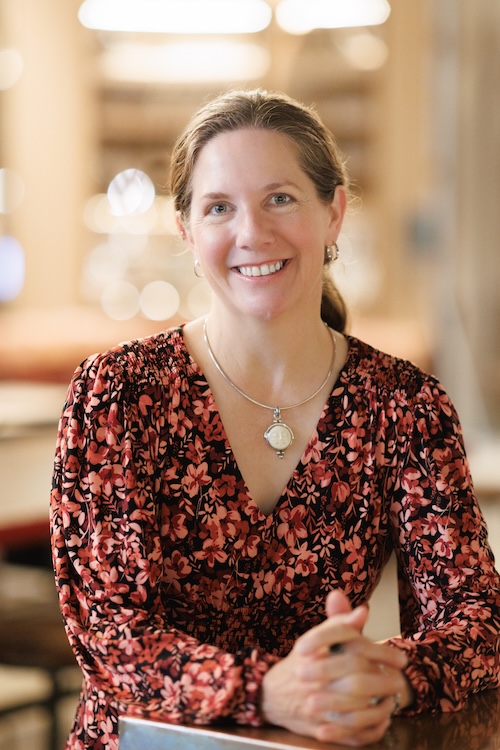
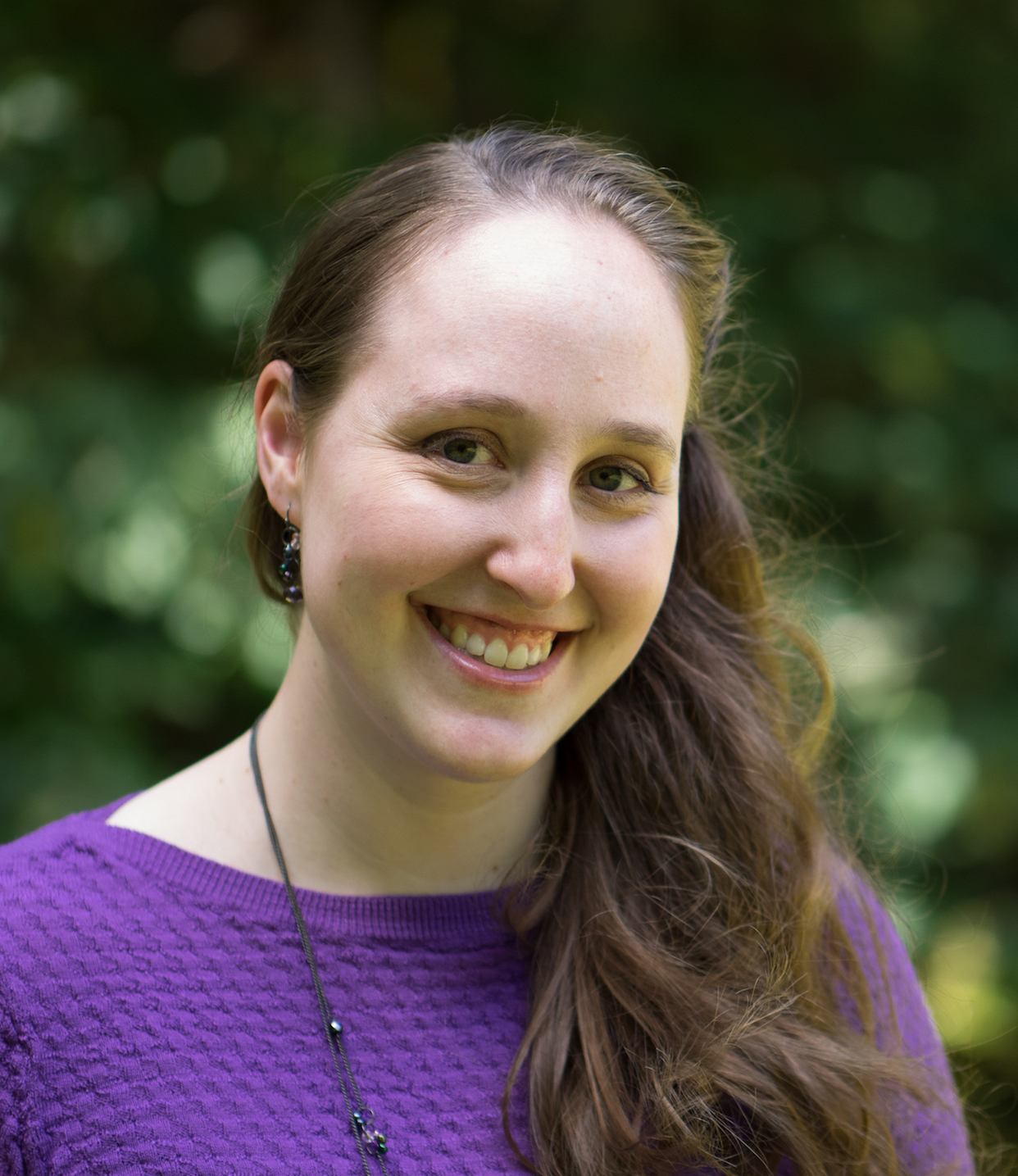
Kathryn Arnold writes fantasy and anything else that sparks her creativity from her home in Kingston, Washington. She currently earns her living as an insurance underwriting assistant, where she also creates marketing and web copy. When not writing, she plays (and teaches) piano and keyboard in a band (or two), and is working on starting a ministry team with her husband. You can find Kathryn at www.skyfirewords.com.