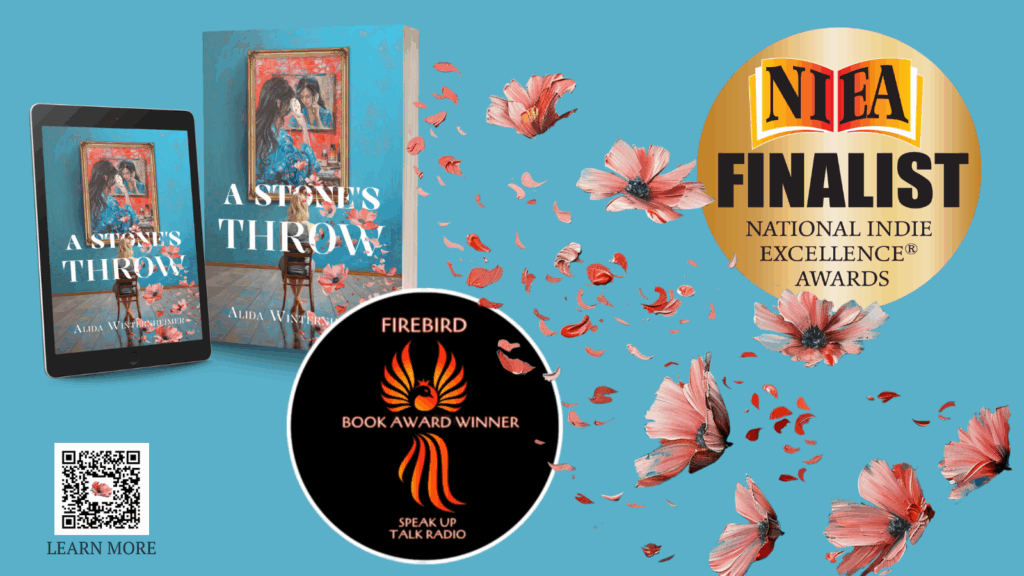
We’re pleased to announce that Alida’s novel, A Stone’s Throw, is a Finalist in the National Indie Excellence Awards!
Two women who never meet, a motherless child and childless mother, are brought together to discover the real magic of creation.
Simona and Gemma live an ocean apart, yet their lives become forever entwined when the women Simona is painting come to life, stepping out of their portraits. They arrive with a purpose: to nurture a broken heart…or two. Simona and Gemma learn about art-making, love, grief, and motherhood when they are magically welcomed into a lineage of women who share their lives’ joys and sorrows during the most creative time of these women’s lives.

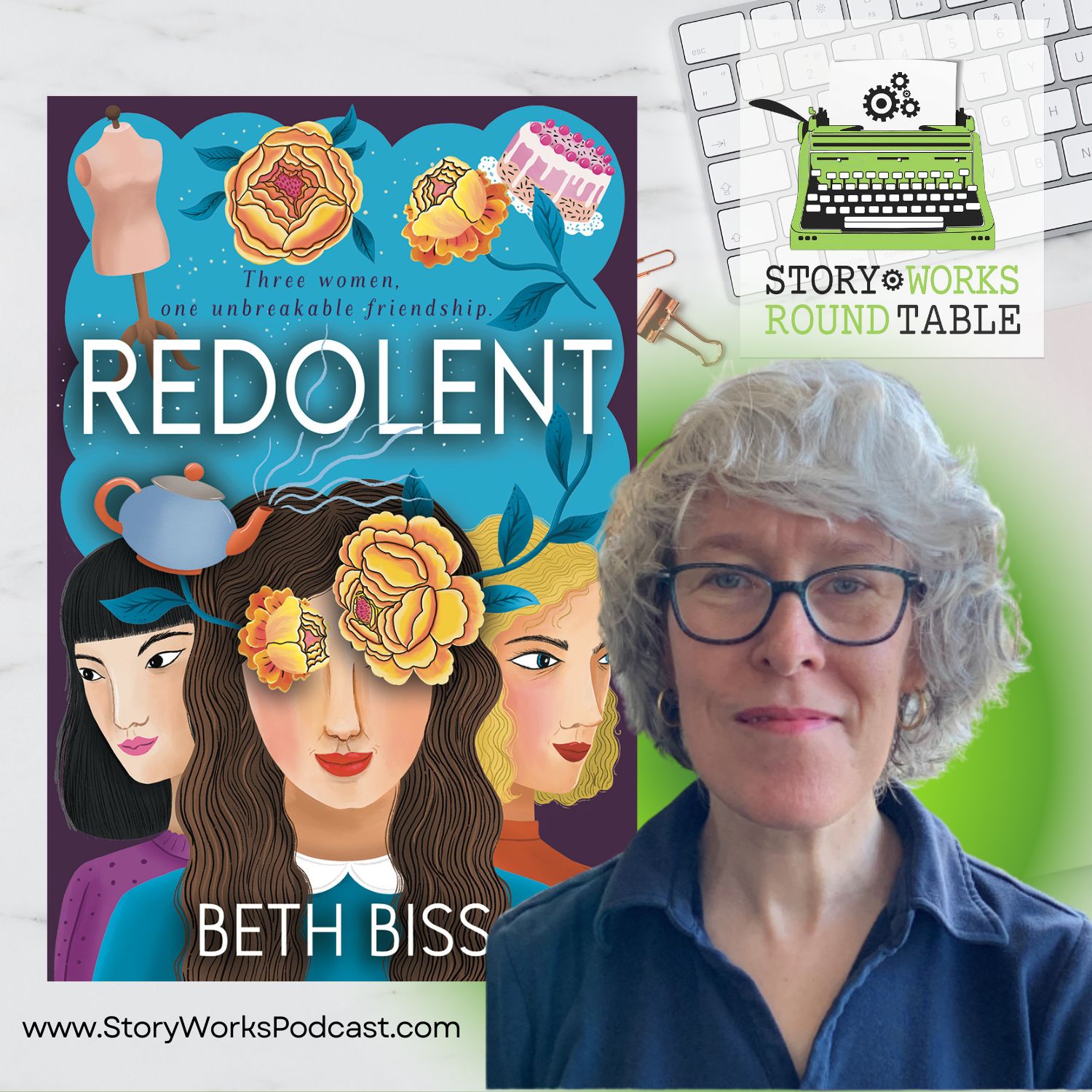
In this episode, Alida and Kathryn explore the intersection of writing and chronic illness with author Beth Biss. Beth shares her personal journey of navigating her health challenges while pursuing her passion for writing. We discuss the themes of identity, acceptance, and empowerment in her work, and how her experiences shape her characters and stories. Join us for an inspiring conversation about resilience, creativity, and the transformative power of storytelling.
“I want to take some of that hope and infuse it into my novels.” – Beth Biss
AUDIO
Beth Biss lives in a small town in Pennsylvania. She is a reader, a writer and a mother. She likes furry animals, but chronic illness and allergies make it impossible to live with any. She writes Women’s Fiction to encourage and empower women who live with an illness.
TRANSCRIPT
This transcript is AI generated. If you notice any inconsistencies or errors, blame the bot.
Alida Winternheimer: Have you ever thought about what you would do if you couldn’t write anymore? I have. I’ve given it thought from time to time, and frankly, it scares me. You know, for some people, it’s physical. For other people it’s mental, it’s fatigue. All kinds of things can go wrong on, our personal health journeys. I have some carpal tunnel and my hands can get released in if. And achy if. I’ve been typing way more than I probably ought to be for a stretch. So, you know, it has crossed my mind. And I’ve tried dictation software and I’NOT gotten very far with it. The learning curve, well, I get frustrated and I go back to typing because I just want to write and do my work and be productive. And I don’t want to stop to deal with technology that, you know, comes. With a steep learning curve. And that’s. That’s me. That’s my bag, man. But what if the day comes when I don’t have a choice? I think it’s worth thinking about. today’s guest, Beth Biss, writes through her own chronic illness, and she writes about characters who are coping with that transition, discovering they have a chronic illness and then learning how to live with it and really reshaping their identity. And, you know, I think that’s the scary thing about this question. What would I do if I couldn’t write because it is my, identity. Yeah, it’s a pretty heavy question, but not such a heavy episode. We had a great time talking to Beth. I think you’re going to enjoy it, of course, because I say that, I say that every episode. But it’s true. It is true. Every single episode. I think you will enjoy this conversation with Beth Bis. And before we get that rolling, just a reminder, head over to wordessential.com events and check out all the places I’m going to be this summer. Doing authors talks, teaching workshops at writing conferences and in authors communities, and of course, putting together some webinars for you. All right, here we are, Catherine and I in conversation with Beth Biss.
Alida Winternheimer: Hello and welcome to this week’s StoryWorks Roundtable. Today, Catherine and I are thrilled to be joined by Beth bss. Beth lives with multiple chronic illnesses, which not only impact her ability to write, but also deeply influence the themes she explores in her work. Through her writing, Beth aims to empower women in the middle stages of life who are living with illness, showing them that they are not defined by their conditions and that their dreams are still within reach. Beth hopes her novels resonate with readers, helping them feel connected to a community of empowered spoonies. Well, welcome to the Round table, Beth.
Beth Biss: Thank you so much for having me.
Alida Winternheimer: So you’ve got one book out, redolent, and you’ve got another one coming out this fall. So tell us just a little bit about your writing.
Beth Biss: Okay. I decided to write not because it was a dream of mine. It’s because I decided I need a holobby. Actually, my mother said, you need Bobby. Because I got to the point where I was kind of down about my life and not being able to do things anymore. I hadn’t been working for years. I was unable to do a lot. And so I was just sort of sitting around. I was reading a good bit, but there was a lot of play on my phones. There was a lot of watching TV and just sort of being down in the dumps. And she’s like, you need avby O. Yes, I think you’re right. I think I do. So I just started writing at first, just for my own enjoyment, to feel better about myself. I feel like I was doing something positive. M. And after I started writing, I started thinking, oh, I could share about my family. So I tried to write a book about my family. I mean, I did. I wrote it to the end and it was like, this is a mess. This is too convoluted. It’so many storylines going on because it was covering six generations. And, I’m like, I can’t even begin to try to edit the first book. It was just too much. Let’s start over. Okay. All right. Much simpler book. And so I thought to keep it really small one person or problem that be that I can handle that. And it just hit me as I was getting in the shower that I depended on my eyesight. What would happen to someone who couldn’t see. Oh. So I started readiting this novel as I’mita ve. It occurred to me that I was feeling really empowered during this and I remembered book that I read where the person had a brain injury. And I realized this person had the same symptoms I had. They have the same condition I had. But these having a brain injury often leads to person to have the same kind of symbtoms I had. They were dizzy, they spots, they had memory issues. I’m like that’s me. Oh. I got to the end of that book he’d recovered and I was mad. I was so ma but no because I was no longer in the book. I was oh o oh. I wrned books where women can see themselves or women feel like they are part of that. So even though in my first book I didn’t quite capture exactly what I wanted in my first book like I’ll keep going forward. I’ll keep moving forward. I’ll keep aiming to have something that’the woman can go oh. I see myself this because in my first book I’m talking about a person who loses their vision.
Beth Biss: People who lose their vision won’t be reading and I don’t have an audio version of this. Meaning. People who can’t see very well don’t have access to this story. People who Love people who can’t see have access to the story. But women who actually don’t see well would not have access to this book. So this is my practice book Releant. It is my practice book. And I was learning about writing. I was learning about how to manage my own personal issues. How to write with chronic illness, how to maintain. There are lots of if you’re in the running world lots of maxims Chairon but can think keyes right every day these sort of things which if you have coric illness you can’t do. I mean you just can’t do these things and you’ve got to figure it for yourself. When can I write? How can I manage this? How can I maintain this? What is a good practice for me that will really vary depending on what kind of illness you might have. For some people they could Write every day except if they have a bad day. for someone like me, I have pots postro orthostaticach is thero. I also have oh which is orthost hypotensen. I also have small fiber neuropathy. and I often have syncope which is like fainting or near fainting, that sort thing. So these issues come and go free throughout the day various times to the day. And so I don’t have a bad day, I have a bad hour. I have things like new to make the next hour better usually. So I have to pace myself. When do I start? Start? When do I work well? Ah. What do I need to do to boost myself up so I get back toing that’s what we would ll do day. So I’ve had to take a lotly advice that I saw other people giving and go. That doesn’t really work for me. That doesn’t really fit what I need to do for myself. And so like I knew that this idea of wrningiting every day I might not be able to do that.
Alida Winternheimer: Sure.
Beth Biss: I do what I could to at least. I’m at least in my story every day I’m thinking about it. Right. I’m thinking about it so on. And that at least is doing something well. I’ve discovered I’ve learned that more I just think about my story then the better I can do to write it. I’ve also learned that sometimes if I have an idea I don’t write down. It’s okay. It really is okay. take. I’ve decided I’m going to try to release one book a year. And with that schedule I’ve got monst and edit monster months. Improve this story months. Take things out, put the exent this sort things. So There was one time where I wrote something and I saved it in onerive and I went to find it. You couldn’t find it anywhere. And panicked. Panicked. I was so possset this whatever scene was gone. But in hindsight I realized I wrote another scene. I had some basic ideas. I edited that scene edit again and then took the whole thing.
Alida Winternheimer: Right.
Beth Biss: Right.
Alida Winternheimer: So I would love to break down some of what you’ve just said so that we can go into some of those pieces in more detail for the. For the listener. Reader. Listener. It sounds like writing helped you with your chronic illness. It was the thing you found to be or you. It started as a hobby. But now you’re working on your second book. You’ve already know published one which is such a big effort when you think about the production that goes into this. So many people think they have a book in them and they don’t get past the first few chapters, let alone finish a draft, let alone revise it and edit it and seek professionals and format and know cover design. So many steps you had to go through. so is writing. I guess I’d like to hear a little bit more about the relationship your writing has to your illness. Maybe not in the sense of, you know, the tasks you get through in the day and how you manage the illness, but you know, does it inspire you? Are you passionate about writing? Like I could imagine if I had been in that position taking up 10 or 12 hobbies before I find the one that I actually felt driven to pursue to the length. You know where you could produce a book.
Beth Biss: yeah. For a while before writing I tried making it. You can see behind me I have a quilt hang on the wall. That’s a quilt. That’s something I made. and I enjoyed it certainly. But I discovered there were a lot of things with that health wise were really hard. For me quiling involves a lot of standing to cut things and standing can be a no no. For me quiling involves being over hot ironing board, smoothhing out inut that heat also aown not for me. So I discovered there were many steps in the quilting process that were very hard for me. Thought this is not as much as parts of it I enjoy. It was tricky. And also I discovered that after thinking for a while I lose my ability to think very well. And with a quilt you got to think and match things up and get things lined up and organize the plan for next things. And if you get one step wrong then you’ve got to rip things apart. I mean literally physically rip things apart. And so I struggled with some of these things and so I got this done. I was like oh man, that was not sure if that’s my hobby and I don’t know. So some of these things me really hard standing. I don’t stand write. I sit. you. Am I over hot ir? No. I’m with my computer and typing away. I also with my writing I plan everything out. So I have to be a plotter. I consider myself a super plotter because I have to write these things down and rely on the the things I wrote down to write a scene. I count on information that I came up with. So I’ve devised a system for writing thingss down, explaining on thatiting more expanding on that right. More. But always having something as a guideline there for me. So in the days of I’m not doing great, but I could write some to take what I have there and go, ah, here’s what I’m writing, here’s what I’m doing and having a road mathem. and then also this sense of accomplishment I have. I just had to give up lot of things and, felt for a while really bad about myself. so interestingly, I hear a lot of writers talk about having this sense of not being a good writer. You know, they’re like, oh, and Plor syndrome about being a good writer. And I don’t have that because years before I dug my way through that imposter syndrome issue with just being human, I felt like I wasn’t a full human being. I couldn’t go to work anymore. I could hardly do any household chores anymore. I couldn’t take myself to do things. I couldn’t stand. I couldn’t walk. Ah. And beyond just not having a job, who was as a person. So I’d work through that. I’d work through this whole impostor syndrome thing and come back to realize, okay, I’m a person. Not because I can produce something and not because I can do certain things. I’m a worthwhile human being because I am a being. It just is inherent who I am. I don’t have to prove myself through anything. And so a lot of the things that writers struggle with are things that I worked through years ago because of my illness. so will I face imp foster syndrome in the future? Maybe it’s possible. but I worked really hard on that. I worked really hard on looking at myself going, I’m okay as person. Even though I can’t work, even if I can’t stand, even if I can’t walk to the back room, my house, I’m okay. There’s nothing wrong with me. I mean, there is. There are physically things wrong with me, but I’m an okay human being. I was m. Just different. so, yes. So I had to work through that. And each little accomplishment I get in the writing, a story is away from me. Wow. Look how much I did. I didn’t know I could do this much. I had no idea I could do this much. I am so, so proud of the book I wrote, and I’m realizing how much my writing has approved. In my sick book, I read through what I’ve done. I’m like, oh, my gosh. I learned. I’ve grown. I’ve Improved. I didn’t know that because of my illness I could improve or grow. I didn’t think those were things I was capable of. I thought my life had been limited. Something so small and so, so. And closed. I didn’t realize that I could become better at something. And I have. I’REALLY very proud of myselfish.
Kathryn Arnold: As you should be. If we can, I want to dive back into another piece that you brought up at the beginning where you talked about reading a book where the person recovered at the end. Right. And so your journey sounds very much, you know, like you could turn that into a book too, where you’ve taken that journey of this is my new normal and you don’t return to the old normal at the end. Right. So I can see where you have that, like, hole in, like, I want to see literature that deals with this new normal become. Going through that journey to acceptance, maybe. Is that a proper term or.
Beth Biss: Yes, yes. My goal is for a woman reading my book to see this woman either, you have the disease develop or realize what it is. And the whole way through the book, coming to the terms with, what do I have to do now in my life? How do things. That’s changed for me? How do I have to interact with people differently? How do I think about myself differently? But get into the book with the disease and going, I could be a complete whole person living with this illness. That’s my goal that with whatever illness I’m looking at, this person goes on a journey of, understanding themself, of, accepting themself, of realizing I have certain limitations. And everyone does. Everyone has limitations. And that is okay. This notion of we’ve got to be productive and we’ve got to do that and we’ve got to be gre. Everything is whoey. And just this notion of, I’m okay, okay, it doesn’t matter what else I have. It doesn’what matter. Limitations I might have don’t make me less of a person than I’m okay. And so I’m hoping my books will invite people in to go, oh, I have this. Or, oh, that’s like me. Or, oh, I struggle with something similar to that. Or, oh, I’ve had those feelings, even though my situation is completely different. I’ve gotten really interested in learning about bibliotherapy. there are lots of therapists using novels to really help people dive into their own personal issues. And coming out on the other side of the novel, being a different person, that reading fiction has this great opportunity for people that your brain, when you’re read fiction, your brain really doesn’t know that’s not happening to you. It’s a very exciting thing. It’s a very exciting thing to realize that what you’re writing gets into people’s brain and changes their brain and lights up things in the brain that makes the brain think they’re living that that’s why some people read something and sob what a character dies or they’re angry. I mean that’s why I got angry through the book. I was living with this person and suddenly I was no longer with the person. I got angry and I actually threw the book. Sorry. Library was a library book. But the possibility for self help in reading a novel is something that has really, really got me interested in fiction even more in what my books could do for people if they’re willing to do that. If you want to read a book and just be swept away the story or entertain for a while or forget the world, because those are all very valid, very, very totally valid reasons for reading. Right? But if you want to read to find a way to improve yourself or to find a way to be different, a book can help you do that. And I don’t mean an non ficted book, a novel can help you do that. Now you often need to reflect on it and journal about thatff just read it generally is not enough, but it is a spot’thing so I’m not just writing these books but thinking more largely about what is I, what to do, what kind of business I want to have out of my novels, what kind of relationship I want to have with my readers. I’m trying to think bigger than just the storyy that I’m writing. And so it’s very exciting that I’ve moved from just I got to the storyy because I got mad that author. Right.
Alida Winternheimer: Right. It’s interesting that this all started with your mom telling you you need a hobby. And it’s grown so much to the point where now you’re even thinking in terms of om mission and how your novels can help others. So at what point did it sounds like and correct me if this is a misconception, but it sounds like you started writing for yourself and then somewhere you started thinking about how these books could impact readers. And then that has grown into so much more than just thinking about your reader’s experience and to really using your books to hopefully help people change their lives. Right to be.
Beth Biss: Yes. This was a progr progression through this. Okay, I need hby because I’m just sitting around feeling sad for myself being all mobid and so. All right, so quilting didn’t quite work out. Was there were sections of’too hard and I’d so goodol thing involves a lot math and there are times when math is super hard for me. my blood pressure falls really low and I get to the point I can’t do simple math. Like I do this test for myself. I draw two numbers of the air. I try that together and I use my phone to see what answer is simple numbers, one or two digits. Sometimes I can’t add two one digit numbers together. Get the right answer. You know when I add together in my brain three and six and I get five or something ridiculous. I’ve done that. I just can’t. I just can’t piece it together. well, I can’t write that either, but I really can’t. But try to do quilts when you’ve got to count things and get things in the right order and I think I just m. wow. So yeah, I’ve got to think about when, when can I do this? So this is like a test for myself. Try to add things. Okay, I need to stop doing things because clearly, clearly my brain isn’t working. I need to pause for a while.
Alida Winternheimer: So when in your writing journey, in the process of developing and writing your first novel, did you realize it was becoming something more for you personally that you. When did that vision start to form?
Beth Biss: Okay, so I told you I started trying to write a different story. I mean I got to the end of that and realized that it was so full of so many characters with so many storylines that I didn’t know how to think about editing it. And so thats why when I got shower on this idea about oh, what if someone lost their vision? So I had a really playless idea to figure out how can I be A story. I wasn’sure it could be a story. And I thought, how can I turn this little idea of someone dealing with losing their vision into a story? So I did research, started looking to what might cause someone to go blind and what a blindness is that then can’t be corrected. Because I didn’t want to get the end of the story and see want her to Nazi. So I did have that idea down already. so stubble on to an idea of Stargart. Now, you might know about Stargart because it’s a company called Two blind Brothers and they have, a thing call shopping blind or buying blind. They just order something and something shows up for you. You don’t know what it is because they’re blind and they’re sending them blind. You just enjoy this anyway, so I’LIKE oh, okay, Stargart. That’s something that the medical community has not learned how to fix. All right? So I had to learn more. What did this do? What to cause it, how do people see? So forth. I learned a lot about blindness in it. Im not going to get the percentage right right now, But a good percent, maybe 90% of people who are legally blind have some vision. They dont see blackness. That blindness is just impaired vision. So with Star Arts, this is something that affects the center of your vision. And, I explained a little bit about it in my first novel, Remnant. because I’ve done the research, I had to drop that in there. I wrote a lot. I like, wait, this is probably info dumping be way back, but I do have her eye doctor saying to her, let me explain to you what you have. Let me explain to you what’s going on. So the reader least goes, okay, I can get this. Now, I do have her going to visit the websites I went to a lot. I got the interview a, YouTuber who makes YouTube videos about his blindness. And he does a lot of videos about, product views and how he does things in the world. So if I didn’t know to do something after to his videos and research, how does he with star artards live with this issue? What does he do in order to make his life warm? No, and active? I mean, he skateboard and stuff like that. He does a lot of things you wouldn’t think a blind person could do. So I learned a lot from him. and thank goodness he let me interview him. So I had to del into this. But I realized that a lot of people starg guards lose a vision like 8, 9. I’m like, well, I don’t wr to Write. I don’t want to write a children’s novel. I didn’t actually want to start that young, but I did read that there are a few people in the late teens, but most people by the time’twenty I have been diagnosed. It’s very rare for someone over 20. Like, okay, all right, all right, so I’ll take this upper end. Doesn’t usually happen, but I’ll take that. I’m thinking. So, okay. What would be really hard for someone to luc a vis at this point? We were, oh, if you design and se dresses, that’d be really hard. There are s things you can do. There are a lot of things you can do when you lose your vision. I mean, you could write a book when you have a vision, because you could dictate things like that. But designing and sewing, no. Okay. So I took someone who was in the fashion design program. I, her. She’s going toa lose her vision. So that’s how. It took me a while to draw the el lead. What did I want? How do I make that work? What did I want? How did I make it work? So I built a little bit of time. I don’t know the people do it that way. So I had to do it. I had a, ah, little brick at a time. With what illness did I want? What I think would be an interesting person that would affect that, her losing this would be interesting. And then take it from there. And then how does she gave you designer? What is she going to do? O. Well, bu. That little brick too. Yeah.
Kathryn Arnold: Is that where you sort of started building in that theme, where you wanted to start seeing people read it as a book of hope or a book of transformational journey. Is that kind of during that process, were you starting to. To make that shift?
Beth Biss: Yes. Yeah. Once I started seeing this, like, oh, this. This has potential. I mean, I knew I didn’t want her to get better. I was, oh, she is dealing with this. Having to turn her life around, having to change where she thought she was gonna go. She’s got to change all of her ambitions. And I had to do that. I had to do that. Well, I guess everyone with an illness has to that, oh, I can use this. And so while I set out thinking this is going to be a trilogy about these three friends, I realized that I want to do something slightly differently as you get a little farther along and move to the next trilogy. Okay. I’m, Not going to go back and tear this all apart and start over with a different illness. Or somethingse. I’ll stick with what I’m doing because writers grow, writers get better. So okay, I’ll just use this first trilogy as a way to grow and get better and learn how to do this and ah, really give a true, true vision out the world with my next trilogy. This is my learning time. My first trilogy is for my quote college. So I’m very proud of what, what I did. I’m very proud of what I accomplished with Sonia and Estorian Releland. I’m really excited about Dany’s story coming out and radiant this fall. I’ve been working with a cover designer book cover. I’m so excited. Eyeball deep in edits that feel really hard. But I’m already thinking toward what I’m going to do for Lynn and her story. But I’m super excited about the next trilogy already because I have these ideas about things I couldn’t quite do with these books because I had things set in stone. So I got these ideas that I want to do in the future. I mean there are things that Im doing with my writing that I didnt know I could do. I didnt know I could have this much hope and excitement about my future when I feel so limited in so many ways. And so I want to take some of that hopeent because I went about the future and infuse these into my novels that the beginning they’re like oh my gosh, what I do now look at the end, look how much I’ve done. Look hm how much I’ve done, how far I’ve come.
Kathryn Arnold: So fantastic.
Alida Winternheimer: Yeah. Yeah. I love how your real life story can be an example for people who can see themselves in what you’ve gone through and can think oh, the attitude of look what I accomplish, look what I can do instead of look what I can’t do. I think we all could take that lesson to heart no matter what our situation is.
Beth Biss: And we, we all go through that with various different things in our life. But it’s okay to be in that. Can’t do any thing more, less. I mean that’s okay. That’s sort of a natural part of the human experience. I’m learning plainly.
Alida Winternheimer: Right.
Beth Biss: That’s just part of experience to have set your sights on certain goals and then realize I can’t do that. There’s a part of you then that it goes, I have to grieve this. And so much of our notion of grief is someone dies, there’s grief. But grief is in changing what you’re going to do, change a college major, leaving a job, getting married. You’re grieving things. You’re grieving something we want. It could be something good ahead. You might have not have any idea with it, but you’re grieving what was behind or grieving what you thought you want to do. And it’s okay. It’s perfectly okay. life is done.
Kathryn Arnold: Absolutely.
Alida Winternheimer: Yes. So for people who are listening who might have a chronic illness or other issue that gets in the way of their writing, that makes it more of a challenge. I’d love for you to give them some advice. And I know you already talked a little bit about how you manage your days, right? Your expectations, kind of knowing when you should or shouldn’t be writing based on how you’re feeling and where you’re at and, being a super plotter and really laying things out. So do you have any other strategies in addition to those that you want to share with people?
Beth Biss: First thing I would say is you want to get a handle on your own health. and by that I just means understand your health, understand what are triggers for you, understand what are things you need to avoid or what of the things you need to do. make notes for yourself about how to help you over the hump, help you get through whatever, if it’s a flare, whatever that is, take good notes so you know what to do to help yourself. I know when things first started happening for me, I was in a mid cycle o oh, this again. And I don’t know what to do and just spiling down. And when I finally was really taking my own health in my own hands, I had to keep a list. I have pages to pages in my bullet journal, of keeping track of things, gaping track of all sorts of crazy things until I finally figured out, oh, there’s a pattern here. Oh, there’s something I can do regularly for this and also a list of things to do. What do I do when this goes on? So I had have lists for me, brain vog, confusion, memory are all part parcel of my illness. that also just happens as you get older. So give me a list of when I’m feeling. This I should do this is helpful no matter what you have going on, you know, but having a list or even just having a list of I’m feeling down, these are things that will make me feel better about myself or you know, I’m feeling lonely, these are things will make me feel comforted. That’s okay. Or so you could tell us off lists Love. But just what’s going to help you get to feeling better about yourself? What’s going to get you to feeling more healthy? What’s going to get you to feeling more like you can do something, know what that is, know what your triggers are, if you can avoid them, avoid them. And know what to do to get yourself out, of that slop and then say what it is you want to do and figuring out where you function best with that. So a lot of this is looking at your schedule, looking at where are your energy peaks during the day. Different people function better at different times. there’s some people say yah it right first thing in the morning. That won’t work for me. And so I’m not going to beat myself up over that and make I feel terrible. I can’t lo advice because it just doesn’t make sense for me. I know for my own self I’ve got to get up, I’ve got to take two hours to do it my medicine and then do my exercises, do all this stuff I’ve got to do just to function. I need my two hours. So being part of 5A Rangers Club makes no sense. I’d have to give three.
Alida Winternheimer: Right?
Beth Biss: So anyway, but just knowing, knowing what works for you, knowing what helps your health, knowing, knowing your limits and knowing that lot people give advice for what works for them. Not to feel bad if it doesn’t work for you. I know that when I started writing I want to know what to do. Tell me what to do. And the sad truth is that we can tell you what to do. You’ve got try it and then go this works or this doesn’t work. If it doesn’t work, stop. If’not working, stop. Don’t beat yourself against a wall. You know, try something and if it doesn’t work o that’s okay. There are lots of other other ways to do this, lots of other things to try. so giving yourself grace to go, all right, I will try a different method.
Alida Winternheimer: You.
Beth Biss: If plotting doesn’t work for you, that’s fine. Really did it’s fine. You know, if rightiting by the seat of pants doesn’t work for you, also fine. Try plotting. I love plotting. So yeah, I mean it’s a lot of experimenting unfortunately and then keeping listed know it works.
Alida Winternheimer: M M yes. Very good advice.
Kathryn Arnold: Know thyself right its very important but.
Beth Biss: Really, really, really be willing to go this is not working for me. And know that is okay. People who give advice are talking about what works for them. They wouldnt be telling you what works, what doesn’work for them because it didnt t work. So if you go to an expert and try to do what they do and it’s not working for you, don’t get down yourself. Because there are so many different people with so many different needs and so many different abilities and so many different talents and so many different skills that I’d say, find someone else. It’s simple. Find someone else. Turn someone else for advice and don’t be h on yourself about it because, it’s fine. Fine. Yes’ll find a different way to do it.
Kathryn Arnold: Love it.
Alida Winternheimer: I love your attitude. You are clearly resilient and adaptable and I love that you keep learning and growing and sharing this with the world so that, you know, maybe people who are struggling or feeling down on themselves can go, you know, I can use a dose of that attitude. I can look at what I am doing or what I can do instead of getting down on myself. So I really appreciate that. Beth, I’m glad you were able to join us. Yes, it’s been such a pleasure.
Beth Biss: I enjoy this a lot. Good.
Alida Winternheimer: Well, thank you.
About Your Hosts
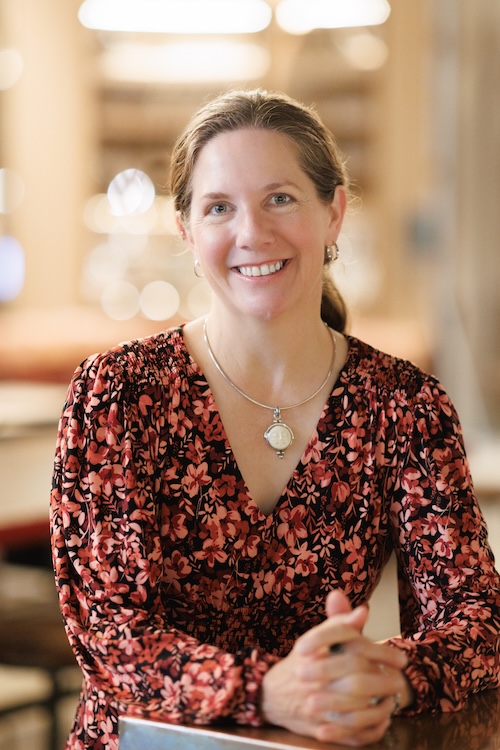
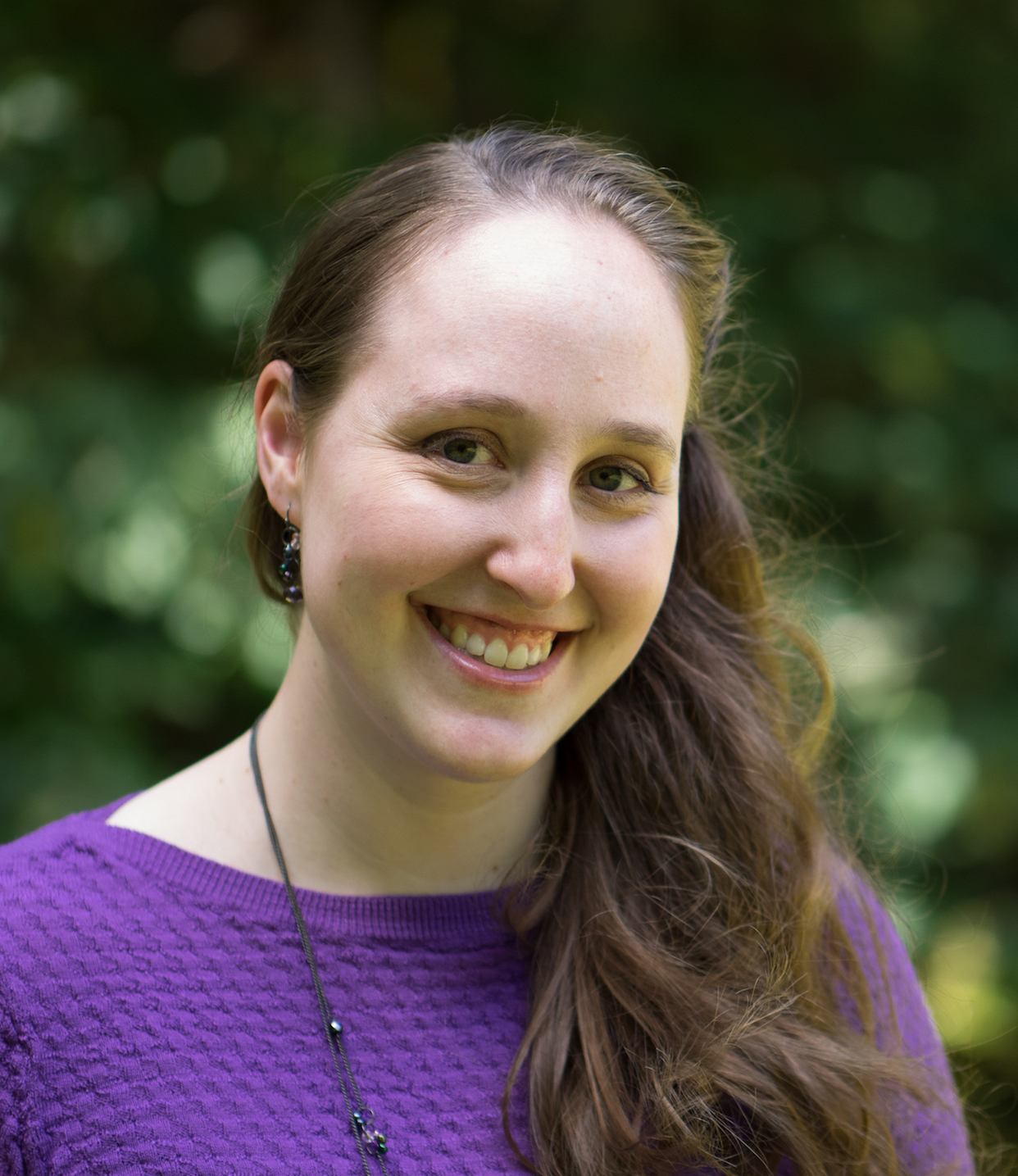
Kathryn Arnold writes fantasy and anything else that sparks her creativity from her home in Kingston, Washington. She currently earns her living as an insurance underwriting assistant, where she also creates marketing and web copy. When not writing, she plays (and teaches) piano and keyboard in a band (or two), and is working on starting a ministry team with her husband. You can find Kathryn at www.skyfirewords.com.