
Register Now for Fall Workshops!
I’ve got a full slate of workshops available this Fall. Whether you want to dive into specific craft topics (Backstory, Stakes & Tension, Weaving Character, Plot & Theme) or tackle your entire first Act (Write Great Openings), I’ve got opportunities for you.
Regardless of the workshop you choose you know you will get:
- A LIVE Classroom
- A small class size with personal attention
- Lessons, Discussion, and Exercises to help you put action to your education
- Answers to your Questions
I hope to see you in my classroom!
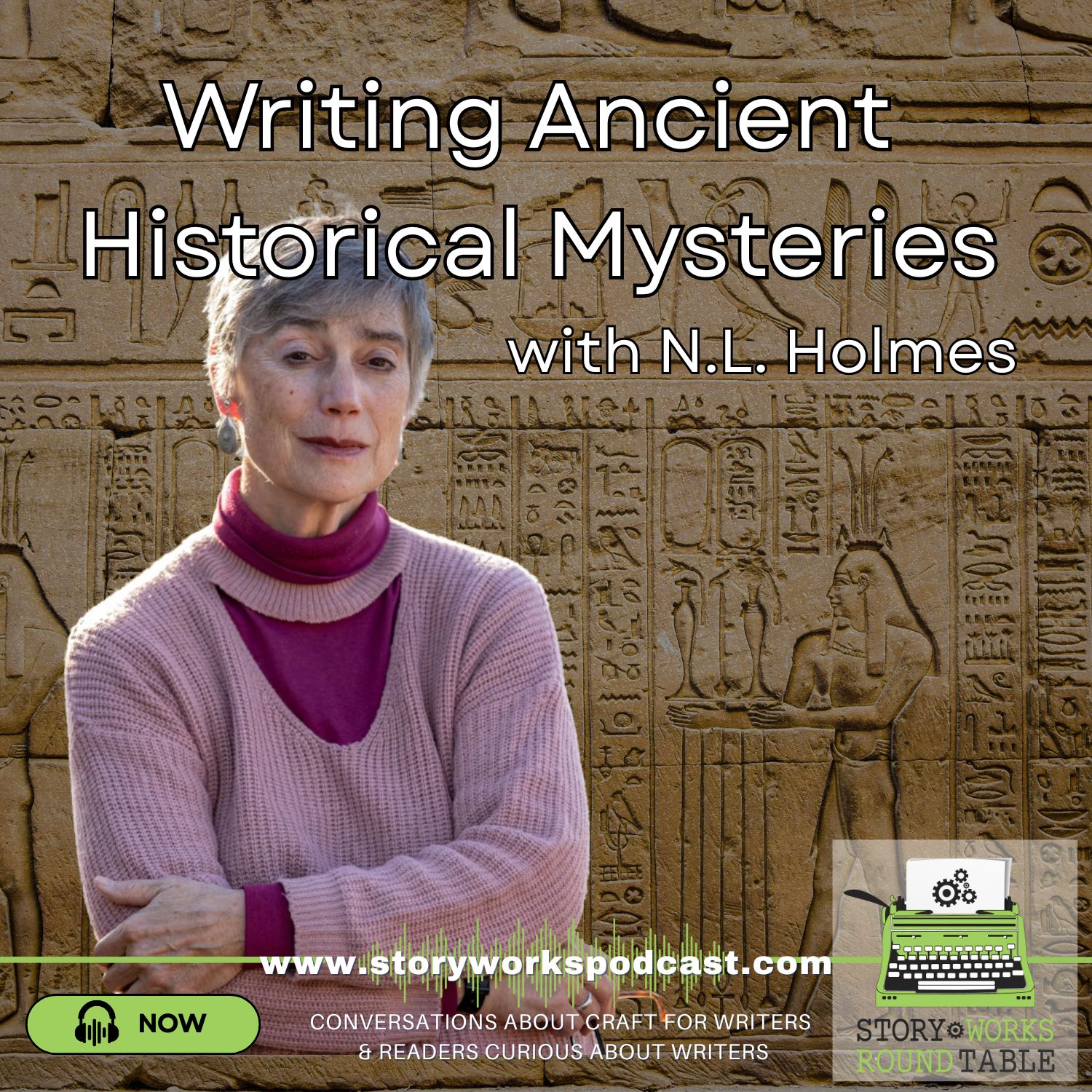
This week, Alida and Kathryn sit down with N.L. Holmes, an archaeologist turned novelist, who crafts mysteries set in ancient Egypt. Join us as we explore her unique journey, the challenges of writing about a distant culture, and the art of blending historical accuracy with engaging storytelling. Whether you’re a fan of her novels or an aspiring writer, this episode is packed with insights into the world of historical fiction and the mystery genre.
AUDIO
N.L. Holmes is a prolific novelist embarking on another significant career phase. Prior to taking up the power of writing and using this pen name, she was an accomplished archaeologist and teacher for 25 years. Early in her career she served as a nun for two decades. In between she was an artist and antiques dealer. Yes, she has lived an interesting life and the sum of her experiences informs and inspires her writings today.
Holmes, who earned her doctorate in Classical and Near Eastern Archaeology Studies from Bryn Mawr College despite an offer to attend Princeton, has excavated in Greece and Israel, and taught ancient history and humanities at Stockton University in N.J. and University of South Florida for many years. She also did archaeological artwork for excavations from Lebanon.
Born and raised in Fort Worth, Texas, she attended The University of Texas in the honors program but dropped out midway to enter into the antiques business. Two years later, she entered the Discalced Carmelite convent in Texas. She left the convent 20 years later and returned to school to get her B.A. in Classical and Near Eastern Archaeology.
TRANSCRIPT
This transcript is AI generated. If you notice any inconsistencies or errors, blame the bot.
Alida Winternheimer: Hello and welcome to this week’s StoryWorks Roundtable. Today, Caatherine and I are delighted to be joined by Nikki Holmes. NL Holmes is a prolific novelist embarking on another significant career phase prior to taking up the power of writing. And using this pen name, she was an accomplished archaeologist and teacher for 25 years. Early in her career, she served as a nun for two decades. In between, she was an artist and antique stealer. Yes, she has lived an interesting life and the sum of her experiences informs and inspires her writings.
Alida Winternheimer: Today, with 13 published novels, Holmes is.
Alida Winternheimer: The creator of the Lord Haie Mysteries and Hani’s Daughter Mysteries.
Alida Winternheimer: Holmes resides with her husband, three cats and a dog.
Alida Winternheimer: They split their time between Tampa, Florida and Northern France, where she gardens, weaves and plays the violin. Welcome Nikki.
N.L. Holmes: Thank you for having me.
Alida Winternheimer: Yeah.
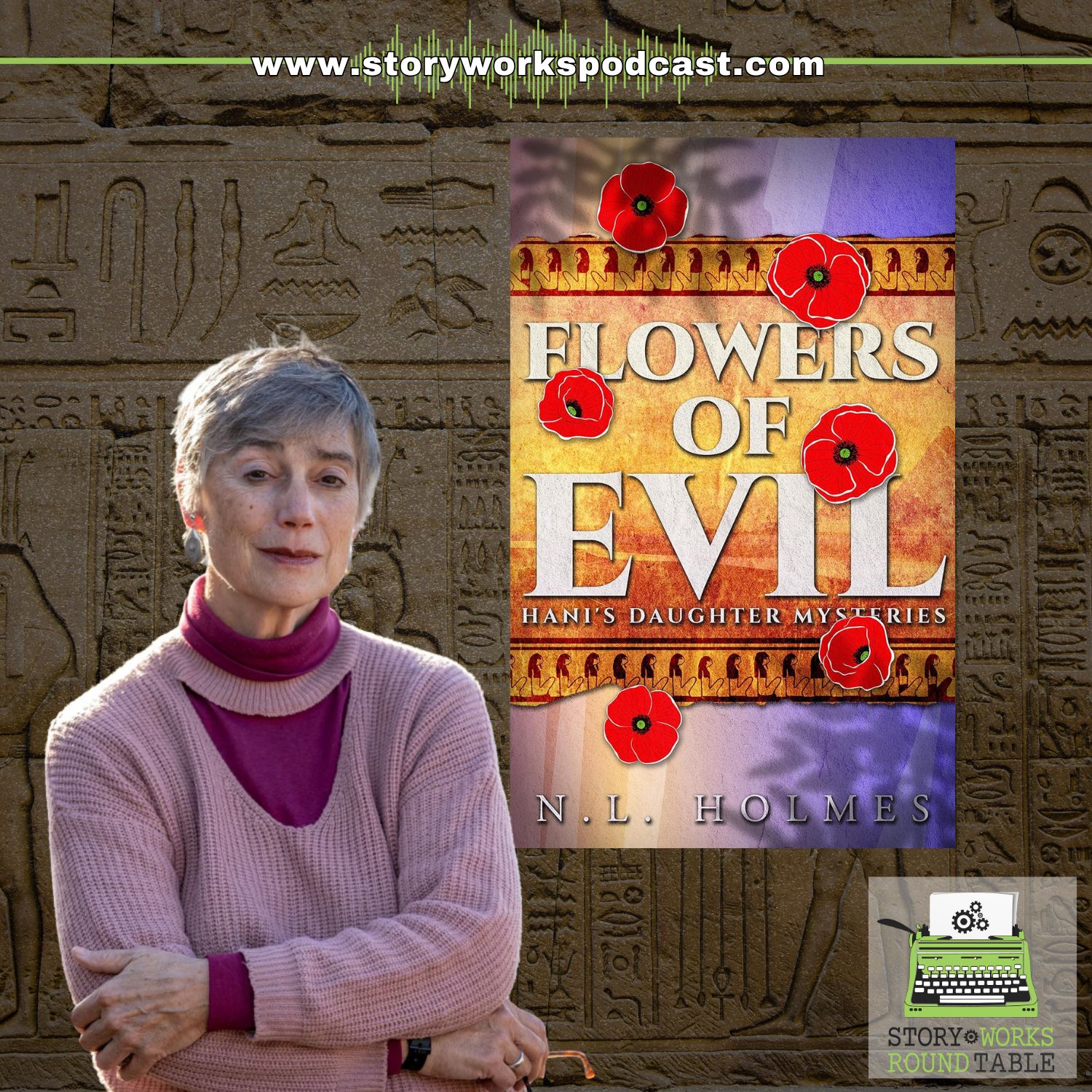
Alida Winternheimer: So Caatherine and I got to read one of your novels, the Flowers of Evil, which is the first in the Hani’s Daughter Mysteries series. And this is part of the series set in Egypt, in ancient Egypt. So I would love to hear something about your journey to this point and yeah, tell us how you became a writer and a write of mysteries set in Egypt, of all things.
N.L. Holmes: Well, I have to preface this by saying I’ve always been interested in archaeology, even as a little kid. Maybe all kids are. But you know, I was serious about it. I collected pennies to save Abu Siml and stuff like that. So, I started in at the University of Texas, with forst work aiming me in that direction. And then after not quite two years I felt like I was plunging full speed ahead and didn’t quite know where I was heading for. And so it was the 60s and everybody was looking for meaning and direction and something bigger than themselves. So I dropped out of college. I went into the antiques business, with the help of my family. And after two years of that, obviously that didn’t satisfy my spiritual itch much. So I entered the convent, the Carmelite monastery in my city. And I stayed there for 19 years. And then I left and immediately went back to college and finished my BA Classical Studies and then went on to do, graduate work in classical and Near Eastern archaeologyy. So you. From there I was lucky enough to get teaching positions in bat field, history and humanities and taught at the University of South Florida for a long time. And then I retired and it seemed natural just to make some use of all the knowledge I’d accumulated and the interesting questions that had posed themselves while I was teaching. Some of the fascinating little snippets of events that you get from ancient documents that really aren’t filled out much. I figured the only way to get those filled out was to write fiction. So that’s What I started doing.
Alida Winternheimer: Yeah, I love that. Now, all of your novels, mysteries, like these two series or do you have other subgenres?
N.L. Holmes: I have other subgenres and Id’be hard pressed to say exactly what subgenre they are. there’s a series. It’not even a series. It’s kind of a shared world set in the, Hittite Empire. And those books are more psychological dramas and family dramas and things like that. They’re they’re more serious and literary. Less kind of genistic, if I can co work, definitely.
Kathryn Arnold: You said they’re set in the Hittite Empire. As if the normal, average person would even know what. That was fantastic. Just throw that.
Alida Winternheimer: We’re just pretending here. Oh, of course, the Hittite Empire. Yeah.
N.L. Holmes: Well, they’re my favorite. Unknown. Him? No, they were contemporaries of the New Kingdom, Egyptians, and were very powerful. They were one of the great powers of their day. But they didn’t last long, maybe four or 500 years. And then they fell, completely disappeared, never to rise again, as many countries did at this moment in time, around a little after 1200 B.C. so, they were Indo European speaking. They were. What attracted me to them was not their military prowess, though they are known for that. But it’s their moral code which I found, very modern in some ways. The idea that war was only to be waged by necessity and that, the king was a shepherd of his people and not just the owner of everything. And that, mercy and clemency were, were moral values. So I kind of like these guys and their history. Although we know practically nothing much other than the bare facts, revealed some real personalities. So I thought that would be, a fun place to sally forth. However, it became apparent to me immediately that I was one of about five people on the planet who cared about the Hittites. So that’s when I migrated to Egypt.
Alida Winternheimer: ###Mm m that’s so interesting. So why mysteries when you said, okay, I’m gonna write stories set in Egypt with this type of character? Why the mystery genre?
N.L. Holmes: Well, I like mysteries. For one thing, they exercise the brain. and also I started doing the mysteries kind of, I don’t know, maybe seven years ago, when the political situation and climate change and everything, the world felt like a heavy place. And, in a mystery, everything is made good. At the end, good triumphs over evil and questions are answered and everybody goes home happy. So I thought that if everybody was like me, they would like to read something that kind of put order into the universe.
Alida Winternheimer: M. Yeah, definitely. While I was reading your novel, it struck me that, the language feels very contemporary. So we’ve got this setting. You’ve done a ton of world building. It’s fascinating. You know, we’re there on the dusty streets with the bare feet and the river and, you know, and you. You include Egyptian words and Egyptian names, and the descriptions are all there. But then the dialogue, the voice felt more contemporary to me. So I wonder if there was a stylistic choice. Right. and why you made that choice.
N.L. Holmes: Okay. I’m glad you gave me a chance to talk about this, because it is controversial. I mean, every reader has an expectation about the way people used to talk. And so I think a lot of us are conditioned by the grandiloquy of veonic pronouncements and monumental inscriptions and stuff. But people didn’t talk that way. And if you consider this, it’s a translation from M. Another language. So the principle of the translator is if they speak colloquially in their own language, then you translate it into coll. Colloquially modern English. So that’s what I’ve done. I’ve tried to avoid anachronism, but to transmit the feel of what it would have been among them. not everyone likes that, though. Some people feel it’s too modern. And that’s okay. Know, I’ve drawn my red line, they have to draw theirs. If they don’t like it, then read another book. What could I say? You’ve got to just set your standards and stick with them as.
Alida Winternheimer: All right. Right. Yes. I wrote a novella set in at the beginning of the 1300s, so very early 14th century, as one of my master’s theses. And I had to consider that, you know, and I wanted. My choice as a writer was to try to evoke the feel of the period with add diction and the syntax, you know, word choices, some of the. But also being aware of what you just said, that the way they spoke, what’s elevated to our ears. Right. Versus what would be elevated to their ears versus common or vernacular to their ears. very, very different style choices. And I, could never accurately capture medieval language. That’s not my field of study. Right. And my goal was not to approximate Chaucer or something want. So where do you find that balance between readability for contemporary readers and capturing the feeling you want, you know, for your book?
N.L. Holmes: that’s a really tricky thing, and I don’t think there’s one right answer. I mean, if you had written it in genuine 14th century English, no one could understand it, you know.
Alida Winternheimer: Right.
N.L. Holmes: Youve got to translate even from our own language. M. As I say, its a subjective call, just where you draw your line, but.
N.L. Holmes: I would say avoid anachronisms, but, in terms of lightness versus Formality, my tendency would be to go with the more contemporary feel. But not everybody has the same aesthetic there, so there’s no wrong way to do it, I guess.
Alida Winternheimer: Right, right. Yes. And I wonder if, the cultural stance on this, the collective cultural stance on this is shifting as we see more shows like, What was the one Shonda Rhimes did?
Kathryn Arnold: Huh?
N.L. Holmes: Y. I was thinking of the tutors with their modernity.
Alida Winternheimer: Oh, yes. Yeah. But what was Shonda Rhimes one? I feel like it starts with the be, but it’s kind of like Jane Austen, but with very, you know, contemporary music. And they take great liberty with the costuming, you know.
Kathryn Arnold: Oh, is that the Bridgerton series?
Alida Winternheimer: Yes, BR Bridgerton starts with the be. Yeah. And even years ago there was A Night’s Tale, a movie. I mean, this was quite a while ago, and I don’t quite remember how authentic they tried to be with the dialogue, but they used rock music. And their, reasoning was that jousting and such. Those were the stadium rock concerts of the time. People would gather there and it was that kind of excitement. And so, you know, we make all kinds of artistic choices that shift that line of what someone would call authentic or accurate or whatever. Yeah, yeah.
Kathryn Arnold: I think that choice of contemporary language shifting goal.
N.L. Holmes: I mean, as you say, I remember the movie about Marie Antoinette when they threw in Loub Boutin shoes and they, you know, when they were looking at the. And somehow that didn’t bother me, but it bothered a lot of people. The mingling of the modern, which, I don’t know, it sort of gave you a measuring stick to judge her frivolity by. Part of me wants to be totally accurate about everything, and I try to be very scrupulous about not contradicting anything we know about ancient history. But, it has to be comprehensible first of all. Or, you know, why write?
Alida Winternheimer: Yeah, definitely. Catherine, you were starting to say something.
Kathryn Arnold: I think that use of contemporary language with the. You kind of have this upper echelon of society in Egypt, and I think you could have kind of fallen into a trap of making her a little less relatable because if you had used a more formal language and having that contemporary language and having her interact with people in a way that, like you said, it’s instantly translatable like, you understand, because they’re using contemporary, modern language. That the way that she’s interacting with people or the way that she’s speaking to people, I think it makes it more relatable and more easy for me to understand where she’s coming from and to, to feel for her, even though she’s kind of this, like, top tier of society, which is different than my own experience.
N.L. Holmes: And within the. The cast, which are all, for the most part, as you say, high society people, there are degrees of formality. For example, the diplomats or Lord Thomas, he speaks very formally, but Nephfert is young and kind of, you know, not frivolous so much as just unconventional. So I don’t think she would have, put on a proper face for anybody.
Alida Winternheimer: She definitely doesn’t in the book. She’s a rebel.
N.L. Holmes: All of you don’t find her anachronistic?
Alida Winternheimer: No, I enjoyed her. You know, I thought it was very real because you think about how many varieties of people there are in society. And I think for us as writers, our job is not to deny they existed in the past, not to glorify the existence of someone like them in the past, but to win appropriate for the story we want to tell, to let them live and be real in the words of our story.
N.L. Holmes: And although I do often have a problem with sort of, sassy heroines in books as anachronisms, in ancient Egypt, women were visible and very participative in society. And I think if you could have gotten away with being out of the box anywhere in those days, it was Egypt. I mean, you have women participating in governance, you have, educated women doctors. I mean, that was a real thing, not common ever, but it happened. you even had women viziers in the old Kingdom and priests and things. So, in fact, that was something I wanted to kind of subtly convey. The fact that they were not restricted to the home or repressed or what have you, even sexually. They were pretty much out there. And, you know, the female body was appreciated and not seen as something shameful or prurient. So, I hope I’ve gotten that point of across without too much belaborment.
Alida Winternheimer: I think you too, you know, as I was, reading it and listening to you just now and kind of thinking about what you’re saying, it never struck me as questionable. And I think because of the world building, because of you’ve got the glossary, you know, the names and the terms at the front of the book, and it’s so apparent your authority as the author of this text, that I was in a state of trust. You know, I was never pulled out of the story to go. Would that really have happened? Oh come on. Is this a suspension of disbelief moment? I mean there was the mystery and that was fun of course, but when it comes to what it was like to be in ancient Egypt, the setting pieces, the relationship pieces, all of that world building stuff, it was never jarring for me.
Kathryn Arnold: Good.
N.L. Holmes: because you know when you’re writing a historical novel and you write historical novels, know this.
N.L. Holmes: That there’s two objectives you have to keep in mind and one is producing a good story, but the other one is presenting the world as it was as closely as you can. I think being reliable is very important because people do trust the author. And I’ve at least started into some novels about ancient Egypt that I just grand they were so inaccurate. It was obviously the person had not done research. And you know, what about the readers? They don’t know any better and they may believe that. It seems very irresponsible to me.
Alida Winternheimer: I agree.
N.L. Holmes: Maybe this is the teacher talking.
Alida Winternheimer: I’m with you 100%. I’m like oh gosh, yeah. Yep. And those details that you know to be untrue or that feels so inauthentic, they send you like running to look it up to verify it. That just that ruins a novel for me, you know?
Kathryn Arnold: M.
Alida Winternheimer: Yeah. I would love to hear more about your life as an archaeologist and how that informs the writing of these series set in Egypt.
N.L. Holmes: Let me preface that by saying that I’m not an Egyptologist. My field is elsewhere in the Mediterranean, so I’ve worked with Egyptian material. And this is, it’s sort of peripheral to my professional interests. But certainly the fact of being an archeologist has had a big impact both on my choice of subjects and also on the way I view the ancient world. I think my interests are more that of the dirt archeologist than of the historian, let’s say. I’m less interested in the political intrigues and stuff, although that plays a large role in the Lord Haey series. then I am in daily life and sort of the texture of the world in which they lived and the material things. That’s what the archaeologist studies is architecture and pottery and in the case of the Egyptians, baskets and leather and all the stuff they really use. So although there were gaps in our knowledge about ancient Egypt, lots of them, we have a very strong visual picture of their lives both because they depicted it and Talked about it in literature, but also because we have objects. And that is part of what attracted me to using Egypt as the setting for these two series.
Kathryn Arnold: Mm
Alida Winternheimer: Notes. Yeah, when so you mentioned that they wrote. They left us a written record. And when I think of Egypt and writing, I think of pictographs and there are some moments in the story when somebody is writing something or looks at a note and I was like, what does that look like? Is that like a little drawing? Is it, you know, what I picture when I think of things in museums that I’ve seen.
N.L. Holmes: So now this is interesting. They had three different kinds of writing. One the formal kind was the hieroglyphs that you’re thinking of, which are pictorial. And those were used for formal occasions like carved in a wall, know a temple or a tomb or on a very formal book of some sort. And these, this was considered the speech of the gods. I mean it was efficacious, like uttering the world. what you wrote was true and I mean they have a whole kind of mysticism m of the written word that’s quite fascinating. But then they also had less formal kinds of writing, obviously things that were faster than that. So they had hieratic writing which was what we call cursive. that’s what Nefert can read. And that’s what people do when they take notes on something. it’handwriting essentially and its stylized. I mean Im’sure it came from the pictures but you cant recognize that when you see it. And then there was a third form that came along later called Demotic and that was a much faster, almost like shorthand kind of writing. So they too realized the unwieldiness of a formal script and just for more formal purposes.
Alida Winternheimer: Interesting. So how do you decide how much detail to include in the story? You know, like when I’m reading there’s just here’s a note or here’s a written word. And you made the choice not to go into some of the detail you just gave us of like describing what is actually on the page. So what is your writerly process when youve got all of this knowledge and research at your disposal, but you want to keep the story flowing for the reader?
N.L. Holmes: the old interior editor. Thats a tough question because its not always a conscious decision. You know, its kind of an intuition or Im always putting myself in the readers position. My priority is always to keep the story going. some people probably find my books slow because I do include a lot of description. But that’s because I’m an artist too, a visual artist. So that is important to me. When I pass through the world, I see things and smell them and hear them and what have you. whereas some people, I guess, want to get on with the action, but here again, I guess there’s no real, right or wrong point at which to stop your elaboration. It’s just a matter of personal style and personal taste. If I make any decisions about that, it’s just where would I, as the reader want to be here? Would I want to push on into the action or would I want to stop and get the flavor before we dig in? So that’s basically. I can’t answer your question.
Alida Winternheimer: No, I like that, I like that. Where do we, where do we want to get the flavor before we push on? I think that’s perfect. It’s a perfect answer. Ye.
Kathryn Arnold: I think, yeah. And I think it depends on what kind of book you’re trying to write. Like, I get the, I got the feeling as I was reading the book that like the mystery was definitely what we were focused on in terms of the plot, but the book was much more of an immersion into the world and being able to really grow with Nepht. And was the little, the girl’s name, was it Muai?
N.L. Holmes: How do youi Muui?
Kathryn Arnold: And seeing her kind of learning from, from Nephrat and all that and, and the relationships with the family and the cultural journey. So I feel like if you’re aiming to just write a mystery, you know, then you maybe wouldn’t set it in a place that you really want to kind of explore those character moments and explore those cultural moments and dive into that world. so in a, in a series like this, I would say, you know, slow down, give them the details because that’s what we kind of want.
N.L. Holmes: Because I’m not a person who wants an action packed book that just whizzes past where it’s bang, bang, bang, one thing after another. I don’t like to read that kind of book. I want a more slow, leisurely experience. And I guess that’s why I kind of prefer the older mysteries, Agatha, Christie type. Things that take place mostly in the mind and with observation, looking around and seeing clues and smelling them, even in So I guess that’s just my personal taste and I’m glad it worked for you. It probably won’t be everybody’s cup of tea, but that’s inevitable. There’s no one book everybody likes well.
Kathryn Arnold: And I think if you’re picking up a book that’s about a culture or a time or a historical that’s not your own, then you’re going to expect it to be a little more diving into that world because it is more important u, in a book like that than say, a contemporary mystery where you already have the context that you need in terms of the world.
N.L. Holmes: That reminds me, I read a book recently and I don’t even remember what period it was set in because it did nothing to bring you into the world. It was just, it was just actions and thoughts and dialogue. I kind of had to remind myself casely, now where are we? As you see, it didn’t stick at all either. So.
Kathryn Arnold: Right. That’s the extreme opposite end of.
Kathryn Arnold: Funny.
Alida Winternheimer: Yeah. So when you are writing, doing your world building and you’re keeping the idea of the reader in mind, do you find yourself thinking about reader misconceptions and where you might need to include more because you’re going to be kind of butting up against some pop cultural idea or striking that balance?
N.L. Holmes: That’s an interesting, question. And not so much in this series, but in the series from which it spun off, the Lord Honey mysteries, that had a lot of political intrigue, it had a full historical arc from the beginning of the reign of Amen, Akenate and the heretic pharaoh to the end of his reign in the beginning of teaiankhamuns reigne. So I think a lot of people have definite ideas about Akenate that are propagated by popular literature and theyre absolutely the opposite of what Egyptologists think. And so I maybe drill down heavily on that, more than I might have for some other king, just because, you know, I think it probably overthrows what a lot of people have been taught about him. So if I’ve helped people to dislike him. All good’not. My favorite person and I’m sure that shows.
Alida Winternheimer: Yeah. Do you everget what kind of feedback do you get from readers? Is it to get pushback or just sort of like ignorant people thinking youe wrong and being vocal about it? I’m just curious.
N.L. Holmes: I have had a little of that. It had to do with, Semitic languages, which I’m not an expert, but I have studied them. And I said something like ancient Egyptian, like modern Arabic and Hebrew have no vowels. They, you know, they just have semi vels. And somebody who apparently spoke Arabic said, oh, I beg to differ. You know, they do have vowels and I know exactly what she’s thinking, but they’re not vowels, they’re semi vowels. So, you know, why argue? It’s just a semantic difference.
Alida Winternheimer: Yes. Yeah. so why Magnefert, a healer? What was. You know. But I’ll just leave it open. What was that choice about?
N.L. Holmes: Well, I wanted. She’s intellectually curious and there’s a limited number of things women could pursue in an educated, sense. They probably couldn’t be a scribe because that was a professional position that was in the hierarchy which was close to them. We know that there were women physicians, at least occasionally. also she had a sister who had been crippled in a boating accident. And at the time, she decided that she wanted to become a doctor to help people like her sister, people who were suffering. So that incident in the previous series kind of sparked her trajectory into the medical field. And then also as a character in a mystery, this gave her a way to do forensics of a simple kind. even in the Lord Honey mysteries, she helps test some poisons and things for him in a way that most people probably wouldn’t have known how to do. And of course, the forensic science is pretty simple in those days. But as a kind of scientist, she would be equipped to do that.
Alida Winternheimer: Yeahah. I love how that choice has to do with characterization. Also plot, also history and the records of the time. And all three come together so perfectly there m. Were the medicines she made, the plants used, and the treatments administered. Is all of that or some of it coming from what we know about that period in Egypt? Are you drawing on different eras of herbal medicine and traditional healing?
N.L. Holmes: no, it’s pretty exclusively what we know about Egyptian medicine, which is quite well documented. We have more about that than many other subjects because they were real scientists in a way. They experimented, they wrote down what they discovered, and then these case books were used by subsequent generations who didn’t have to invent the wheel again. they would look through the books, see what the symptoms were. Then either Do I treat this or do I tell them, sorry, I can’t help you. If I treat it, what do I give them? And if that doesn’t work, try this. It’s very methodical and very clearly laid out. they used what we would call herbal medicine, probably, quite reliable at things like willow bark, which contains salicylic acid like aspirin and other things that were proved to work over time. They did this over thousands of years. So they were known to be the most advanced, medical people in their day by a long shot. I mean it was really just sort of witch doctor elsewhere. And they too had, their priests and their magicians that didte healing services and things like this. But if you want to put this all together in a context that you could call holistic medicine, it’s very effective faith healing. And people who believe they’re being looked after and cured and the demons are being driven out of them in addition to receiving medicine.
N.L. Holmes: It makes them feel better and their bodies get going and those antibodies kick in. So I think probably all of these things work together to achieve real successes. And they kept up with it because it worked.
Alida Winternheimer: Yeah. Interesting. one thing I was wondering about is the flowers. You know, as I was reading, I accepted it. It didn’t jar me out of the story because of the authority. Right. That the trust established as we’re drawn into this particular world. But I did wonder, like, okay, we’re talking Egypt, right. My conceptions about Egypt, and I don’t know what it was like in ancient times, obviously, but clearly they had rivers.
Alida Winternheimer: What was the climate like?
Alida Winternheimer: And how did they have these fields of flowers that they were able to bring such massive amounts of bouquets to the temples. And you know, I’m just really curious, what was their growing season like?
N.L. Holmes: Ah, irrigation from the river. That’s how they did it. Ah, the river flooded before the Lake Nasser and the Aswond Dam. The river flooded every year in the late summer, early fall, and that was considered the start of the year. That was the big event. they had channels cut out into their fields with gates. And so the water would rush out into the fields, they close the gates, it was trapped there. And then they would let it out of the channels little by little as they needed it throughout the winter, which was the growing season. And by spring their wheat was ready to be harvested or their flowers or whatever. So mean they had the art of, irrigation and farming by irrigation down to a perfection. In fact, people think that this was maybe what sparked the beginning of their civilization? Somebody developed enough know how and enough power to command a large workforce to do this. And therefore the people could eat amply. And this was their way of getting across a period of climate change at the beginning of Egyptian society. So maybe theres a lesson in that for the future.
Alida Winternheimer: Oh, I think so.
N.L. Holmes: Water is going to be a thing.
Alida Winternheimer: Yeah. Yeah, thats fascinating. Kryine, what haven’we talked about.
Kathryn Arnold: I would, I would love to hear some of the gaps that you had to close with fiction. So where was that? Some of those knowledge pieces that you just simply had to make up and how did you work that together to make it feel real and whole?
N.L. Holmes: Yeah, that’s, that’s a good question. If I can remember specifics from that book. well you can use any of.
Kathryn Arnold: Your books, it’s fine.
N.L. Holmes: The idea that they, the florists worked all night, I mean that’s, they would have had to, to have things ready in the morning obviously. But when you consider the climate there, which hearkening back to your previous question, is very hot. I mean its more comfortable in the winter, but on the summer its extremely hot. Its as hot as Texas where I grew up. And so it would have been death to the flowers to keep them out of water that long. So they would have, it would have had to work at night probably.
Kathryn Arnold: It was a logical gap.
N.L. Holmes: Yeah, yeah, exactly. And how do you illuminate a ah, nighttime job like that? You have to light torches. So that was just kind of probability of closing in on the truth there.
Alida Winternheimer: Yeah. What about other gaps? Maybe ones that don’t have such a logical answer where you just kind of work through the problem and surmise?
N.L. Holmes: But yeah, that’s a good question. I can’t think of anything right off. Well, I guess the setting up of their dispensary. I don’t think we actually have any clinics to look at how they would have arranged things. Would they have had tables? they were typically had little furniture, I mean it was very expensive. Would they have had benches? Would they have laid people out on the floor? That’s very possible. although they did have beds. So yeah, I kind of had to wing it there. M. Forgive me, it’s hard to come out.
Kathryn Arnold: No, it s all good. Did you just take other things that you had knowledge of and just sort of figure out how you could like you said, logically fill the gaps but also stay true to the culture and things?
N.L. Holmes: Right. Not to exceed their level of technology, for example. Sometimes ID probably unconsciously borrowed from other cultures. Where we do have evidence about something on the basis that they all would have been operating about the same level. yeah, I’m sorry, I can’t point to something specific.
Kathryn Arnold: Well, no, but like you’re talking about, you know, you don’t, know how they would have set up the dispensary, but furniture was very expensive. That probably because there’s not as much resource for that.
N.L. Holmes: Right, right. There’s little forestry in Egypt. They’re, you know, very little wood. Palm trees are okay for some things, but they’re not fine wood. So if to get hardwood you have to cut down a tree. And they’re, they’re pretty rare. And so it was, the poor wouldn’t have had much furniture and they would have sat on the floor and laid, probably slept on the floor. But the wealthy, like Nephrine, her husband is almost limitlessly wealthy. So they would have been able to buy the furniture they needed.
Alida Winternheimer: Yeah.
N.L. Holmes: O. I can think of an example from the third book in this series which is about chariot making. I went through everything I could find about the art of wood bending, and the way they, might have done it. There were, people who have done experimental archaeology and reconstructed how these chariots might have been made. How could you bend the wood and things like this? so the idea of building very long boxes and steaming the wood and then building it, bending it again, we don’t know that’s how they did it, but it’s almost the only way you can bend wood is to either soak it or steam it. So I picked up on these, reconstructions of the process and gave it my seal of approval.
Alida Winternheimer: Yeah. That’s so interesting. I was recently in the Maritime Museum in Bath, Maine and they had an exhibit about that. Because in shipbuilding that’s what they would do to shape the wood that forms the hull in a ship. And I had no idea that they were steaming all of this lumber, you know, to get the thing.
N.L. Holmes: Seems incredibly advanced, but they’ve been doing it since forever, practically.
Alida Winternheimer: Yeah, yeah. And then they had like a long house for the rope making. Think about how long ropes had to be to manage sail. And you’d have these schooners with 6ma and so it was like blocks long and over the river and they’d have to, you know, soak the fibers and do. And I’JUST like, oh my gosh, what an incredible industry. And technology, when you look backwards at history and what people accomplished without the machinery and the computers and everything that we have today, it’s just mind blowing.
N.L. Holmes: it is mind blowing and I think that’s one of the things that attracts people to Egypt because they did accomplish such incredible feats of engineering. while in many fields their jewelry is just Faberge and yet they did it with incredibly simple tools. Bronze and flint and you can’t get any simpler wood. It’s just human skill. They were masters of their arts.
N.L. Holmes: And actually that’s something that I have wanted to convey in this series because each one of the books is centered on a different career. Ah. Or a different art. So that the one that you’ve read is about florists and the second one is about weavers and the third one’s about chart makers, etc. So was those are just sort of little Easter eggs for theer that is interested in to give them a little knowledge about how things were done.
Alida Winternheimer: Yeah, I love that. I bet listeners right now are like okay, this is the Chariot book, this is the beaving book. I got to read that. That’s my niece covers.
N.L. Holmes: Give them the.
Kathryn Arnold: I love that.
Alida Winternheimer: Yes. Yeah. Wow. so what haven’t we talked about that you would love to share with listeners?
N.L. Holmes: Have future plans? This is something ask. Yes, well I just submitted a fifth Nefert book to the editor so that will be coming out in the fall probably. thats about cook it called A Taste of Evil and then I’m starting to work on a prequel for the Lord Honi series. So Nefffert’father is the protagonist in these and it’more in his professional capacity as a diplomat. he is based on a real character in the Amarna letters which is a series of 14th century diplomatic correspondence. His name occurs a number of times over a period of about 20 years as a trusted M M emissary. And at one point the king says about him, everybody’s happy when Hani comes. And so that sort of helped me shape his character. And then I’ve sent him off on each of those adventures which he really accomplished in life, embroidering heavily I might add because they’re just barely mentioned in these documents. but then there was one I had not gotten to. And this is when he goes to the kingdom of Naharin or Nitani to bring back a foreign bride for the king. So that one will be coming up sometime in 2026.
Alida Winternheimer: Oh, interesting. Okay, so that begs the question. He went to bring back a Foreign bride for the king. What were other civilizations around Egypt like at that time? You know, it seems like there might be enough discrepancy or disparity between these civilizations that I’t know. That might be a tough match.
N.L. Holmes: Yeah, well there it would have been culture shock for the girl for sure. I think. the other two big kingdoms at this moment were the Hittites as I mentioned, who were in what is now Turkey, so rather farther north. And then the Metanians who were in inland Syria in kind of the northern part of Mesopotamia, Iraq. Modern Kurdistan is where they lived. they were a very brief power but they were powerful while they were up and at it. So the three of those empires kind of were either in a cold war usually or else allies and rivals. What they would frequently do to avoid world wars was to set their vassal states against each other, let them kind of slug out the borders. And they both held a lot of small states. The whole coast of what is now so of Palestine, Israel, Syria was parceled up between them. Egypt had the south, the Hittites had the north. And sometimes Maani came and got some of them. So they let those little states punch each other the nose so they didn’t have to go to war. So it makes for a really interesting dynamic. And then those little states manipulated the great powers to their advantage. And if they’re under M, let’s say they’re under the Hittites right now, they could threaten to go over to Egypt if they didn’t get more whatever they needed. So it was a really interesting ever shifting dynamic going on there. It’s just, it’s been loads of fun to explore that.
Kathryn Arnold: Yeah, kidding.
Alida Winternheimer: I bet.
Kathryn Arnold: Wow.
Alida Winternheimer: So where can our listeners find you and your books?
N.L. Holmes: they can find my books, in any online bookore or probably certain brick and mortar stores. But also you can get them through my website which is www do and elhomes uh.com.
Alida Winternheimer: Perfect. Well, thank you so much for joining us today. It’s been a lot of fun talking about ancient Egypt and mysteries and you enjoyed.
N.L. Holmes: I certainly have.
About Your Hosts
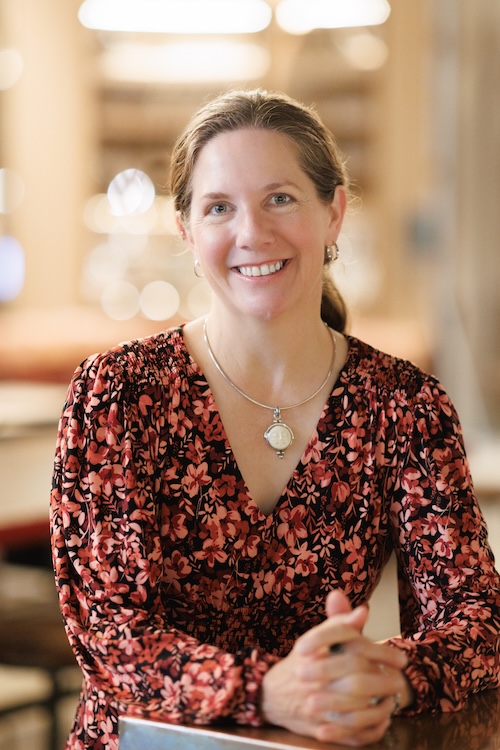
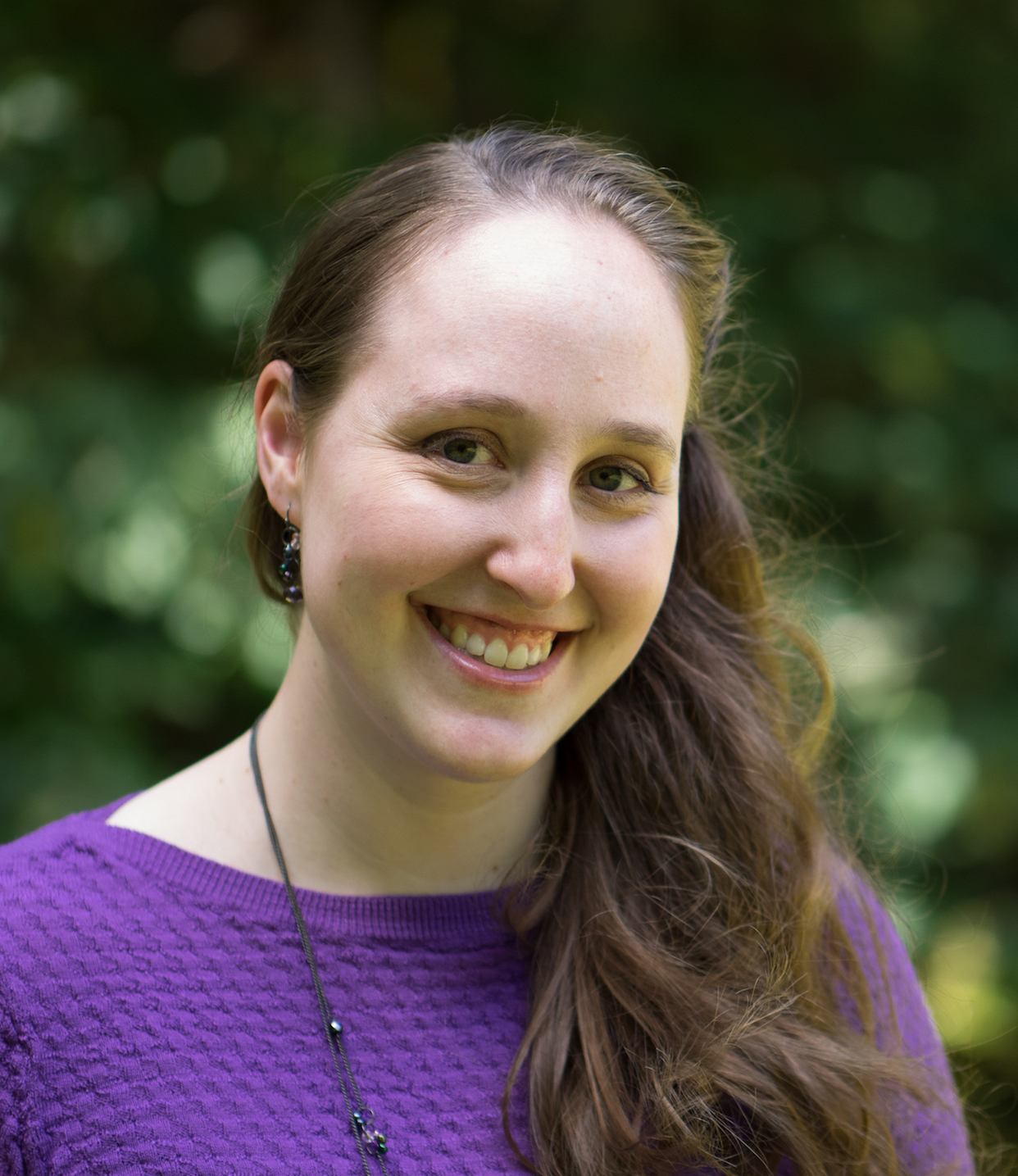
Kathryn Arnold writes fantasy and anything else that sparks her creativity from her home in Kingston, Washington. She currently earns her living as an insurance underwriting assistant, where she also creates marketing and web copy. When not writing, she plays (and teaches) piano and keyboard in a band (or two), and is working on starting a ministry team with her husband. You can find Kathryn at www.skyfirewords.com.