The Novel Journey
Discover How to Write a Novel You’re Really Proud of in One Year
The Novel Journey is a year-long novel-writing and author-development experience that takes writers from page one to “the end.”
Write your novel while growing as a writer without impossible word count goals, bending your story into someone else’s plot formula, or sacrificing your voice or vision for genre expectations.
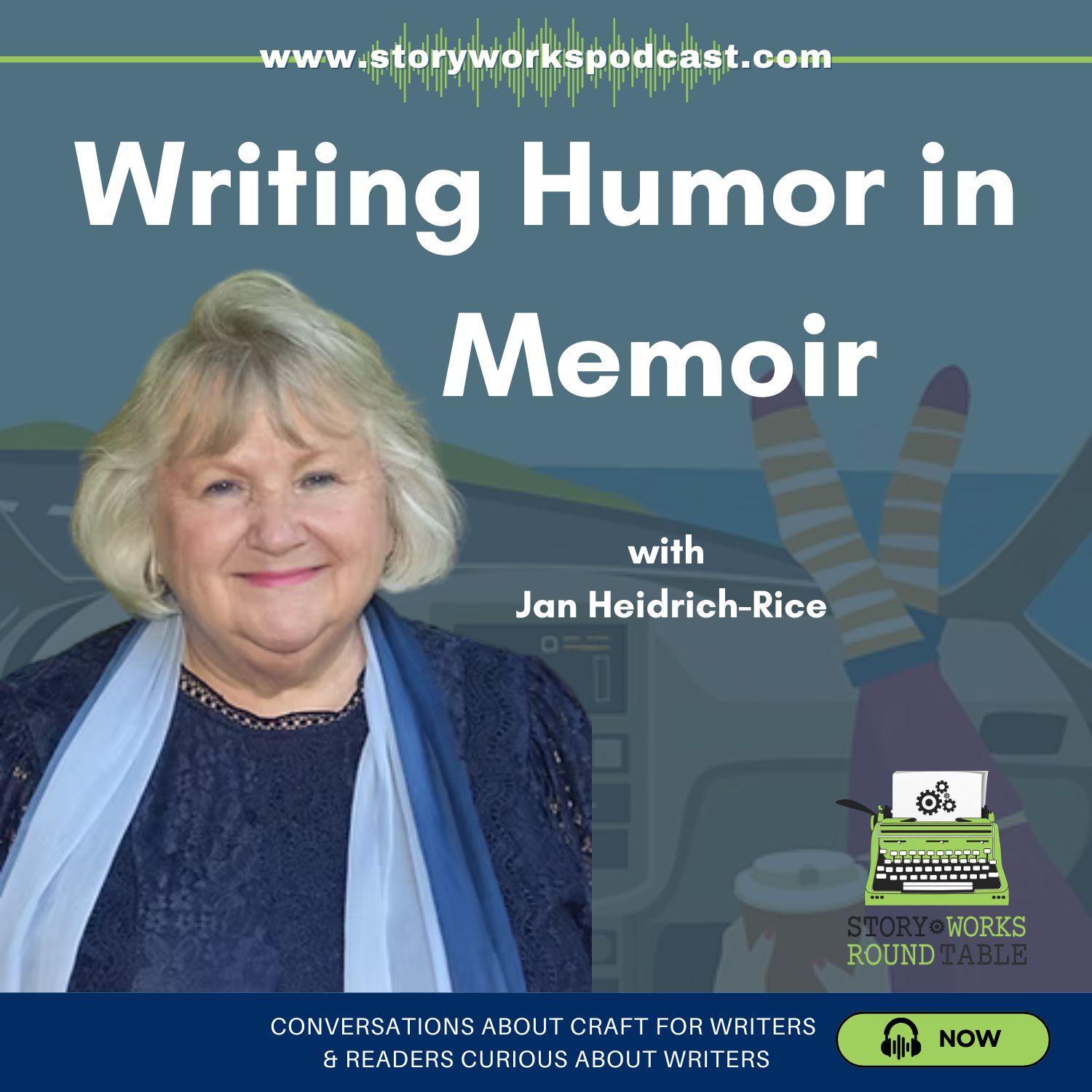
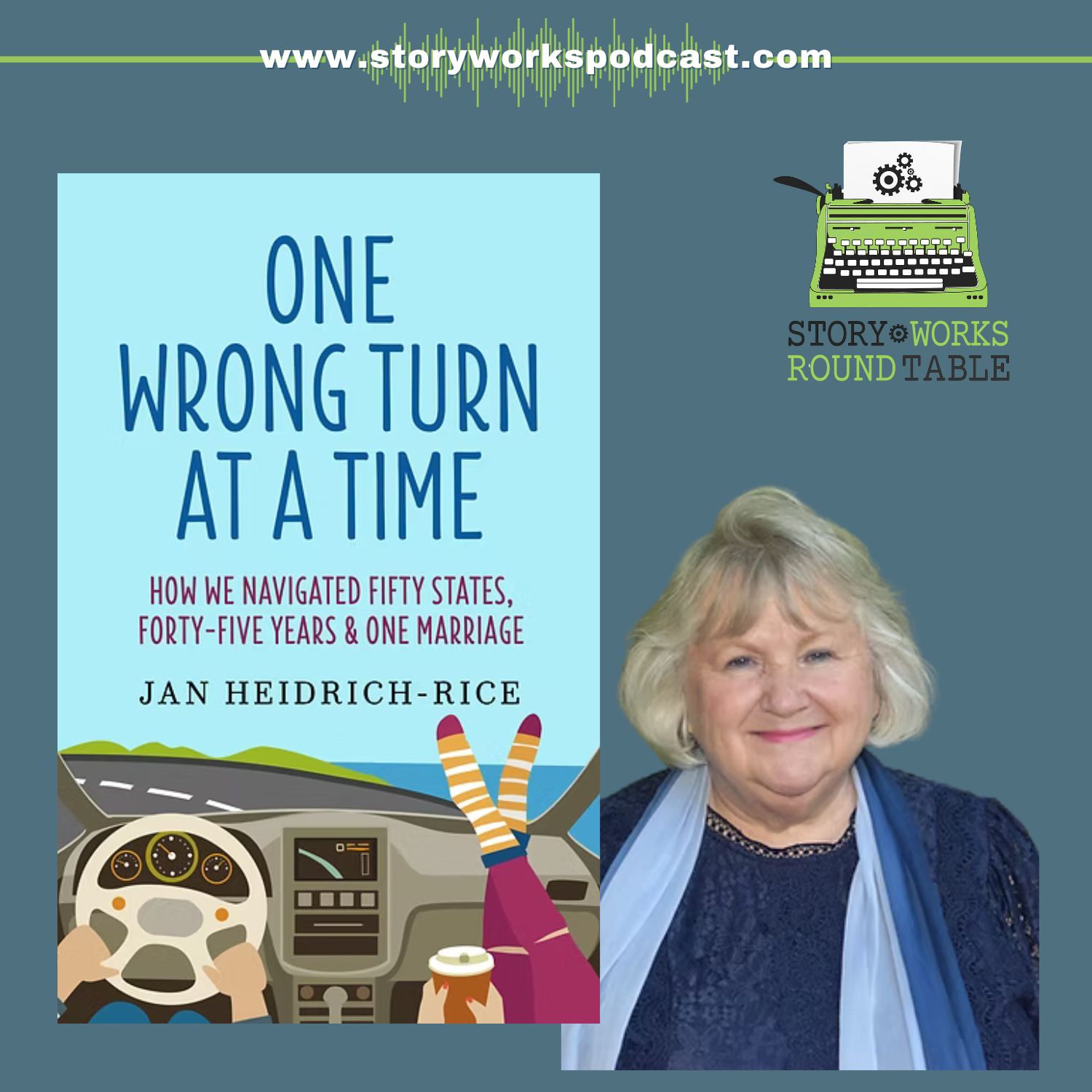
In this week’s episode of the Story Works Round Table, Alida Winternheimer and Kathryn Arnold welcome back Jan Heidrich-Rice, a talented author known for her mysteries and an engaging travel-humor memoir. Join us as Jan shares insights into her latest work, which reflects on 45 years of marriage and adventures across 50 states. With a blend of humor and heartfelt storytelling, Jan discusses the challenges and joys of capturing life’s journey through her unique lens. Join us for an inspiring conversation about love, laughter, and the art of memoir writing!
AUDIO
TRANSCRIPT
This transcript is AI generated. If you notice any inconsistencies or errors, blame the bot.
Alida Winternheimer: Hello and welcome to this week’s Story Works Round Table. Today, Kathryn and I are delighted to be joined by Jan Heidrich Rice. Jan is a friend of the show. She’s been on the podcast before, talking about ghost stories and mysteries. And today she’s joining us to talk about her travel humor memoir about life on the road, 50 states, and 45 years of marriage. Jan writes contemporary fiction and creative nonfiction, occasionally haunting, often funny, but always filled with hope and heart. Her Marnie Putnam mystery trilogy features cozy, dark southern mysteries that weave together small town secrets, emotional healing, and whispers of the supernatural. Her nonfiction combines insight and humor to help readers navigate midlife shifts, creative reinvention, and the beautiful mess that real life detours bring. Whether she’s exploring otherworldly possibilities or real life crossroads, her work is rooted in hope and human connection. Welcome back, Jan.
Jan Heidrich-Rice: Thanks, Alita. You made me sound good.
Alida Winternheimer: I’m glad.
Jan Heidrich-Rice: It’s a pleasure to be here.
Alida Winternheimer: So was writing humor natural to you, or did you take this on as a craft challenge? Like, okay, how do I make this funny? How do I translate my humor into words for readers?
Jan Heidrich-Rice: I think it was a natural when once I decided to, write the nonfiction about my marriage and my travels. And it was sort of a love letter to my husband because he was so supportive when I wrote Secrets of the Blue Moon. And I thought I should really be writing about our life, not, you know, a fictional character. Although I like that. I like to write that. But our life is. We haven’t had huge traumas. We. We’ve. You know, we’ve kind of learned to laugh at ourselves along the way. And that’s a little bit what I wanted to share is just that’s how we have done it. And it’s not a how to book. You know, the. What is it? The how we navigated 50 states, 45 years and one marriage. it’s not a how to book at all. It’s just. In fact, the title is. I think title was just like, oh, my gosh, this is our life. So it was fun. It’s fun. I like to look at the lighter side of things because life is hard.
Alida Winternheimer: Yeah. Okay, so this begs the question, the origin of this book. You mentioned your subtitle, so it’s One wrong turn at a time. How we navigated 50 states, 45 years, and one marriage. So I’m guessing you and your husband took a lot of road trips together.
Jan Heidrich-Rice: We did. And, you know, they weren’t all on the road. Some of them were. we’ve flown and we haven’t done any RVing. And, oh, my God, he told me once we should do that when we retire. And I said, I want to stay married. We’re not going to do that. So, power to people who can do that. I would kill him because he’d be, wake up. You need. You’re missing stuff. but we have done road trips, and our Last one in 2023 was, I think we put 4,000 miles on. And that was when we decided, enough, enough. So we haven’t done any big, long ones since then.
Alida Winternheimer: So your. Your book. We were chatting a bit before we started recording that. It’s kind of a collection of shorter pieces Personal essays, if you will. But it’s also kind of a memoir. So, spell it out for us a little bit. Like, is it a collection of pieces about a number of trips? How did you frame it when you were sitting down to write and thinking, there’s a book here? This is what I’m writing about.
Jan Heidrich-Rice: Right, right. I started to think about our travels because folks have said to us, wow, you have traveled a lot. And I, I don’t think of it that way. But you know, some people it is that we’ve traveled a lot. Other people will be like, that’s nothing. We’ve been way more places than you. But I thought that’s kind of a neat skeleton to work with. And initially I wasn’t sure I was going to do it chronologically, but my writing partners were just like, oh my gosh, you’re all over the place. You got to do this chronologically. So I started to think, and here’s something with memoir that people don’t always think about. But that was pounded into my head. Memoir has to have a story arc, just like fiction. And so that was sort of a way, if I went chronologically and looked at our travels and this picked out highlights of, you know, where we went certain years and where we were in our lives, that was how I thought I could frame it. And it did. I’m pretty happy with how that turned out, if that makes sense.
Alida Winternheimer: No, it does. A memoir absolutely needs an arc. You know, when I’m working with memoir writers, I find we are always talking about the structure of the story, both in terms of, you know, what we fiction writers call plot. You do with the memoir as well? To a degree. Right. But it’s sort of the tangible framework of movement. So in this case it would be the travel. Right. The travel over time, that chronological experience, but then also the thematic movement. And what is the story really about? Because if it’s memoir and not travelog, then the travel itself isn’t the book, it’s the personal journey. And so you’ve got the 45 years and the marriage aspect there. So what is the book about, Jan? Right. You know, it’s about travel.
Jan Heidrich-Rice: I think you said it well. It’s about the journey. Life is a journey. you know, you’ve heard that phrase, it’s not a destination, it’s a journey. And that is, I think, a really good analogy for marriage is a journey. and our life together has just been a journey. It’s not been perfect, it’s had a lot of, detours and potholes and
Alida Winternheimer: But.
Jan Heidrich-Rice: But it’s, it’s been a journey that I think is worth celebrating. Certainly. You know, I was, when I wrote it, I was hoping he’d read it, which he did. He, had plenty to say about it. And then, my kids have read it too, and enjoyed it and you know, they’re in it, so that’s probably why. But, it, it’s. I lost track of what I was going to say. But it’s, It’s a journey. Yeah.
Alida Winternheimer: Yes. And I love how travel gives us so many metaphors for life like potholes and detours. Did you find. You know, I think, when we’re writing things that maybe we weren’t conscious of, come forward because we start doing the mental work of processing our own life story and thinking about things like imagery or synchronicity or meaning and metaphor. So you mentioned doing this chronologically, the different stages of your life and your marriage, but then also your travel. So were you writing this and finding, oh, look, like this state or this trip offered this kind of imagery or metaphor. And look at how it lends itself to this thematic element that I’m writing about in my life. What was the process of kind of shaping those things and forming it into story?
Jan Heidrich-Rice: Well, I think, how we as a couple grew. For instance, the first chapter is our honeymoon in Mackinac island back in 1979, when we were babies, we didn’t even know enough to make reservations. Ah. And we were broke. All my, all our friends, a lot of my friends were lived in Michigan and they were getting married and going on cruises and all these fancy places. And I thought, you remember the old compasses? You know, where you put a point on the paper and then draw the circle. I actually got that out and said, we need to stick in this circle. So we found a place in Michigan called Paradise, which. Oh my God. Well, read it if you want, but it’s, it’s. It’s Paradise. But we. That was one of our stops. And then we went to Mackinac island and it was just. We didn’t know what we’re doing and, but we had fun. And But then our last trip to Alaska, we. It was such a progression. It was like, we’re staying in this. We did a cruise and it was, you know, lying in this wonderful king size bed thinking back to when we were, you know, up in Mackinac Island. I don’t know if it was a double bed or what it was, but we’re just thankful we got a bed. So I think that’s been the fun part is just looking where we are at different stages. One of the things, I really tried hard. I, I tried, you know, me, Alita and Catherine. You don’t, but you will. I, I, I don’t. I have a hard time even when I go to a sports activity with my grandkids. I don’t like anybody to lose. I, so I don’t, I didn’t want to come across like, I hated this state or I love this state the most. I tried to be pretty even keel about it, but there were a few that I really, I loved. I loved North Dakota. I adored it. I never dreamed, but it was, one of our most recent trips and it was just gorgeous. You know, the, the bison crossing. You know, you have to stop your car because they’re gonna, they snort at you and you’re like, okay, we’re not gonna play chicken. But it was so interesting to me, how just going in and learning. Teddy Roosevelt was very instrumental in getting the park system going. And one of the things he found, North Dakota particularly soothing and therapeutic. He lost his wife to childbirth and his mother to death in the same day.
Alida Winternheimer: Oh, wow.
Jan Heidrich-Rice: And I didn’t know that. So little things like that. I find, I, don’t know, I find those way more fascinating than going to look at, forgive me, the Eiffel Tower or something. I know, I know I’ve been able to do that, and I’m fortunate. And slap me if I sound like, you know, I’m not a lucky gal, because I am. But I love the little off the beaten track things and, and learning about myself, about other people, about our humanity, how we, we’re, we’re so much more alike than different. And I think that was, I think the travel really helps you learn that. M.
Alida Winternheimer: Yeah. So I’m interested in writing this kind of a book and balancing the different elements. So the relationship, right. The journey through the marriage, but then also the travel, the pieces of it that you find fascinating and portraying all these places you visit and 50 of them, right? All 50 states. So finding that balance and keeping the story thread progressing while also providing the portrait of a state while layering in the humor. What was that like? What challenges did you find?
Jan Heidrich-Rice: It was, it was challenging to, like, I say, I like to be, I like to play fair and, and be equal and, and I didn’t probably, I don’t even know for sure if I covered every single state. I think I Did. But, I. I tried. You know, some were like. The Pacific Northwest was one of my favorite areas too, and so covered, a little bit of Oregon, Washington, and, Canada also. We went into Canada, Victoria, which we loved. And we took. Actually, Bryce and I went there twice. We went once by ourselves. And then we liked it so much, we took the kids back when, our oldest was getting ready to graduate, and we thought, you know, we’ve always gone to the beach. We’ve. We haven’t done a lot of investing in travel with the family. Let’s do that. And that was a real fun trip. So, So, you know, some of those. Some of the trips are fun. Some of them. One of her worst trips was a cruise. our daughter was supposed to get married on it. And Hurricane Matthew came through. And totally, Well, it was. It was a debacle and a comedy of errors. And we did get married eventually in the backyard of her husband’s parents, which I had initially suggested because I thought that’d be nice and economical, but, you know, no, no, no. Let’s do a cruise. Well, we cruise and no wedding. But that came a month later. So it. It’s just. I don’t know how things are for you. I. I just. When I plan things, you know, I am not a people, that plan their holidays are perfect and they have all this stuff up. I don’t. I don’t try to do something because I’m not good at it. So I think it’s just. That’s part of my, way of coping is just to learn to laugh at myself and try to accept myself. And that’s been hard. and I think writing the book, one of the hard things was going back to the early years because in some ways, I didn’t like myself when I was writing these things. I was like, man, I didn’t like myself that much. But I did at the time. I mean, I’m probably overreacting, but I just remember Anna Quindlen, one of my favorite writers, said one time, we need to learn to forgive ourselves for things we did when we were 22. And I thought, yeah, that’s. You know, as you learn, you hope you learn and still do some silly things. But, maybe not as many, hopefully.
Alida Winternheimer: Yeah. Yeah. So is it hard writing? Did you find it difficult writing about that younger version of yourself where, as you say, looking back, you might not be as fond of that version of yourself?
Jan Heidrich-Rice: Yes, I think. And that I wanted. There’s. I wanted to be honest. And yet it’s personal family, you know, so you, you want to be respectful, of the family and not put things that would be hurtful. But you’re still honest. And I, one of the things I, I was pretty honest about is I wasn’t earth mom. I’m, still not. I mean, I adore my kids, I adore my grandkids. I think I was a pretty average mom and I think there’s nothing wrong with that. But, you know, looking back, it was kind of like, oh, do I have to admit this? I wasn’t room mom. I wasn’t this or that. And so as I just became more comfortable that it’s okay, Jan. Just write the truth. And you can’t be all things to all people all the time. Just write the truth and, and accept yourself. Move forward. You’ve learned. And so it got easier as I went. And I think really, my, my husband, is a wonderful. Like, he, he’s got a great sense of humor. So he would look at all the chapters because I said, did I remember this right or. And he’s got a great memory for things and I don’t. So few of the times he said, no, you didn’t remember. And usually I trusted him, but I hope he was right. Anyway.
Alida Winternheimer: Yeah, that is memoir. Well, I love what you just said. I think that’s such a great, supportive, permission giving thing for everybody to hear, whether you’re writing a memoir or not, that be honest with yourself, with whoever in your writing, however it applies to you and accepting and just, you know, love yourself and keep going forward.
Jan Heidrich-Rice: Yes, yes, yes.
Alida Winternheimer: Yeah, that’s great. So did you write about that cruise in the book?
Jan Heidrich-Rice: Oh, yes.
Alida Winternheimer: And how do you layer in humor? I imagine when you were in the middle of it, there wasn’t a lot to laugh about. It was probably terrifying.
Jan Heidrich-Rice: So it was irritating. It was, it was, it was irritating. That’s a bad word. But I think setting it up, even the, the year, my daughter has been with her husband for ever, but they had, they had a child and it’s in the book, so I’m not really paddling. They had a child in 2012 and didn’t get married till 2016. Because. And this is part of my sense of humor is a little dark. Why don’t you want to get married? Because married is a big commitment. And I said, well, what do you think of having a child is. So it’s those kind of things that are just. I built those in. We didn’t plan. We didn’t know they were Going to get married. And of course, we had just decided to invest in redoing our kitchen, spending money. and Patrick came over. And of course, I’m the feminist in me hates this tradition of the guy coming over to ask dad’s permission. Mom and dad’s permission. My daughter’s very, very much a traditionalist, and my husband loved it. So I had to, you know, kind of grin and bear it while he was doing it. But, he came over, and then after he left, I’m like, we just spent all money. When I say that word. I’m sorry. Go for it.
Alida Winternheimer: it’s fine.
Kathryn Arnold: Okay.
Jan Heidrich-Rice: Okay. I’ll try to keep it limited to that. But it was like, well, we did spend all that money or have it all ready to spend on this renovation, but by golly, we’re having a wedding and we’re cruising. And let’s take all the kids, too. Let’s not just do. Let’s all go so we can all go. So we all went. And of course, it was not to see a wedding. And it’s just, you know, the. The guys, some of Patrick’s friends were like, we got money. We can, why don’t you get married over in Port au Prince or somewhere? And we’re like, well, because we don’t have a marriage license there. You know, it just. Again, it was kind of like the stage of life. They’re looking at things. We can solve this, and we’re looking at things. Well, no, we’re going to live with it and get through it, and it’ll be fine. And you look for the humor. You do look for the humor.
Alida Winternheimer: Yeah.
Jan Heidrich-Rice: Which is hard. Sometimes.
Alida Winternheimer: It is. And how do you make people laugh with words on a page? You know, we think of comedians, and they’re on a stage, and we’ve got their full body and their voice, and they’re pausing right there. They are in total control of how the story is told. And when we are translating our stories to ink on paper, it’s punctuation, Right. It’s the word choice. It’s the paragraph breaks. It’s all. And that’s so little and intangible compared to so many other means of sharing humor. So what. How did you handle that, and what tips do you have for writers who want to be funny on paper?
Jan Heidrich-Rice: I think it is tough. and like I said, some people probably don’t find me that funny. I do keep. I have been told by people that I’m funny, so I. I did try to keep it conversational. And, like, I’m just talking to somebody and. And sharing what’s happened. So I think that helped one, thing. And I learned this a long time ago. If you’re going to poke fun at somebody, poke fun at yourself, because, you know, that a lot more palatable than reading, you know, about my dislike of this or that or that, or making fun of something that I really have no business to make fun of. I. My editor, wrote a book, I think, Brian Clems. And it was, oh, boy, you’re having a girl. And he wrote it. He’s, father of three girls. And it was humor. That’s why I kind of went to him. And he was helpful to just say, you know, draw this out, or, cut this out. But he was a little more pro. I want. I don’t want to say slapstick, but, you know, men and women have a little different humor. And so there were times when I definitely thought, yeah, I’m gonna take his advice here. And other times I thought, no, I’m gonna trust my gut and go with what I think. So you just test the water. I. My critique people, they know me, so they. They enjoyed it because they know me. So what’s been. Right before I put it out, when I went to launch, I. I really about had a panic attack. Like, who do I think I am? I’m putting this book out. People aren’t. They don’t know me. They’re not going to like it. And I’ve had just very nice reception to it. So, you know, I. I couldn’t ask for more. And it’s. It’s been fun.
Kathryn Arnold: Yeah. Listening to this, it sounds like a lot of the situations that you’re writing about are the way that you’re portraying them is in a humorous light. So, like, are you setting them up, like, going in one direction, then twisting it to. To show that humorous twist that’s happened that makes it funny? Like, we’re going on a cruise for a wedding. Just kidding.
Jan Heidrich-Rice: You know,
Kathryn Arnold: I.
Jan Heidrich-Rice: You’re probably right, Catherine. And I don’t know that I even think of that. What? Sometimes. When I was writing this, I took a couple memoir webinars, and, you know, I was hearing about the Braided Memoir, you know, hearing all these different things, and I thought, oh, my gosh, I have no business writing this. So I had to back down a little. And I do think there were twists, and I do think that I probably had a few more craft tricks under my hat than I realized, but I had to sort of Let go of the, what you have to do and just say, hey, I’m just going to tell this story. I’m going to talk it through. Like I’m sitting down and having a glass of wine with somebody and saying, can you believe this happened? M. Oh, I can top that.
Kathryn Arnold: Would you say that your light hearted approach to life and the way that you kind of try to find humor and everything helped with creating those kind of conversational, situational humor moments in your book?
Jan Heidrich-Rice: Yes, I, I think it’s a personality thing and it may be a defect, I don’t know, but it’s Okay, this is, this is horrible, but my mom was widowed three times, before I was 20. Her longest marriage was six years and she was widowed. I mean, it just, it happened. And, but you know, my husband, it’s. She’s like, when we’re getting engaged, he’s like, this better not be a pattern in the family. So it’s just, you know, I mean, and you have to be careful because sometimes enough’s enough and you, you don’t want to joke about horrible things. But it was kind of like he had a point there. Hope it doesn’t run in the family. So, so yes, situational. How. How do you get out of things and move forward and just laugh and have fun?
Kathryn Arnold: Yeah. Seems like it’s a perspective of your life, which is, would translate probably pretty well on paper.
Jan Heidrich-Rice: Oh, thank you.
Alida Winternheimer: So did you have any qualms about writing your husband and even your kids as characters into this? Did you ask their permission before you started or show it to them and say, okay, this is what it’s going to be? How did that work out?
Jan Heidrich-Rice: I told him I was writing it now, now rice and in the very front. I mean, and that’s another thing when, you know, I told him I was writing it and I kind of said, would you mind if I write a little bit about you? And you know, maybe in a humorous light. And he was like, I don’t know why you’re asking me now. You’ve never asked me before, so you know that it’s just, that’s kind of how our life is. And I thought, well, he’s got a point there. But he did vet every chapter and to help me remember. And he didn’t, he wasn’t like, don’t make Me sound. He never said, you make me sound bad or take that out. the kids. I. There was something like. I’d say, do you mind if we write about the wedding to Quinn? And he said, no, that’s okay. And then I did send them all an arc, and I just said, this is going to come out in a, couple months, and I want you to read it. And if there’s anything you’re not comfortable with, tell me, because, I’m not a, Who. Who. Pat on. Is that. No, no, I have the wrong. The wrong name. He’s passed away. He’s a wonderful writer, but he, The Great Santini. I have his name wrong, but he was estranged from his daughter for much of his life because of his writing and that. I drew the line there. I’ll be honest, I’ll share, but I’m not going to let it ruin a relationship with somebody in my family. So that was real important to me. I don’t know if they read the arc, but that’s on them. I gave them the option.
Alida Winternheimer: Yes. They had the chance. Yeah. I think that’s a great line to, set in stone. Not even the sand. Right. Why ruin. Why ruin the relationships you value? yeah, no kidding. That’s nice that your husband was supportive and, you know, that you were able to just write your story and run with it. I think that’s amazing. So many people find themselves in a situation where they’re censoring what they write because they’re afraid of what somebody close to them will think about it or object to. And, you know, you can only decide for yourself, what you’re going to write and who you’re going to show it to and if it’s going to go out into the world. But how nice to have, that opportunity to tell your story freely.
Jan Heidrich-Rice: And, yes, it was it. He’s a gift.
Alida Winternheimer: Yeah.
Jan Heidrich-Rice: Painful one. Painful one. But. But
Alida Winternheimer: there’s the humor.
Jan Heidrich-Rice: Yeah. Yeah.
Alida Winternheimer: Yes. What else? What haven’t we touched on on humor, Travel, memoir, life, marriage, writing.
Jan Heidrich-Rice: Boy. I don’t know.
Kathryn Arnold: Well, I. I don’t know. I think I just want to put out there that it’s encouraging to hear. I wanted to write this as a celebration and to share, like, the celebration of this long life of joy and travel and relationship that I’ve had. It’s encouraging to have that be the impetus for a story, for a memoir, because so often we hear it come out of pain, and it’s awesome to have that kind of twist on that humor and celebration. And to encourage people that you don’t always have to have something traumatic happen in order to want to tell a story about your life.
Jan Heidrich-Rice: So that’s a good point. And there are some beautifully told stories that are traumatic and, and I’ve read some and they’re, they’re beautiful and important books. So I don’t want to take away from that at all. But I do, I think, you know, sometimes, even when I’m writing the fiction, sometimes I think why am I doing this? And the answer is because I can. And I don’t mean it because I have the skill level to do it. It’s because I’m still alive and kicking and have my senses. And so many people my age don’t. you know, I just lost my brother in law a couple of weeks ago and he was, he was a bit older. But we just don’t know how much time we have. We don’t know. we just have to celebrate what we have and enjoy what we have. And man, I am a cornball. But I do believe that.
Alida Winternheimer: Absolutely.
Jan Heidrich-Rice: Yeah.
Alida Winternheimer: And thank you, Catherine. That’s such a great point.
Jan Heidrich-Rice: Very much to make.
Alida Winternheimer: Yes. Yeah. Well, where can our listeners find you, Jan?
Jan Heidrich-Rice: Well, pretty much if they want.
Alida Winternheimer: I,
Jan Heidrich-Rice: janheidrichrice.com is my website and mostly if I’m on Facebook and I’m on Instagram, those are my two main socials. I have an author account on Facebook but I really post more on my personal account because I’m still learning the game and I’m slow sometimes. But I would love to have you follow me or reach out to me. I love to hear from people, I love to hear their stories. I’m, I do also write a creativity blog once a month I have guests and so if you have something you do, that’s, that’s ultra creative. I’d love to hear from you about that. And if you have ghost stories that you have, you know, if you’ve had a ghostly encounter, I also collect those. So I love, I love what I do enjoy about the writing is the interaction with people is I am shy and I am introverted and so it can be tough, but it’s also one of the biggest joys I have and so make sense of that. I don’t know. But I love to hear from people.
Kathryn Arnold: Awesome.
Alida Winternheimer: Excellent. Thank you so much for joining us today, Jan. We are thrilled to have you back and look forward to your next book which will be the sequel to Secrets of the Blue Moon.
Jan Heidrich-Rice: Mmhmm I appreciate you having me very much. Thank you.
Alida Winternheimer: Yeah, our pleasure.
About Your Hosts