
Memory • Emotion • Body
Writing begins with ourselves,
our unique memories, emotions, and embodied experiences.
In this immersive weekend workshop and retreat, we will work with our memory, emotion, and body to explore what it means to bring the power of our unique experience to life in our writing. Held in a private, virtual room, this retreat is a safe space to explore the story you need to tell.
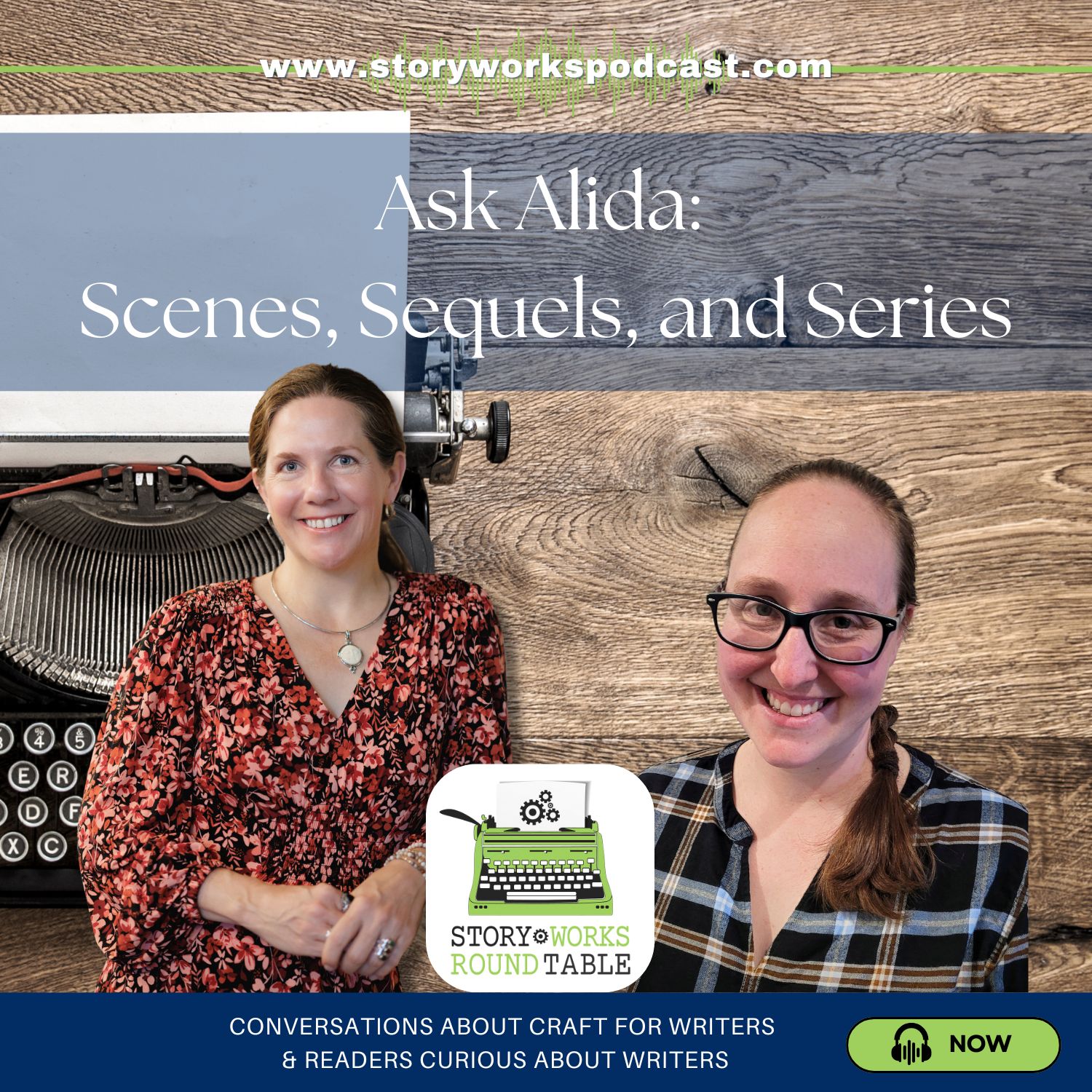
In this episode of the Story Works Round Table, we present a double episode featuring lively discussions from our monthly Ask Alida Q&A session. Join us as we explore the intricacies of crafting scenes and delve into the art of writing sequels and series. Whether you’re a seasoned writer or just starting your journey, these conversations are packed with valuable insights to elevate your storytelling skills. Don’t miss out on this engaging exploration of the writing craft!
AUDIO
TRANSCRIPT
This transcript is AI generated. If you notice any inconsistencies or errors, blame the bot.
Kathryn Arnold: This week we’ve got a double episode here on the Story Works Round Table. You get two conversations recorded during Ask Alita, a monthly live Q and a Alida hosts on the first Monday of the month over at booksandpencils.substack.com so this week we hope you enjoy these conversations first about crafting scenes, followed by writing, sequels and series.
Kathryn Arnold: I’m going to go ahead and start with an opening question. so if you guys have any questions or Kristin, if you have anything you want to talk about this week, let us know in the chat. but my opening question, my kind of, what you call the icebreaker is are you a one idea at a time writer, or do you find yourself drawn to different things as you work on one project and pulled in many different directions?
Alida: so idea or project, is there different things?
Kathryn Arnold: You could take it either way. You could take it either way.
Alida: Yeah. Yeah. So I’d like to focus on one project. I like to be immersed in it and work on it. But I also find, that can be hard to do because my projects tend to be research intensive. And you know, what I’m working on now, what I’ve been working on for years is literary historical. So a lot more focus on the prose. I’ve started working, sending chapters to a critique group. So then I’m kind of writing and revising and writing and researching. Right. So then while I’m doing that, I’ve got other projects, you know, trying to kick me in the butt and trying to get me to focus on those as well, so the third Scott hall book, the next craft book, and then getting Saving Annabelle, which is literary historical, out into the world. So I’ve got a lot going on creatively as a writer this year and part of me just really wants to hunker down and keep working on, on Evelyn, on the current work in progress. But I know if I do that I won’t get the third skunkhole book out and I won’t get the plot book out. So Yeah, yeah, I just need a clone. Just clone me a few times.
Kathryn Arnold: So in your heart of hearts, you’d be a one idea at a time person, but because of the schedule and the way you’re working the writing, you’re not.
Alida: Yeah. You know, when I was getting my mfa, I had to write my novel. That was my thesis project. Right. So that was very much intense, immersive, long form fiction. But at the same time I was still a student and so I had to read books and write papers and you know, fulfill story prompts and other assignments while I was also working on my novel. And I think there’s great benefit to doing side projects if they aren’t too similar to and detracting from your main project, you know. So if you’re working on a novel and it’s taking months or years as they do, then you’re in one narrative, you’re in one setting, you’re with one cast of characters. And I think it can refresh things if you do little side projects, if you write some short stories and not just rewriting prompts, but actually with a mind to engaging and being involved with a different project, the narrative, the characters, to do that work of development and really see it through. But something like a story or an essay where it’s going to take days or a couple of weeks and you can maybe do it in addition to your main writing project instead of stopping and starting the main one, you know?
Alida: Yeah, I’m not doing that at the moment, but I have done that in the past and I think there’s great benefit to it.
Kathryn Arnold: Yeah, kind of like a reset on the writer brain. That’s an interesting. Yeah, I like that.
Alida: Yeah.
Kathryn Arnold: Right. Okay, I’m gonna jump into my main topic for today. we’re gonna talk about crafting scenes, that all important building block. I found myself messing, around with some scenes in my opening of my book and I was like, you know, this would be a good thing to ask a few questions about. So we’re going to lay the groundwork and then we’re going to get into a little nitty gritty in terms of what I’m dealing with right now. So first of all, how would you define a scene, what is a scene? As a building block of story.
Alida: So a scene is, the smallest unit we think of in terms of our narrative. You know, you’ve got scenes within chapters, chapters within movements, movements. You know, a book might have parts, it might not in the book, in the series. And so you can sort of think of, theme as the base unit. Right. And a scene. All of these units are boxes. They’re containers that we put parts of our story into. And so we want like with like. So in terms of the scene, you’ve got, you know, a beginning, a middle and an end. Right. And often the container, the shape, has to do with a break in your character’s movement. So we’ve got a time break or a setting break or a shift in who’s on the stage. If you think in terms of theater and you think about when the lights go down but the curtain doesn’t drop. Right. It’s not an act. Nobody’s going to shift in their seats. It’s just that like lights down, lights up, the players have moved around and the action has changed. It’s kind of like a quick reset button.
Alida: Right. So, that is a really helpful way to think about a scene. And then the question is, what do we put into that container? What is the relevant material? What needs to be there to tell the story? And how is it going to connect with what came before, what came after? And if it’s a beginning scene or an end scene, then, you know, we have a whole nother set of questions to use. Right. So anyway, I could probably talk for an hour, but I’m going to throw it back to you. Yeah, that was adequate
Kathryn Arnold: one. Welcome to Paulette and JQ and Michael. if you guys have anything you want to ask Alida, make sure to drop it in the chat. I’m bringing the topic of scenes, but we will talk, about whatever you would like as well. yes, every scene has a purpose. I heard you say beginning, middle and end. So they do kind of have a full story structure in them. Or can you break a scene before you have had that full arc?
Alida: So, yeah, interesting way to word that. When you think of a scene, you don’t necessarily think of it as having an arc in the same way you think of a chapter or a movement even, or a novel.
Alida: Having an arc, but think more in Terms of. Right. Let’s say the lights go down on the stage and they come back up and maybe the setting hasn’t changed, but we’ve got different players on the page. We still need a beginning in the sense of grounding the reader in the action. Who’s there? Are we already familiar with all of the characters? Do we know why they’re together in this moment? Let’s establish whatever needs to be established so the reader is grounded, not confused.
Kathryn Arnold: Right.
Alida: And then you decide what the purpose, what the action is going to be in this scene and what it needs to communicate. And you take it through that. Right. Develop it, create, write the scene and where’s it going to end and why is it going to end there? So when I say beginning, middle and end in terms of scene, I’m thinking less of arc and more as the logic that makes it a unit. Right. That M fits within a series of other units that comprise the chapter, the movement, the part, the book. So does that make sense?
Kathryn Arnold: Yeah. So leaving a scene doesn’t have to wrap that movement or that thing that happened up with a bow. It can have that sort of tension that draws in through to the next one because it hasn’t been kind of finalized just simply through changing location or changing time or changing characters. I feel like that was a question. Sort of.
Alida: Yeah. It’s kind of hard to talk about without an example, without looking at some scenes and breaking them down. Right. Like you can definitely. And to seeing with that sense of the action is incomplete, but there’s the expectation of it continuing.
Alida Winternheimer: Right.
Alida: I don’t know if this is getting a little abstract.
Kathryn Arnold: All good, we’ll move on a little bit. So something that I’m running into right now is I’m running into the idea of I’m. I feel like I’m have a scene that’s maybe too long that I feel like needs to break up. But I don’t know where those natural breaks are because I, I don’t feel like there’s a shift in location or a shift in time, but it’s, it’s dragging. Like the action has not, has not had enough, I guess resolution at a point to where I feel like, okay, this is a natural scene breaker. I’ll break it and then I’ll change my mind and recombine it and break it again and trying to find that point where it’s. I guess there’s kind of a pacing component to it where it’s not dragging on too much, but there’s Also a component of I haven’t changed, so why would I break?
Alida: Yeah. If there’s no change in characters, setting, time, those components, then what is happening with the action of the scene? There might be a place where you can break because tension has peaked and we’re going to have kind of an emotional reset and then pick up again elsewhere. You might find a break where you want to do something with your narrative. Like maybe the next scene is going to be in flashback or something. so you can think about a good place to, to break a scene in intangibles as well as tangibles, you know, and then I would want to know why is it dragging? Is the dragging because you’re putting in too much detail and it’s slowing down the action? Is it dragging because there’s not enough dramatic tension here? There isn’t enough of an emotional component to keep the reader invested in the action that’s happening. So it might not be about length or breaks. It might be about the material in that container. Right. That might have to shift.
Kathryn Arnold: Okay. And there’s not really like a scenes, too long or scenes too short type. I mean, and we talk about this with chapters and things where it’s like your chapter is as long as it needs to be. Is it similar with scenes where you don’t really have necessarily like a. A word? I want to say word count. Because that’s a way of measuring length of time in a book. Right.
Alida: But it’s more like where someone’s reading
Kathryn Arnold: and it starts to feel like, wait, where is the break? Or where’s the breath? Or where’s the. Or they’re reading a scene. It’s like, wow, that was a really short scene. There’s no like right or wrong in terms of length there. Right?
Alida: Correct. Yeah. There is no right or wrong. So there are certain genres and I’m sure certain teachers who would say you want to have, you know, this kind of rhythm for pacing. And so you want all your chapters to be no more than five pages long. If you’re going for a fast paced book or you want whatever. I don’t describe to any of that. I think our stories have a rhythm that is organic to the story being told. Right. And you could have a single scene chapter that’s 10 pages long. But if it moves, if it breathes, if the reader’s engaged for the whole 10 pages, then who can say that’s wrong right now, you know, it can be nice to have a kind of symmetry where you’ve got that 8 to 12 page typical chapter length. So the reader kind of has a rhythm. you know, they kind of know the chapter break what’s ahead, and then to break that up so it doesn’t become stagnant. Right. So every so often you’ve got a very short chapter or you might have one or two longer chapters. But I say that with a caveat that I never want to give someone prescriptive advice. So if that’s the way your writing is turning out and it’s working for your story and you aren’t trying to shoehorn anything into a mold, then that’s great.
Kathryn Arnold: Right?
Alida: But I definitely would not want anyone to say, okay, I need to have 5,000 words every single chapter with, you know, a 300 word variant. And that’s how I make a good book. Because that’s not true.
Kathryn Arnold: Right. Well. And I feel like the length of your scene does affect, well, visually how you read it on the page and maybe how you feel, feel about the, like, whether that’s again, like the pacing of the book. Like, is it frenetic?
Alida: Is there like jump cuts all the time?
Kathryn Arnold: Or, or if you’re kind of like sinking into a scene and really like luxuriating in this, this stretch of, of time in the book. So is it, is it, you know, like that prescriptive advice of, you know, this many words or this many pages feels like that would take away from that effect that you’re trying to create within your book, Right?
Alida: Yes, absolutely. And you know, as writers, we get to make the rules and then we have to abide by the rules that we make. So if I’m writing a story that has this type of narrative voice where the language is maybe a little quicker, a little more copy description is present, it’s there, but it’s not going to be, you, know, really flowing. I’m not going to get into page long paragraphs or anything like that. And I want that feel because it suits the story, it suits the character. Then whatever I do to create variation, it should not feel jarring, it should continue to flow.
Kathryn Arnold: Right.
Alida: So if you’ve got, you know, the problem you presented, Katherine, of having a scene that seems to be running along too long, I’d want to know how does it fit in the larger narrative? Is it breaking up a rhythm that you’ve established in a way that’s a negative instead of a positive? And if so, why? You’ve got to do the work of assessing what’s on the page and seeing if it’s an. An issue with dramatic tension, emotional Resonance or something more mechanical, like, putting backstories somewhere it might not belong, or backstory that could be broken up and spread out or something like that.
Kathryn Arnold: Yeah, definitely. And in my case, mine’s in the opening few chapters. And so I feel like I. I’m maybe trying to over explain in the middle and not. Not allowing this, the action to talk for itself. but I. It’s one of those things where it’s like I. I want to trust my instincts. And I feel like my instincts are leading me, maybe not astray, but where they aren’t quite sure. And so do you. I mean, other than like a storyboard, you know, and like laying my scenes out, what kind of tools for evaluating that do you. Do you think I could use? I shouldn’t say, other than a storyboard.
Alida: Yeah, I’m like, you just took a storyboard off the table, Catherine.
Kathryn Arnold: Maybe more appropriately, m. How could I use my storyboard and what details would I put in there to evaluate where that scene might be dragging or could be broken up into two scenes or maybe even eliminated entirely?
Alida: Yeah, well, let’s. Let’s leave the storyboard aside. I mean, that’s always a great tool. But for this particular problem, it might even be more helpful to look at the scene as a whole and maybe get three or four highlighters, you know, and, then try to read it like a reader who’s never seen it before instead of, like yourself, like the writer. And have a highlighter for pace. Right. Is there somewhere I’m starting to lose interest because it’s dragging because the action has slowed down too much, you know, market, circle it, whatever, and just note that. Right. And then character confusion. Have a color for confusion. Right. Like, is there anywhere I’m unsure what’s happening because something isn’t on the page or because there are too many moving parts on the page, or because that if world building maybe isn’t as pertinent as I first thought it was to the reader, right here, right now, pertinent to the story, or it wouldn’t be there, but maybe right here and right now isn’t the right place. And then, yeah, so just go through on anything you notice, market. And then you’ve got to do round two of assessment and say, okay, what is the fix for this? And, you know, if you go back to the storyboard idea and you just make a summary, a narrative summary of the scene that you’re writing, you might look for a place where, you could change the action. Like, maybe there’s something You’re. That’s obscure in the narrative. Like your eyes looking at the page, going through the same word by word. You’re in a certain type of flow, your mind is in a certain type of head space. But if you see it as a summary, something else might jump out at you and you’re like, oh, here’s that shift, that change where I could make the break. Or here’s that place where the tension is really lagging and I should maybe take some out, move the dramatic high point of the scene closer. Right. Condense the scene, put some other stuff elsewhere. So I mean, it really just comes down to an assessment. And man, if you do both of those and you still need help, you know, start bringing fresh eyes on it.
Kathryn Arnold: Yeah, that’s right.
Alida: That’s right.
Kathryn Arnold: Yeah.
Alida: Well, and I just want to say again, if anyone. Yes. And I just wanted to throw it in. If anyone has a question you brought or you want to comment, go ahead and type it in because we love that and we’re here for you. So yeah, physical copies, physical highlighters, it
Kathryn Arnold: changes the way your brain thinks. So that’s, that’s good as a tool.
Alida: It does. Yep. We are more creative at, ah, problem solving with long hand writing than typing.
Kathryn Arnold: Yeah, that makes sense. That’s awesome. Sorry, my brain’s connecting like 8 million things right now. So there you go. All right. And yeah, and if anybody has a question, now’s a great time. That’s kind of my end of my questions on scene. I do have a closing question for Alida, before we do announcements about, workshops and things coming up. So if you have anything, just drop it in chat and we’ll pop it in and answer your question. Or you can comment, join the conversation. All right, so my final kind of closing question is how important is it to you to get occasional dedicated time for your writing? like a retreat or a time away. Like, you know, you talked about that in the beginning with your, with your one idea at a time kind of an idea to really immerse yourself. Mm.
Alida: Critical. Yeah, it’s the best time of the year. You know, anytime I can leave home and write, it’s a gift. I think it’s the gift creatives need to give themselves. There’s something. Even if you’ve got a room with a door on it where you do your writing, it’s not the same. You can shut out your house, it’s still not the same. I think a part of our minds is always on what’s going on around us. So when you can turn on the autoresponder, leave home, you should definitely do it. And you know, I think the simpler the environment you go to, the better, so that you aren’t tempted to go do other things. You don’t feel like you’re missing out on other things. I’m actually going to be on retreat next week. so it’s winter in Minnesota and you know, I’ve gotten kind of off season, middle of nowhere airbnbs in the past. This year I took a, pet sitting gig so I can use somebody else’s house to sit and write and shut out the world. And it works. You know, there are definitely, low budget options for retreats. It doesn’t have to be a big thing you put off till someday. Absolutely. All right.
Kathryn Arnold: Kristin had a question here. She said, and the lot and others
Alida: have said your first draft can be
Kathryn Arnold: a mess and the book really comes together in revision.
Alida: Do you agree? So, sure. You know, I think, I think the idea of the shitty first draft is a powerful one because it is permission giving. Right. And there’s a lot to be said for just getting something on the page and then fixing it. And that works really well for short form writing. So short stories, personal essays, substack posts, whatever, that’s great because you’re only looking at 2,000 words, 10,000 words, 20 if it’s a long short story and it’s complete. So you can get it down and then you can dig into it. But when you’re working on a book, you’ve got 80 to 120,000 words ahead of you. And I mean, there are people who can fast draft and just get that first draft down and then revise it. more power to you. I wouldn’t recommend that as an approach necessarily. Like maybe if it works for you, great. but there’s so many elements that you need to control. There’s so many threads to your story you need to bring together. We do a lot of development while we’re writing. Even if you storyboard right, you start writing and then you get a new idea and you start pulling these things together and then. So I would rather do my development and pre writing, do some writing as that discovery happens. Right. Reshape as I need to keep writing and kind of meld them together so that I’m not forcing myself to ignore the new discoveries and the new ideas so I can get that first draft down. But I’m also not avoiding making progress by pre writing forever. Yeah, I like that.
Kathryn Arnold: Kristen said you need to build some momentum.
Alida: Yeah, definitely.
Kathryn Arnold: All right. And JQ says, interesting. We’re more creative using handwriting. I thought that was true for me. And now you confirmed it.
Alida: Yes. Yeah, it is, it is true. There have been studies that show that people are better problem solvers and more creative thinkers when they switch to handwriting. And so, I do all of my pre writing, like idea generating by hand and then when I’m drafting, sometimes I hand write, sometimes I type as I draft. But whenever I hit a problem, whenever I need to problem solve in my story, I go back to the journal and handwrite.
Kathryn Arnold: Mm.
Kathryn Arnold: I was watching something just the other day about kids and learning. Sorry. And how they’re proving that digital learning is not as good as, as books like reading written word and, and writing and physically using your body. so I think that.
Kathryn Arnold: All kind of ties together our brain works in that way.
Alida: It does, yeah. I think it’s something to do with the kinesthetic connection between the mind and the hand and actually involving the body instead of just passively kind of, you know. Yeah, for sure.
Kathryn Arnold: Pretty cool.
Second Conversation:
Alida: So what do you have for me today, Katherine?
Kathryn Arnold: I want to talk about writing sequels or maybe on a broader level, writing in series or writing a book that is not solely a standalone book. we did have an episode a while back with, I believe it was with Alethea, where we talked about writing a sequel. But I feel like there’s a lot you can cover when you’re talking about that craft of moving from one book to two books or to three books or crafting maybe even a series that you kind of know from the beginning.
Alida: So.
Kathryn Arnold: So okay, so first to start us off, I’m just gonna say how is it different to writing a sequel from writing a first book that was a Very awkwardly worded question. Writing a sequel, how is it different from writing a first book or from writing a standalone? and you have both. So in your experience. Or in your editing experience, your coaching experience, how is that different?
Alida: Yeah, so I think if you, if you go into it knowing that you’re writing a series, then you know from the beginning that you’re going to be plotting multiple books, right? So you can think about that from the very beginning. Whereas if you write a book that you intend to be a standalone or you don’t have plans for as a series and then it does well, or you fall in love with the supporting character or whatever, then you might do a sequel. And that we could make a distinction that might be useful between, writing a series and writing a sequel with the series being the thing you know, from the beginning. So you start conceiving of it as multiple books in one world with a fixed set of primary characters. Right. Whereas the SQL, you maybe have no intention of it, at least not when you start. it might not be the same protagonist or the same rule, so you’ve got more liberty to change things. Like my current work in progress, just to give a quick example, started as one book. It’s so big, I think I’m going to make it a duology. So it’ll still be one story, but in two books, right? And then my protagonist has a daughter and it’s kind of in the back of my mind that that might be a great sequel and my current protagonist wouldn’t even need to be in that book. She could have aged out, right? So it would be a sequel, but the protagonist would be the daughter who’s a young child in this book and so has a minimal role. You know, she’s dependent, she’s not a decision maker, she doesn’t have her own storyline. So that’s a great example of a sequel. Whereas, like skycall books, I knew from the beginning that I wanted to write a series. And so then I’m thinking structurally in a different way. And I’ve got to think, what is my protagonist journey that she’s going on over the course of multiple books? The setting and supporting characters, right, that’s going to span multiple books. Not that supporting characters can’t come and go, but then what about the plot? Do I want to have a linked plot like you see in a lot of adventure stories or fantasy stories where, you know, each, each book has its own plot, but over the course of the series they add up to be underneath the umbrella of one bigger plot or standalone plots, which you get in a lot of mysteries, which you get in Skoghall, where each book could be read alone because the mystery is a self contained thing and the umbrella arc is really the character arc and the world’s building and such. Yes, yes.
Kathryn Arnold: You just covered a lot of ground, things to unpack. Yes. Oh, I love the idea of a duology. Okay, I want to go back to that first because I feel like that’s something we haven’t talked a lot about, is when your story gets too big and you decide to split it because you have to still have a satisfying arc and ending in the first book. It’s not like you just hit the middle of act two and they boop, the end, start over. You know, how are you crafting that to where you. You’ve now written something that you’re like, this is too big for one book. How are you now changing that craft of the arc in order to make it a duology?
Alida: Well, I’m lucky because it’s kind of baked into my story. This book M is epic and it’s got four main settings already. And it just works out very tidily that I can have kind of world all, actually four or five settings. But the first three make one book in a very neat way that take my protagonist, Evelyn, from her home setting to an institutional school setting to a halfway house setting. And then when she leaves that world and sets off, independent of any of those prior influences as a real adult with adult agency and actually being responsible for someone else. Right. That’s a great place to put that divider. So I got lucky. But I think if, if someone were in that position of saying, I’ve got this epic book, it’s growing into a monster, I know it’s going to stay epic even without any extraneous elements, even without being a bloated story. I think I want to make it a duology. Then I would say look for a transition point toward the middle where you can see, study what you’ve already got in terms of plot and character and say this is a natural breaking point. And importantly, book one can have its own climax and resolution.
Kathryn Arnold: Right.
Alida: Right. So I think in my case, although I haven’t written that far yet, I’ve, you know, I’ve outlined and I’ve done a lot, but I haven’t written through in such a way that I can say with certainty, here it is, it’s done. But in my case I can say, okay, this stump from some kind of Institutional life to independent life. Right. That makes sense. And the thing that is her decision making point before she makes that leap. That works. I can have a climax there that will satisfy readers of book one, even if they never read book two and they just want to think, okay, that was girls and institutions in the 1920s in America. You know, I’m satisfied. So look for those criteria. Can I have a climax and a resolution without forcing it with some sort of natural break so that the transition makes sense? Just like, you know, when you’ve got a scene break, there’s white space. We have to jump it. The reader has to jump that white space. It’s little. You’re. You’re hopping over a puddle. You know, you get a chapter break. You’ve got across the creek. You might need a little, a few stepping stones or a little footbridge. You’ve got an act break, it’s bigger. You get that book break where you’ve got to actually go out, maybe wait for the second book to be published. Go out and make that decision, make that purchase, invest in reading it. That’s a really big break. So definitely make it worth your reader’s while to complete the first book. Don’t just leave them hanging.
Kathryn Arnold: Yeah, yeah. We are, not very happy people when we get cliffhangers. I think both you and I agree on that one. We are not cliffhanger people. Like, don’t do it to us.
Alida: Right. And you know, you hear sometimes about those trilogies where someone says the trilogy was great, but book two, all that did was fill in the middle between book one and three. Like, okay, really, should that have been its own book?
Kathryn Arnold: Yeah, exactly, yeah. Knowing that structure has to be there for every single book. We need to have that satisfying ending. And I, I want to talk about that with, not just a series like a duology like you’re talking about, but also like a series where you have a very, I guess it’s like a, a layer of stories within a larger narrative structure. Right. Those are those. The Harry Potter series, you know, things where you have a very big arc, you know, you’re fitting into. And we have satisfying endings in every book. Right. So how do we handle an end hook at the end of the book where you have, you grab the readers and they say, oh, I can’t wait for the next one to come out. Oh, I need to know what happens next without ruining that satisfying ending of the book. Right. Hm. So there’s that tricky
Alida: situation there. Yeah. So I think with Harry Potter, Rowling just did it very well, because we invested in Harry and his friends. We invested in the world of Hogwarts as the stakes increased and things got bigger and broader. We invested in the, magic world versus the mundane world. So all of those things keep us wanting to come back and getting more. So then the first thing I would say is make sure your readers have a good reason to invest not just in your protagonist. Right. Storytelling is much more complex than our character arcs and our plot arcs make it seem at, first glance. the second thing you can do is leave something open ended that is not your main plot. So supporting characters and subplots do a lot of work for us. So like at the end of Murder in Skoghall, the murder mystery is all wrapped up. It’s got a bow on it. Everything is resolved.
Kathryn Arnold: Right.
Alida: But, Jess and Beckett, her new boyfriend, come out of his shop at the end of the book and parking his truck across the street is her first love interest from when she moved to Scott hall, who caused all kinds of trouble. Right. And there’s a little bit of rivalry. So then a reader who cares, who has invested in Jess and her character arc and her relationships with supporting characters is going to see Tyler rolling up and go, oh, what’s going to happen there? So they can safely bet that in book two, I’m going to give them more of that. I’ll give them a new mystery, new murder thriller stuff, but a, continuation of the subplots with the supporting characters. So, emotional investment and also some non critical plot or subplot element that can carry over into the next book.
Kathryn Arnold: I’m just looking at my notes. I have, I wrote down questions because I’m in the middle of this right now myself. I’m pretty happy with where my book one is. I have a series plotted out. I’m starting to work on plotting book two. I’m. So this is all very, like, timely for me. So this is my question. Anybody else who has questions, you’re welcome to join me. okay, so I talked about layering stories within a larger narrative series. I feel like there’s maybe three different kinds of series and you already touched on this a little bit. Like there’s the one that has the overall narrative arc where you’re like, okay, I’m in this for the long haul. I understand that this entire plot arc is not going to be ended in book one. Maybe I understand already from the beginning. I might be three or four or five books deep by the time I’m done with this story.
Alida: Cool.
Kathryn Arnold: Then I feel like, there’s that. That kind of intermediate layer where it’s like, this could continue and I could keep going on this journey maybe similarly to like, murder mysteries and things like that, where it’s like I’m following the protagonist, but maybe there’s not a huge overarching plot. And I called those, like a series of interlocking stories. Right. So they’re all locked together. We’re there for the protagonist. I want to talk about a series of standalone books. So it’s like, I think the romance genre does this a lot, where it’s like you’ll completely skip over. You’ll jump into side character right from book one that all of a sudden is the protagonist, and you may have some pieces that stay the same, but you’ve completely jumped ship into a completely different story. So setting might stay the same, friend group might stay the same. You might see the protagonist from the previous book. But can you talk about maybe some elements of, of standalone series that is different than like a series of interlocking or layered books where you maybe are trying different characters or trying different plot lines and still managing to keep the reader?
Alida: Yeah, so I haven’t, personally, I haven’t written that kind of a series, but I think with that just like the, theories where the plots are independent of each other, but you have character arcs. It’s like that. But instead of leaning into the character arc and the subplots with supporting characters, you’re leaning into settings and theme, you know, so if you’ve got, you mentioned romances, you’ve got a group of best friends and each one gets a book, and they all live in the same town or whatever unifies them. And so then why are readers going to come back? I mean, we might come back because we find that friend group so enchanting. But if Friend two or three takes us on an entirely different kind of journey than the prior ones, we’re probably going to disconnect. You know, if you’ve got, light romantic comedies for a couple of books, and then the third one, the protagonist falls in love just as she gets cancer, and then it’s, you know, like love versus mortality, it’s a different world. So even though you might be in the same setting with the same characters, you just threw the reader a curveball. Right. So with that sort of series, you’re going to want to probably think in advance, who are these characters? We, we need to be careful with that type of, of character building, because in book one, you’ve got your protagonist, right? And you’ve got two or three, first tier supporting characters who are going to trade and become protagonists in later books. So we need them to be prominent enough in each other’s books that we get to know them, especially the one who’s coming up next. Right. Where you’re, who you’re passing the baton to, but not so prominent that they steal the show or that the main protagonist isn’t as interesting or. Right. So then instead of thinking as much about plotting the series, I would be putting some extra time into thinking about character arcs for each of those books and who’s got what role in, in the broader sense and who’s got what role in relationship to each other. So then as character B becomes the protagonist and character A drops back, I’m thinking, what are C and D doing? How is their friendship different with B than it was with A? Right. so it’s, it’s a type of plotting, but it’s very character focused plotting with that series in mind. Definitely.
Kathryn Arnold: Okay, so with building a character for a series, you mentioned, you know, focusing on those different characters in that kind of standalone series. But when you’re crafting a series around a character like Jess in Murder and Skoghall, is there a different consideration you have in terms of her character arc or her flaws or the way that she’s growing based on the fact that she’s going to be in a series rather than just one book that you’re dealing with?
Alida: Yeah. So I think, with, with a character like Jess, you want to have room for growth over the series, whereas with a character like, Sherlock Holmes or Ms. Marple or any of those, you know, you don’t really need to see them grow. We don’t really need Ms. Marple to come out of her parlor and stop serving tea. You can keep doing that at the end of days and we’re happy as long as she solves a mystery. So when you think about a, character’s arc over multiple books instead of one book, it’s going to tie in to plot and subplots. Everything does. Right, right. So character traits come in the form of skills and qualities. So Jess comes into the story with the set of qualities, her inherent personality, quirks and history and, you know, all the stuff that makes her who she is. But then as she goes through the series, she’s going to be learning and developing things. So I can tell you, at the opening of book one, she wasn’t at all psychic. She bought a haunted house. So over the course of several books, she’s got to figure out what it means for her to be able to see and communicate with the dead. So those are skills that she’s developing. Right. As a character trait, and something that will evolve her because our experiences shape who we become down the road. She also, in the second book we get a little more, crime thriller, the sheriff’s investigators involved. And so she goes to a firing range, she buys a gun. Right. So thinking in terms of a series, think about escalation through your plots. And do you want your books to be sort of one and done like the Agatha Christie’s art? Right. Where you don’t necessarily need to see an escalation book to book to book. You just need each mystery to be interesting and contained and keep readers happy. Whereas if you get into something like a Harry Potter, then book two is more intense than book one and so on to the big climax. So there we really have a seven book plot arc.
Alida: You know, and I think if I hit a book where I feel like I’ve taken Jess as far as she can go, I would be done with her. Right, right. So then maybe it’s not about evolution, so much of her as a character, but about those relationships and supporting characters which. And let me back up, that’s something else I’m thinking about along the way besides character traits. Like, by book two, she’s already on her second love interest in the, in the series because number one was just a rebounder. He’s quick and oh, you know, yeah, I’m not, I’m not trying to disparage Jess here. I’m just, you know, such is life. Right. So then, do I want romantic relationships to feature into the stories? To what degree is that important to her character, to the subplot, to the town? Maybe she and Beckett the Potter can just kind of settle in for a book or two or three. And then when I need to mix things up again, I change that. So as writers, we’ve got tools at our disposal. We can look at character setting, you know, those traits, the skills that they develop and adapt along the way and then subplots. What kind of changes can we throw into the mix for our characters as we work our way through the series and all of that should work to complicate our main plots. Right. And as you know, complications can be positive or negative. So we can have a very good thing in our lives, but it’s making something else tricky, more complex, more nuanced or whatever. So looking at all of those elements, I just touched on and asking, how does this help me keep advancing my story, raising stakes and tension, and engaging my reader? That’s what we want to do. Absolutely.
About Your Hosts
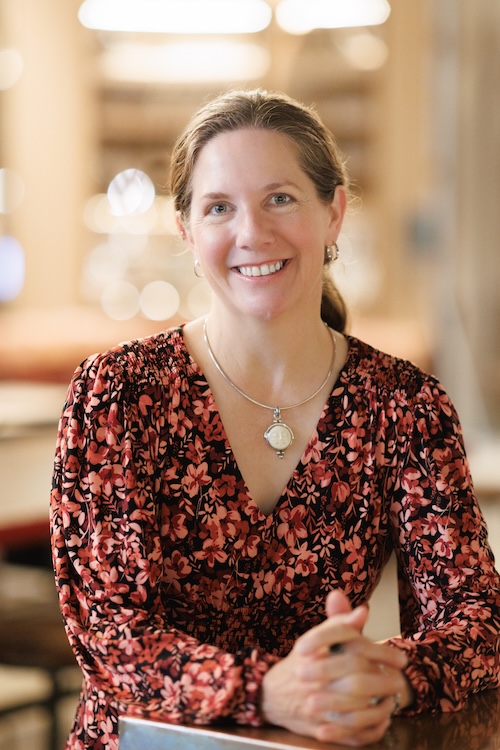
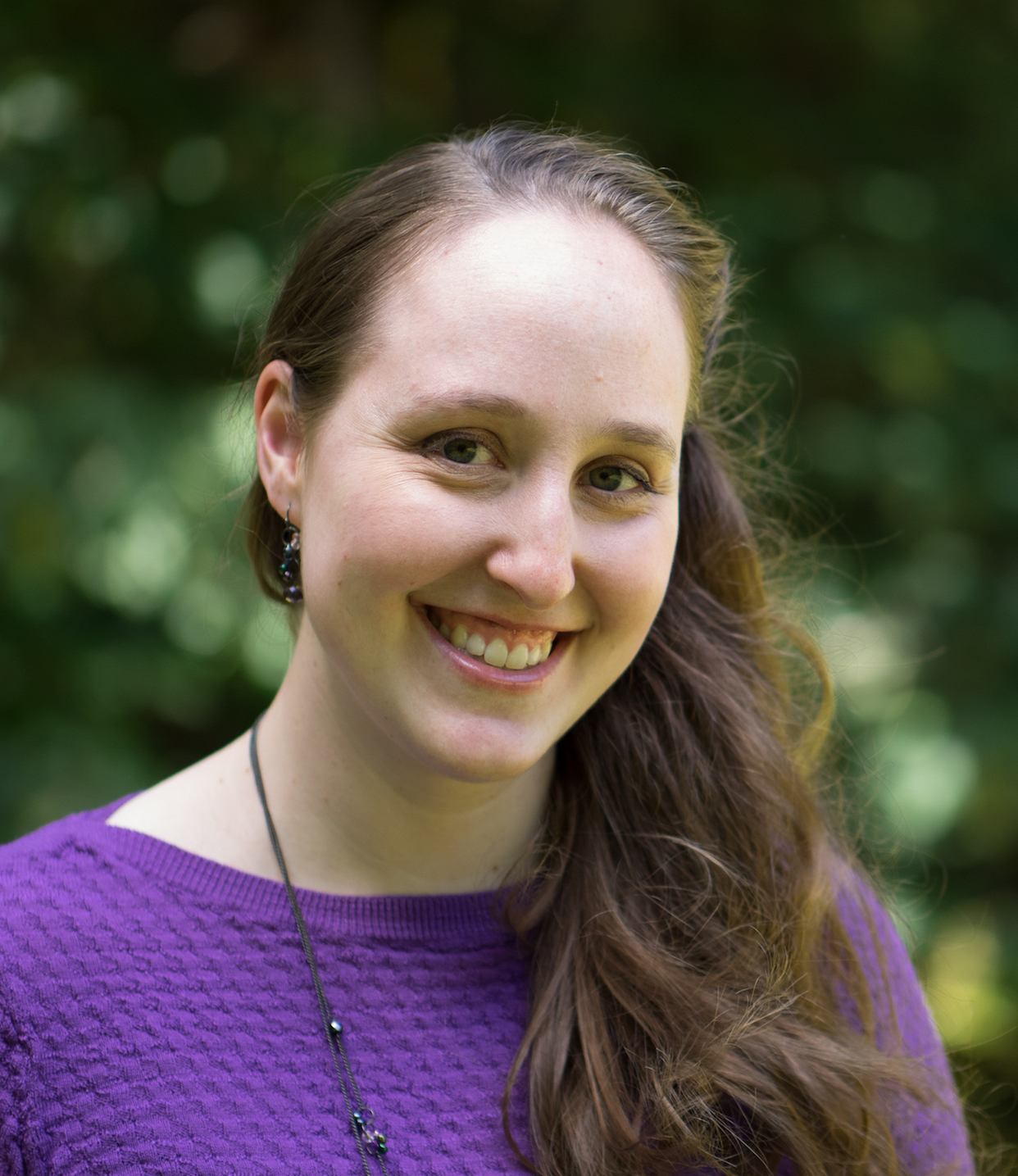
Kathryn Arnold writes fantasy and anything else that sparks her creativity from her home in Kingston, Washington. She currently earns her living as an insurance underwriting assistant, where she also creates marketing and web copy. When not writing, she plays (and teaches) piano and keyboard in a band (or two), and is working on starting a ministry team with her husband. You can find Kathryn at www.skyfirewords.com.