

We’re pleased to announce that Alida’s novel, A Stone’s Throw, has won the Firebird Book Award!
Two women who never meet, a motherless child and childless mother, are brought together to discover the real magic of creation.
Simona and Gemma live an ocean apart, yet their lives become forever entwined when the women Simona is painting come to life, stepping out of their portraits. They arrive with a purpose: to nurture a broken heart…or two. Simona and Gemma learn about art-making, love, grief, and motherhood when they are magically welcomed into a lineage of women who share their lives’ joys and sorrows during the most creative time of these women’s lives.
In this episode of the Story Works Round Table, Alida and Kathryn talk with Stephanie Elizondo Griest, author of Art Above Everything. In this perspective changing conversation, we talk all about centering your life on art. We talk about the sometimes painful journey of being an art monk, and what it means to dedicate yourself to the creation of art. Join us as we talk about the journey Stephanie has taken to realizing that Art is Enough. And what Enough even means in this capitalistic culture we live in.
The Question: is Art Enough?
The answer: Yes.
Join us as we talk about why!
AUDIO
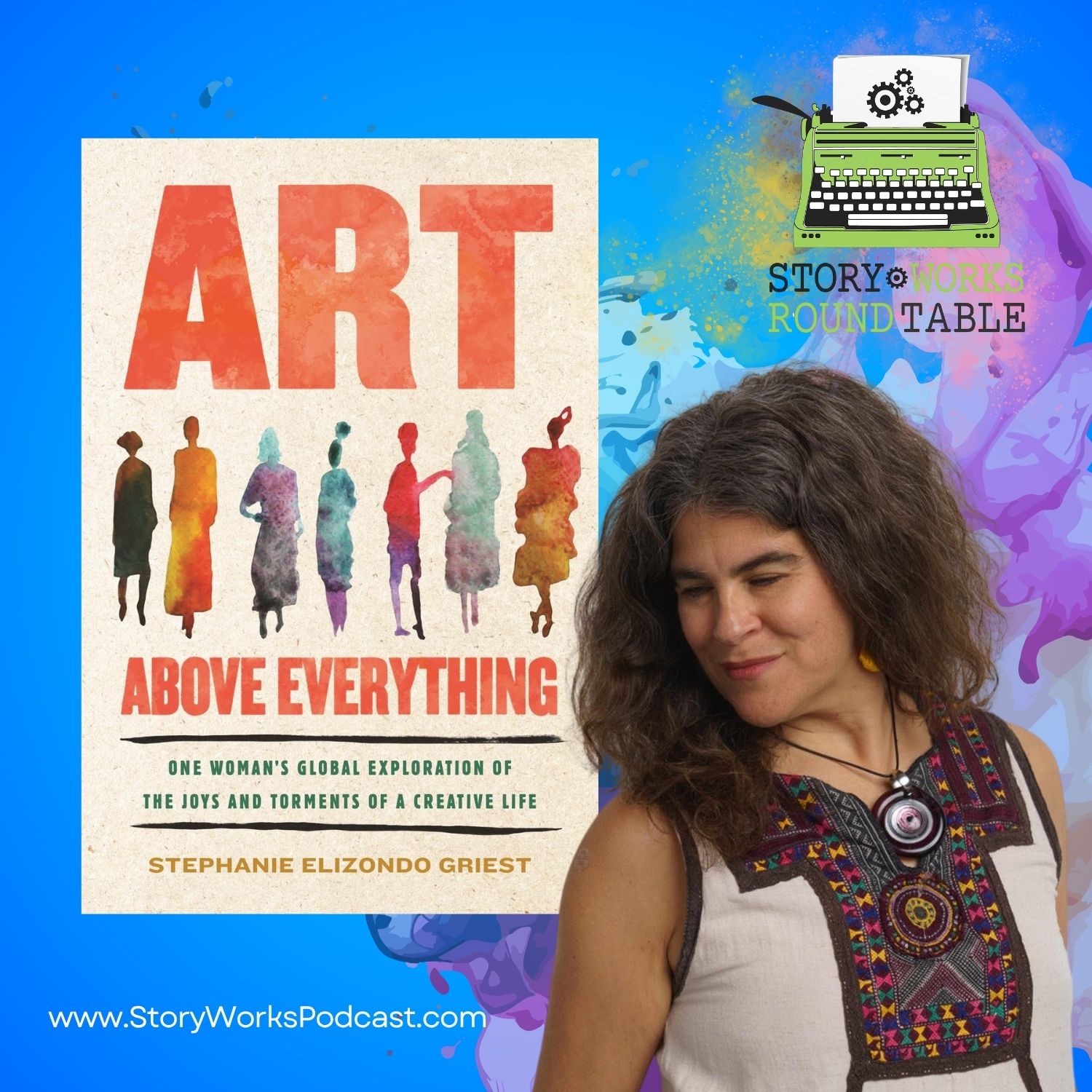
Stephanie Elizondo Griest is a globe-trotting author from the Texas-Mexico borderlands. Her six books include Art Above Everything, Mexican Enough, All the Agents and Saints, and Around the Bloc: My Life in Moscow, Beijing, and Havana. A professor of creative nonfiction at UNC-Chapel Hill, she has performed as both a Moth Storyteller and literary ambassador for the U.S. State Department
TRANSCRIPT
This transcript is AI generated. If you notice any inconsistencies or errors, blame the bot.
Alida: The question: Is art enough? The answer? Yes. Because art is…
Stephanie: Art is inheritance. Art is a spiritual orgasm. Art is reconciliation. Art is descent. Art is self-actualization. Art is a waltz and the palace of the moon. Art is revenge. Art is medicine. Art is unzipping your body. Art is a house of your own. Art is lineage. Art is love. And art is immortality.
Alida: I love this episode. We are joined today by Stephanie Elizondo Greist, author of the new book, Art Above Everything. Stephanie went on a quest, a decade-long quest to answer the question,Is art worth it? All of the sacrifices we make as artists, all of the things in our lives that get second or third place behind our art, is it worth it? And what if those things come first, sometimes for years or whole periods of our lives, and then art is in the second or third place? Is that worth it? How do we feel as artists, as human beings? What does it mean to pursue art and live a fulfilled life? Where do we place our values and what does it cost us? These are big existential questions, and Stephanie doesn’t just answer them for herself. She travels the globe and interviews artists across multiple disciplines in all kinds of countries with various backgrounds. This is possibly the most meaningful episode we’ve ever recorded. It is sure to make you think. And I know you’re going to be so impressed by Stephanie. Not only does she have a fascinating story, she’s really fun to talk to. So grab a cup of coffee or tea, sit back, and enjoy this episode of the StoryWorks Round Table.
Alida: Hello and welcome to this week’s StoryWorks Roundtable. Today, Kathryn and I are excited to be joined by Stephanie Elizondo Greist. Stephanie has written for the New York Times, The Washington Post, The Believer, The BBC, VQR, and The Oxford American. Her five books have won a Margolis Award for Social Justice Reporting, an International Latino Book Award,a PEN Southwest Book Award, and a Lowell Thomas Travel Journalism Gold Prize. She currently serves as a professor of creative nonfiction at the University of North Carolina, Chapel Hill. Welcome, Stephanie.
Stephanie: Thank you so much for having me. I’m thrilled to be here.
Alida: It is our pleasure. Now, your book, Art Above Everything, is Wonderful and fascinating. I love the way you brought together your journalism writing and some memoir writing and interviews. And I felt like we were also getting a bit of uh travel and cultural connection with all of these places you went and the people you spoke to. And I would like to start off by asking you to just tell us about the books. Genesis, ’cause it was quite a journey for you, wasn’t it?
Stephanie: Quite a journey indeed. Yes, yes You know, maybe what I’ll do is I can start off with, I’m going to read just one paragraph of the introduction that kind of sets up the book, and then I’ll give you a little bit behind the scenes as well. So here we go. Is art enough? Of all the questions I’ve wrestled with during my 20s and 30s, this one taunted me most. Was constantly prioritizing writing over everything else, from postponing children to living nomatically to save on the rent, leading me to fulfillment or regret? I couldn’t decide, and my eggs were vanishing by the minute. So in 2014, the year I turned 40, I started asking other women at the sacrifices they had made for their creative pursuits felt worthwhile. Each story was so revelatory. I sought another until I had invested an entire decade into traveling to every region of the world for more. Listening to women reflect on their own internal strife with art, their insecurities, their jealousies, their disappointments, was deeply cathartic. Though what truly moved me was hearing how their art had enabled their survival of externally imposed traumas like totalitarianism, like war. When my own country descended into political chaos, those stories became a guide for powering through. I share them now with hopes of inspiring the same. So that’s a little bit of setup about the book. Um And even though I began working on it when I was 40, that’s when I was just like gripped with this inspiration to write this project. But IThe genesis I would actually point to with an earlier project. So there’s only one book I’ve ever abandoned in my career, and that was a book that was called The Book of Silence. And it was going to be a deep study and reflection on on all matter, all aspects of silence. So it’s going to start off with silence that is chosen. So people such as monks, particularly Zen. I I actually spent a lot of time at the San Francisco Zen Center, and I spent time at the at Leb Shimea, which is a Catholic House of Prayer, where they actually have two canonized Catholic hermits who have been silent. For since the 1980s. So really long, deep, deep, deep silence. And then I was going to go to silence as imposed. And then I spent some time with people in solitary confinement and who had who had just left or just finally been released from having served decades in solitary confinement. And then I was studying sign language and I was going to spend time in deaf communities. Anyway, I was just doing this whole like excavation, you know, exploration of silence. And the reason I abandoned that project, I did it. I I worked on it for like 5 years. And then one day I was in grad school and I just started grad school. And one day I woke up and I had like literally 30 forwards from the New York Times Book Review, which is never a good sign if you haven’t recently written a book, you know, thinking somebody has beat you to the chase. So all these people were sending me the sad news that the New York Times did this rave review on a book of silence. And just by virtue of her having chosen the article A where I had chosen the article VI knew her book would be better because she was more enlightened to realize that, you know, if you really go into silence, you know, right, the book of silence, like that was so presumptive with me, you know? You really got what Simon’s meant with a you know, so so I abandoned that project. But I’m so grateful that I that I did this and I feel like in a way my last two books have come from that experience. From there I ended up writing a book about the border which became All the Agents and Saints, my last book and then and then the other sort of offshoot of it was I think this book because when I was at the Catholic House of Prayer. I was fascinated by these hermits. I’m like, what is this about? How can you not talk for years, decades? And and you actually had to take a vow of silence even to be at this place. And so I was so anxious about that until I actually got there. And I was there to work on another book, Mexican enough. But while I was there, I just started realizing, like, wait a second, my life is largely lived in silence. And it shouldn’t being in a place where you specifically go to be in silence that I realized, wait, this is my normal. I don’t. I cannot write with any music, any sound whatsoever. You know, I have to have noise cancelling earphones if there’s even, you know, birds. Like, I mean, I’m just, I need deep silence when I’m writing. And I if I’m home, I’m actually working on my projects. Like I I kind of am continuously in a state of working and writing and being in contemplation. Also, I’m often in silence because I’m I. At my work as a travel writer, I’m really very often in countries where I don’t know anyone and I, you know, I’ve learned, I have studied multiple languages, but I’m not fluent. And so I quickly run out of things to say, you know, anyways, you know, so I happen to understand what’s going on around me. So I’m just like in silence probably more than the average person, not as much as like the Catholic, you know, canonized hermits, but a fair amount. And then I began thinking more about what it means to be a. A writer, what it means to be an artist. And that is what I, you know, when you think about actual monks, religious monks, particularly in the Catholic order, they take vows of chastity, poverty and obedience. And that was also really similar to what I felt I had done. You know, chastity. You know, I I was putting off having a child for my writing. Obedience. You know, we are certainly obedient to amuse poverty. You know, I was not making hardly any money. And we also quite like monks. We also have these really profound encounters with what I would call like ecstatic experience. And when you start going deep into the readings of these ancient desert fathers and the the the original hermits. That is what made their lives so incredibly rich, is they would have these really powerful encounters with with God. And I feel we have, I mean, I’ve never had one of those, so I can’t quite compare, but I have been so lucky to experience ecstatic elevation through performance and uh through being deeply immersed in artistic projects and having like the kind of communal joy that arises when we are allExperiencing the same song, the same, you know, the same theatrical performance. And also sometimes in readings you also just like that that moment when your hands just, you know, all of your hairs just come up and you just like feel the energy going through the crowd, right? It’s such it’s it’s just ecstatic experience. It’s so extraordinary. So anyway, that’s when I began referring to myself as an art monk. OK, that’s a that’s a long way to go about saying, yeah, but there’s a point to my digressions. So that’s when I started calling myself an art monk. So I’ve been calling myself an art monk for like 20 years. But when I got to be 40 and still hadn’t, I still didn’t have a house. I still didn’t have a partner. I still didn’t have kids, you know? And I began to realize, like, there are consequences to choosing art every single solitary step of the way. And and that was that was a frightening moment when I began realizing that these are consequences that I’m going to have to live out for the rest of my life. That’s when I began thinking, oh, so this is what it means to be an art monk, right? And so presumably, you know, religious monks also have that realization at a certain point as well, like there are consequences to this really extreme way of living. So. So then I decided what I needed was a congregation if I was going to continue this lifestyle. So that’s also, that’s the real genesis of the book.
Alida: Wow.Wow All of that comes through throughout the book, you know, your own story, but also everybody you interview their their stories. And so much of it is relatable to me, you know, as the reader entering your narrative and meeting the women you’re interviewing and hearing about all of these different art forms, because it’s notjust writers. And as different as my experiences are from everyone else’s in that story, I think there is such a commonality among artists of the vows, right? The The chastity, obedience, and poverty. And maybe we don’t all pursue it to the same degree, right? But it is common to us. Sacrifice comes up a lot through this book. So I’m wondering when you began this journey, you had some notion of commitment and sacrifice and then you embark and you have all of these amazing conversations. Did the meaning of commitment and sacrifice change or evolve for you?
Stephanie: Umm Yeah, Yeah that’s a really interesting question. The sacrifices that I personally made were largely financial, which were very significant in my own life. However, I mean, not that we should have things like on a hierarchy or a scale or comparison, but um my life was never in danger. Um I mean, maybe one, my mom would probably say yes. You know, just because like all the crazy travels that I did, you know, earlier in my career. But but I wasn’t at risk at that moment in my earlier life of being arrested. I wasn’t at risk of have, you know, being surrounded by people with tiki torches that wanted to set my house on fire. I wasn’t surrounded by by people wanting to arrest me or wanting to hurt me just by nature of what it is I was writing. So those sorts of sacrifices. And I also wasn’t at risk of doing damage to my body in a really powerful way, a way that you may not actually return back from. But which was the case of, you know, some of the ballerinas that I interviewed. Frankly, I interviewed quite a few ballerinas in preparation to interview Wendy Whelan and you know, the injuries that ballerinas often sustain and. Both both injuries that you can have mid-performance, but also what one needs to do to keep their body at the standard, the beauty standard of that is so evasive in in Western ballet. Which it turns out, as I was so shocked to discover in the book, was actually brought about by by the very famous choreographer Balanchine who. Formed his aesthetic during the World War, working with, you know, then Soviet ballerinas who were emaciated not because of an aesthetic reason, but because they had no food and they were. They could not get enough food to have the calories to. They couldn’t. They couldn’t find enough calories to reconstitute their body for all of these really punishing, grueling rehearsals they were doing. So they became so emaciated and that just became his aesthetic because those are the ballerinas he was working with. And that’s how American Ballerina became what it is and why so many have an eating disorder. I mean, it’s obscene, right? You know, so I wasn’t having to do that for my art, right? So yes, you know, my my financial lows were certainly very painful and sad for me, but just toast compared to what so many women around the world routinely face. in order to continue their pursuit.
Alida: Yeah, you know, I think there’s there’s maybe an economy of scale and certainly differences from pursuit to pursuit. You know, one of the um sacrifices that comes up throughout the narrative is this question of motherhood. How much do you want to be a mother? Are you willing to not be a mother? Some of the women you interview say, you know, absolutely, I never wanted children because my art is my life. And I think there were a few who had children and managed to integrate them. But this question of partnership and parenthood, I mean, that’s an existential Sacrifice to be made no matter what art form, art form you pursue or what your economic situation is or, you know, anything else you confront in the world. Yeah,
Stephanie: yeah, it’s really, really hard. I I did meet actually Sandra Cisneros, I think put it really, really well. You know, she said she did meet a few. She’s known a couple of writers who whose. You know, women, women writers who found, you know, wives, essentially, you know, men who were willing to be this incredible supporting role, but the rest of them did not. And that is why they’re not where they are in their career, why they where they wanted to be in their career. It’s really, really challenging, I feel, for heterosexual women to find a male willing to completely embrace. Their art career and really be there for them and and do do the hard work of, you know, the cooking and the cleaning and the managing and the, you know, taking up, you know, doing what what what art wives have traditionally done for their male partners, painters. And you know, very famously there have been books written about, you know, how hard it is, how hard it’s been traditionally for a woman married to the great masters in the European. Painting tradition in particular, women who were muses or women who were just like nurses and, you know, maids essentially for their male partners. So yeah, that’s a very, very, very hard thing to find. And and so some people just walk away from all of it. Like Sandra Cisneros, she, you know, she, she is the most successful. Chicana writer ever to have lived and one of the most successful writers, period, to have lived. And and she is the first to say that, you know, her agent is what enabled that, but also her decisions not to marry and not to have a child. Yeah. And I know for a fact that I would not have been able to do the kind of books I did earlier in my career if I’d had a child or if I’d had a spouse. That’s not to say I couldn’t have written other kinds of books, but the particular kinds of books that I did would not have been possible, especially my earlier books, because those those books were all about me, you know, moving to other countries and living there for a year and doing really intense reporting, being out all night, all morning, and just whenever I was. You know, not actually actually out in the straight and reporting. I was transcribing. I was doing all this reading. I was writing my interview questions. I mean, it’s just obscene amount of time, obscene amount of work.
Alida: Yeah, yeah, It seems like one of those dilemmas that women artists face that’s inherent in being a woman and in being an artist, unless you do find that. that gem of a of a partner who can who can take on that role for you. And I think, you know, if you’ve got the children, how could you ever regret that? But then if you pursue your art and you advance your career, how could you ever regret not having the children? So there’s this kind of odd sort of duality in it.
Stephanie: It really is, yes. And actually, I should also say I don’t want to be sounding like I’m hating on men. I so I did think the solution for a period of time was, oh, I’ll just be with another woman artist. And so then I found something very interesting with my my experience with that, which is, you know, I was, I was with an extraordinary violinist for seven years, 6-7 years, a virtuoso violinist whose career took both of us all over the world. And it was really thrilling and. I found myself, you know, very quickly feeling, oh, she is a much greater violinist than I am a writer. And so I then stepped into art wife mode of really, really propping her up. And I wonder that. And I was also like this really interesting dynamic, I think between a musician and a writer. It’s hard to imagine a situation. I mean, unless the musician was just not very good. But I think if you have a really good musician, it’s really hard to come anywhere near that because of the immediacy of of music. You know, we just had these unbelievable experiences, like when we went to Rwanda to get to she was my partner when we went to Rwanda. I didn’t write about her in the chapter. She didn’t really make sense in the chapter. But you know, I brought her with me to this incredible arts festival and she. All she did was just take out her violin and began tuning it. And it was just this magnet, everyone gathering around, and then it opened up every door. Suddenly we would be invited to all of these, you know, incredible experiences that would not have happened if I was there with my patent pen, even though that has its own sort of magnetism. But there is nothing, nothing can unite people the way a really skilled musician can. Like that is, that is this, thisI think it’s, you know. Not that there’s a hierarchy of artists, but there is. I mean, musicians are at the very top. They’re like the most connected to to to the universe, bringing all people together because you don’t need language, you know, and everyone just gathers. And she could make people cry cross culturally within minutes. I mean, it was really profound. So yes, so I did find that that was a challenge. So I think. Artists together, then you kind of like begin to rank yourselves and you know one can one person become become more like the alpha artist and the group. So that’s actually something really interesting that I maybe at some point I’ll try to explore like alpha artists out of partnerships, you know, but it’s it’s a head trip. It’s very, very hard, which is why a lot of us. Become monks.
Alida: Right. Right. Or we struggle to advance our careers while we’re also juggling the relationships. And I had a six-year partnership with a photographer, and neither one of us were, you know, advanced in our careers at that point. But it was hard. Kind of who gets the time away from the kids in the house to pursue their art twin and who’s paying this bill and who’s. Yeah. Kathryn, you were starting to say something.
Kathryn: I was going to say, well, I think it’s interesting you talk about like parenthood because I have two small children and for me that kind of is my art form right now is raising these children. So it’s like to some extent I think even if you have the most brilliant, most supportive partner who wants to be, you know, your art wife or whatever, there is that draw, especially I think as a woman. to be wholly invested in the lives of your children. And I think that that you can’t get away from that. So there is that element of like, you have to sacrifice one or the other. You can’t wholly devote yourself to to just both. There’s just not enough time or focus in the world.
Alida: So true.
Stephanie: Yeah. And I think that what’s something that’s maybe is important for us to do is to reconceive how we conceive of what it means to be creative, because absolutely, I think motherhood is one of the the highest forms of creativity. And also we have to reconceive of creation. Umm Why is only like the diapered variety a creation, you knowYeah, we can give life, we can give birth to many things.
Alida: Yes, yes, yeah. Yeah, and just okay, a little side note going back to something you said about you’re talking about the ecstatic moments that the monks receive and it reminded me some years ago I was talking to a spiritual teacher and lamenting that my meditation never took me anywhere and I never felt like I was connecting right to the universe’s mojo. And the response I got was, what do you think you’re doing when you’re writing? And I was like, oh, I, yeah, I guess I am plugging into something and okay, okay, I’ll take that, you knowYeah. So, okay. You’ve got a chapter set in India in Nrichagram, which is a traditional Indian dance, ashram or colony. And you set the way of life there and the way they approach being artists is so different. from our approach in the West, and it shifted your perspective. So I’d love to hear what you learned about how to do art, how to be an artist from that particular experience.
Stephanie: Thank you, yes. So um what’s really special about Nuri Ugram is this isOne of the most successful attempts in the modern age to recreate the way art traditionally was passed on in India, which was through the gurukul system, wherein artists, people, so, so the the really, you know, wise established artists would um live in a place and invite students to come and live with them and and study with them. Not only the art form, but the philosophy of the art form. This is how you garden when you’re like this wise and, you know, not wise, but this wise elder within an art. This is how you garden. This is how you cook. This is how you eat. This is how you entertain guests. This is how you just live. And so all the classical arts in India used to be taught in this way. And so this really extraordinary woman named Protima. Bedi decided to resurrect the Gurukul system for Odissi, which is one of the classical Indian dances, and this was an impossible thing to do. It’s really extraordinary she was able to do this. She was able to get the government in Karnataka to lease a plot of land for I think it was like 30 years, although she didn’t get the 30 years all at once, but it was just scrub rush and. She and it was full of like cobras and scorpions and, you know, very scary creatures. And she just set up a little tent and got out, you know, and just began to dig and try to. And she was this very famous dancer and incredibly charming, incredibly beautiful, ravishing woman. And she was able to inspire people to come and help. And and soon enough students began to arrive. One student of whom has yet to leave, Surabha Sen. And Strupa Sen went on to become, you know, Mark Morris. And I think Baryshnikov has also considered her, you know, Mark Morris has said she’s like the world’s greatest choreographer. And Baryshnikov, you know, has essentially said the same thing, that she’s just this unbelievably talented, divine woman, divine mind, divine artist. And so, so yeah, so basically when you become a part of Gurugram, like you go and you live there for a period of six to seven years, and you’re in training all day, every day for all of those years. So you are dancing 10 hours a day. And that tradition dates back to, there was another period in Indian history whereYoung girls were essentially sent to live in temples and they they did this tradition of just dancing, dancing for the divine. So this was so fascinating to me because I arrived there after completing my first year at UNC Chapel Hill. I’m in the creative writing program. We are unusual in that we we have we’re considered one of the top. Programs, creative writing programs, but we’re only for undergraduates. So we we just focus entirely on young people, you know, in their early 20s and and they over the course of the time they’re with us, they actually, if they, if they, if they do the entire sequence, they end up writing their first book in this honors class that we have. So I get to know these students very well. And so and that’s that’s why I specifically wanted to work here. I really wanted to like have an impact and really, you know, work, work a long time with students. And so anyway, so this whole experience, it was very, very hard for me to go into academia because at the time and I apologize, I I understand that we all. Writers often have complicated relationships with academia. I I hope to not sound like a jerk when I say this, but I was just coming from a place of having sacrificed a lot and given up a lot to be a writer. And so when it turned out I couldn’t make that work out financially and needed to go into academia, that to me felt like a failure. Just my own messed up way of looking at things. I that is how that was my attitude when I first went into academia. It felt like a failure. And so going to India and seeing how they see art, that you are part of a lineage and that your your guru is your spiritual force in the world and they are your guiding light always until you then become the guiding light for someone else. And so just seeing how beautiful that system is. And how, how honorable it is to be a teacher really helped shape how I have since approached my own students in the classroom. So that was like one of the many incredible gifts that I got from going to India.
Alida: Yeah, Yeah I love that. And I think the, the tradition of the guru, you know, which isbe. So I studied, I’ve got a background in yoga as a spiritual practice, right? So guru, the two seed syllables that make up the word guru are, and now I’m afraid I’m going to get it wrong because it’s been so long since I was deep and immersed in yoga practice. But um darkness and light, I believe, are the two meanings of the seed syllables, gu andand guru means the one who brings you from darkness to light. And so the goal of the master teacher is to guide the aspirant to the light, not so that the aspirant can be trapped forever in a cycle of study, but so the aspirant can experience the light and become a light bringer for somebody else.
Stephanie: Wow.
Alida: Yeah. Yeah So no, I think that’s, um,a profound takeaway from your time there in India. Yeah, I really appreciate that. Um And in that chapter, you quote, you have a quote here, art is about abundance from one of your interviews.
Stephanie: Umm Yeah, Yeah thank you. Yeah, again, because myWhat I viewed at the time as my quote unquote failure um was so it so yes, this is this is a complicated thing to talk about. So I think another realization I made in this book is that I’m like culturally, culturally capitalist and so. It’s challenging to be an artist when you’re culturally capitalist, which I would say probably most people, most artists from the United States are culturally capitalist, right? So what it means to be culturally capitalist is that we a very unfortunate word gets lodged in our brain, which is the word enough. And so we are we we can only do OK, not only it is really hard. to do art without having a basis of economic threshold, right? Because we do need health insurance, we do need rent, we do need, we do need food. And I, that is, which is why like, I’m like one of the, one of these three things needs to go because I’m still not making it, right? So that’s why I became ultimately nomadic, um because that was the one thing I felt like I can’t not eat and I do need, and well, I also dispense with health insurance too for a long period of time. SoSo only paying for food, right? And so that’s why I just began to release all as much as I could. But so I began to see art through the eyes of scarcity, which is a really tragic way to view art. But yet that is how it felt to me, because I was realizing I was no longer going to be able to continue. creating art at the same rate that I feel like I was put on the planet to do because I didn’t have enough resources to continue on with this. Um So going to Nuri Igram, another thing that was really extraordinary about it was that they had created essentially an art monastery for themselves and theyI mean, they certainly have like phenomenal saris, you know, and beautiful, like they have beautiful performance outfits that are amazing. And beyond that, not a lot of, not a lot in the way of possessions. So, so they and yet, you know, art for them is. Create, you know, gathering stones and a glass of water and putting a beautiful flower in it. And that is like your devotion for the day and that is, you know, that is decoration and and it so it’s just it’s it’s finding like abundance becomes this religion and abundance becomes this way of of being one with your artistry and that. You know, yeah, these are these are these are really hard things to talk about, to even put into words, right? But it’s just in a way of viewing art, not from the deficit of what you don’t have, but just finding the beauty and the magic of what you do have, and also creating the system that enables that to thrive, which I think is really ingenious and it’s,It’s unfortunate, you know, the MFA program that there’s no comparison to an MFA program where this is a good or cool, right? There are just completely different systems. And you know, also in the in the, I think the MFA program is perhaps even where we began to a lot of writers maybe have their first encounters with this idea of enough because you start feeling like, oh, am IA writer? Am I enough of a writer to be here? You began having doubts, you know, you began envying someone else’s. Career and oh, they got into this and I did not. And you just start seeing things in terms of scarcity in MFA programs or any anything we do. That’s what I’m saying, like we’re just kind of culturally capitalist, right. But not being that, I feel like it’s just a it’s just a different flip of the mind and it’s just seeing beauty and fruit, like literal fruit and flowers and finding your abundance in that and the fact that you are dancing all day long because that is. what you, that’s who you are, what you do, that is your joy and you do it all day.
Alida: Right. Right And I think in our society, we have so much, you know, you said that capitalist lens earlier, we spend so much time thinking in terms of that scarcity and that enough mindset. And I think it gets in the way of,art making and I think that was one of the really relatable things that came through in your personal narrative in this book you know what you were just describing um when you’re talking about the time before you went to India you know we think well I need this and what am I going to do to get it and the answer is generally not I’m going to make my art it’s I’m going to go find a side hustle I’m gonnaget the job, I’m gonna. Right? And so it becomes that cycle, which I think is depressing, you know, becomes the grind. How do we survive as artists when all we want to do is make art? But we have all of these pressures to do and be other things. And in the gurukul system there, you’ve got this sanctuary to be the artist. and make the art in a community of artists, you know, like the idea of living in the ashram. Everybody carries their weight, does their work, the chores, whatever the community needs, right? But you’re there with a unified purpose and a unified mindset.
Stephanie: Exactly. And you perform as a team. And so, and your team is your company. you know, like and you are continuously in company with one another and your art is beautiful by all of you working in sync with one another to uplift each other. So it does remove some of the individualism. Um And even, you know, and even the guru himself, in this case Durupa Sen and and then Bijani has since left, but BijaniYou know those are the the two gurus and they they’re they’re also not in there for an individual pursuit because to them the guru is Protima and then and who had since died by the time you know I I was there and Protima, she wasn’t the guru, the guru was her guru and the their guru and you know so so again just like this idea of lineage and eventually you know then you know Sorupa’s students will go on and they will be the guru and. Again, this idea of lineage is beautiful and um that that was really life-changing. And that is sort of on an emotional level, like how I really made the shift to embrace and really love teaching.
Kathryn: Yeah. I’m going to jump in here with the, I feel like there’s a language of valuation when you’re talking about this, like,Art’s value should not be monetary. Art’s value is so much more spiritual, emotional, holistic. And so I feel like that’s the thing that I was coming out of these chapters with was this feeling of the value of art. Right now we’ve cheapened it.We’ve turned it into numbers. We’ve turned it into a judgmental. System, right? Like he’s better than I am, or she’s better than I am, and she makes more money, so therefore her art must be better. But it’s not about what it gets you in terms of the things or the money. It’s about what it does for you. And I feel like that’s a much more interesting and impactful journey, not just for the individual who’s the artist, but for the person who’s consuming the art. Right. So whether you’re listening to music or whether you are reading a book or whether you are looking at visual art or performance art, I feel like the the impact and the value and what needs to be enough, quote UN quote, is what you take away from it, not from what they have gained in, you know, ticket sales or book sales or whatever.
Stephanie: Yeah. And what’s so tragic is that you need those ticket sales and book sales if you want to keep the art. Yeah, it just keeps off of itself. So I will say that the best thing I’ve done for myself as an artist in like maybe my entire art life, besides when the I mean the the two really great things I’ve done for myself in my art life was first when I began taking my my first notion of a book seriously when I was in my early 20s, that became Around the Block. And the second best thing is a bit more recent, which actually it’s right here, my my jarana, right? So I have started to play the jarana, which is the Mexican ukulele, which is part of this music tradition called son jarocho, which is from Veracruz. And the extraordinary aspect of this instrument and this type of music, son jarocho, is there is no leader, you stand in a circle,You play, it’s, it’s you know generally there are not more than just a few chords. So it’s something that people can, you know without having any sense of music, can can pick up to just at least strum along on a very basic level. And it’s purposely kept very simple. So you focus on singing and everyone is supposed to have a voice. AndWhen you do this and each each song, which is called the song lasts about half an hour and and you’re just playing the same chords again and again and again and that becomes this kind of like ecstatic experience. And the idea is you eventually slip into a trance and almost like a rolling nervous, right? You like you go into a trance and then that’s when you’re dead appear, your ancestral lineage comes out. And so getting involved in this music has been just so. evolutionary in my life, because this is not something I will ever make money. I do not want to make. I don’t want. I don’t want any capital associated with this. Um I just want it to be about the connectivity that occurs within it. Um, that is. The great thing that art can do is bring in the connectivity. That is the whole purpose of it. That’s what I witnessed. You know, that’s what I that’s that’s what the one of the major benefits of that long-term relationship I was in with this extraordinary violinist was just witnessing like, wow, the connectivity that occurs with this. So yes, so art monks, like, I feel like I’m on to something with this, right?
Alida: Yes.
Stephanie: Virtual connection that unfortunately, because we are culturally capitalist and also pragmatically capitalist and we just live in a capitalist system and in a moment in time when it’s very difficult to pay bills, even with a job, a normal job, it’s very, very, very, very, very hard. And so we’re asking our art to also provide for our basic financial stability, yeah.
Alida: Yeah. And I think another aspect of this that’s really coming through is there is a collective nature to what you were just describing with the music and with dance and with the ashram type of living, but we as writers are solitary creatures, which, you know, is why you came up with Art Monk in the first place because of that. The vow we take, you know, and I was thinking as we were kind of talking about this, that even the the art we produce, the story or the essay or the book, it’s solo work. I mean, sometimes writers collaborate, right? And of course you can have collaborative writing, but by and large, you do this thing and you put it into the world. And that’s it. Whereas with the Gurukul system, the lineage is present. It’s living and breathing in everybody’s daily lives. You know?
Stephanie: There are pluses and minuses of every art form. You know, serious pluses and minuses. Um You know, what I really appreciate about being a writerthat is very different for the other forms, with the exception of maybe visual, some visual art and sculpture particularly, is just the permanence of arts, and also how easy it is to distribute and disseminate what we do. And there isn’t just one, right? There are so many of it. Um That is deeply valuable, and the fact that it is permanent. So I think that what’s really hard for dancersis that they are literally like living, breathing sand mandalas. And it’s just, you know, all of that extraordinary capability and all the beauty of the technique and all of this magnificence that is cultivated from age three on. I mean, usually ballerinas in particular start when they are so young and um justOne wrong move and it’s just that’s just when the monk blows against this and all the sand just blows out. And so the impermanence of that, you know, there comes a day in every artist, in every dancer’s life when they suddenly can’t do the jump and they can’t do this and then it’s gone. It’s like it’s there and then it’s gone. And that is impossible for dancers to contend with. It’s so, so, so difficult.
Alida: Yes.
Stephanie: We’re very lucky that we as writers at least have this like, the documentation lives forever.
Alida: Right. Right And in the Wendy Wayland chapter, you write about how she had her choreographers or composers, or maybe it was both, who um who helped her create her farewell performance. Were contracted to never do it again. Nobody else could ever dance it. It was. It was hers. And it was that ephemeral experience once and never again. Never again.
Stephanie: Never again. Once and then it’s gone forever. So holding that’s hard.
Alida: Yes, What did you learn about being an artist and aging? Right. We all face mortality, even if we aren’t looking at the physical decline that the ballerina has to contend with. We all have to confront aging and mortality and illness and whatever life throws into our road.
Stephanie: Yes. Yes So in that sense, um something really profound happened to me. About halfway through this book, which is I grew a really mammoth tumor on my ovary, my left ovary. And it happened in a moment when I was on book tour, which is my total joyful, ecstatic happy place. So it was just so. painful for me to let go of a book tour that I’d spent six months planning, preparing for and paid for and you know, um and also it came at a moment when I was really seriously thinking with my partner that we would move forward with having a child. Um So I was diagnosed with ovarian cancer and then I could not have this child. Um And AndIt was really interesting. Just like 2 weeks before I was diagnosed, I was looking. I just like had this kind of glimpse of myself in the mirror and I I just had this experience up until cancer. Where I would see people that hadn’t seen me in a long time and they’d be like, oh, you’ve never changed. Or even people would often, I would get carded at, you know, bars and whatever. Like people just always thought that I was a lot younger to the point that it was annoying. Like I would, you know, walking around you and see people thought I was a student. I’m like, guys, I’m a professor, like, you know, whatever. So and and I had this like fleeting moment, like, huh, I wonder when my looks will change. And I had this thought like, you know, sometimes people like kind of gradually age and sometimes people age all at once. And since I hadn’t done the gradual thing yet, I was like, huh, I bet something’s going to happen and I’m going to age all at once. And then two weeks later, Oh my God, like I the difference. I mean, it’s really shocking to look at the before and after. And it’s well documented because, you know, I was on book tours, so a lot of people were taking photographs of me. And just within a span of two weeks, I lost 20 lbs. I, you know, I had massive scars all over my body. I had a port, you know, and and I was suddenly bald. um and just looked like, you know, that’s when my wrinkles appeared, like it was just, you know, full, like it didn’t seem possible in two weeks you could look so different, you know, wild. And um and then when my hair did grow back, it grew back in gray and I didn’t have gray hair prior to that. Um Thank God it did start to kind of turn back a little bit brown, but I mean, but yeah, I’ve got a lot. So yeah, so I think going through such a dramatic experience such as that, I I imagine if I had not gone through that, I would be dealing with this. I would be dealing with the challenges of aging a lot more than I am. I’m so lucky to fully embrace being Bray. I’m I fully embrace my my scars like I am. I’m just so grateful that I survive. and that I chose an art that, and I’m now a teacher, which is the closest that a non-mother can come to being the model for a better word, lack of a better word. Yeah. So I’m really lucky I don’t have that, but I have 100% empathy for for women who do. Cancer does, if you survive cancer, which is obviously we don’t all survive cancer, butit does bring with it some really amazing insights and gratitudes. So I look back on my cancer experience, that is the dominant emotion that comes with it. It’s just the gratitude of um both surviving it, but also the the ideas and the realizations that come through that survival.
Alida: Yeah. In your chapter with Sandra Cisneros, youYou talk about the inner demons that artists face and ambition comes up. Has your ambition changed or evolved, especially now that you’re on the other side of of cancer and various various experiences?
Stephanie: Yeah, yeahI would love to say I’d love to be like, ah, I’ve been able to work through my ambition. Yeah, no, you know, ambition is. Yeah, ambition is is such a complicated beast because it’s it’s so necessary early on. Um But what happens when your ambition and your the success that you want don’t align? Then the ambition, you know, at a certain point, ambition can become toxic. And soI’m really grateful that I have a lot of ambition because I would not have made it anywhere near as far along. But what happens when you kind of like hit your peak of what you can achieve? Like, I think you can, you can make certain achievements through hard work alone. But then again, because we live in like this kind of capitalist system, you can start to feel like. To elevate further, it is beyond your control. It is totally out of your control. And so if you’re very ambitious, that fact can drive you a bit insane, especially when you see people that in your opinion are not quite as talented as you, you know, are going further because you know the the luck of the draw or whatever, the lightning strikes, it hit them and not you. That that is like a head trick that is. I think one of the most hellacious parts of being an artist, that that completely sucks. And if I could change one aspect of my art life, it would be to take a little Q-tip and remove that little impulse from my brain and just throw the Q-tip away and be done with it, right? Um But uh but yeah, so it has helped. What has really helped is developing meaningful relationships with my students. That has probably helped more than anything else. Umm Yeah, Yeah I think meaningful relationships, whether with students or peers or, you know, mentors or whatever, makes such a difference to the journey. It really, really does, yeah. I mean, what I love about working with my undergraduate studentsIs that they are in it for all the right reasons. They’re not in there thinking they’re going to be professional writers and be able to like buy a house and a retirement home with their right like they don’t that’s they’re in it because they want to a improve their craft and B they want to get to know themselves better and three they want to like get to know one another better. So it’s just these three very pure reasons and that has really helped return me to the original. You know, why I originally wanted to do this to begin with. But it’s just hard as you kind of like after you’ve been doing it for a while and you know, again, like you want to continue doing this, you need capital. Anyway, it’s just like this circle. So you have to break out of the circle at some point and teaching is a really good way to do that.
Alida: Yeah. Yeah, it is. Do you have time for another question or two?
Stephanie: I’m ready, yeah.
Alida: Awesome, great, great. Yeah, I wanted to come back to this idea of the marketplace and art as a commodity. When you were in Romania, interviewing one of the artists there, she said, and I’m going to paraphrase this, she said, If you’re clever, you watch the market, but if you make art for the marketplace, then you might as well be making art. for the regime, right? Because that restricts your ideas and your creativity. And then you reflect in the narrative that you were once offered a magazine writing job and you turned it down because you would you would have had to write about lip gloss, right? Which is that that idea, right? So the Romanian artist was functioning under a totalitarian regime, but even somewhere likeAmerica, we still face these choices of art for art’s sake in our own personal motives or the marketplace. And I would love you to reflect a little bit on that and the idea of freedom.
Stephanie: Yeah, God, that is such a hard one, right? I mean, it was really tempting. Like my friend was, you know, worked for this, you know, very famous woman’s magazine that I just made a promise I would never, you know, say which magazine, but we all know it. It’s like on the grocery counter, you know, right. It’s and she made a lot of, she made like 2 bucks a word writing about lip gloss and ponytails and offered to hook me up with that. And and the reality is if I had done that, I would have had a lot more time for my writing. But I just wanted to be like, you know, among the I have many ambitions and one of them is this, you know, I want to be like what I consider like a pure, you know, I don’t know, like I just wanted to. And what does that gain me? Nothing at all. But also everything I I I really did not want to write about anything I didn’t want to write about and umAnd that is something else that has been a real powerful aspect of being in academia, another gift of academia, in addition to getting to work with these amazing students, is that um I I am able to write now about topics I actually want to write about, even if I’m not going to nut very much. You know, my last book, All the Agents and Saints, a book that took me 10 years to write, I did hundreds of interviews in borders north and south. was an insane amount of work. I got a $5,000 book advance on that, right? Like that book would not have been possible if I did not have the patronage system of the university behind it. So yes, um I wanted to be free. And that really did, that idea of freedom, which I’ve always sort of like inherently felt, really came to light by spending timeIn Romania, with these incredible visual artists who had come of age during the Ceausescu regime, where under Ceausescu, Ceausescu was unlike other communist dictators would imprison you for doing things outside of it. But so it wasn’t quite as dangerous in Romania as it was in other regimes, but what? But it was also very insidious and it lasted such a long time. That you you could not, you couldn’t show your artwork unless it was about the Ceausescu’s. So literally you had to print this man’s face, paint this man’s face and his wife’s face. You know the the art from this era is so insidious. That was the only way you could actually have showings. Art exhibits, exhibitions. That was the only way you could get studio space. That was the only way you could have access to good brushes is if you did things that were in line. I mean, not only the Ceausescu space, but it are things that were, you know, in some way elevating the state. So it had to be the sort of like romantic views, vistas of Romania, you know, pastoral, whatever. So it is really, I found it really interesting that a lot of people who live in difficult countries. go to abstract art because you feel you can be free within that and also not paint the dictator space. Um But then how different is that from writing about lip gloss if you don’t want to write about lip gloss? Or doing fiction or, you know, different times in my life I’ve been approached about doing book projects. You know, I did accept one once and that’s how my book, 100 Places Every Woman Should Go came about. And that that book was actually fun and it was really fun to tour with it. And I had very meaningful experiences about it. But sometimes I’m embarrassed to have written, you know, a guidebook. Like, I don’t know, you know, you could go, you could go like all these directions, all these head trips about being a writer, which is really obscene and stupid. And I’m embarrassed to even talk about it, frankly.
Alida: But yeah, I think freedom is something artists struggle with. Right? Because we want the freedom to pursue our art. We need it, we crave it. But then there’s the financial pressure which takes away some of that freedom, right? And then in some cases for some artists like in in Romania and those in in that regime, um it’s a whole different kind of pressure and lack of freedom. But the struggle, you know, I think is universal, even though it can be expressed very differently on extreme scales or really sort of ordinary scales. Right? So the drive for freedom is is the thing.
Stephanie: Umm Yeah. Yeah, the the one artist that I I spent time, one of the artists I spent time with there, I interviewed I think 8 when I was there. Just incredible. I I loved, I I loved everyone I met everywhere. They were all just so amazing. But Marilena Preveda Sank, she, you know, part of her way of inhabiting freedom is to just do every art form. So she is, you know, she does video art, she does sculpture, she does performance art, she does this, she does that. Like it’s just. You know, she’s just still, you know, the Ceausescu regime has been over for for a couple of decades now, but she is still like luxuriating in the freedom, the freedom, the freedom. So is Florica Prevenda, the other artists I, one of the other artists I really focus on. I mean, the amount of work she produces is just unbelievable. And it’s because, you know, at the, you know, the the height of her youth, she feels was. You know, it was so tragic when she graduated from the top art school in Romania. This was, this was a time during the regime when, you know, by virtue of you haven’t gotten this free education, the government then expected something in return and they would assign you to these work units. And if you were not a member of the Communist Party, and not only a member, but you had to be like a really active member and you had to be kissing up to this person, that person, you know, and that was what?That’s what determined your placement and your work placement.And so she was sent to this terrible clothing factory 2 hours away and two hours by a really sad Romanian bus with no A/C or heat.So just this, you know, and no place to sit because it was so crowded and the bus would often be an hour late.And anyway, she had to do that for six years and she had to do it. And it was just this mind-numbing work and she could only paint one day a week and. Anyway, so now she paints seven days a week for 10 hours a day.
Alida: Wow. Kathryn, you looked like you were going to say something a minute ago, so I just want to make sure we don’t blow past you.
Kathryn: No, I I feel like that freedom, it changes it from a skill set to a a calling. You know, it’s like, I’m a good writer versusYou know, this I produce art, you know, it’s, there’s, there’s a, again, it’s that valuation thing that I just, I keep returning to, but.
Alida: Yes. Yeah. Wow. Um, so Wendy Whelan, the ballerina, you quote her saying, Art helps me find who I am. It helps me discover my soul. I’m not ready to let that study go. So art in the soul.
Stephanie: Yeah, Yeah God, that was such a heartbreaker. You know, and I’ve I’ve been really lucky to get to see Wendy perform. And I didn’t see her at at her absolute height, but I did still see her when she was doing types of ballet. And then when she, you know, went on to a different form and with her,I’m not sure if she’s performing as as quite as much. Actually, I shouldn’t say that. I I don’t know. But there were there was a period when I first was working on this story where she was still doing quite a lot of performance. he she’d left the New York City Ballet, but she was still performing. And one of the many legendary things about Wendy Whalen is that she did not retire from the New York City Ballet. Until she was in her late 40s, which had that’s only been done by a few ballerinas in history. Like it’s just a very rare thing. And not not in modern history, not not earlier history like, but in the Balanchine era when you had to be this emaciated creature. Yeah, that’s when that’s when ballerinas began retiring in their early 30s. But she was able to hold on because she miraculously did not have an injury until she was in her mid 40s and then and then the the injuries became. Unfortunately, one after another. But her her reason for dance, in addition to it being her absolute love, in addition to it being her soul, in addition to it being her passion, in addition to it being her cash cow, that is how she is able to pay the rent. It is also what enables her to walk because she has this spinal issue that is her. She has an S curve in her spine and if she does not. do really, really, really, really, really rigorous exercise like like dance, but she has to do something um because otherwise she will begin to collapse and imperil her organs if her spine were to return that way. Yeah, yeahYeahIt’s amazing what we do. So yeah, so she, she’s an incredible, I admire her so much. She’s She’s really, really brilliant. And she also has become the, one of the directors of the New York City Ballet. So yeah, really, really changing the culture of the New York City Ballet.
Alida: Yes. Wow. So before you read a little for us, I wonder if you would like toTalk about having space for your art. Sandra Cisneros says you don’t just need a room of your own, you need a house of your own. The importance of space.
Stephanie: Yeah, Yeah wow. So I, as I mentioned earlier, became nomadic. UmWhen I I I came, I became nomadic so that I could continue making work so I could continue writing. And so I had a three-year period of nomadism. I also had a year-long stint of my life when I was even more nomadic than that. I was part of a documentary team called The Odyssey and we lived in cars and literally lived in cars for a whole year. We drove about 45,000 miles across the country. making this documentary of a people’s history in the United States following that book by Howard Zinn and updating it for kids. So um so I, so this is just to say I spent four years without a house and then I’ve also just lived in really, really random places. As an adult, I’ve moved about 27 times. Um So um I never thought that home ownership would be in the cards for me. And when it finally occurred to me,After I’d been at my job at UNC for many years, it finally occurred to me like, oh, wow, maybe I could actually buy something. But the moment that I made that switch, I realized that the price of housing had gone up unbelievably. But thank God I still pursued it in 2019, like the last minute when I could have, even though I had gone up about $150,000 just from the time that I’d lived there, it then doubled, more than doubled. in 2020 during COVID like the housing market here was insane. So I very fortunately got a toehold in real estate um and I can’t even tell you what it’s been to have the house I’m in right now like it’s just been it has been so extraordinary to I hadn’t seen all of my possessions like ever laid out ever. Ever in my life. I’ve never had them all laid out since I was a child. And to just really be in sync with the space for a sustained period of time. Also, I’d never had that experience of, you know, soon after I I moved here, my father died and then COVID happened. Um So I did real work in this house. So I feel like very in sync with this home that I’ve created. AndNothing now gives me the joy of having dinner parties, having people stay over. Like, it’s just really, really special. So I do think that yet another case where Sandra Cisneros is speaking true wisdom. She is my sort of special Madrina, and there’s probably no one’s life advice I’ve followed more closely than Sandra’s. And yeah, having a house has just been everything for me.
Alida: Yeah. I think finding that, that space you can claim as your own to create in nourishes our creative souls. You know, I think it does so much for us. And I loved in the, in the reading, how, when you were with Cisneros in her home, it sort of opened your eyes to the possibility thatyes, you can have this and yes, like the every dollar is well spent. You know, your your shower you threw for yourself in the market was delightful to read about.
Stephanie: Yeah, Yeah it was interesting because I did not, I didn’t think, it was very hard for me um to use the money that I had been saving all of my lifeYou know, I got my first checking account when I was, you know, quite young. I got, I had, I had a job when I was like 13 or 14 and you know, I just started saving since then. So I’ve been saving money all of my life and then it kind of became a point. That’s when I finally realized like, oh, maybe I should actually get a place cause I actually have money and I have not. I’ve been lucky to not use it even. I’ve just always been stashing like hoarding money all of this time that eventually grew and but I didn’t. want to use it on just myself. I was like, I thought like I have to be married to buy a house. Like how do you buy a house just for yourself? It just felt like a selfish endeavor and I wasn’t worth spending my own money on. Um So Sandra,really gave me a firm talking to, you know, over the course of, cause I actually interviewed her multiple times. I I write the book as though everything happened in San Miguel de Allende, but we had been actually interviewing for a couple of years prior to my trip to San Miguel. That was like the ultimate. So she had been lecturing me about needing to get a place of my own for steadily for years. And so the timing of that was just such a gift. Yeah, yeah, just to realize likeI mean, we’re an art monk, right? We deserve to be an art monastery, you know
Alida: Right. Right And I think it connects to what we were saying at the very beginning about sacrificing for our art and being women and our, all of the beliefs, you know, that we have sort of ingrained in us through our culture and our family and our, all these different voices that are saying things like,It would be selfish if you bought yourself a home, right? Yeah. Yeah Wow.
Stephanie: But also, I think there is this idea that being an artist for women is selfish. And I just want to say that my last notion of being an art monkis that like how monks pray for the souls of the world, for people they do not know and will never meet, and have faith that that prayer is doing something in the world that is important and necessary, so must we, as writers, write. We are also writing for readers we will never meet, we will never see, we will never interact with, and we have to have faith that what we are writing will have the same change.
Alida: Beautiful. Would you like to read something from Art Above Everything?
Stephanie: Sure.
When the phone rings, Mom is busy coaxing Dad out of my kitchen. By the time I hang up, she is kneeling beside me while he eats every chocolate in the pantry. We stare at each other, too stunned to speak. My gynecologist has just diagnosed me with ovarian cancer. Chemotherapy starts in three weeks. The first thing you realize as a cancer patient is how many of your body parts are expendable. Loyalties are instinctively drawn and keenly felt. Like my right ovary, even when I learned its partner grew the tumor, I felt no mercy for it. I wanted both ovaries gone, did it with my breasts. When the geneticist screened me for the BRCA gene, I vowed to have a double mastectomy if she found even a trace. Losing my hair to chemo is another matter entirely. Not only do I associate my hair more with my womanhood than either my womb or my breasts, but it is also the most visibly Mexican thing about me. I have the blue eyes and the light skin of my paternal Grice family, but my pelo is puro elizondo, thick, dark, curly. One of the last things anyone remembers my maternal abuela saying before she committed suicide at age 25 is that she didn’t ever want her youngest son’s curls cut. His aunts upheld that wish until he was refused enrollment at elementary school because of it. Having few other connections to my abuela, I started wearing my hair halfway to my elbows in high school, and I’ve kept it that length ever since. my ovaries, my uterus, my cervix, possibly even my breasts. None of these losses make me any less myself. But my hair is my identity, my ancestry, my inheritance. I will not feel part of my lineage without it. Suddenly I am hyperventilating. Mom steers me out onto the balcony, grabbing Dad along the way. He has reached a stage of Alzheimer’s where he is largely self-absorbed, but he still enjoys excitement. For the moment,and more intriguing than the chocolates in my pantry. Mom plunks me down in the Adirondack chair. She orders Dad to hold my hand while she punches numbers into her phone. I assume she’s calling back my gynecologist, but then the voice of my sister resounds to the speaker. All my family is now here, yet breath does not return. My body has been absorbing one trauma after another for 14 days straight. Apparently, my lungs have declared una huelga, a strike. Mom holds the phone. Dad holds my hand. I hold my pillow and heave. It is late September in North Carolina. The oak tree above us is already autumnal. As a breeze rustles through, golden leaves begin to fall. You see that? Mom asks. That is you. You are going to lose your hair just like the tree will lose its leaves. As the wind intensifies, more leaves swirl around us. stare up at the branches as they slowly denude, like my body soon will. Not only my pelo, but also my eyelashes, my eyebrows, my leg hair, my arm hair, my pubic hair, until I am wholly naked, until I am a middle-aged woman reborn. And then spring will come, Mom says. Spring will come. You will grow it back again. With this promise comes a breath. We slowly exhale. The cabin lights dim. The writer climbs into the director’s chair. The breast cancer survivor, the psychiatrist, the photographer, the violinist who used to be the fiance, the opera singer from Italy, and the mother from SA Texas gather around her. The hairdresser enters with the makeup case. The column, the rubber bands, the scissors, and the razor rise from its depths. The rider grabs the pillow that is hung halfway to her elbows since high school. The psychiatrist hands her the gin and tonic instead. The violin is unsheathed. The opera single rattles A tambourine. The rider takes a long, cold swallow before returning the glass. The seven women wait for her nod before they begin. The opera singer emits the wail that transports him to another time. The violinist bows him to another sphere. The hairdresser combs the pillow into the ponytails that get snipped off 1 by 1. The breast cancer survivor carries the ponytails to the table. The hairdresser flicks on the razor. The writer cries out. The mother takes her hand. The Italian singer howls. The violin erupts into arpeggios. The tambourine pows and trembles. The pillow falls all around them. The photographer documents the transformation. The writer weeps. The mother weeps. The violinist, who used to be the fiance, weeps. The hairdresser flicks off the razor. The psychiatrist holds up the mirror. The writer reaches for the fellow that once hung halfway to her elbows before leaning in to see the woman she will become.
Alida: Thank you. That is a stunning passage. I wanted to tell you, I’m so appreciative of the personal narrative that you wove into art above everything. And in that chapter, art is medicine. When you come to um you’re at the lowest of lows and then you you’re invited to a classroom and of course the book tour. um had to be canceled because of your cancer diagnosis. So your book baby you write has, you know, And then you walk into this classroom and you see students and they all have your book on their desk. And I was crying. It makes me want to cry now. It’s just, and I don’t, I don’thave the same experiences in my journey, but it just resonated so deeply as a writer, as an artist, and and just knowing what it means to have those those books there. So it’s just, it’s beautiful.It’s a really beautiful chapter and such a beautiful passage you’ve read.
Stephanie: So much. That means so much to me. Thank you.
Alida: Thank you for reading it.
Stephanie: And I just want to say, like, if anything that I’m saying resonates with you, then the book is absolutely for you. I’m not like condoning that women go out and become art monks. This is more at all. That’s not, this is not a guidebook. This is just more like a prayer for those who have already made this radical decision. And I want you to feel legitimized in your decisions, and I want you to really, really inhabit and own the fact that art is enough. and you chose correctly. If your heart led you to do this, it was meant to, and you were really, really brave for following it.
Alida: Well, thank you so much for joining us. Where can listeners find you and your book?
Stephanie: Well, let’s see. I am about to do a really big mammoth tour. I am on sabbatical in the fall. And so I’m just going to be traveling for this book. I’m going to about 20 cities already lined up. So and I’m expecting to add up probably another 10. So I’m going to be going all over East Coast, West Coast, SW, Northeast like it’s all happening Midwest too. You can look on my website, which is my very long, cumbersome name. Stephanie Elizondo griest. com. Yeah. And under events you will see all the details and that’s also where you can find the book.
Alida: Fabulous. And we will link to it in the show notes as well if anyone missed that URL. And boy, if you come to Minneapolis, Saint Paul, let’s let’s go grab the glass of wine.
Stephanie: That would be so fun. I would love that. Yeah, I actually have been talking to the loft. I’m hoping that that will work out, yeah.
Alida: Fantastic.
About Your Hosts
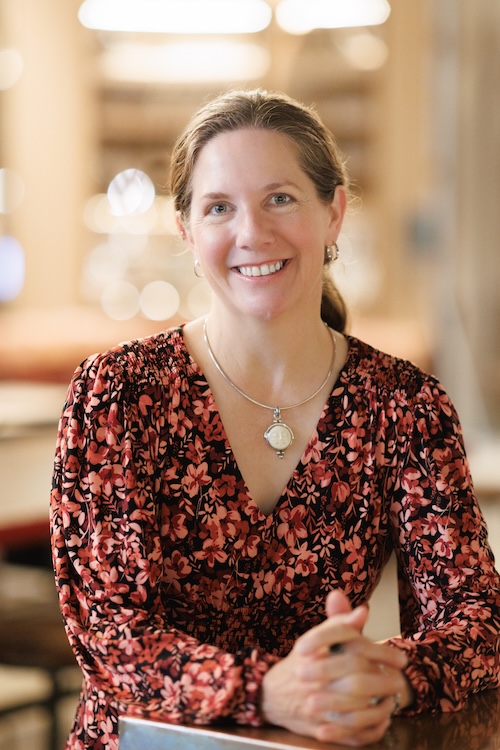
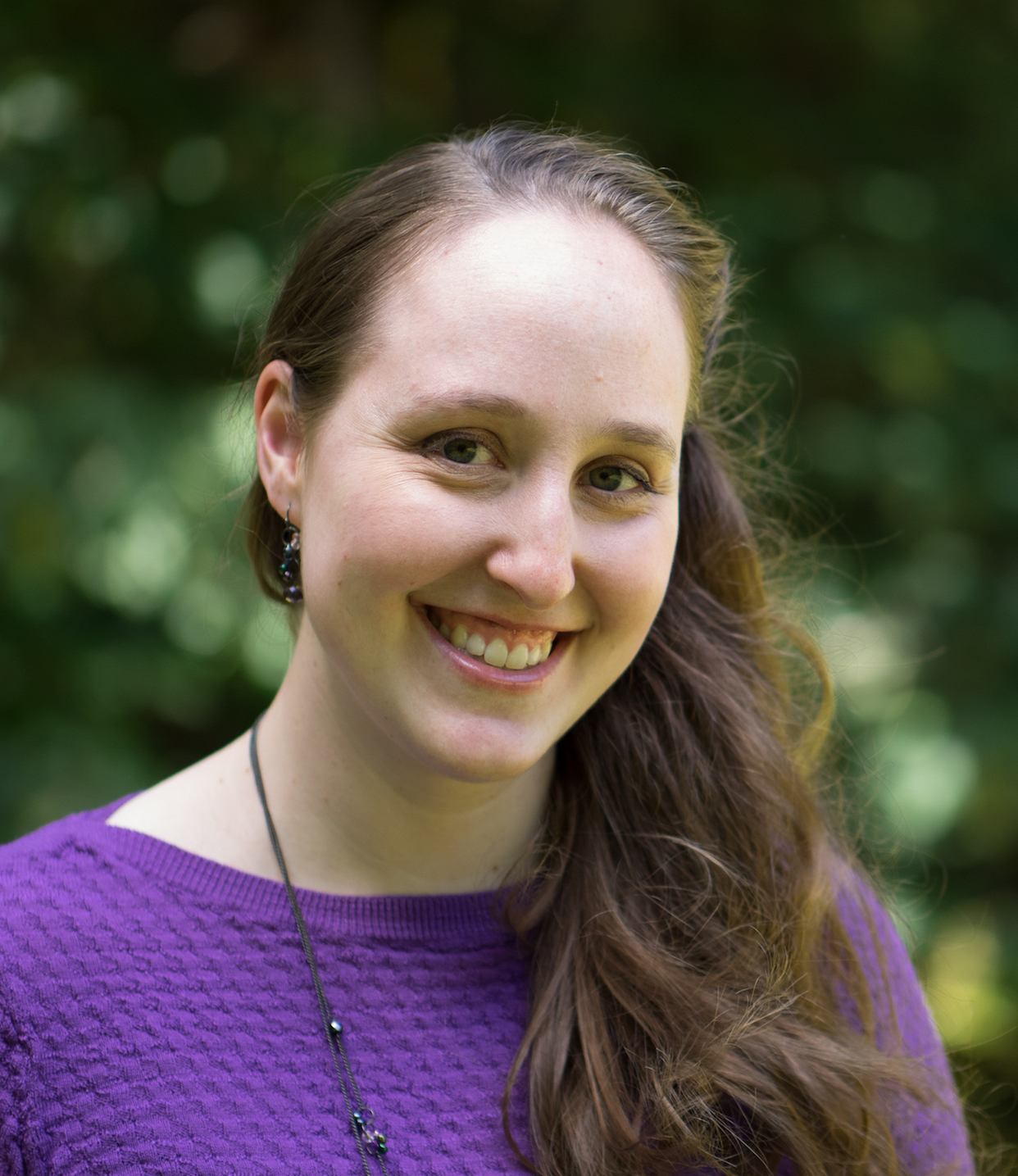
Kathryn Arnold writes fantasy and anything else that sparks her creativity from her home in Kingston, Washington. She currently earns her living as an insurance underwriting assistant, where she also creates marketing and web copy. When not writing, she plays (and teaches) piano and keyboard in a band (or two), and is working on starting a ministry team with her husband. You can find Kathryn at www.skyfirewords.com.