
Beyond the Hook: a free, live webinar
- Everything you really need in your opening scene.
- FREE 1-hour webinar.
- Live session.
- Learn what it takes to get your readers from opening hook to committed to your book.
- One session, three dates to choose from.
July 30, August 12, August 26
2:00 – 3:00 p.m. E / 11:00 a.m. – noon P
Register for the webinar here & get updates about workshops (not a newsletter). Your email is safe. Your time is respected.
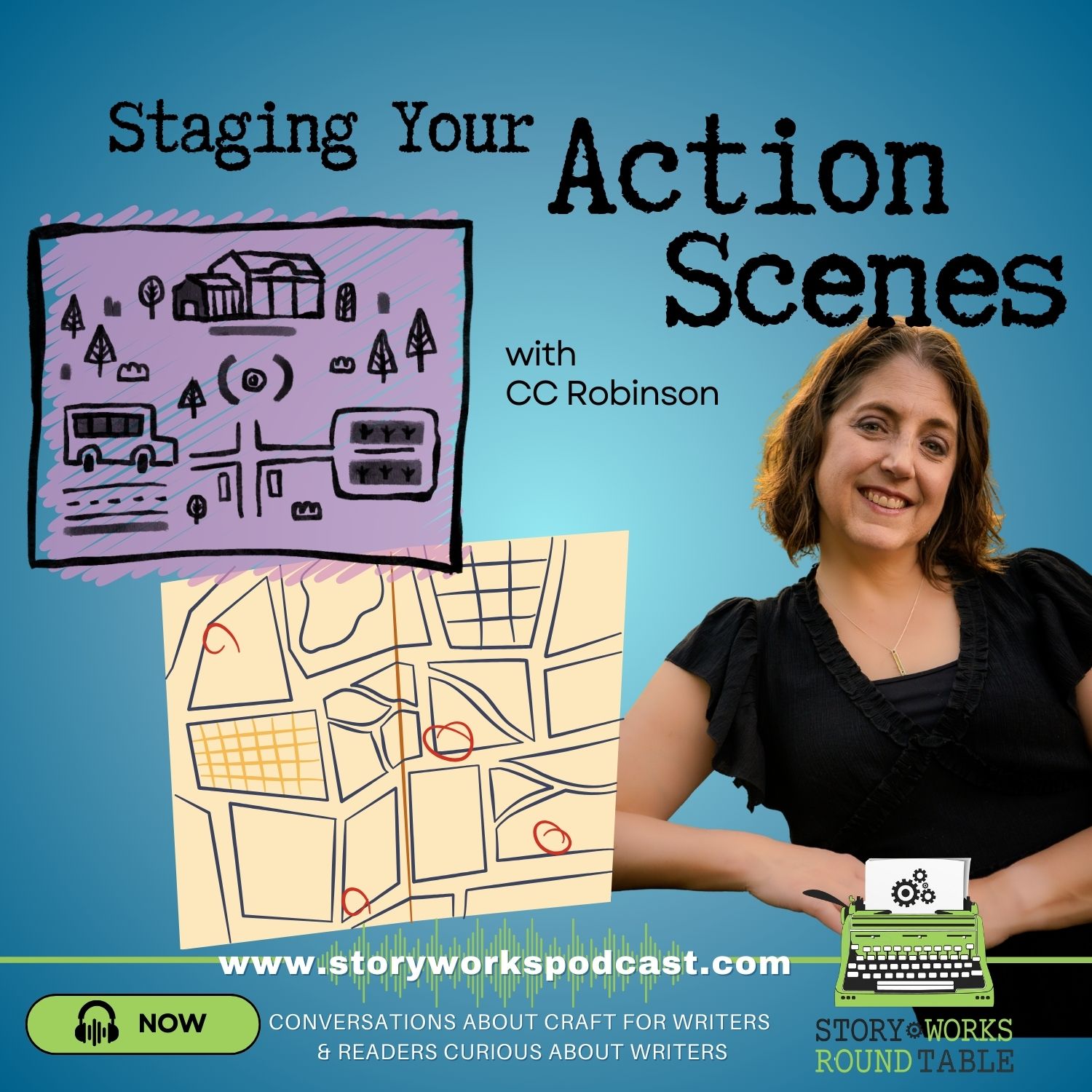
In this episode of the Story Works Round Table, Alida and Kathryn have a lively discussion with award-winning author CC Robinson about the art of staging action scenes in writing. Drawing from her theater background, CC shares insights on blocking fight scenes and how to orient readers within the physical space of a story effectively. With real-time sketches and engaging dialogue, we explore the interplay of character goals, motivations, and the dynamics of action sequences. Whether you’re a seasoned writer or just starting out, this episode is packed with valuable tips to elevate your storytelling craft.
“It’s not just about the action; it’s about the interplay between characters and their goals.” – CC Robinson
AUDIO
CC Robinson is a dynamic force in the world of racial reconciliation. As the author of the Divided young adult dystopian series and an Associate Pastor at a multi-ethnic congregation, CC pioneers the way for people from diverse backgrounds to move from yelling at each in rows to discussing issues around a table as colleagues. When CC speaks, audiences see a way forward from the current climate of division and hatred to greater collaboration and, ultimately, a unified approach to issues that affect their communities. With over twenty year’s experience as a missionary to post-civil war nations and a pastor in a multi-ethnic congregation, CC has grown from a white woman steeped in the colonialistic views of American culture to an author and advocate for collaborative, respectful, multi-ethnic, and compassionate community-building.
TRANSCRIPT
This transcript is AI generated. If you notice any inconsistencies or errors, blame the bot.
Alida Winternheimer: This conversation with Christy Robinson was especially fun for me because as you may know, may or may not know, I have a background in theaterre. Now, it’s been a lot of years since I did anything in the theater, but I do have a degree in theaterre. And Christy brought to us this idea of blocking your fight scenes. So it was super fun to not only talk craft and fight scenes, but also to, bring out some of the old theater chops and, and talk about blocking in those terms. Now this episode is different. Christy did some drawing for us, so she got out a notebook, sketched out some stuff, held it up to the camera. So we blocked a fight scene for a novel, not for the stage in real time. During this conversation, Catherine and I had a blast with her. So we’re going to post the video@, storyworksodcast.com. catherine’s also going to grab some screenshots to put into the show notes. So whether you want to watch the video or just take a peek at the screenshots, you can do so again. Storyworkspodcast.com and I do make the effort as we’re talking to kind of describe what’s going on. So if you’re driving or something, you aren’t going to miss too much by not having the visuals. so just a note there that you might want to really dig into the show notes this week. So these days I am preparing a lot of fall offerings. I’ve got some really great workshops coming up now. I’m doing something new and fun and exciting this summer I’m running some live webinars. The topic is beyond the Hook. I thought it would be fun to give people a taste of what I do. So one of my lessons from the many, many offerings I’ve given over the years about act one really gets into the nuts and bolts of your opening scene. Right. So that opening scene is about all I can give you in an hour long webinar. but that’s what I’m doing. So if you’ve ever wondered what to do in that opening scene to really ground your reader in the world you’re building, introduce those key players and get the reader to commit to actually reading the book. Right. That’s why I call it beyond the Hook, because that, that flashbg opening isn’t where it’s at, especially today. Right. We all encounter so many exciting, interesting, intriguing, mysterious, hot, you know, pick your adjective, whatever, opening hooks in all the stories that we consume. and that’s not the make or break moment for a reader. What really matters is what comes after that in your opening scenes. Whether your opening is explosive or quiet and contemplative doesn’t matter. You still need the same elements in your opening scene to lock that reader in, right? To get your reader to say, yes, this is a story I want to read. So if that sounds interesting to you, head over to wordessssential.com workshops. Grab your seat, reserve it today. This is going to be live. Bring your questions if you know anything about me. If you’ve been listening to this podcast, you know that I love answering questions and helping people in real time. So that first session is July 30th. Okay, here we go. Me, Catherine and the amazing Cece Robinson blocking some fight scenes. If you’re serious about your craft and ready to take your writing to the next level, check out Word Essential. That’s my home for developmental editing, writers coaching and workshops tailored for serious writers of, fiction and nonfiction. Whether you’drafting your first book or polishing your fifth. I bring decades of experience to the table as a published, award winning author, teacher and editor. I work one on one with writers to dig deep into story structure and craft. So if you’re looking for expert guidance that’s both insightful and actionable, head to wordessential.com and let’s talk about how I can help you reach your writing goals. If you enjoy this podcast, we would love it if you would show your support wherever you’re listening to this, click like and subscribe. And if you’ve got just an extra minute in your day, that’s all it takes, I promise. Give us a rating and a review. It really helps the show and increases our discoverability. Thanks for listening and now enjoy this conversation at the StoryWorks Roundtable.
Alida: Hello and welcome to this Week StoryWorks Roundtable. Today Catherine and I are delighted to be joined again by CeCe Robinson. CC is the award winning and Amazon best sellling author of the Divided series, a young adult dystopian series set in a racially divided future America. She has over 2 decades experience in cross cultural settings as a medical doctor working in post Civil War nations and as an associate pastor at a multiet ethnic congregation led by an African American man in Cincinnati. The setting for Divided when she’s not throwing on her superhero cape to save her characters from their dystopian antics, cece enjoys hiking, gardening, dancing, swimming and driving her Jeep through the woods with her husband and three Gen Z kids. Well, welcome back to the roundtable.
C.C. Robinson: Thank you ladies. I’m excited to be here today.
Alida Winternheimer: M. And we are going to talk about staging our action scenes. Yeah, I can’t wait.
C.C. Robinson: ye.
Alida Winternheimer: So how do you want to get us into this conversation? Do you want to tell us a little bit about the role of staging in your writing as you work on your books?
C.C. Robinson: Yeah. So for me, action scenes are some of the easiest to write. But what I’ve noticed when talking with a lot of other authors, which we talk, fight scenes, action scenes can be difficult because you get turned around in your head. Or all of a sudden, like when you’re reading a book, there pops up a bookcase. Like, I didn’t know there was a bookcase there. Like, how to get. Get there. Has it always been there? Did I just not see it in my head? And so I think it’s important as authors writing action sequences to really orient our readers to what’s happening and to what’s in the room, what’s going on around the space, but in a nono obtrusive way, because you don’t want to go walk into the room and say, so and so walked in. There’s a bookcase to her left, and then there’s this big table. And then there’s a man standing there and he’s holding a gun. Like, that’s not. That’s boring, you know, so that’s that. But you also don’t want to just plunge in. And then all of a sudden she’s using said bookshelf to like, knock him over the head or something. Well, how big is that bookshelf? Can she lift it? And so you’ve got to orient your reader somehow. And I’m an old, like, tech theater kid, so I was not the person on stage in front. I actually controlled the curtain. I had a really big role.
Alida Winternheimer: The.
C.C. Robinson: Curton and the lights. So I got the lights in the car.
Alida Winternheimer: That’s it.
C.C. Robinson: And maybe like reading the script and like queueing an actor with a line or something. But one of the things that is so important in theater is stagecraft and stage movement and where people are on the stage. And I noticed as I was on the tech career that like those dress rehearsals, a lot of it is fine tuning where people are and what they’re doing. Like, oh, why are all the extras? Why have the audience clumped on one side? Is that intentional? It might be, but maybe they need to spread out or maybe they need to concentrate so they feel like one group. And so it’s just seeing physical space of a book in a scene with the Eye of a director and the eye of someone who’s watching. And a lot of readers will say, oh, you know, action scenes are need to be. I need to be able to see them. They need to be playing like a movie or cinema in my head. Some people, when you read that’s not what they need, but a lot of people do and they need to be able to see it. And so it helps me be able to write it well if I can actually diagram it. And so, I thought what we’do today is I would show you my hand drawn messy, not perfect. And they’re not even the final version. Sketches from Divide. Because I don’t want to spoil anything. Even in a story blc even in this. I don’t want to spoil anything. And then, show you kind of how I use the map. Even, you know, those maps in the front of the books. I love maps. They’re like my favorite thing in the entire world. When I see a book has maps, I’m like nearly turn a cartwheel. I get so excited. and so when I could actually buy maps, I was also very excited. and so how I use maps while I’m writing. I just did it today in a scene, so I can take you through kind of how I used a map in the scene to orient the reader and orient me while I’m writing. And then I thought we might actually sketch a action scene live.
Alida Winternheimer: Ooh, love it. It’snna be.
C.C. Robinson: I don’t know how this is gonna come out because I’m on camera and I don’t use a zoom whiteboard. so I would literally do that on paper. But you can see. We’ll be really like rough with it, but you’ll be able. I’ll raise it up so you can see and hopefully people will get an idea of kind of how to do this. Does that sound good?
Alida Winternheimer: Sounds super fun. Yes. And I’ve got to say, I was a theater major in college. I have a bachelor’s degree in theater and U emphasis playwriting and directing. I never actually acted because that was way too much of an introvert. Not my thing. But yes, I have fond memories of blocking scenes and you know, before, before you’ve even got a set buil you’re just using black cubes and you’re moving them around and stacking them and saying this is the couch and this is the tree, this is the doorway and stuff. And then you, you place your actors and get that. That physicality actually happening in front of you. I’ve Always felt that my theater training informs what I do as a novelist. So absoly, like, fired up for this conversation. Absolutely.
C.C. Robinson: And all the gaff tape in the world. And then how do you get that gaff tape up when the next production is time like that. That was always the issue, getting the gaff tape off the floor. Anyway, fact that I know what gaff tape is. Anyway, we won’t even go there. so I just wrote a scene today. and we’re gonna use. This is my not published yet book. It’s published on the 24th. But, so this is the map of Queenstown.
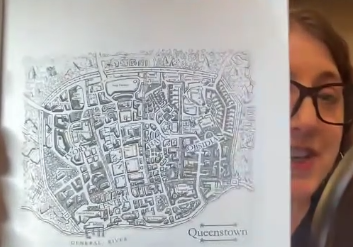
This is where, my action is all set. when we’re in the first two books. And so you can see you’ve got the river here in the front, and then over here, I got to reorient myself. Okay. Yeah. This side is the ivory wall. This side is the obsidian wall. And then next, obsidian is Havana, and then little Asia. And so when I’ve got a scene of my characters actually walking through the city in book three, because that’s what we get to do in book three, I start over here near Harriet’s house, and I literally trace a path all through the areas until they get to the ivory market day. And, like, going through which gate are they going through? They going through the gate, the south gate, or the north gate. Know what are they passing as they go through that? Taking my reader on a journey through the city. Because this map will be in the front of the book, and I know nerds like me will go to the front of the book and then trace through there and see where they’re going. And so I wanted it to be accurate. And so this is one way by. In this. This map was, done off of my detailed sketch, which is a mess, but it’s my detail sketch in pencil, so I could erase and redo things as I needed to. But once you set things in the world, you kind of need to keep them there. M. You know, buildings don’t move.
Alida Winternheimer: Right.
C.C. Robinson: And if you move them, readers notice.
Alida Winternheimer: Yes. Yes, they do. So true. And, you know, do you. So, two thoughts. first, I was wondering, do all writers do this just because we do have that responsibility of continuity throughout our stories and especially, you know, if you’ve got more than one book in a series. And, also, I was thinking I do this at. You know, I’ve done this for, saving Annabelle to get the layout of the town and the farms. I’ve done this for Murder in Scott hall, even just down to the house and its floor plan. Because I wanted to really be certain I was orienting readers to where the action was happening in the different rooms and such.
C.C. Robinson: So, yes.
Alida Winternheimer: Do you think this is universal? The need or the drive, you know, to create maps and do sketches? No matter what we’re writing? In what genre?
C.C. Robinson: I think it depends on your own internal hard wiring. I have trouble seeing that in my brain. maybe other people don’t have that problem. I need to be grounded in the physical world and so I need that tool. Maybe there’s other writers that are just better. They can just remember where everything is. That would be amazing if I could just remember. But I’m creative enough that I will move that bookcase, I will decide that the Warehouse is somewhere else. So I need. I need to like fix myself in place. Does that make sense?
Kathryn Arnold: I can’t even remember whether my character’s hair is blonde or brown sometimes. How am I supposed to remember where the Warehouse is? I feel like I’m really good at creating like small spaces where I can sort of remember how things are oriented.
Alida Winternheimer: But the.
Kathryn Arnold: As soon as you start expanding the number of pieces that you’ve identified or you know that people have a location for.
C.C. Robinson: Yeah.
Kathryn Arnold: You have to put it down on paper. You’re goingna mess it up.
C.C. Robinson: Yeah. So here, I’m gonna show you. I gotta get the page. My initial sketch for Queenstown, it’s back here. It’s also water stained because I spilled coffee.
Alida Winternheimer: A day in the life. Right.
C.C. Robinson: I mean, this is normal. This is totally normal. What are you saying? Like, this is totally normal? Of course this is normal. I should have bookmarked it.
Kathryn Arnold: Should have like a book fueled by coffee sign.
Alida Winternheimer: Right?
C.C. Robinson: So that’s my original sketch.
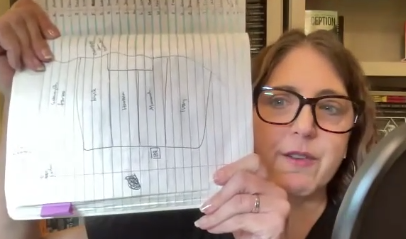
Alida Winternheimer: Very detailed. Right.
Kathryn Arnold: That’s my level of artistry right there.
C.C. Robinson: I mean, the trees, the granularity are just beautiful. Aren’t.
Alida Winternheimer: Right. And if you’re listening just to the audio, that sarcasm. It’s the stick figure version of the printed map in the actual book.
C.C. Robinson: Awful. Literally awful.
Kathryn Arnold: Yeah, it’s like, you know, what’s north, southet and west? And that’that’s important right there.
C.C. Robinson: pretty much it. That’s pretty much it. so yeah, I do these sketches and then I erase everything and then I reorient and I get it to a place where. Okay, this is it. And so my initial sketch in the map that’s in divided was hand drawn and then put into Canva, which is embarrassing. I’m going to replace it. So if you have the original copy of Divided, it will become a collector’s item at some point. For my hand drawn sketch, it’s getting replaced with the nice one by Anna. but if I didn’t have that map, I would forget. Like, okay, where did the deadland start? Like, okay, what does, what’s this city name? And what’s the river name? Like I kept confusing the river names. Like, oh my gosh, I named these. I shouldn’t have this problem. But then again, I call the dog the cat name and the cat the dog name. So this is, it’s all through my life I named them and I still need help. So this, it’s sort of like when people talk about a story bible for their characters. This is the story bible for your world, the maps for your world. If you’re, especially if you’re in sci fi or fantasy and you’re creating something that’s not based in reality or you’re changing reality, you can’t rely on Google Maps for that. It’s not going to work. So I got to make my own version of Google Maps.
Alida Winternheimer: Guess writing a novel doesn’t have to be a lonely road. Twice a year I open enrollment for the novel journey with small group coaching cohorts designed just for novelists. These groups bring together writers at similar stages to work through their manuscripts with craft focused feedback, personalized guidance, and the kind of community that keeps you motivated. I’ve seen writers go from stuck to inspired first draft to done, and from page one to the end because they’ve finally had the structure and support they need. If that sounds like just what you’re looking for, visit wordessential.com fictioncoaching and get on the list. So you’ll be the first to know when the next cohort opens. So next step. You laid out for us a whole plan for this episode, and I’m excited.
C.C. Robinson: So next. So next we are gonna look at, one of my scene blocking. And this was the original first book, which ended up now being the second book because we swapped the orders after my editor and I talked. And this was also not the version of the scene that ended up in the book. So no spoilers in here, but this is the council room
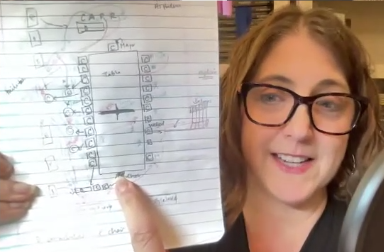
where the big fight takes place. And you’ve got, this is just the first drawing, the first sketch. So you’ve got the council table and you got a bunch of chairs. And then you see this. All right, so see all those arrows? M. This is my original style of blocking. As I took a person with their own little box and their own designation. And then I started putting them everywhere in the room. You can see all the eraser marks. That’s how many times I changed what I did. there’s even one time when they’re going under the table. So we’ve got them going under the table. Then there’s another time when someone goes over the table. You know how you do that? You slide over a table? Yeah, that.
Alida Winternheimer: That’s cool. I’ve never done that.
C.C. Robinson: I mean, this is young adult. Yeah, we do that. and then there’s people who’ve overturned furniture, so they’ve got these barriers that are made here, and then there’s some behind that. And then there’s overturned chairs and barriers up here. So we’ve got a whole bunch happening. We have entry and exit points. There’s stairs into the tunnel, enter an exit here, and then into the lobby over here. But those doors are closed, so there’s no exit that way. They’re locked. and then we even have where they’re facing. And so what I’ve done is I followed them in, and then you can see where they’re going because, this is. One is coming here, here, here, and then here. And then we’ve got another. Starts up here, comes over, and then ends up here. So I’ve blocked them off and I’ve shown movement and connected the arrows through the movement.
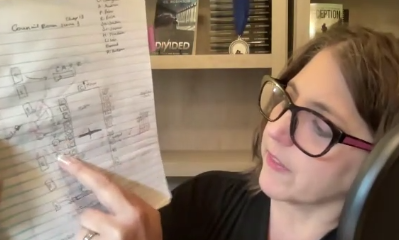
And, when you can do that, then once I’ve done that, once I’ve gotten the scene set in my head, then I start writing it. And in the writing, sometimes you’ll realize the character doesn’t want to really do what I want them to do. They want to slide across the table. And that’s when the eraser comes out and we slide them across the table, and then we redo it. But so you. I’d start out in pencils so that. And these are colored pencils so that I can actually see what’s going on. But eventually.
Alida Winternheimer: So can we give list. Oh, ink. Let’s give listeners an analogy in case, you know, they’re listening to all the words. It’s kind of like, war room. You know, if you’ve ever seen a movie where people are in the war room and they’ve got the big map on the wall. And you can see this is where the water is, and this is where the hills are, and this is where the forest is. And then they’ve got those, figures if it’s on a table or like the different things like here are the tanks and here the infantry, and here, whatever. And then they slide them around or move them across that map so you can see where they’re going. So what you’ve shown us is like a diagram of the room where the fight takes place. Then you’ve got your little figures with their initials and the arrows for that movement over the landscape of this room or the setting.
C.C. Robinson: It can also be thought of as like a play, like for a football or basketball team. As you’re as, as they are, as the offensive coordinators is drawing out the play. They’ve got their team and then opposing team. And the idea of drawing someone this way or pushing someone that way, that is, it’s part of this as well. Because when a character goes in a certain direction, it’s going to have an effect on the person, whoever they’re fighting. So know this person sliding across the table. One, they’re exposed. If there’s gunfire going on or knife being thrown or anything like that, so they’re exposed. And then two, theoretically they can also have the advantage of height. So who else is vulnerable? Because now they’re at a higher point in the room. And so there’s always a reaction in that action. So it’s not justh he’going to go here, then he goes here and then he goes here. He goes here. Does this, this happens.
C.C. Robinson: This person then does this and our character reacts by doing this and then there’s a reaction to that reaction. So you see, it’s a dance. It’s a drama of going back and forth between your protagonist and your antagonist in that moment or whoever they’re fighting.
Alida Winternheimer: Right. Yeah. I love that, that what you just said, that really brings into focus the interplay and exchanges between the characters and the dynamics that you are creating in your story to build the scene.
C.C. Robinson: Yeah,
Alida Winternheimer: Love that.
C.C. Robinson: And then if there’s an injury, what happens because of that injury is is that person immobilized or do they have to then seek a shelter of a sort? Do they have to seek help in that moment? And so there, there’s impact, you know. Yeah, you can stand there, you know, from your high place and shoot down, but at the same time you’re now vulnerable. Are you going to get injured? And that, that has to be accounted for. You know, we’re not like the guy in 24 who could sustain a bullet wound and then run a marathon like that. It’s not real. So you know, your readers will go with you for a Little while. But there’s a point where you have crossed into disbelief. I cannot suspend my disbelief any longer. And I’m now, this is not right. This is not possible.
Alida Winternheimer: M. Yep, we hate that here.
C.C. Robinson: Yep. That’s why you both start smiling when I said that.
Kathryn Arnold: When your character becomes a superhero or a supervilllain or something. This is very much that, when you’re writing a fast paced action scene, slow down, right? Because as you’re talking about all these reactions and things, if you’re caught up in the moment as you’re writing it, you’re probably not going to take the time to see all of this. So I love this action of physically slowing your brain down and putting it on paper and being able to say, no, no, no. If he steps up here, what does this person over here do? Because they’re not like. It’s not like time only moves for one person.
C.C. Robinson: Yeah, Yeahuse.
Alida Winternheimer: Hm.
C.C. Robinson: The everybody in the scene should have a goal. If they don’t have a goal, why are they in the scene?
Alida Winternheimer: Hm.
C.C. Robinson: And when the action starts in a scene like at the end of Caged, their goal is to survive. But that also involves taking out the enemy, whichever side you’re on. And those opposing goals will come into impact against each other. They will come into and collide and have an impact on each other. And at some point, either one side wins by defeating the other side or the other side gives up. At what point? Where’s that tipping point in an action scene? When is enough action? Sometimes I feel like in some books the action goes on too long. Get kind of. And I get kind of weary of that. It’s like the adrenaline is a little much now. Maybe that works for like a sci fi military thriller. Okay, great. That’s where you want to be. Adrenaline popping all the time. But even in young adult dystopian, there’s like a too much level and you need to let the readers breathe a little bit. So even within an action scene, there may be an opportunity for a character to have this micro reflection. It’s not like, oh, I’m unloading at my counselor’s office. You know, kind of dramatic. One hour. You know, pause the action, everybody. I’ve got to deal with my emotions. But it may be like a, am I gonna die? Like this is hitting me like I almost gota hit by a bullet for the first time ever. And I’m terrified and I’m shaking. That’s normal. You know, let’s let our characters have their humanity in the midst of the action. Yes, a lot of people get tunnel vision too. So how do you portray that tunnel vision in the midst of an action scene? And it’s that focus, it’s the, I don’t even see anything happening. If you get in my way, I’m going to mow you down like that’that’s. A different type of character. But each character has to stay within their characterization. Even within an action scene.
C.C. Robinson: Yeah, many.
Alida Winternheimer: Oh, absolutely. How many characters do you put into an action scene? You know, I mean, obviously sometimes the story dictates the type of, action scene, but as writers, even if we’ve got say, eight people in the fight, you can’t vot, you can’t focus on eight people. You can’t bring eight people into the readers len simultaneously. Right. So, can you say something about how you manage numbers? And if the scenario lets you kind of pick and choose how many people to throw in the room, what guides your decision?
C.C. Robinson: So the world and the plot are going to guide who it needs to be there. for instance, this last scene in Caged is during a council meeting, a city council meeting. And so all the council is there. What do I do with them? we can conveniently kill off a few that aren’t even named in the first place.
Alida Winternheimer: Get rid it easy.
C.C. Robinson: There’s a couple, there’s militia in there too, and they’ve confiscated all the guns. So. But some people are going to naturally hide and they’re going toa assemble others to hide with them. And so you can get rid of people by clumping them. So I can take three militia members, clump them all together. They’re a team, they’re a squad. I don’t really have to name who’s in there. Know, maybe one of the people is, a named character. That’s great. The other two I don’t have to name. And then I’ve got another clump of people that are all, you know, hiding, terrified for their life behind the thickest piece of furniture they can find or overturn. And I’ve dealt with five or six people like that and they’re laying down, they’re not engaging, they’re staying out of the way. That leaves room for my protagonist. Maybe there’s two or three, a few people that are going to engage from that original city council squad just because they’re already named characters and they’re in the room. They’re named character and they’re in the room. They need to have a job, they need to have something to do and Then a fewists, antagonists to go against my protagonist. And you’ve got enough people. But in the midst of a battle in a room like that, it’s going to feel confusing. So I kind of. I want to lean into that. I want to lean into that confused feeling. But at the same time, okay, the characters are constantly checking in with each other. And I’m switching points of view pretty fast in there too, because I’m a multiple POV writer. So I have that sort of weapon or tool in my belt. I can switch POVs between the two main leads. And so we get different aspects and viewpoints of the room and of the fight itself. And so there’s different ways to manage that. kind of segment the room in half and let Rose talk about this half and let Jason talk about this half. And if they cross over, we’re going to flop or we’re going to get in each other’s spaces. And so there’s this dynamic of, okay, I’m watching him do that, Rose is watching him do that, and then Jason is watching Rose do something else. So that way we’re also orienting people in the space from the other perspective.
Alida Winternheimer: Right, Yeah, I like that. Another good.
C.C. Robinson: It takes a lot of editing, takes a lot of editing and a lot of revising at this point to smooth out those details. M.
Alida Winternheimer: Yeah. So is there another step in the blocking and the diagrams you were going to show us?
C.C. Robinson: Yes, actually. I was actually going to show you how to do it.
Alida Winternheimer: Great.
C.C. Robinson: We’re just gonna make up something. I mean, I can show you more diagrams. They’re gonna be the same. It’s a lot of rooms. It’s a lot of, figuring things out. And I do this on paper because, I need to see it, but. All right, so action scene.
Alida Winternheimer: Great.
C.C. Robinson: Give me two characters.
Alida Winternheimer: you want like names or kind of person?
C.C. Robinson: Two names. Two names.
Alida Winternheimer: Okay. Joseph and Catherine. Pick a name.
Kathryn Arnold: Samantha.
C.C. Robinson: Okay, Samantha.
Alida Winternheimer: Joseph. Samantha.
C.C. Robinson: Okay, this is a. Choose your own adventure, ladies.
Alida Winternheimer: Come on, work with me.
C.C. Robinson: Joseph versus Samantha. What’s our weapon?
Kathryn Arnold: Do we have to have the same weapons?
Alida Winternheimer: Oh, sword.
C.C. Robinson: Why bring a, knife to a gunfight? You can bring a submachine gun. Whatever you want.
Kathryn Arnold: Yeah, well, why don’t we do a sword fight? Let’s do a sword. Sword.
C.C. Robinson: Sw. Swords. All right, we’re doing swords. What’s our setting?
Kathryn Arnold: Do we wanna be confined or do we wanna not be confined?
Alida Winternheimer: How about a farmmus?
C.C. Robinson: It’s too big.
Alida Winternheimer: Un.
C.C. Robinson: Likely too big.
Kathryn Arnold: so what about inside a barn at a farm?
C.C. Robinson: Inside the barn. Okay.
Kathryn Arnold: Inside the barn.
C.C. Robinson: Okay, so I start off and I’m not real exact barns have big doors. So there’s the big doors on that side and there’s big doors on that side. But those are locked with a chain cause I don’t want them to be able to go out that way.
Kathryn Arnold: But there’s one entrance, one exit.
Alida Winternheimer: Good.
C.C. Robinson: There’s the hail loft up here and there’s a window exit that only Joseph knows about. We’give Joseph the bandage there because I’m gonna give Samantha the bigger sword.
Alida Winternheimer: I love it. Okay, so can you hold that, up to the camera so we can maybe get a screenshot of it?
C.C. Robinson: Yes. Love it.
Alida Winternheimer: Excellent. Lifted a little higher. There we go. okay, Keep going.
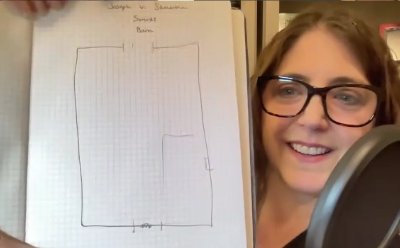
C.C. Robinson: All right, we got it. We’ve got horse stalls over here and over here. So horses on both sides. Right.
Alida Winternheimer: Okay.
C.C. Robinson: This is the hayoft Back here there’s an office with a door. And then this is the tack room. Right. I don’t write fantasy, so I don’t know Barnes as well as I maybe should, but we got a t attack room in the office. And then hay loft is above here. There’s a, you know, stairs up and down and then there’s more feet over here underneath it all. Ah, right.
Alida Winternheimer: Okay.
C.C. Robinson: So it’s pretty thorough.
Alida Winternheimer: I’m impressed.
C.C. Robinson: So Samantha is in the office working.
Alida Winternheimer: Mm
C.C. Robinson: So I’m gonna switch colors. We’re gonna let Samantha be blue. So she’s an ness. She’s in the office working.
C.C. Robinson: When Joseph is pink, Joseph, her sworn enemy, walks in through the barn. Samantha has no idea. But then the horses notice him and he’s not usually there. So they start knickering and you know, doing what they what horses do when someone unfamiliar walks in and there’s no dog out here. I would love a dog, but we’re not going toa have a dog. Barn cat, thoughph, because he’s coming from the light into the dark. Accidentally steps on the barnt on the barn cat’s tail. So the cat is right here and the cat goes flying out that way. So the squeals meows. That alerts Samantha who then blue one comes to the door and looks. She sees a figure silhouetted against the bright sunlight outside. Because it’s dark in the barn and it’s bright outside.
Alida Winternheimer: Okay, can we pause?
C.C. Robinson: Yeah, I.
Alida Winternheimer: Okay, lookift it up a little bit more for that screenshot’re great.
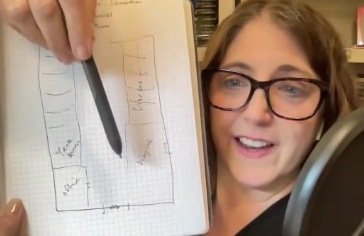
I just want to point out to listeners how fantastic this is. We start with the very general setting of a barn and we see Christy putting in these elements that we all know would be there. Right. But you’ve got to be aware of that and think about it. Okay. What kind of elevation do we have? What kind of entrance and exit do we have? You know, staircases, animals, even the stalls. And I’m just, I’m already seeing ways the action can play out, but it’s because of what Christie is doing with the setting and incorporating the elements and the realism right down to the barn, cat and the way the light backlights Joseph as he’s coming through the door. So some really excellent takeaways for you already. M. All right, Unpop.
C.C. Robinson: All right, so. So remember when I, when I have an arrow, that’s where the action stops. The person stops there for a moment. So we’ve now got two arrows showing. We’re stopping now. Joseph has stopped here because he stepped on the cat’s tail and it alarmed him and he’s drawn his weapon already because he knows he’s there to assassinate Samantha. This is assassination plot. Ok? Samantha doesn’t know why he’s there, so she sees an unfamiliar person there and goes back into her office along her wall, which is her. Like all her weapons are on the wall, so she is getting her weapon at the same time.
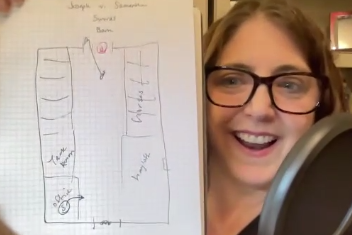
Joseph takes off and runs toward her because he thinks that she’s gonna try to escape. Cause he doesn’t know there’s not a door there. so Samantha then comes back out of her office and goes to meet him in the first confrontation. So when we’ve got a confrontation, I always mark it with an X. So we’re gonna have some action there. They’re gonna fight swords. I don’t do swords because I’m not a fantasy author. But there’s lots of things that happen, like moves, sword moves and forms and all this. They do all that and. But what is Joseph’s goal? Joseph’s goal is to assassinate Samantha. What is Samantha’s goal? Survive.
C.C. Robinson: Escape. Her goal is escape. She doesn’t know who this is. She doesn’t know if I kill him, is the king going to come down on my head? M. Like, who is sending this assassin? I’m assuming we’ve got a kings. So we’re in fantasy. We got swords. We’re in fantasy, so.
Kathryn Arnold: Or historical fiction. Either way there could be a K. Or maybe.
C.C. Robinson: Yeah, true. Either way there’s a king. So we’ve got her in this fight. The only door she can get to in time is way over here. But she knows there’s a escape out the hay loft. It’s a fire escape and it’s literally a rope, a rope ladder that she has to open the window and throw it out the window. But only Samantha knows this. Joseph does not. Oay, does he? Yes.
Alida Winternheimer: So another pause here. No, I just think this is great. And I want to point out what you’re doing with the advantage disadvantage elements here. So Joseph comes in through the only available doors. So essentially he’s blocking Samantha’s exit. But then Samantha has knowledge, Joseph doesn’t. Right. And so these are all the kinds of things we should be thinking about as we’re developing our scenes and starting to block them and figuring out how our characters and their action interact with and are affected by the environment they’re in.
C.C. Robinson: M. So let’s take that a step further. Ktherine, how tall is Samantha? Ooh.
Kathryn Arnold: Let’S make her fairly average female height. 5.
C.C. Robinson: What?
Kathryn Arnold: 4.
C.C. Robinson: 5, 5, 5, 4, 5, 5. Alina, how tall is Joseph?
Alida Winternheimer: 6.
C.C. Robinson: 3. 6 3. He’s a hulking monster wielding a sword. And he’s doing it chop style. Because when you’re that big you don’t have to really aim. Right. Yeah, there you go. And Samantha however, is short. She has the advantage. She can get up under his guard. So somehow in here, Samantha gets a shot in and hits his somewhere on his torso. Maybe it’s an arm or leg. And now Joseph is bleeding.
C.C. Robinson: Which gives Samantha the opportunity to go up the stairs to the hay loft and start to unroll said ladder. So we’ve got that. So we’ve got Joseph bleeding on the floor. Blood is always a puddle. Got a puddle of blood. There’s just a bit a puddle there. It is always way more than it is in actuality. We think, okay, that’s a cup and it’s like a teaspoon. Anyway, and. But he’s. So he eventually trails after her. So he follows. She’s having trouble getting the window unstuck. Cause whoever goes out that window, it’s a firescape. Yeah.
Kathryn Arnold: Probably not very often.
C.C. Robinson: So they have another confrontation up here. Except Samantha had her back to him. It’s only because he’s 63 and is lumbering up the stairs that she realizes he’s coming. He can’t approach her very quietly because he’s lumbering giant. So she knows he’s coming. She gets ready. She hits it. They’re fighting, fighting, fighting. They’re all over the hay loft. So you’ve Got now obstacles, hay bales. Hay bales are not small. I don’t know if you’ve ever tried to throw a hay bale, but it’s about 120 lbs. You can stand on a hay bale, you can vault off a hay bale, you can do a backflip off the hay bale if you really want to. So let’s just assume that Samantha, being the smaller of the two, is a little more nimble and so she can actually get the height advantage and maybe even swing from the rafters if they’re there and help her get escape. Because remember, her goals is escape.
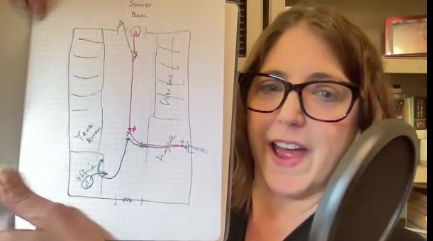
C.C. Robinson: So at some point we’ve got a confrontation here that then bleeds. This is the confrontation. It bleeds over here and then it goes over here and she pushes him off the side. Joseph ends up, on the ground. Samantha, our, hero, our heroine, runs back and then down the ladder and she follows the cat.
Alida Winternheimer: Excellent.
C.C. Robinson: She’s in the wind. And she’s in the wind. Notice I don’t have her go back in for one of the horses. That would be great. That would be an idea.
C.C. Robinson: If she could get it, if she could make it happen fast. Remember, survive. She’s just trying to get away, trying to get out of there.
Alida Winternheimer: Right. Well, it really depends, on the kind of state Joseph is in once he falls.
C.C. Robinson: Yes. You know? Yes.
Alida Winternheimer: How badly wounded is he?
C.C. Robinson: Is she gonna stick around to look at that though, do you think? If her goal is to survive. I don’t, I don’t knowe. You have to know your character. You got to know your character. y. Do you need to take a screenshot of this too?
Kathryn Arnold: O. Yeah, I will do that.
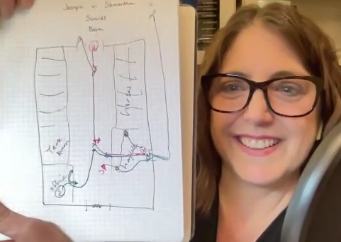
Alida Winternheimer: Yep. Great. Perfect. Thank you. So tell us more takeaways from this process you just walked us through.
C.C. Robinson: We all know as authors about the ideas of goal motivation conflict in a scene, in an action scene, it can be tempting to forget about that. But your goal motivation conflict, your characterizations, who someone is, will affect how they deal with the action. And we’ve got to bring that in. And so when you’re writing an action scene, you have to slow, slow way down. Just like Catherine said. Slow way down. Block it out if you have to. Make sure you can see it as a writer. But then also ask yourself, what’s this character’s highest goal? What is their motivation in this time? What’s the conflict? And who is the conflict? Because the natural protagonist might not be the one they’re conflicting with in that time. It could be someone else. It could be a common enemy. So what do those dynamics look like? And then remember that furniture and other people need to be accounted for. Absolutely. So, yes, those are the takeaways. Those are great. and learn your sore techniques if you’re gonna be writing fantasy, because tr. I don’t know.
Alida Winternheimer: Right. Oh, definitely. Yes. So what challenges have you come up with in writing action scenes? what hurdles have you had to overcome?
C.C. Robinson: Yeah, so I think, for me, I can maybe write them a little too fast. So I’ve had to force myself to slow down. That’s one thing I learned through doing, and then bringing the emotions in, even if it’s just a little, just a little checkpoint. How’s your character doing? I, think is important because while the action is the main star of that scene, we still are dealing with a human being. And so we need, we need to reflect that in the writing. Yeah.
Alida Winternheimer: Yeah, that’s a great takeaway. Anything else we want to share with listeners? Thinking about blocking your action scenes. Then go get that sketch. Paad. Start doing itactly. Yes. It will make your writing better. It will certainly make your writing process easier.
C.C. Robinson: I think it’ll make your writing clearer. And I think we all want clear when it comes to our writing.
Alida Winternheimer: Yeah, absolutely. Wow. Well, thank you so much for joining us. Where can listeners find you and your books?
C.C. Robinson: They can find ccrobinsonauthor.com and I have a special offer. Anyone, who wants to check out my writing live, see how all of this comes into real time and books, gets, the first book in my series for free by signing up for my email list. So this is the book you get for free. Upheaval. It’s post apocalyptic. It’s a prequel to the Divided series. but you just go to ccrobinsonauthor.com/storyworks all one word, no hyphens and it’s yours.
Alida Winternheimer: Awome. Thank you. Thank you. Yeah. What a fantastic offer.
C.C. Robinson: Cool. You’re welcome.
Alida Winternheimer: Welcome.
C.C. Robinson: It’s been a pleasure.
Alida Winternheimer: Want to keep up with my latest thoughts on writing life and the writing life? Join me in a room full of books and pencils. My newsletter on Substack where I share craft insights behind the scenes, peaks at my own creative process, upcoming workshops, coaching opportunities and book news. If youre re enjoying storyworks Roundtable, this is the best way to stay connected and make sure you never miss whats s coming next. Just search a room full of books and pencils on Substack or follow the link in the show notes.
About Your Hosts
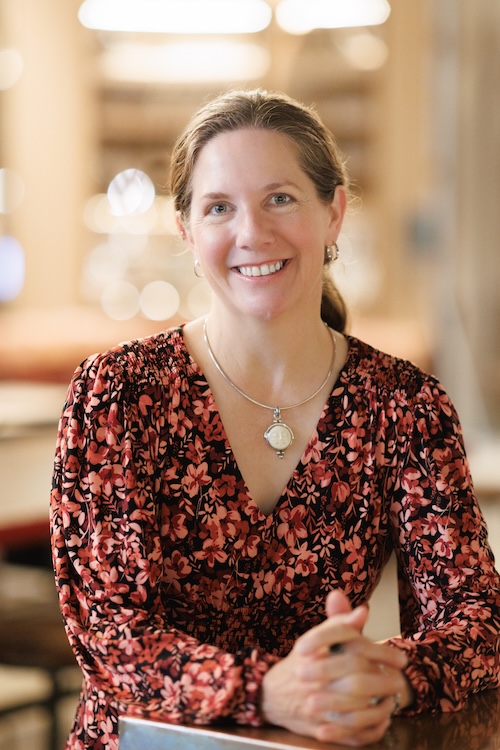
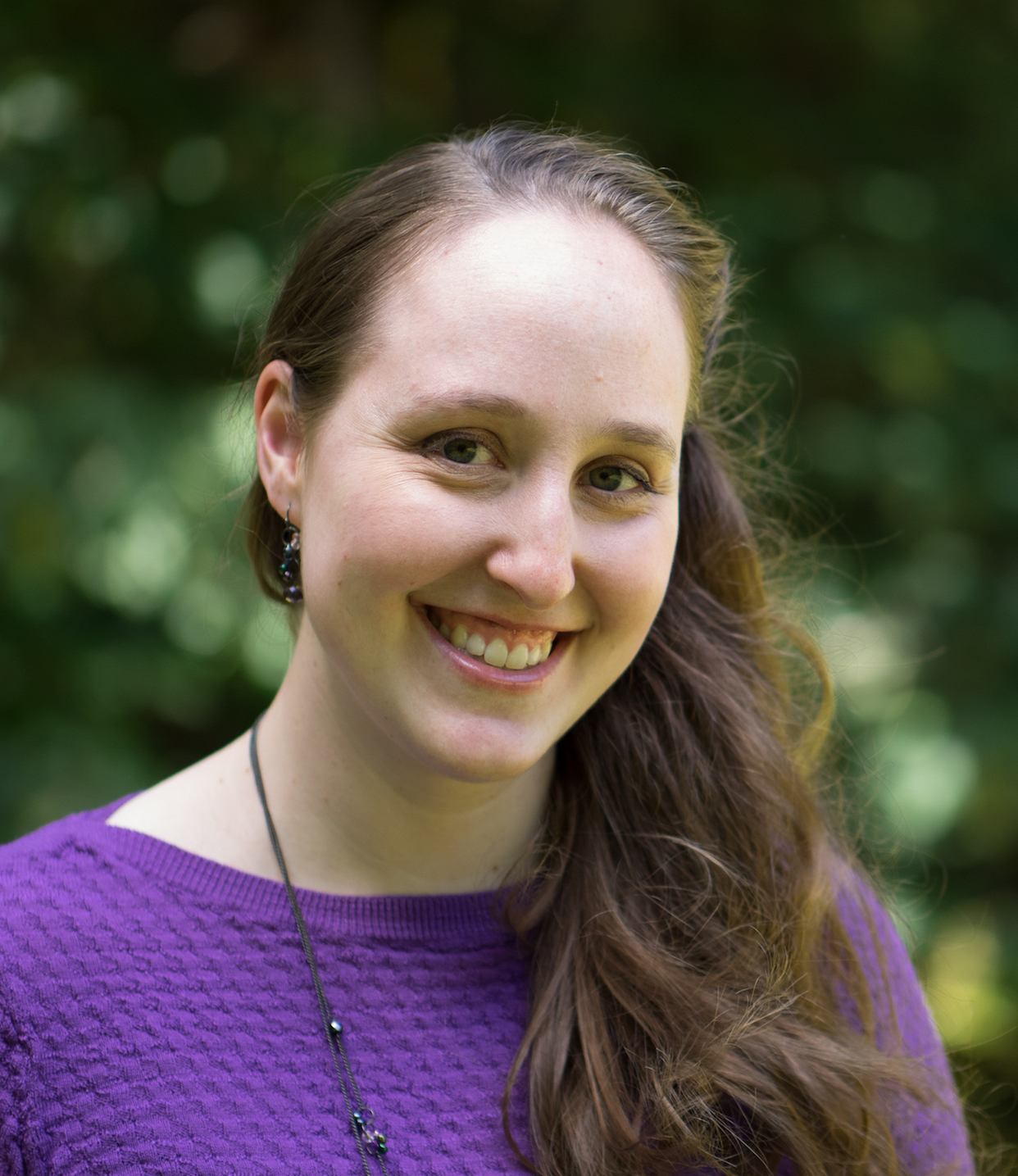
Kathryn Arnold writes fantasy and anything else that sparks her creativity from her home in Kingston, Washington. She currently earns her living as an insurance underwriting assistant, where she also creates marketing and web copy. When not writing, she plays (and teaches) piano and keyboard in a band (or two), and is working on starting a ministry team with her husband. You can find Kathryn at www.skyfirewords.com.