
Winter 2026 | 3 Workshop Series
I’ve got a full slate of workshops coming up soon! Whether you want to dive into specific craft topics (Backstory, Stakes & Tension, Weaving Character, Plot & Theme) or tackle your entire first Act (Write Great Openings), I’ve got opportunities for you.
Regardless of the workshop you choose you know you will get:
- A LIVE Classroom
- A small class size with personal attention
- Lessons, Discussion, and Exercises to help you put action to your education
- Answers to your Questions
I hope to see you in my classroom!
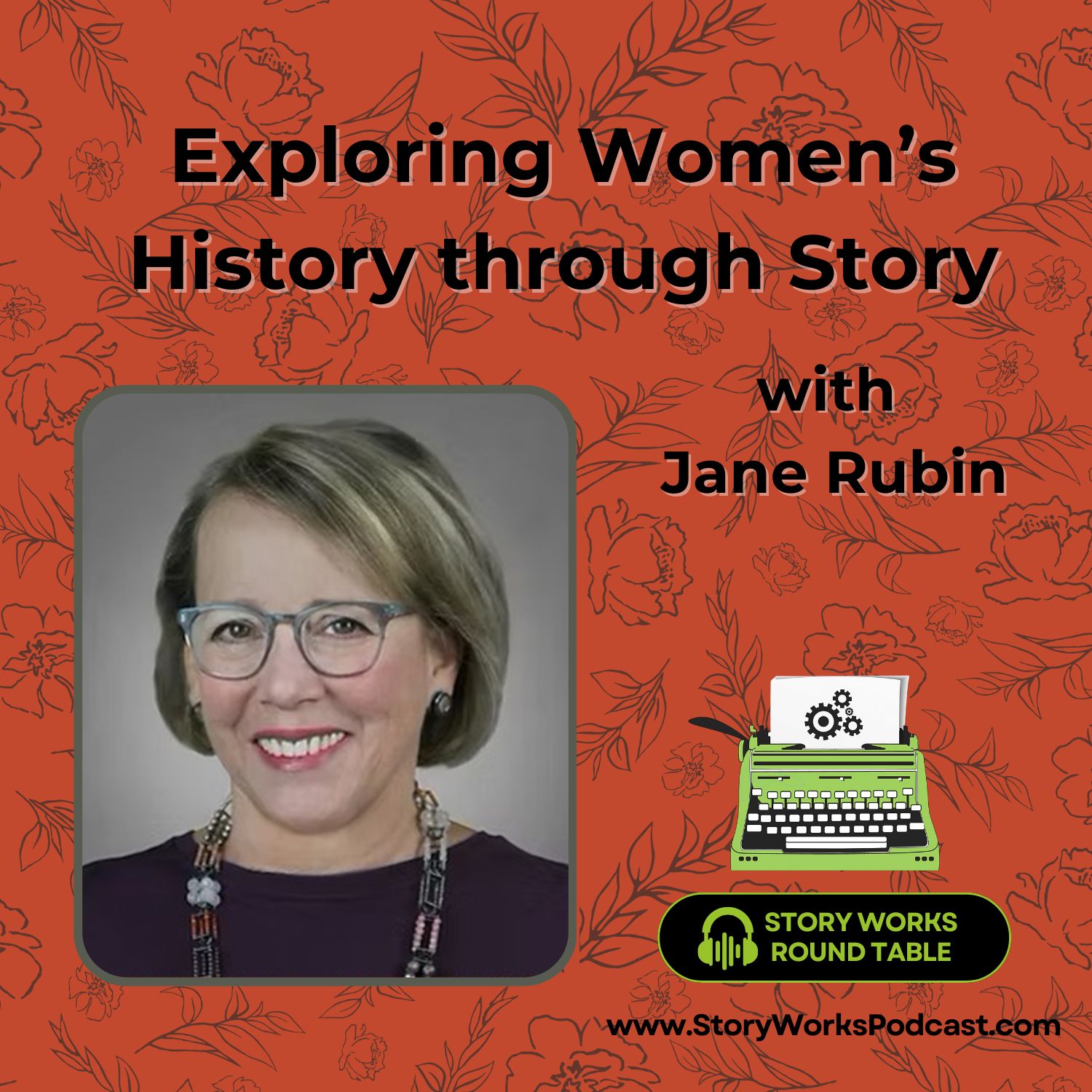
In this week’s episode, we sit down with the inspiring Jane Rubin, who shares her remarkable journey from a healthcare executive to an accomplished author. Diagnosed with cancer, Jane turned to writing, ultimately leading her to pen a series of historical fiction novels that explore themes of immigration, women’s rights, and the impact of war. Join us as we delve into her creative process, the importance of research in storytelling, and the powerful narratives that emerge from her experiences. You won’t want to miss this enlightening conversation!
AUDIO
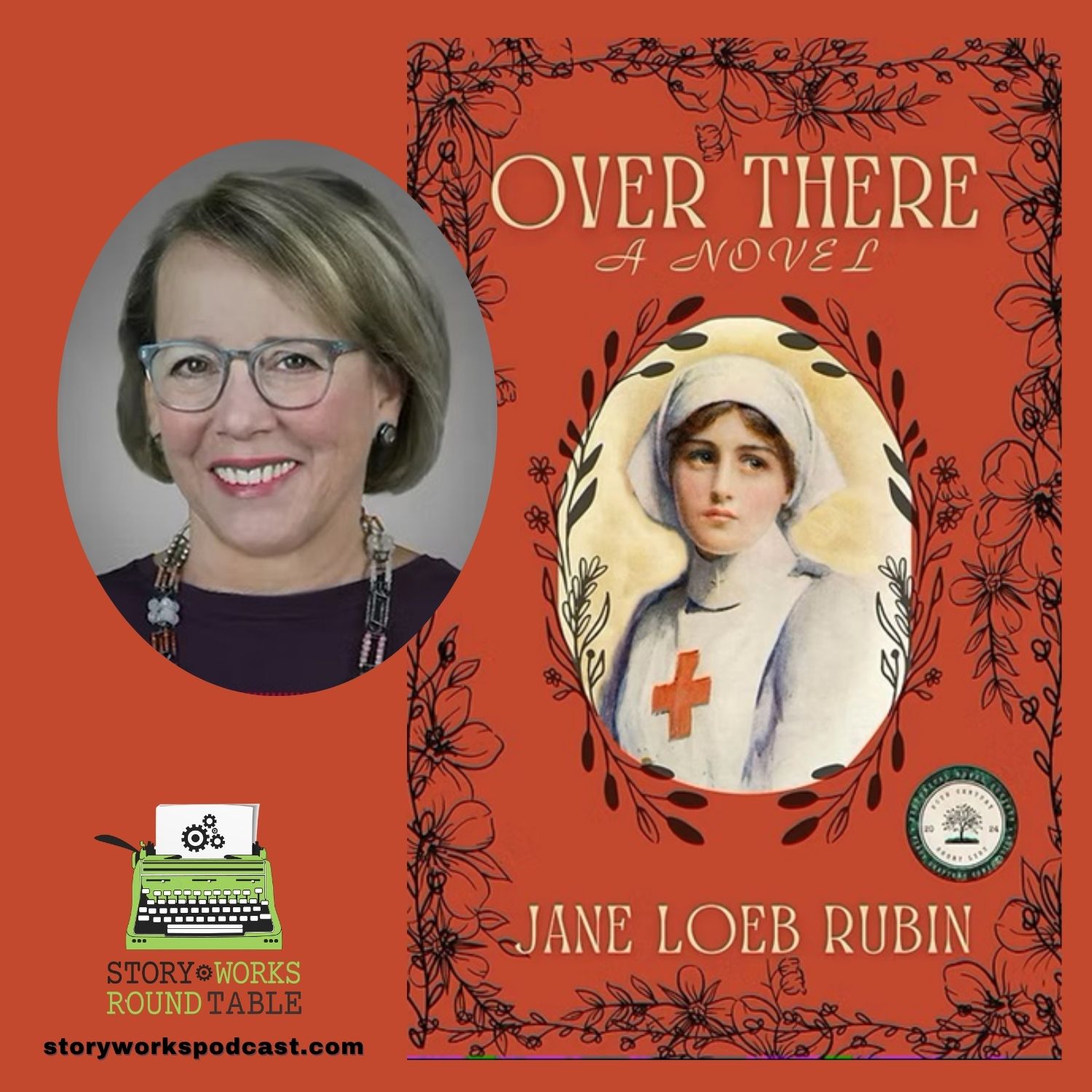
Jane Rubin is a graduate of the University of Michigan (BS, MS) and Washington University (MBA), retired from a 30-year career as a healthcare executive to begin writing full-time. Over There is the third book in the trilogy, which includes In the Hands of Women and Threadbare. Jane’s other publications include an essay memoir, Almost a Princess, My Life as a Two-Time Cancer Survivor, and multiple magazine articles. She writes a monthly blog, Musings, reflecting on her post-healthcare career experiences and writing journey. She lives with her husband, David, an attorney, in Northern New Jersey. Between them, they have five adult children and seven grandchildren.
TRANSCRIPT
This transcript is AI generated. If you notice any inconsistencies or errors, blame the bot.
Alida Winternheimer: Hello and welcome to this week’s StoryWorks roundtable. Today I am delighted to be joined by Jane Rubin. So welcome Jane. Thank you for joining me at, the StoryWorks roundtable.
Jane Rubin: Thank you for having me today. I’m very excited to, talk to you about my work.
Alida Winternheimer: Yeah. So tell me how you got started as a writer because I understand it wasn’t all that long ago and you’ve had an interesting journey to where you’re at today with your books.
Jane Rubin: I actually had two starts when I was diagnosed in 2009 for the second cancer that I had. Ah, primary peritoneal, which is like an ovarian cancer. I was in a position at a healthcare system, I was in an executive position where I handled neuroscience services. And a woman had come into my office pitching a grant for using language and writing to help stroke patients. And I found it fascinating. I originally was a speech in language therapist many years ago. Anyway, she was talking about the power of healing and writing. And so ironically, two weeks later I get this diagnosis. I’m sitting in my office with this horrible news and I just started typing into the computer. And it culminated in an essay memoir where I looked at where strength came from in my family. And in the process of doing that I knew that I wanted to raise money for treatments for this disease. And fortunately a lot of people like me have done that because I’m a 16 year survivor. So I’m way out there, three standard deviations out from the bell curve. Anyway, so I, wanted to raise money for research, and I wanted to go back to work. But before I did that, I wanted to know where my genetic defect came from. It’s a BRCA1 defect and it’s, it’s found in populations that are very isolated, so there’s a certain degree of inbreeding. You find it in the Norwegian population on the fjords, you find it in the Jewish population, the Ashkenazi population, and you find it in Italian villages as well. So it’s definitely connected to marrying second third cousins and so forth. but nobody, as I began to trace, the cancers, nobody could remember the name of my great grandmother and great gr. My mother was the only person alive from her generation. And I said, how could you. Nobody know her name? And she said, well, you know, she died before your father was born in 1923. And so I think she was a young woman. And I said, well, what do you know about her death? And she goes, it was a woman’s disease. And that said it all, right? That’s what cancer was. Breast cancer, ovarian cancer, they were women’s diseases and they took women very young. and so for her name to get lost in history was not really that hard to imagine. So I started digging. I found her name. Her name was Matilda Tilly in parentheses. And I named the fund, the Matilda Fund and raised over $80,000 so far and went back to work. I really still in my mid-50s. I was just at the peak of my career. I was, doing some great things with my team and I wanted to finish my career out, so I went back to work. But lo and behold, my cancer symptoms continued to come back. So a treatment would work for a couple years, intimidate the cancer cells, and then they morph into a different pathology and come back. So we went through that a few times, but I was getting tired because the side effects of a lot of these drugs really beat you up. So by the time I turned 65, I was getting told at major cancer centers that this was probably what I’d die from and that if I wanted to have a second chapter in my adult life, that I should if end I was ready, I should consider retiring. And I did. my children are all in the medical field and they were, mom, it’s time, you know, retire when you’re on top. Anyway, so I did. But I was worried because I was such a type, a kind of person that I had to have lots of stuff to do. And I don’t mean canasta image on. I mean, I needed to fill my head and learn and I couldn’t travel the world, so I kind of did. But at my desk, I was writing a lot in my career, but I wasn’t writing fiction and I certainly wasn’t writing historical fiction. So I began taking classes, joining critique groups, really going from an absolute neophyte to a polished writer in a matter of years. But I worked at it. I worked at it every day. Every day I was up, at 5, 30, 6:00, having my cup of coffee. By the time we hit seven, I was at my desk for three solid hours. And then I’d take a walk. if I had any more juice in me to write, I’d sit down or I’d research or I’d do some marketing. and lo and behold, I finished the first of the three books and it was called Threadbare. Redbare is a story of Tilly. Tilly’s immigration, her poverty and The Lower east side. Her creativity in developing a garment business with her girlfriend. And they had to do it in the shadow of men because they couldn’t own anything. And it was a very different time. And she takes in her younger sister Hannah. Hannah. As a result of their mother’s death and their father’s remarriage, Hannah is just not been into the plan. And so Tilly’s father asked if Hannah can come live with them. It was a big ass. But it was not uncommon during those times for family members to come and live with relatives. So Hannah grows up, she’s brilliant. Tilly, who doesn’t get to finish high school, is and was very brokenh heartted about it, decides Hannah’s gonna have everything she didn’t have access to. And Hannah becomes one of the first OB GYNs in New York City. starting out, ah, at ah, Johns Hopkins where they had, they routinely admitted women every year. and she’s dealing with a world that, where there’s no reproductive rights whatsoever. There’s birth control is illegal, all forms of termination are illegal. And it’s pretty messy out there for women. we have unchecked immigration that makes today’s world look like child’s play. people were pouring in from all over Europe. Most people from the Eastern European countries were not well educated. They were having babies like crazy, living in the tenements. It was just a terrible situation. and people were desperate to control their family size. So a lot of terrible accidents happen and Hannah finds herself in the middle of that. gets implicated in what wasn’in a crime that wasn’t her doing, gets sent to Blackwell’s island and has to find her way out. And it’s a rodeo. people have loved in the hands women threadbare, a little more sentimental. When I go on speaking tours, it evokes a lot of stories about family immigration and the garment industry and Uncle Murray who you know, was a tailor and But in the Hands of Women is a very evocative book because in the historical context of the time, it raises a lot of issues we face today. So those books were doing so nicely that my publisher level Best Books, which is a small traditional press, offered me a second two book deal. And in May the third book in the series, Over There came out. Over There takes my medical characters into World War I, a war that very few Americans know a whole lot about and including me. so I start every time I’m in a room speaking. I admit that because people like, are really nervous because nobody remembers anything from school about World War I. But it was an amazing war. Although nobody knew why they were fighting, but that was beside the point. It was the first war with modern warfare and modern medicine. Amazing things had begun to happen in medicine. X rays were in field hospitals. machine guns were used for the first time. But those X ray machines enabled doctors to find shrapnel. Blood transfusions were used right outside the trenches in the first layer of care. and there was an ambulance service that the American Red Cross began. It was the first time scientists were able to equate outcomes and mortality to speed. So the faster they got the injured soldier from the trauma to care had a huge impact on the outcome. So that became a very important part of their survival rate.
Jane Rubin: Also better antiseptics. Even though we didn’t have antibiotics until another 10 or 15 years later, the endiseptics that were being used were much better and also the anesthesia. So all these things were all taking place in the field of medicine. And you’ve got to remember the US was only there for 18 months. And it was in the last few months, like the last four to six months, that the Spanish flu hit. The Spanish flu killed as many soldiers, nurses and doctors as trauma.
Jane Rubin: It was a staggering number. And because it was during the big push with the American forces to finally win the war, they needed a lot of open hospital beds, not only and from the trenches, but in the more tertiary hospitals like the American hospital in Paris, the hospitals in London, so that they can move their patients into this assembly line of medical care quickly. So they were sending sick patients with the Spanish flu home. And that is the super spreader event that created the pandemic.
Alida Winternheimer: Right.
Jane Rubin: It’s very fascinating.
Alida Winternheimer: Fascinating, yeah.
Jane Rubin: A lot of anles to it. And one other fact before we talk about the characters and the point of view is that, the immigrants in the United States represented 20% of the armed forces. So 20% of the armed forces were filled by individuals who had either come to the United States from another country or were first born Americans, but lived in very isolated neighborhoods where everyone kind of guarded the culture and the language and so forth. So it was very interesting that they signed up and there’s a few reasons why that happened. for example, my characters are Jewish. Three percent of the United States was Jewish in 1917, but 6% of the military was. And there was close to a dozen medals of honor to Jewish soldiers. So that’s one example, but even more startling example is the Italian culture. They were also representing 3% of the US but 13% of the military. And because Italy was an ally, they could either go and fight with the Italians and go back home, which some did, or they could stay and fight with the Americans. But there were several factors propelling these immigrants to sign up. One was and this didn’t happen right away, but it happened a few months into the war. They were offered a fast path to citizenship when they returned so they could skip a lot of the years. And that meant a lot to them, to be able to see themselves as American citizen. But the second goes back to why they came in the first place. They were leaving terrible situations back in their home country. they were poor, some of them were constantly beaten, they couldn’t feed their families, they couldn’t keep a job. And so all these veryic basic needs were not getting met. But when they came to America, even though they were still poor, there were people helping them find jobs. There were factories inside the tenement buildings. There were some fast and ready work that they could jump into. And there were a lot of social services like the settlement houses that helped provide their necessities and English school and so forth. And they were feeling very grateful that the United States was living up to that side of it. It may not have been pa, but it was living up to a, like the Statue of Liberty promise. And that ran very deep and meant a great deal. and so there was a real pride in being an American. Yeah.
Alida Winternheimer: Yeah. That’s interesting. So something, listening to you talk about these books, something that really stands out to me is that I write historical fiction as well and fiction can serve to educate readers. Know you said that when you go speak about your books, the first thing you do is admit that you didn’t know much about World War I before you started writing this either. And I’m guessing you probably didn’t know a lot about immigrant tenement houses before you started writing your book’s either. And I think as a writer, when I’m doing my research into a period, I’m always fascinated by just the littlest thing that I know. My characters wouldn’t give a second thought. It’s just part of the warp and m Wolf of daily life. So I’d love to hear you speak to that sum. How we do this work of research, we weave these material facts into our stories and then that’s received by readers and we aren’t making edutainment I don’t mean it that way, but there is just this layer of learning and discovery that happens with historical fiction that I think is pretty special, actually.
Jane Rubin: yeah, it is. It’s as fun, almost as fun as weaving the story and the conflicts. although right now in the fourth book, which I hope we talk about for a moment, I’m having a lot of fun with it anyway, so I start out when I’m editing the prior book, because when you’re on deadline, you oftentimes have books that overlap. So you finish writing, you’ve cleaned it up, but it has to still go through layers and layers of proofreading. And I personally find that dreadful. But when I’m doing that, I also split my time and I begin researching generally what the next book is about, time period wise. What were the major events that were happening during that time? What did the world look like? What did their world looked like? What were people wearing? What were they eating? how long did they live? What were the medical innovations during that time? What diseases did they die from? I mean, so I started getting a picture of what that world looks like. So I used it as a reference, as, It’s sort of like a play, like a Broadway show. It’s the backstage, it’s the staging, it’s the colors, it’s sa. The architecture. And that is the first layer. The run of this stage is where it gets interesting. It’s where your characters are. And the characters are kind of just human beings. And that’s the one thing about historical fiction I love, is that human nature has never changed since the beginning of mankind. We love, we lust, we hate, we argue, we go to war. These are things that are as old as time. So that when you put your characters into a certain historical period and then began to toy with them with challenges, because a good novel always has lots of challenges for your characters. you create like this laboratory, which is a lot of fun. But once I start writing, I wait to write until I have researched to the point where an opening scene comes to me. Because an opening scene to me makes or breaks a book. If you don’t have an opening scene. There are so many books out to choose from. So many. A million or 2 million books a year. It’s wild. And if you have a book that grabs you in the first several pages, you’ve lost your reader. And they can do that online, they can do it in a bookstore. They’re going to make a decision before they even get into the meat of the story. So I wait until I’ve got something that is really compelling for me, and then I start writing. And once I start writing, I am constantly researching. I’m seeing what little invent when, I had to figure out when platelets were discovered. I had to figure out, when ovulation was discovered. Because in the hands of women, scientists hadn’t discovered ovulation. So there was no rhythm method. So that was. You would think that would have been the obvious thing, but no, it was really withdrawal. That was the only thing. Or abstinence. And so you can’t even imagine both how short courtships were. Yeah. Ye. And also how many, unplanned pregnancies there were. So those were, like, the little details. And I have a bibliography in each book for people who either don’t believe what I’ve written or, and I have pointed. I’ve been at places, particularly in the hands of women because it was, finished a year before Roe v. Wade was overturned. And so I didn’t even know that was coming. and so people were sometimes argumentative about what I had in there. And I just said, look. Look at the bibliography. If you don’t believe me, read my primary sources. I said, it’s shocking. It really is. History can be shocking. but when you’re informed, you make the better decisions, and they may be the same decision that you already had, but at least you understand the pros and cons differently.
Alida Winternheimer: Yes.
Jane Rubin: Yeah.
Alida Winternheimer: And don’t you feel like the world might be a better place if everybody read this type of historical fiction? The idea that history repeats itself and what you were saying about people not believing what you had written being in history being shocking. And I certainly find that myself and in the things I research. And sometimes it’s just like, oh, my gosh, if people today were looking at what I’m looking at from, you know, a hundred years ago, basically, they would. They would have a different lens to view this. They’d be like, o.
Jane Rubin: maybe.
Alida Winternheimer: Right, maybe. Right. Maybe.
Jane Rubin: But at least you’ve given it your best shot. yeah.
Alida Winternheimer: M. Or a more informed lens. Or you’d say, yeah, just there’s so much about human nature not changing. And. Yeah. Anyway, I think it’s so fun.
Jane Rubin: M. But not only do I come up with, like, smaller details, like the discovery of the ballpointing pen or a thermos, came. Which were details that I came up that I found when I was writing in the hands of women, but right now I’m writing a book that Has a working title called the Hat Trick. And it takes the surviving people, the medical people from over there and they return to a farm in Sullivan County. Now in Threadbare, the first book. When Tilly comes to the United States in 1866, her father, Sam takes the family up to Harlem. Harlem was still farmland and mostly livestock because it was so rocky. But they had a farm there. But within a decade or so the farm is getting reclaimed by the city to be built as part of the grid plan. And so there was a benefactor, a German Jew, called the von Hirsches, Baron von Hirsch, who had he was like the Rothschischild family, but quiet money. And he had a foundation for were European Jews that was used to relocate them to farmland in Israel. Interesting. In the mid-1800s.
Alida Winternheimer: Wow.
Jane Rubin: Argentina and upstate New York of all places. So they moved the farm to Sullivan county back in the 1800s. So now you’re at 1917. 1919. The characters are back from the war. They decide to get out of the city and have a more peaceful life in Sullivan County. And they used to open up a clinic. Lo and behold, it’s 1924. It’s during prohibition. Lars are constantly back and forth between Canada and New York City. Some even have breweries in those counties that are disguised. And my research, in my research I absolutely stumbled on the fact that the Ku Klux Klan had resurfaced and they had set up a hub in Bingington, New York that spread to Monticello. And they were, it was like spores on a cancer metastasis. And these kind of ignorant farmers, uneducated people were signing up because all of these immigrants were coming up from the city. They didn’t speak English so well. Their cultures were different and they wanted them out of there. And so now I had two major conflicts in this peaceful, peaceful countryside. and so I’m having a ball writing this book. But I didn’t know about the Klan until I started doing my second level of research. And in the hands of women, I didn’t know that there was a 20 year maternity hospital on the Lower east side. I was going to invent one thinking, oh my God, all these immigrants, they’re all having babies. They need to have a maternity hospital. And so it was just kind of going through hospitals and. And all of a sudden I’ve found this Jewish maternity hospital that the Biali stalker Jews from Poland that their synagogue had built and opened between 1909 and the depression. And during the Depression, Beth Israel bought it and they left behind building that was used as a retirement home for rabbis. Wow. Yeah. So it was really interesting. but I thought, wow, here in my head I’m thinking supply, demand, and you know, it didn’t make sense, but yet it not only made sense, but there was really a hospital. So, so you sometimes find that your intuition leads you to these historical pearls that are amazing. And, you work them into your story.
Alida Winternheimer: Yeah. I love that. So you’re writing a four book series. They’re all standalone, but they are tied together. So I’m gathering that you’ve got continuity of characters because it’s a family lineage. Right. Do I know Hannah? you mentioned as the little sister in the first book, and then she’s the protagonist. It’s her story in the second book. So what kind of continuity do you have from book to book? And talk a little bit about the craft or authorial decisions you had to make when you said, okay, here’s this character and subject. Here’s this character and subject. And, you know, create those four distinct stories.
Jane Rubin: Right. well, I tell as little as I can about, the, other books. Although I do refer to things and I don’t leave it like a big cliffhanger. I’ll tell enough that if somebody really doesn’t want to go back and read it, they don’t have to, to get the gist of things. But I try and make it enticing that, wow, that’s got to be an interesting thing. Miriam got to Paris in a really weird way because she had polio and the American Medical Corps wouldn’t take her. So, you know, I put just enough birdeed out so that people want to nibble in and maybe say, well, I want to read that book next. And then, so I’ll do that. But I am really careful that, I mean, the books take place in different times segments and they cover different major issues. So, I like that because I’m learning constantly when I’m researching new stuff. and so that is really different. But one of the techniques that I decided to use and over there that I had not used before, because both Threadbare and In the Hands of Women are written in first person. So Threadbare is through Tilly’s voice. In the Hands of Women is through Hannah’s voice. But because my characters were going to different locations in France and one of them was staying back in New York, I really wanted the reader to be able to get close to their piece of the story. So the four characters include two men and two women. And thankfully I’m getting really good reviews from men cause are not like the biggest readers. And I really wanted to open my audience to male readers anyway. So the two male readers are Ben who shows up near the end of in the Hands of Women. He’s a surgeon, he and Hannah, Mary and over there he’s a senior surgeon, president of the medical staff at Mount Sinai in New York. And he is just under the cut off and he feels that he needs to go and take care of these American boys. And he’s very very experienced and he feels even if he is training other surgeons that he will do his bit. Miriam, who is kind of the pseudo protagonist and over there, marries a man, Eli, from who she meets at ah Beth Israel. Eli is a young man who’s a surgeon and he’s very capable but he’s very like Jumpy. He likes everything under control.
Eli ends up getting sent to an evacuation hospital which is the first layer of care outside of the trenches. And the injured pour in so it’like the highest level of a trauma center. And he is scared to death. but he does adapt, but he has some challenges on the female side. We still have Hannah who is married to Ben. And Hannah is an OB GYN at ah Mount Sinai. And she she’s the character who’s staying home with the children. Ben’s two kids, their joint child, Ben’s son who’s 14 is acting out terribly. The boys at school are fighting. They’re all scared for their fathers, they’re all letting the steam out in all kinds of destructive ways. And she’s caught in the middle of this. She’s also taking care of women who were left pregnant and now delivering, afraid that their babies and their fathers will never meet. So this is her world. it’s a very real world during a time of war. And I wanted to represent it in the story. So the best vehicle for me to tell these different stories. Oh, and Miriam, who’s a nurse at ah, Beth Israel, contracts polio in 1916, the first year it showed up in New York, because she was a pediatric nurse and these children were coming in with symptoms and eventually she caught it. So she has this lame leg and a brace and nobody will let her go into the service. And she is smart and determined and she wants to go in the worst way. And so circumstances arise and m Some very unexpected things happen. M and so, her story really is a story in the center. and I just felt with two grandfathers who fought in World War I, a father and two uncles who fought in World War II, all in active battle, that their stories were kind of never told because they didn’t talk about them. M and so, unfortunately I didn’t know a whole lot of what went on in my family. But mean, it was important to me to explore it. Yeah.
Alida Winternheimer: Yeah. So how did you, tackle four first person point of view? So four first person characters narrating their own story in one novel. And keep those voices distinct and build out everything we have to build out in a narrator, you know, four times over.
Jane Rubin: I just got inside each character. It got a little confusing with the eyes when using word I m Every chapter has the character on the heading so you know who it is. And if necessary I have a location because some of the characters are moving around a bit in France. But I just got in their heads so deeply. And know when I say I spend a lot of time writing, I’m very disciplined in my writing. I am. And so sometimes I’m dreaming about what I’m going to write. I know what chapter I’m up to. I write very linear, so I follow the timeline. Buth, I had an Excel sheet for this book that had everything going on in the war, everything going on with the Americans in the war, and then each of the characters where they were during these months. And I had to like, be really careful that I kept them on the grid. because you know, when you’re writing fiction, it May be historical, but you do get to make some stuff up. and so I just didn’t want to get carried away. I really wanted to hold on as well as I could to the historical timeline, especially once the Spanish flu got into the picture. Yeah, because that was really a, that was a bad surprise.
Alida Winternheimer: Right.
Jane Rubin: And one of the things that I try and do that I haven’t really talked about, but I grew up in a very, very diverse community and I didn’t really. My father came back from World War II an atheist. we didn’t have any religious affiliation growing up. I didn’t really find any shreded Jewishness in myself until I began to make friends in college. And so I felt like I grew up in this world where I understood a lot of different kinds of people. and yet now that I’m older and I have a lot of Jewish friends, I see how clustered they are very much. I sometimes kid around and I said, the New York metropolitan area is one big shttle. I said, come on you guys, get out of it. You know, make some friends who aren’t Jewish. And you know, it’s like really? and so I, always in each book I try and cross the aisle. the immigrant story of the Lower east side is identical in themes to what was going on in Mulberry street with the Italians and the Greeks and even the Asians who were settled down there. The Irish maybe not so much because they came under very different circumstances many, many years before most of the Jewish and Italian people came. But I use these cross cultural themes in all of my books. And as a matter of fact, and over there I purposely, after a character dies and Hannah’s going up to the farm and she’s grieving, she’s crying in the car, she pulls over at a gas station. It’s owned by this middle aged couple, childless couple. It’s a dusty gas station. And the owner comes to the car, he sees she’s crying, invites her to come out and have a lemonade with his wife. They had lost a son and so. And they had never met a Jewish person before. So this gave me an opportunity to talk about loss and pain as the universal emotion. And I do feel very strongly as a writer that I have a responsibility to myself and to my readers to teach, to show humanity across the board. And even though at the center of my stories are Jewish characters, which is fine, there’re no different than anybody else.
Alida Winternheimer: Right.
Jane Rubin: Land started going crazy in Sullivan County. They were picking on the Italians Anybody with an accent. The thing that was really interesting is that in the south they had scared to death African Americans who were just emancipated. And so they were a very different kind of, prey than the immigrants who had just come back from fighting a war with bayonets and machine guns. They weren’t going to tolerate it. A bunch of guys in white hoods who were comic like. And so it was a highly combustible situation which makes it more fun to write about.
Alida Winternheimer: Yeah, that’s fascinating. I want to read that scene now. I want to see that.
Jane Rubin: Yeah, that’s coming out in May. May next year.
Alida Winternheimer: May.
Jane Rubin: Wow. Soon. I’m almost done with the first draft.
Alida Winternheimer: Oh my gosh, that’s fantastic.
Jane Rubin: the 65 pages left. Who’s asking?
Alida Winternheimer: Well, that’s nothing. You’ll knock that out quick. so when you’re writing with the first person narrator, let’s say you’ve got multiple characters in France and you’re describing their experiences in the war and we can all imagine different war like experiences. Know if you’ve got a narrator and third person characters, then your narrative voice is the same across those characters. However many points, point of view, characters you have. Right. So your descriptions, your exposition can all be of one voice. But when you’ve got four first person characters, even if their experiences are very similar, you’ve got to give the exposition and that character’s narrative voice. And I’m wondering if you had challenges.
Alida Winternheimer: Or what you found as an author crafting those four points of view.
Jane Rubin: Well, every time I start I’m scared because I try and challenge myself to something new in each book and I’m thinking, oh, I’ve only been writing for five or six years. I’ve never done this before. I don’t even know what this term means. And even though I probably have taken enough classes for an mmfa, I don’t have one. I have an mba. so I just find that I look for my comfort spot and I stay there because the more comfortable I am writing a scene and the character and the conflict and the dialogue, the more, the better it comes out. Better.
Jane Rubin: It comes out. So I try not to break it down like that and think analytically. I just, I am a very, You know, people talk about plotters and paners. I am not a plotter. I do plot a little, but I don’t plot like some people fill up notebooks before they start writing. Yeah, I’d never get a book done. I let my characters Take me on the ride. And I may have five bullet points after every, chapter that I need to cover in that chapter. But I let things happen that take me a little off the page and come back. For example, in the hands of women, Hannah, she has a lot of problems finding love. That’s one of her personal challenges. And she has this very, close boyfriend who proposes to her. And she brings, Joseph and his spinster sister to her totily’s house for dinner. And around the table are all of these old friends and relatives. And one of them is the key designer for Bloomingdale’s. And he is a funny guy. He is my father incarnate. And so I had, I was creating a dinner scene. And in the dinner scene the spinster sister, who’s just a souruepuss, is laughing so hard because Leo has gotten her going. And all of a sudden she chokes on her brisket. So Joseph gets behind her, smacks her on the back, the brisket goes flying out of her mouth onto Leo’s plate. And Leo looks up and says, so this is how you get seconds around here. That was my father. I didn’t plan that. It was just as I started writing it, I just knew there was real humor there and, and he came alive on the page. So I don’t ever want to pull back on stuff like that. And it’s one of the reasons why I’m not a very, serious plotter. Because a distraction like that doesn’t hurt the story. It helps. It actually. It gets people a little chuckle, but they, but it. So it gives it dimension and it’s spontaneous. And I thought that was just. That made it so much.
Alida Winternheimer: Yeah, yeah, that sounds like a great scene.
Jane Rubin: He was that kind of funny guy. M.
Alida Winternheimer: Yeah, I want to read that scene too now. That’s so fun. You know, it’s so hard to laugh out loud by yourself. And I can only think of one book I’ve read in my life that was so funny it made me laugh out loud, like sitting in public reading a book. And I couldn’t help laughing in that scene. Sounds like one of those scenes.
Jane Rubin: thank you.
Alida Winternheimer: Yeah. Yes. So, sorry, now I’ve got a, like a tickle in my throat. I’m feeling, I’m anticipating a cough coming up here.
Jane Rubin: yeah.
Alida Winternheimer: So what advice or encouragement would you give to anybody who’s maybe in a similar stage of life? You know, you mentioned, that you were able to retire and then really pursue your writing. And I Feel like I’ve heard something like your third season or there’s a word for it or a name for it. That is a good name. But I don’t remember exactly what it was.
Alida Winternheimer: But I can imagine a lot of people who hear your story might think, wow, I would love to make that kind of a shift, whether it’s writing or not or something else, but. Oh, hang, on. Sorry.
Jane Rubin: Well, I’ll edits today. I’ll give you some relief.
Alida Winternheimer: Okay, great.
Jane Rubin: I do get asked that question a lot, particularly at speaking engagements. And I just feel it’s important to follow your dream and that when you are done supporting the household and supporting your retirement account, that you take a look at, that time you are given ahead of you like a whiteboard similar to what you had in college when you had to pick a major. You could be nething. And once again you have this golden opportunity to be anything. And if you choose to just hang out with your friends and play card games and do stuff like that, that’s great. If that’s what retirement is for you, I have no judgment about it. But if you’ve always wanted to learn watercolor or you wanted to write, or you wanted to write a blog or a how to book or to study photography, then you’re not going to live forever. You need to get on it. And that’s my advice. Don’t wait until you can’t do it.
Jane Rubin: Because the day comes when you can’t do it. So enjoy your retirement and a very fulfilling way. I have met people who are doing all kinds of things. I have spoken as a keynote at a number of cancer fundraisers. And the people, the committees that put these programs together work all year on them. That’s their thing. And they. It is a beautiful, beautiful thing. And I’ve become friendly with several of these women, along the way. this is what gives them a feeling of purpose. And I love it. Because life without purpose is not much of a life.
Jane Rubin: So, I think that you have to have one of those heart to hearts with yourself.
Alida Winternheimer: Yeah, yeah.
Jane Rubin: That’s my advice. And don’t be afraid. I mean, when I keep getting these contracts and all I could think of was, am I going to live to finish this stuff? And I don’t know. I don’t know. I started a new treatment regiment in November. It was looking kind of bleak. My son, who’s an oncological surgeon, was starting to not smile so much with mom. and bingo, it worked. He hey, Everybody, I’m not going anywhere yet. and then the next thing you know, we have this wonderful, wonderful book launch in June, which was the best ever.
Alida Winternheimer: Fantastic. Congratulations.
Jane Rubin: Thank you.
Alida Winternheimer: Yeah. Yes. And great advice. You know, I think so many people have the yes but syndrome. Yes, I want to do that, but I would have to learn something new.
Jane Rubin: But, you know, it’s too late. I’m too old. and then with the books, it’s like, I don’t have time to write a book. And what if it didn’t get published? And I’m like, so what? When I wrote Thread, be the first time, I didn’t present it because I didn’t think it was good enough. And I wrote in the hands of women. It got picked up in a month with a two book deal, so I had to go back and rewrite Threadbare. Didn’t love the idea. It’s like, it’s like I never like getting lost and having to drive on the same road again. Uh-huh. Such a waste. But it was a lesson learned. And I had learned so much writing Threadbare that I was able to use all that knowledge in writing the second and future books. So, let it take you along. Don’t set huge expectations. Not everything has to become a series or movie.
Alida Winternheimer: Right. Right. Wow. Well, this has been so much fun. where can our listeners find you and your books?
Jane Rubin: Well, I have a website, https://www.janeloebrubin.com/ and they can find. My books are all on Amazon. but a lot of independent bookstores carry them. And if you ask at an independent bookstore, they’ll order it for you. If you’re go, go independent bookstore. so they can get the books that way. They’re in Kindle. and I convinced my publisher to keep my kindle price to fivellars 99 cent, because that’s what Starbucks charges for a not so fancy coffee. And I felt like coffee book. And I really think that people. There’s a lot of people that are adverse to buying a book. And it’s so sad because authors are measured by book sales. And if you have an author you love and you don’t buy their Kindle, their Audible, or their book, you’re really kind of giving them the kick, because they may not get their contract renewed ultimately. So libraries are great and sometimes they buy a ton of books, so that they can help people who don’t have the means. But 599.
Alida Winternheimer: Right.
Jane Rubin: You just can’t beat it. And how many people. I mean, a book this one is 17lars 95. Think of a gift for under $20 that will give somebody, like, a full weekend of not wanting to move out of their chair. They’re so engrossed. I think there’s nothing for dollar that comes close.
Alida Winternheimer: I love it. Yes. Yes. Can I hire you to give that speech for my books, too?
Jane Rubin: I will if you ask me to. I will. Absolutely.
Alida Winternheimer: I love it.
About Your Hosts
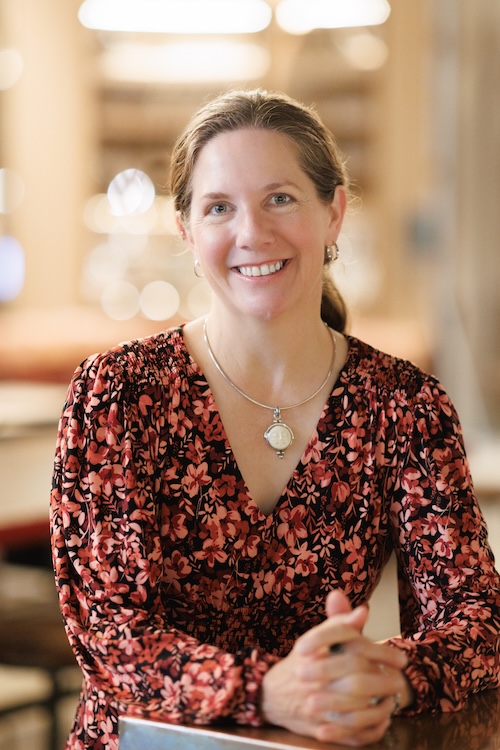
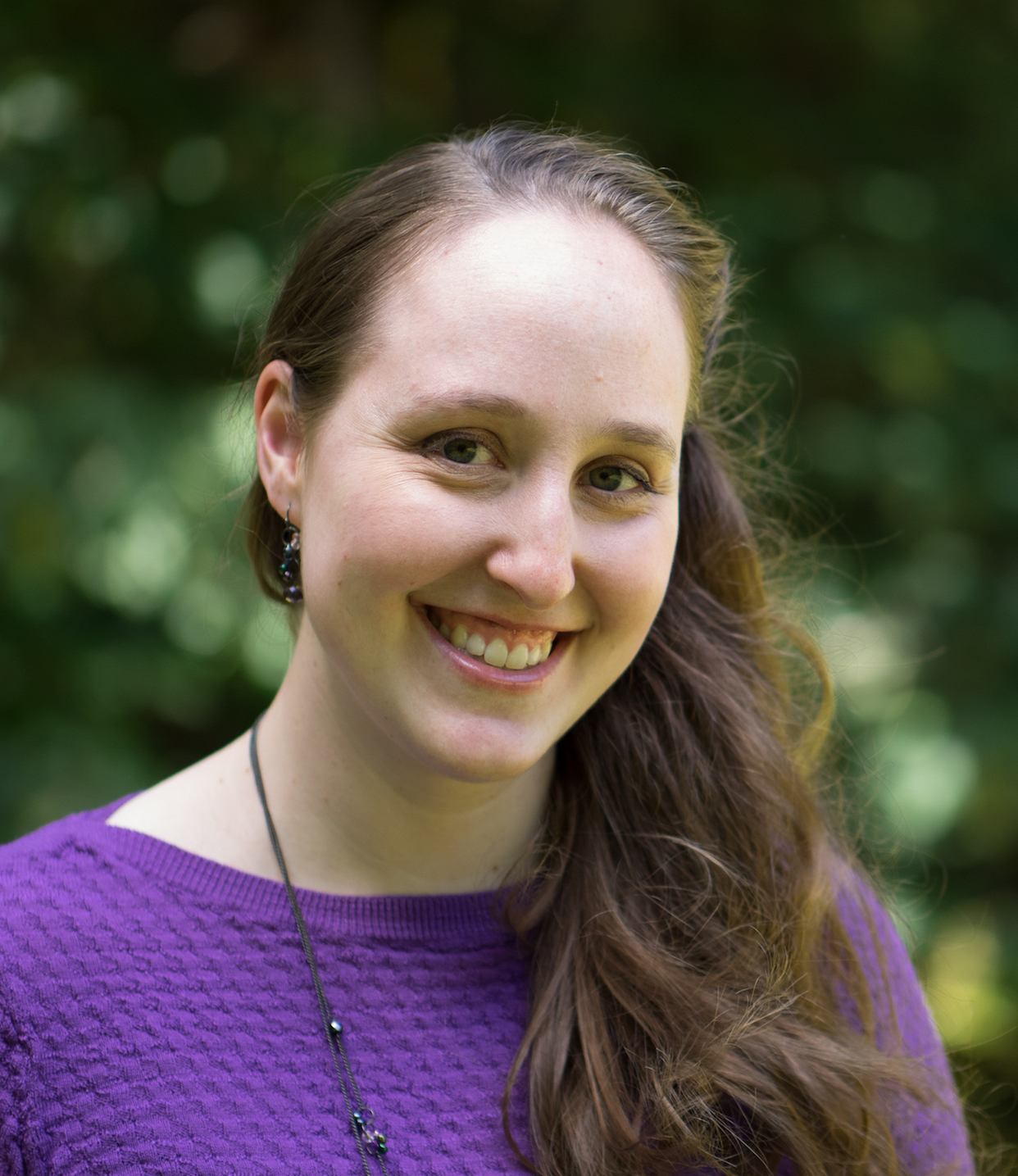
Kathryn Arnold writes fantasy and anything else that sparks her creativity from her home in Kingston, Washington. She currently earns her living as an insurance underwriting assistant, where she also creates marketing and web copy. When not writing, she plays (and teaches) piano and keyboard in a band (or two), and is working on starting a ministry team with her husband. You can find Kathryn at www.skyfirewords.com.