The Novel Journey
Write Your Novel in One Year
The Novel Journey is a year-long novel-writing and author-development experience that takes writers from page one to “the end.”
Write your novel while growing as a writer without impossible word count goals, bending your story into someone else’s plot formula, or sacrificing your voice or vision for genre expectations.
Click below and I’ll explain to you how the program works, everything you’ll get from it, and my unique guarantee. Learn more and book a free discovery call with me today.
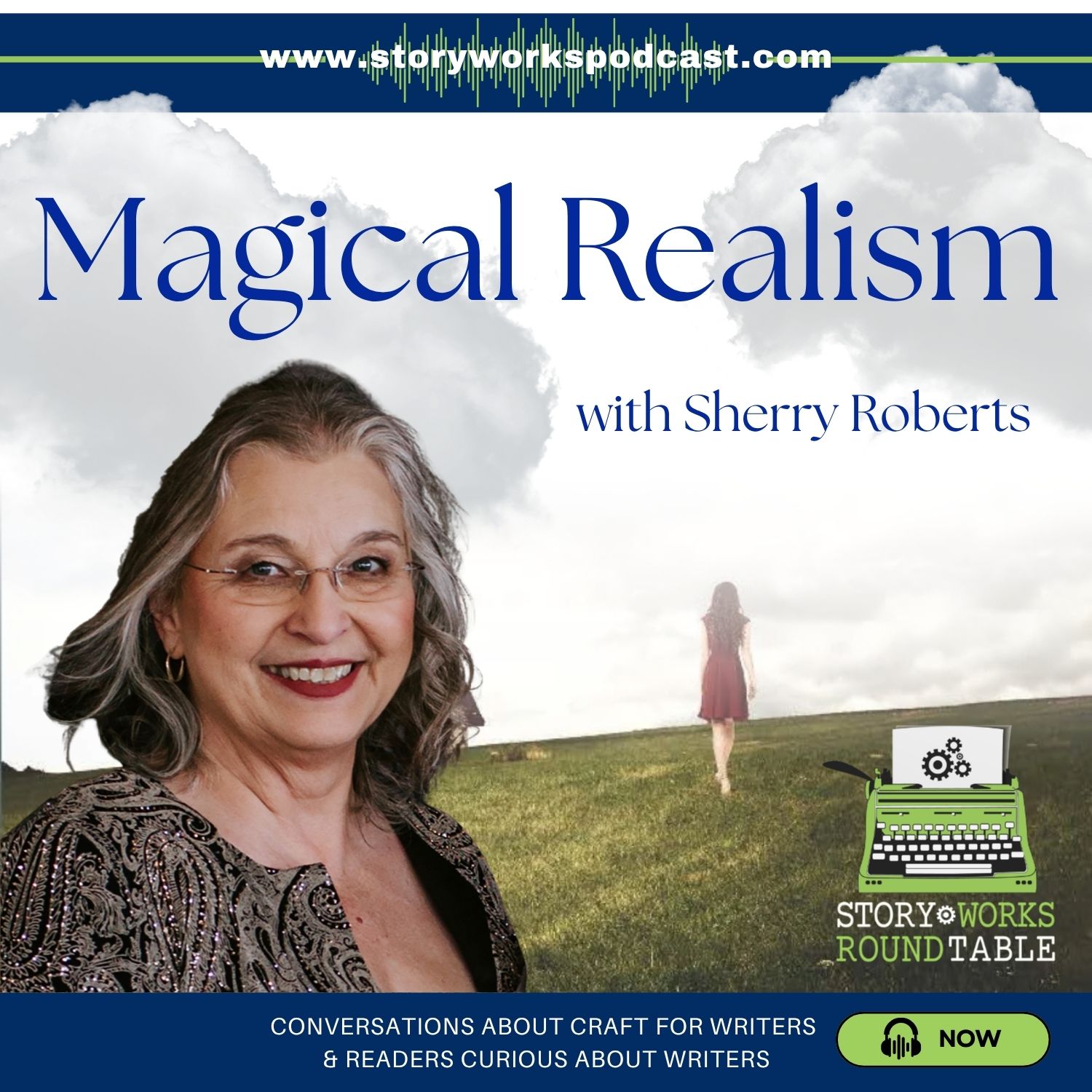
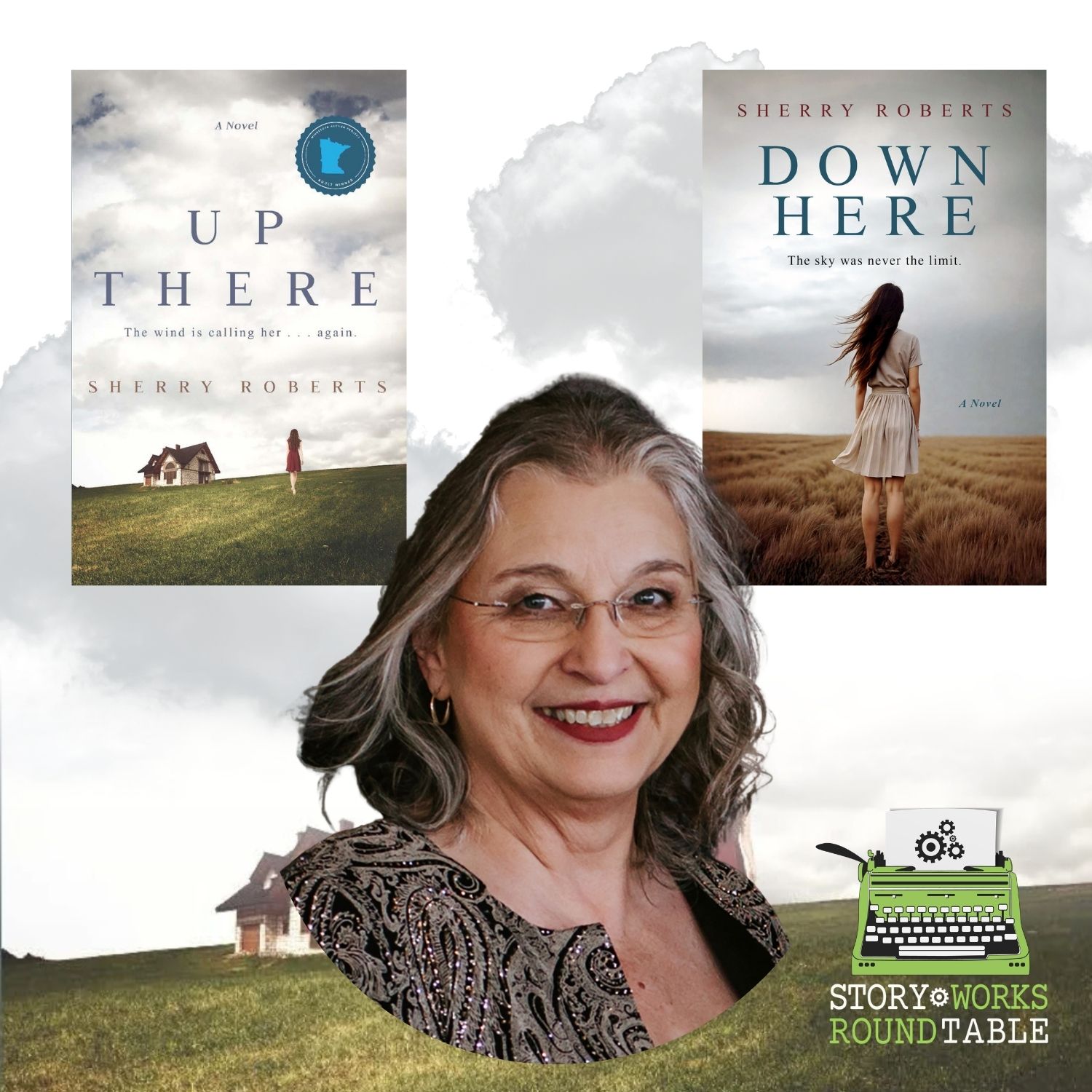
In this episode of the Story Works Round Table, Sherry Roberts joins us to talk about the craft of telling stories using magical realism. Learn how magical realism interacts with story elements, how to introduce it to your reader, and the deeper thematic consequences of using magical realism in your fiction. Join us to learn how magical realism differs from magic systems, how it can support your story, and how it opens up possibility and purpose.
AUDIO
Sherry Roberts is the author of award-winning contemporary fiction (Down Here, Up There, Book of Mercy, Maud’s House) and cozy mysteries (Down Dog Diary, Warrior’s Revenge, Crow Calling). Up There won the 2024 Minnesota Indie Author Project presented by the Minnesota Library Association. Several of her books also are Indie Author Project Select titles as well as finalists in the Midwest Book Awards. Sherry has contributed essays and short stories to various publications including Saint Paul Almanac, Mystery Magazine, Minnesota Not So Nice, Dark Side of the Loon, and It Was a Dark and Stormy NightDontcha Know. She lives in Apple Valley, Minnesota.
TRANSCRIPT
This transcript is AI generated. If you notice any inconsistencies or errors, blame the bot.
Alida Winternheimer: You know those times in life. They come up every so often. More for some of us, less for others. When big change is not just coming, but you’re in the middle of it. I’m in the middle of big change right now.
After 18 years in my current home in Minneapolis, I’m moving. I’m quitting the big city and heading for the country. This is going to be not just a change of locale, but of lifestyle, of how I spend my time, who I know, and even of what matters in a day.
I’m looking forward to settling in and discovering the shape of my new life. And I’m excited for it. I’ve been thinking about how when you’re willing to change, when you’re open and responsive to whatever is happening right now, when you’re not only dreaming but believing in the dream,
that’s when things happen, big things, the things that life turns on. It’s magical. Like, the universe has all this good stuff ready for us, and it’s just been waiting on us. Waiting for us to say, okay, I’m ready and willing. I’m stepping onto the ride. Let’s go for it.
We’re talking about magic today with our guest, Sherry Roberts. Sherry and I met last fall. We’re both winners of the Minnesota Author Project Award, and Both writers of mysteries and of magical realism. It was a real pleasure to have Sherry join us at the Story Works Round Table to talk
about writing magical realism and her award-winning novel Up There. We dive into the craft of using magical realism and How the magical elements interact with the mundane. How to introduce it so the reader accepts it as openly as they would a character driving a car. And we get into the deeper thematic consequences of using magical realism,
among other things that I’m sure you’ll enjoy. Here’s today’s episode with Sherry Roberts. If you’re a dedicated writer who is ready to grow, if you’ve got a novel you’re meant to write, if you’ve been looking for a place where craft, accountability, mentorship, and author development come together, join me in the novel journey.
It’s a year-long mentorship in novel writing with a small group of peers designed to support your development as a writer while you draft your novel. The novel you are uniquely meant to write. The Novel Journey is for writers who crave a guided developmental process from idea
to finished novel while simultaneously becoming the kind of author who can sustain a writing life well beyond one book. Get the details and schedule a free discovery call at wordessential.com slash fictioncoaching. If you enjoy this podcast, we would love it if you would show your support wherever you’re listening to this. Click like and subscribe.
And if you’ve got just an extra minute in your day, that’s all it takes, I promise. Give us a rating and a review. It really helps the show and increases our discoverability. Thanks for listening. And now… Enjoy this conversation at the Story Works Round Table. Hello and welcome to this week’s Story Works Round Table.
Today, Kathryn and I are delighted to be joined by Sherry Roberts. Sherry is the author of award-winning contemporary fiction, Down Here, Up There, Book of Mercy, Maud’s House, and Cozy Mysteries, Down Dog Diary, Warrior’s Revenge, and Crow Calling. Up There won the 2024 Minnesota Indie Author Project, presented by the Minnesota Library Association.
Several of her books are also Indie Author Project select titles, as well as finalists in the Midwest Book Awards. Sherry has contributed essays and short stories to various publications, including St. Paul Almanac, Mystery Magazine, Minnesota Not So Nice, Dark Side of the Loon, And it was a dark and stormy night, don’t you know?
She lives in Apple Valley, Minnesota, and I am cracking up by the Minnesota-isms there. Welcome, Sherry.
Sherry Roberts: Thank you. It’s a pleasure to be here.
Alida Winternheimer: Yes, and we are fellow Minnesotans, fellow Minnesota Author Project Award winners, and we’ve actually had the chance to meet and Hang out and have coffee. So I’m excited to have you on the show today.
Sherry Roberts: Thank you.
Alida Winternheimer: Yeah. So we want to talk about Up There and specifically writing magical realism into stories. So to get us rolling, why don’t you give us the synopsis for Up There? What is this book about?
Sherry Roberts: Okay, Up There is the story of a woman who was born with the gift of flight. And this is a gift that comes down through the women in her family. And so I start off the book, you know, in her childhood, trying to figure out how to deal with the wind and the sky
and what Up There is like. Up There is her name for wind and sky. And it She becomes, she has to, her mother makes her wear very heavy shoes to keep her grounded to the earth. And that, of course, makes her ostracized in classrooms and school friends.
And so she spends a lot of her childhood being the other, being not normal. And she wishes more than anything to be normal. The book moves into when she becomes an adult and she has by that time decided the only way to be normal is to not go up there.
So she denies herself for several years until she once again is called back to the family farm in this little town called Cosette, Minnesota and faces her fears.
Alida Winternheimer: What inspired The story of a girl who was born with the ability to fly. Where did this idea come from?
Sherry Roberts: It came from a video that I saw of a competition in Europe of people who compete in wind tunnels. They go into wind tunnels and they do all kinds of acrobatic moves. And they look just really cool. And I thought, wow, what if someone could actually do that?
I think it’s interesting because I have so many people who say to me, I always dreamed of flying. I dreamed of flying all the time. And I think that the dream of flight, the dream of flying, it’s a dream of transcendence, a dream of becoming something other. And that’s what Ariel Lee, the woman in this book, is.
She wants to become something else than what she is. But what she finds is that she gets her real strength from being up there. But that’s where it sort of started, was that video of seeing those people floating around, you know, they’ve got their legs crossed in lotus position and they’re just,
you know, sipping tea or something in this window. And I just imagined that’s what it would be like for her.
Alida Winternheimer: Wow. Now I want to see this video. That’s amazing.
Sherry Roberts: And who knew that they made a competition of it, right?
Alida Winternheimer: Yeah. Wow, that’s so cool. Are they wearing like squirrel suits or anything to kind of have wings?
Sherry Roberts: No, wings are not part of it all. In fact, I very specifically did not write wings into this book because I didn’t want anyone picturing them flapping their arms like crazy in the air, right? So I didn’t want that. So what you’ll see is you’ll see people in these aerodynamic suits
and helmets wearing That go through this doorway and as soon as they step through the door, they’re swished up into this big cylinder that they can then do their act. And I wanted to try it, but I was afraid that I wouldn’t be able to get out of the cylinder.
Because it seems to me the hardest part of it is walking in, walking, getting lower enough that you can walk from air to nothingness through that cylinder, the little tunnel that gets you into the cylinder anyway. So I didn’t try it personally, but I think that Ariel would.
Alida Winternheimer: Yeah, that’d be really interesting research to do for your book. You know, the things we do for our art. So when you wrote this, you said, okay, what would it be like if you can fly? I’m going to write this story. Were you thinking about magical realism as…
Like a part of your genre, like, okay, I’m writing a magical realism story. This is what I have to do as an author. These are the parameters or was it more just here’s a girl she’s born with flight. This is what it looks like. You know,
I’m curious if you were sort of consciously thinking in terms of the mechanics of writing or what that, that creative process was like as the story was evolving.
Sherry Roberts: I wasn’t thinking of the mechanics. I was thinking of wonder. I wanted the audience to wonder. And I think that’s what I look for a lot in books and I look for that in life, you know, that I wanted to create art that the reader would encounter with wonder and say, oh, that’s cool.
I wish I could do that. So the story sort of evolved from that. I really didn’t study the mechanics of magical realism, although I’ve read, you know, Sarah Addison Allen’s work or Gabriel Garcia Marquez, you know, 100 Years of Solitude, who hasn’t read that? The Night Circus by Aaron Morgensen.
I’ve read those things and I’ve just, the magic catches you. And that’s what keeps me reading. And so I wanted the reader to be captured by the magic of Ariel and the magic of up there. So that’s what kept me going. I think it wasn’t I wasn’t following any rules. I was and the rules that I did follow was the rule that was character development. I really, really studied a lot about character development while I was writing those books
because I wanted to show growth and what was going to happen with character with Ariel. How was she going to develop? What was she going to fear? How was she going to get over her fear? What kind of person was she going to become?
Alida Winternheimer: Yeah, I wonder if that’s true of all the writers who write magical realism, if that’s maybe one of the sort of lines between magical realism and fantasy. You know, when I wrote A Stone’s Throw, I would say exactly what you said. I wasn’t thinking about the mechanics of it.
I was just thinking about And as this is happening, what would it be like? And how would this come about? And I think because the magic is in the world and is real and it isn’t like something people are trying to do with spells or wands or,
you know, we aren’t inventing a system of magic in our world building. I don’t know. I wonder, I’m just thinking that off the cuff. I wonder what you would think, Sherry, if you agree. I like
Sherry Roberts: the contrast between reality and magic in reality. I like that you’re dealing with, you’re grounded in a realistic place that just has some really odd and unusual magical things that are happening there that you can still relate to. You know, if, for example, you know, I can relate to trees talk to each other.
You know, they protect each other. That’s magic. You know, water and wind carry memories. That’s magic. You know, a smart crow can trick a car into smashing its food so it can eat better. All those things express wonder in me. And I think that’s what I wanted in the book.
I wanted people to say, oh, yeah, I wanted to fly at one time. I dreamed of flying.
Alida Winternheimer: Yeah. So why start with Ariel as a little girl in the heavy shoes? Was that always the plan or did you have her starting? Later as an adult character and then decide, no, you really needed to write in this childhood part. I’m curious about the development of the story arc and your structure.
Sherry Roberts: Well, I, a lot of times I will get a scene in my head, not just a scene, but an image and the image of a child in heavy shoes. That was the image in my head and that started out with the book as well,
is that I wanted to show this kid is having a lot of trouble and the mother is having trouble because the mother is not born with the gift of flight. So she can’t guide the kid. So she’s trying to figure just how to protect,
she’s a single mother trying to protect her kid from all of the bad things that are coming to her in the world. So she puts these very heavy shoes on her to try to keep her grounded. And eventually, Ariel has to learn to partner with the wind and control the wind.
And when she does that around the age of 10, everything changes. She doesn’t have to wear the shoes anymore. But she’s still considered an outsider at school and among kids and the bus and things like that. So I wanted to start out young and show that That she had a tough time from the very beginning.
And so the whole first act is just her childhood, those from age five to 16 or 18. And then from act two on out, she’s an adult. She’s a, you know, she’s a 29, 30 year old woman who is still trying to find her place in this world.
And I wrote this entire, the first draft of this book entirely during the year of the pandemic. And at that time, I was, you know, we were locked down. No one was going outside. But every day I got to sit at my desk and go outside with Ariel Lee. And that was the coolest thing. So, you know,
I think that I just wanted to start her young and each chapter shows her a different age. So we go through her childhood fairly quickly in act one. We’re not going to… Because that’s when her insecurities start. And that’s when her fears really become enhanced. And that’s what pushes her into a different type of an adult.
Alida Winternheimer: Yeah. So you mentioned the magic. You know, we’ve got magical realism. We’ve got the magical world. We’ve got the real world. You mentioned going outside in nature. Nature is such a strong presence in the story. The way you handle setting is really impressive in this. Are you born and bred here in Minnesota?
Is this what your hometown was like growing up? It is, but my hometown was in Missouri.
Sherry Roberts: It was a small town in Missouri. Okay. But I have always been really connected with nature. I continue to go out in it every day. I love it. I mean, I love to figure out the names of wildflowers and feed my birds and hummingbirds and all of that stuff and identify birds when I’m out on my walk.
So I’m very much into nature. I’m very supportive of natural causes, environmental causes. Environment was a big part of this book as well because I was thinking a lot about that at the time So yeah, I’m used to small towns. My town was less than 5,000 people in Missouri.
And so I kind of know how those people think and how they would really step back from somebody who was that odd. I mean, we’ve all had those kids in school who, you know, those are the kids that are made fun of. And I’ve also considered myself pretty much An outsider like Ariel.
I never felt really comfortable in school. I never felt really comfortable in high school. I’ve always felt I was the person looking in from the outside. And that was also what she was feeling, I think.
Alida Winternheimer: Yeah. So what steps did you take? It’s 2020. You’re in lockdown. You can’t just hop in the car and drive to Central Minnesota and get the flavor of, you know, like country of towns like Cosette. So what steps did you take as a writer to really bring your setting to life and
to ground us in that realism while writing this magical story?
Sherry Roberts: Well, one of the things that happened when I first moved to Minnesota about 20 years ago is my husband took up geocaching. And we traveled all over Minnesota geocaching. We were in little towns, big towns, out in some farmer’s field. We were just in a lot of weird places because our goal was to find a geocache
in every one of the 100 counties or whatever of Minnesota. So a lot of that is, you know, when I look at the Statue of Harriet, Which I make up in, I make up Paul Bunyan’s Sister Harriet for this book. And I put a statue in the town’s park.
Well, you know, I saw the statue of Paul Bunyan’s girlfriend in that little town up north. And it was very much in my mind when I was writing that scene. So yeah, a lot of times I will just, what I did was I picked a town, a small town in Minnesota.
And I researched it in terms of demographically, would this town have, it was small, but would it have enough people to have a hospital or a clinic or a library? So I did all of that type of thing online as I sort of searched around for Minnesota towns that were in that size and what did they have
and how were they laid out? But a lot of it is just from traveling around Minnesota and picking up odd things.
Alida Winternheimer: Yeah. Yeah. So tell us what the story is about. And there, let me unpack the question a little bit. So there’s all, you know, stories are always about multiple things. It’s layered. There’s the plot level and there’s the theme level. And we know the stories about a girl who can fly, right?
And it’s also very much about environmentalism versus economic opportunity in a small town like this. And how do you weigh one versus the other? And There are multiple themes in this story. You’ve already identified a couple, but I’d like you to speak to what you think the story is about and the interplay
of these different story threads and maybe even what you want readers to take away from the story.
Sherry Roberts: I think that I want readers to connect with the idea that being different is okay. That’s what I wanted again and again. You know, I’m a grandmother. I’m seeing my grandchildren dealing with stuff in their schools. And I wanted all of them to say, it’s okay to be different. It’s okay not to do what everybody else does.
It’s okay not to, you know, go off the cliff like all the other lemmings. You know, it’s just, that was one of the big themes that came coming in my head again and again. It’s okay to be different. It’s okay to, But also during that time frame that I was writing this book,
which was during the pandemic, it was also a very political time. There were lots of things going on with our country. People who were refusing masks, people who were wanting masks, people who, you know, couldn’t understand why someone would support someone who doesn’t want a mask. There was all that going on at the time.
And so I was, you know, kind of thinking, we’re living in a changing world. And how do we handle it? Who do we become? Don’t we all change all the time in a changing world? Don’t we all become something else? Maybe I know myself that I discovered things about myself during that time that I didn’t know.
You know, I might have said, oh, I thought that neighbor always thought the way I did when he doesn’t or she doesn’t. And then how do I handle that when I see them on the street or hiking trail or wherever? So I think that that was a big thing, too, that I was trying to figure out.
The world is not going to stop changing. And it hasn’t since then. It keeps changing tremendously. And so we have to keep adapting to it and we have to keep changing. But sometimes people don’t want to change. And then what happens to those people?
So I was forcing Ariel to face this changing world that she was in and just to start taking stands. I think that we have to figure out how to take stands and still live with each other.
Kathryn Arnold: That thematic idea of changing and then you have that element of the magical realism with the wind, which is like maybe the most changeable element of weather or, you know, the things that we interact with in the world. I want to talk about the way that you handle perspective and kind of using that idea of the wind.
For me, after the first couple of chapters, I sort of felt like we were blowing through the town. And getting into whatever the wind was in, you know, the wind kind of directed us through that and being able to see the changes, not just in Ariel, but in the town and in the people that surrounded her.
So can you talk about the choice of that, the way that you use the perspective and the wind in that way?
Sherry Roberts: Okay. Before I, as I was writing this, I started setting a challenge for myself. To see how many times I could use wind words without saying wind. So, you know, I had a whole list of wind words, squall, you know, dervish. It just went on and on and on. And I was trying to think,
how can I use these in this book without continuing to say wind and wind and wind. So, so… That’s part of the flavor, I think, that you’re finding in the book is a little bit is that there’s always some different terms for wind in there, but there’s also some ways of using wind terms for other things.
I’m trying to remember an example in particular, like their hair. I always often zoned in on what was happening with their hair because their head was If you’re outside in the wind all the time, your hair is always a mess and it’s always tangled. And so that was part of the thing of their personality.
I don’t really get into characters’ eye colors or that kind of stuff. I really want to know what’s impacting them from their surroundings. And wind was definitely one thing that was impacting Ariel and the other people in their lives. And it And then you have the whole meteorological aspects with Ruddy,
the boy who is the love interest in this book. He’s a kid who went to school with her and he’s always known what he wanted to do. He’s the opposite of her. She’s never known what she’s going to do. She’s never known how to go forward.
And he has always known I am going exactly where I’m going to be. I’m going to be a meteorologist. So he was a fun character too, is to think about how he was going to face meteorology. How does a meteorologist go out the door every morning and look at the clouds
and go, cool, what’s this day gonna look like? And then, you know, they’re just, I read Paul Douglas every day in the newspaper because I like the way he writes about weather.
But so that was a part of the thing, writing some weather words To do with Ruddy and the meteorology and contrasting those two. And then there are times when things got really calm in the book. Where is the wind? You know, when she’s at the age of 10,
when she discovers that she’s just tired of the shoes and she throws them away and suddenly the wind is picking at her, picking at her hair and saying, come on, let’s play, let’s play. And she’s just angry and she doesn’t want any part of it. And she just says, stop, leave me alone.
And when the wind leaves her alone, it’s like living in a vacuum. There’s no air. Nothing is surrounding you. Nothing’s pushing or pulling you. You’re just there. And she didn’t realize that she didn’t like that. The wind was so much a part of her by then that that’s
when she started really learning how to work with the wind and to walk the wind. Walk the stairway to heaven. I love that. I love thinking of a mime, walking the stairs up into heaven with that wind supporting her. So I think, I just think wind is so cool. I love wind in Minnesota.
I’m outside in the wind all the time if I can be there.
Alida Winternheimer: Yeah, I love how the wind is personified and I felt like the wind’s presence Grew as the story went on. And, you know, earlier on, it seemed like an element, a natural force. And yes, Ariel spoke to it and it responded some, you know,
and then she has her period where she’s in the cities and she’s rejecting who she is and then comes back to the farm in Cosette and, um, From that point forward, the wind really seemed like more of a character, like it had more of an identity, if not a personality.
I wouldn’t go so far as to say it was anthropomorphized, but it just… And I enjoyed the expansion of the wind, the way I felt like… Maybe, and I don’t know if this is what you were thinking, but maybe as a child, Ariel can only relate to it as a child. And so it’s a little more amorphous,
a little more of a presence than a being, even though I said I wouldn’t anthropomorphize, right? But I thought that was interesting. Were you conscious of that while you were writing or revising? Were you developing the wind over the course of the story with An eye to, you know, how the reader would perceive and conceptualize its role?
Sherry Roberts: I think it evolved. It evolved because in the beginning of the book, she’s a kid. And what do you know about the things around you? You just kind of take them. You don’t analyze. And as when she’s older, She’s, the relationship between her and the wind becomes even stronger because she’s older,
the wind is more demanding and she’s more demanding of the wind. So she, her relationship with the wind gets, she realizes that she can do things with the wind that she wasn’t, she never thought of doing when she was a kid. The kid was just, oh, float in the air, this is fun, you know?
But as an adult, she’s gotta figure out some ways To figure out what she’s supposed to be doing with the wind. And that’s part of the book is that, you know, what is her purpose in life? She’s got this special gift and the wind is there to show her,
to sort of teach her what’s in store for her or what she needs to do. And so then I started adding a little more conversation between Ariel and the wind as the book got along. Because I guess the wind got stronger.
Alida Winternheimer: If you’re serious about your craft and ready to take your writing to the next level, check out Word Essential. That’s my home for developmental editing, writer’s coaching, and workshops tailored for serious writers of fiction and nonfiction. Whether you’re drafting your first book or polishing your fifth, I bring decades of experience to the table as a published,
award-winning author, teacher, and editor. I work one-on-one with writers to dig deep into story, structure, and craft. So if you’re looking for expert guidance that’s both insightful and actionable, head to wordessential.com and let’s talk about how I can help you reach your writing goals.
Kathryn Arnold: I do wonder, cause I think the magical realism really does bring a different dimension to the story that wouldn’t, I mean, obviously it wouldn’t be there without it, but you know, we do have at the very base level, we have this story of this girl who is getting overcoming fears.
So what drew you to using that magical realism to like punch that up rather than just letting her go through something that was kind of a more normal, you know, occurrence in people’s lives?
Sherry Roberts: Um, One of the things about fear is that she’s afraid of letting her secret out. So this book is a lot about secrets. You know, she lives a secret life and she and her mother is drilled into her. You don’t let anyone know what you can do,
you know, and so she has lived a secret life even with her best friend. She doesn’t tell her best friends. She doesn’t tell anyone. And I think that that The secret part is very important because I think we all keep secrets and they change us.
Sometimes they change us for the good and sometimes they change us for the bad. And they lead us down different paths depending on how much we want to protect them. So that was, I think I have forgotten your question now, but that was the idea was fear and secrets. Came up together in my head again and again.
And what can you fear? What secret can you fear? You can, revelation, you can fear that someone is going to find out what you are and who you are. And especially if you are Ariel and you, she’s not ashamed of what she is, but she just doesn’t like it.
She just wants to be an ordinary person, an ordinary kid. You know, there’s something in the book that says, you know, Blinka, her best friend, is sort of an oddball kid. And she has an oddball grandmother who gives her a lot of courage. And, you know, the grandmother Trout,
Blinka Trout’s grandmother would say, you know, everybody is, no one is normal. Everybody is not normal. And, you know, Ariel would reply that not being normal is the worst thing in the world to her.
Kathryn Arnold: Well, and her, with the magical realism, with the wind, she’s the epitome of not normal, right? Like there’s nobody else
Sherry Roberts: who can do what she can do. There’s nobody else that can do it. That’s right. And so that means that if no one else is going to be able to do it, that means there must be a reason she can do it.
Alida Winternheimer: Mm-hmm.
Sherry Roberts: What is her purpose in life?
Alida Winternheimer: Yeah.
Sherry Roberts: And I think you get to that by the end of the book. I don’t know if I want to spoiler alerts, but you get to that at the end of the book, finding out when she truly discovers what her true purpose is.
Alida Winternheimer: Mm-hmm. Why tell the story of it’s okay to be different, right? And conservation and the other themes running through this with the magical realism of this girl who can talk to and walk and fly the wind as opposed to just giving her some other obvious difference as a child that makes her grapple
with Her identity and whether this makes her an oddball or as a gift and all these other issues. Why choose magical realism for the story?
Sherry Roberts: I think I chose magical realism for the story because of the environmental aspect. Because I didn’t want her to disabled in any way. I didn’t want her to have a, You know, have emotional or psychotic, you know, problems. I wanted the environment to have an impact on her.
And I wanted her to realize that the environment was important, not only to her, but to everyone, to all of us. So I’ve been a very big supporter of environmental causes for the last few years. And my last I wrote the book before I wrote this was a mystery and that had a lot
of environmental stuff in it too. So I was already on an environmental kick as I was going into this book.
So it became natural to have Ariel being an environmental writer. It became natural for her to make friends with a retired science teacher who was there at the original Days of environmental activism. And that gave me an opportunity to do a little bit of info dumping, I guess. But it was fun that way.
I liked doing the research on that and doing the Earth Day research and having her connection with Earth Day and having the teacher’s connection with Earth Day. And there being a reporter, a journalist, she would do a story about Earth Day. That was a natural.
So I think that the key to putting magical realism in is making it believable, but not just believable, but for me not to explain it. It just is. It just is. That’s why I started out with that very young scene of her Forgetting
to put her her heavy shoes on and going outside and the wind just taking her up in the air and whipping her around and banging her into the house and breaking her arm. So that you know to think my kid is up in the air floating around up there being whisked around playing with the wind
that you know that was magical realism and it was accepted from the very beginning then because we knew that something was gonna She had a part with us. She had a part in the winds story. I think this is a wind story, too. Yeah, I think I did.
I’ve done a lot of and a lot of research about wind and storms and what what what happens in those. As a reporter, I used to do things like chase tornadoes, you know, trying to As I was covering tornadoes in Missouri, I would do that. And wind is something that Minnesotans are very conscious of. Wind and weather. We always talk about the weather. Yes.
Alida Winternheimer: Yeah. I think you touched on a really important point about magical realism that what distinguishes it from fantasy is that it is accepted As maybe not normal, it can still be exceptional or weird, but it’s within the realm of the story. It’s just this thing that happens.
And so the magic has to be as real as everything that is ordinary, that is the realism part of it. And thinking on the question I asked you, why use magical realism instead of something And then applying that question to my magical realism, the stone’s throw, I think,
I mean, it’s absolutely fine just to say that’s what I was inspired to write, right? That’s the story that came to me. It’s what I wanted to play with as a writer. We get to do that. But then beyond that, You know, like with A Stone’s Throw, the protagonist, Simona, is pregnant and she’s a painter.
She’s an artist. So there’s all of this creative energy sort of running through her and through the story. And she’s longing for something. She never knew her mother. So she’s longing for a connection to not just her mother, but to mother wisdom, to guidance,
to sort of a female Community that can kind of mentor her through this time. And so then the woman she’s painting in a mural comes out of the mural. It kind of comes to life and that’s the magical realism there. So there’s also this kind of logic and internal logic to the story that I think I was
Conscious of inventing, but was, you know, like you needed, it’s necessary the story. And I wonder if you feel that way about the backstory with Ariel’s grandmother and even like if her mother hadn’t seen the grandmother flying, if she hadn’t grown up with her own secret,
it would have been that much more terrifying to see Ariel Get picked up by the wind and everything. So, yeah, I’m just wondering if you have thoughts on that kind of internal logic of magical realism.
Sherry Roberts: I think what makes magical realism work is that the characters accept it. Not the reader necessarily, but the characters accept it. So from the very beginning, Ariel and her mother accept this condition that she has, or it’s not a condition, it’s a gift, that Accepts this. And, you know, life is going to go on.
How do you raise a five-year-old kid who can float the wind? So you’ve got to do something. You’ve got to buy special shoes and try to keep on the ground. How do you, you know, how does you, and then you have to send her to school. And you don’t want her floating around in the school. I mean,
she couldn’t go to a birthday party at a swim pool because suddenly if she has to take her heavy shoes off to go in the swim pool, the wind can whip her into the air. So they accept these problems and these issues that are related to magical realism. And I think that, once again, they just are.
Magical realism just is. This is what is happening now. And it’s not something you have to explain. It’s not something you have to, you know, find it. Find a clear and distinct reason for. Magic realism is kind of fuzzy in some ways. It’s, you know, yeah, I’m gonna step, you know,
you’re inviting the reader, step out on the limb with me and you will have a fun. That’s what you’re saying with magical realism.
Kathryn Arnold: I think of magical realism as a miracle It’s the aberration. It’s the spark that happens that is unexpected and unknown, but it’s not a system. It’s not systemic. There aren’t 18 people throughout the world that have the ability to fly. It’s like the one… It’s this miraculous thing that has happened to her.
And so it is a gift and it’s an opportunity. And then it’s kind of an obligation a little bit. It’s got that like duty portion to it. Like you talked about her purpose where it’s like, I’ve been given this gift, this miracle, this opportunity. What am I going to do with it?
And I think the same thing happens with Simona in Alida’s book too. It’s like she feels this obligation to spend time with them and to understand and to gain this wisdom because she’s been given this gift. She understands it’s fleeting. Ariel, too, she has that statement.
I can choose to be there or not, and this gift is rejectable. That’s for me, that’s the line between where it’s magical realism versus like a magic system is that it’s this miraculous moment and this opportunity for the character to interact with something beyond rather than like an act like a layer of story. Yeah.
Sherry Roberts: Yeah. And, you know, I like the word miracle because that’s exactly what I think you have to have. You have to have a belief in miracles to to write Magical realism and to read magical realism. Because, you know, the most important question that you ask yourself when you’re writing magical realism is, what is possible in this world?
You know, what is possible? You know, you have to have a belief in magic and miracles. And I guess I do. I do believe that. There are too many unexplainable things in this natural world that just knock my socks off. So… I really think that one of the things that people who are intending
to write magical realism is don’t explain the magic too much. Just let it infiltrate the book. Just let it be. And, you know, that’s one of the rings. As I said, I never used the word wings. I didn’t want them flapping their arms. I very seldom use the word flying.
I use the word gift of flight, but I use when walking and when riding. But, you know, things just are. An oak tree can bloom roses, a cake that can make you experience the feelings of a baker. Those just are.
And if people from the very beginning of the book accept that, then I think the reader will too.
Alida Winternheimer: Yeah. Yeah, I think that’s another good takeaway as well as not to explain it, you know? So even though you might have that kind of internal logic of the story, which we need for consistency, we need for coherence through our narrative, it’s not something that gets dissected and analyzed within the story. It’s, as you’ve said, accepted.
Sherry Roberts: Yeah, I think that… I don’t, I didn’t ever want to say how she does this. I wanted to give a background of why she can do this from her heritage. But it’s kind of, you know, the wind and her heritage are the two things that really combine to give her this gift.
So, and I think that That a little bit isn’t connected to the land as well, her farm. Her farm becomes some place that she really feels the closest to her wind. And I’ve written a second book, I can’t talk, I don’t know if I can talk about that or not,
but down here is the second book to this. And in that book, I continued to talk about people who are looking for their wind. Her wind, where is her wind? Her wind is on her farm, but she has a child and maybe her child will find her wind someplace else. Where did her grandmother find her wind?
So I kind of look at that as this very personal, the wind choosing you in that place is the land is part of it, the land and the nature.
Alida Winternheimer: Yeah. So why do you think magical realism, these miracles, speak to us? Why tell these stories? What is it about them?
Sherry Roberts: I think it comes back to transcendence. It gives us an opportunity to be something else. It gives us an opportunity to grow, to advance, to… Be in another place, in another person’s mind. I mean, sure, fiction always does that. But magical realism talks about possibilities. What are the possibilities here?
And wouldn’t it be great if you woke up one morning and you could fly? Or maybe you were dreaming last night of flying. I mean, I’ve had one woman who told me, I dream of flying all the time. And I asked her where she goes.
And she says, I go over the school ground and I look down and I laugh at the teacher. That’s what I want to do.
Alida Winternheimer: So it brings out some other, maybe other issues you might have.
Sherry Roberts: You know, what are the possibilities? What if I could fly? What if I could read minds? What if I could, you know, There are so many things that magical realism can do, but by connecting them with the realistic elements of day-to-day life, they become even more special and precious.
Alida Winternheimer: Yeah. Yeah. I think that’s interesting. I like what you said about possibility, you know, and I think maybe the flip side of possibility is desire or longing. If I, as a reader, invest in Ariel and her gift, and I start thinking, what if I could fly, right? Well, there’s that yearning there.
To transcend, to accept my gift, to be exceptional in whatever way is possible for me, right? So should we take the miracle in the magical realism story as a metaphor for possibility?
Sherry Roberts: Yeah, I suppose so. Yeah. Yeah, probably possibilities. It’s a good idea. It’s also, well, no, that’s too science fiction. I don’t want to say that. I was thinking Star Trek’s going where no man has gone before. But yeah, it’s exploring possibilities and realizing that you have possibilities.
I mean, one of the things is that this book is Being different is beautiful. Exploring that possibility is very cool. And I wish that every kid, every junior high and high school kid could recognize that, to not shut themselves down. I mean, I noticed that. You notice with kids who are getting,
they’re just open and wonderful and talkative and loving to explore things. And then they reach about seven or eight and then the peer pressure starts coming in and they don’t want to be weird. They don’t want to be different. And it wasn’t until I was an adult that I realized that being different was actually kind of cool.
It was a lot more fun. Yes. But then, you know, you have to develop the type of skin that you don’t care what people think. And that’s not something that kids can do. So that’s why I wanted to start the book a little bit with her in her childhood. Sure.
Because you don’t develop a thick skin in childhood. You develop it later. And that’s what growth is about, I guess. So that’s where you start recognizing possibilities. I think that we stop growing. When we stop thinking of possibilities, when we think, oh, I’m just going to sit here. There’s nothing I can do today but grow old.
What are the possibilities? Well, maybe I could stand up on a paddleboard. Maybe if I had good knees, maybe I could. Those are possibilities. Will I try that? I don’t know, but maybe someday. Possibilities. Definitely.
Alida Winternheimer: Yeah. Yeah. Kathryn, you were looking thoughtful a moment ago.
Kathryn Arnold: I think it puts a point on purpose and a little bit on destiny too, because I feel like this idea of finding your wind, the one place you’re supposed to be in this world. And then by the end of the book,
that purpose to be in the community that she’s in and to support and be a part of that wind. And I think Magical realism and that miracle gives you that. It defines more permanently that purpose, I think, and that destiny, and it invites you to fulfill it in a way that is both fulfilling for you and for
the story, obviously. But it’s like possibility, yes, but also the possibility. This purpose-driven, you know, like you have been given this gift. What are you going to do about it? What are you going to, are you going to fulfill it in a way that matters, that makes the difference, that satisfies that gifting?
Sherry Roberts: Yeah, you know, we don’t capture the wind. It’s impossible to capture the wind. And that’s why the wind is it. It’s full of impossibilities. You can’t catch it. You can’t change it. But she tries. She tries very hard to do that and discovers that the only way that she can do
that is if she partners or has a relationship with the wind, you know. So I think if we want to take that out farther, you know, it’s like if we want to If we want to change our natural world, then we’ve got to be out there doing something with it.
We’ve got to establish a relationship with the birds and the trees and everything else in order to affect change.
Alida Winternheimer: So true. Yeah. So what haven’t we talked about related to magical realism? Is there anything we’re missing from this conversation? We talked a little bit about how it’s different from fantasy, maybe where that fuzzy line is and the importance of characters accepting it, not explaining it to the reader,
how it functions as the miraculous in the story and opens up ideas of possibility and purpose. It’s a pretty good list of takeaways, actually. Good summary. Definitely. Yes.
Sherry Roberts: Yeah. Wow. This has been fun. No, the little section that I just started to read gives you more explanation about wind. So I thought it might go into what we were talking about. This is a section when she’s 30 years old, she’s back at the farm wondering what she’s supposed to do.
And she finds a note from her grandmother, whom she inherited her gift from. And so it goes, Dear future granddaughter, if you are reading this, it means I passed before we met. I wish I could see you, hold you, guide you through this time.
I have recently become certain that the wind does not call to my daughter, Sahara. Since our gift sometimes skips a generation, I am guessing that you, future granddaughter, will be a wind rider like me. I know that is scary. There will be days when you curse this friendship with the wind,
and there will be days when it literally makes your heart take flight. When we who ride the wind are young, it is hard. It takes time to realize the connection, how the wind binds with our emotions and responds. And as kids, our emotions are jitterbugs on the water all over the place.
I can’t tell you how many times I accidentally wind wrecked something because I was in a smit or thoughtless. I call this confused bratty wind. Then you will grow older and learn to dance with the wind. You will fly. The air will lift you, fill you, and your heart will sing at every new experience.
You will have fun and can’t wait to step into the air. I call this playmate wind. Finally, though, you will discover that you have the power to meld with the wind, work with it, and partner with it. This is when you realize that you are not just wind, but you are sky and trees and grass.
You are of the elements. Your heart beats with theirs. Your cells respond to the call of their cells. You hear the hum of the earth. I call this true friend wind. You probably found my journal in the loft, in the barn, my writing place. It is like a treehouse there, and I feel comfortable in trees.
Is it the same with you? When no one is looking, I would stand by the hay door, call for my husband Will, and then step out into the air and float into his arms. It was like drifting home. Granddaughter, I am sure of one thing. This land and the wind that roams here will never abandon you.
They will rejoice with you in your happiest times. They will heal you in your darkest moments. The wind will comfort you, whisper to you, sing to you. Answer it. Listen to it. Do not be afraid of who you are. Do not be afraid to be extraordinary.
Alida Winternheimer: That’s lovely. That’s a calling. It strikes me as a calling, not just to Ariel, but to the readers as well and to every person to recognize our connection to nature, to the trees, to the sky, to the land, and to answer that call on the level of awareness and appreciation for the gift that the earth is,
but then At the end of that letter to answer the call to not be afraid to be exceptional.
Sherry Roberts: Yes.
Alida Winternheimer: Yeah. Yeah. Lovely.
Sherry Roberts: That’s one of the themes.
Alida Winternheimer: Yes. Yes. A very strong theme in this book and a beautiful one. Thank you so much for reading that. Thank you. And thank you for letting me come and talk to you. It’s been delightful. Our pleasure. Sherry, where can our listeners find you and your books?
Sherry Roberts: I have a website, sherry-roberts.com. All my books are available there. And I talk a little bit about what’s going on with writing the book and where I came from for that. So, yeah, I have people go to sherry-roberts.com and send me a note on the contact page or read about the books. There are seven books now.
Up there is the sixth and down here is the seventh. And up there is really about learning what she needs to learn up there. And down here then realizes that she’s got to learn a whole new set of things to deal with life down here on the earth, given her skills and her, you know, it’s a,
The down here is five years, six years after up here. So by then she is married. She has a child who has inherited her gift and she’s got to teach her child how to deal with it. And she has to face her old shadows. She does not want to put the heavy shoes on her child.
She has to teach her child to figure out how to deal with the wind early on, but she also has to teach her how to keep secrets. And do you know how to keep a five-year-old how to keep secrets? It’s very difficult. So the book that follows up is another different place as well.
It was interesting when I was writing the second book, I actually felt a maturity in her character. That I hadn’t felt in the first book.
Alida Winternheimer: Yeah.
Sherry Roberts: So I think that’s what happens when you become a mother and a wife. You just, you know, start tackling things a little differently.
Alida Winternheimer: Yeah. Yeah, that’s interesting. We could do a whole nother episode on the growth of our characters.
Kathryn Arnold: Yeah, absolutely.
Alida Winternheimer: All right. Well, thank you so much for joining us at the Story Works Round Table. This has been such a pleasure. Thank you. It was a lot of fun. I love talking to you ladies.
About Your Hosts