
Memory • Emotion • Body
Writing begins with ourselves,
our unique memories, emotions, and embodied experiences.
In this immersive weekend workshop and retreat, we will work with our memory, emotion, and body to explore what it means to bring the power of our unique experience to life in our writing. Held in a private, virtual room, this retreat is a safe space to explore the story you need to tell.
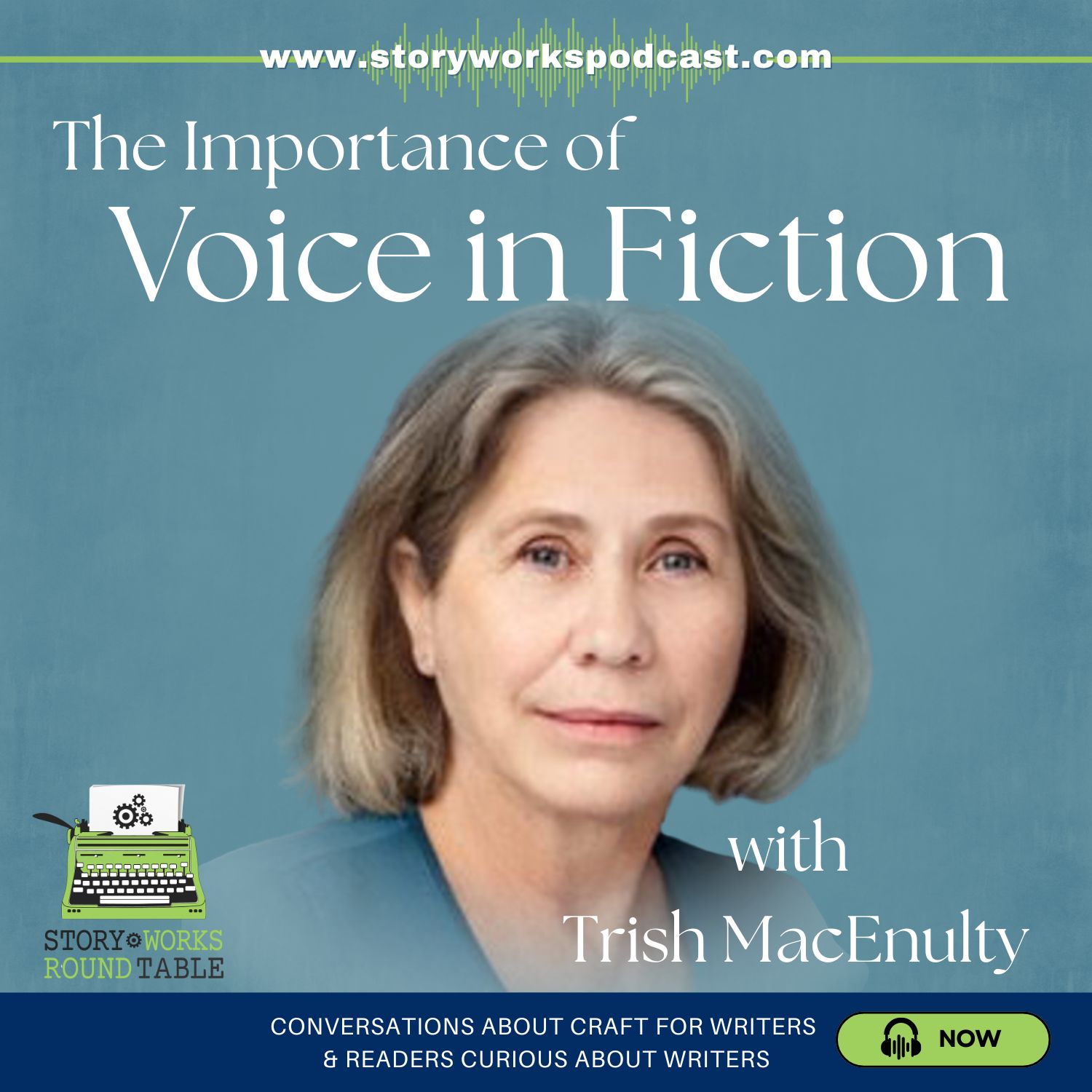
In this week’s episode of the Story Works Round Table, Alida and Kathryn are joined by Trish MacEnulty, an accomplished author known for her award-winning historical novels and mysteries. Together, we explore the essential role of voice in fiction, discussing how a strong narrative voice can captivate readers and set a story apart in a crowded literary landscape. Trish shares her insights on defining voice, the importance of individuality, and the tools writers can use to craft memorable narratives. Whether you’re a seasoned writer or just starting your journey, this episode is packed with valuable advice and inspiration!
AUDIO
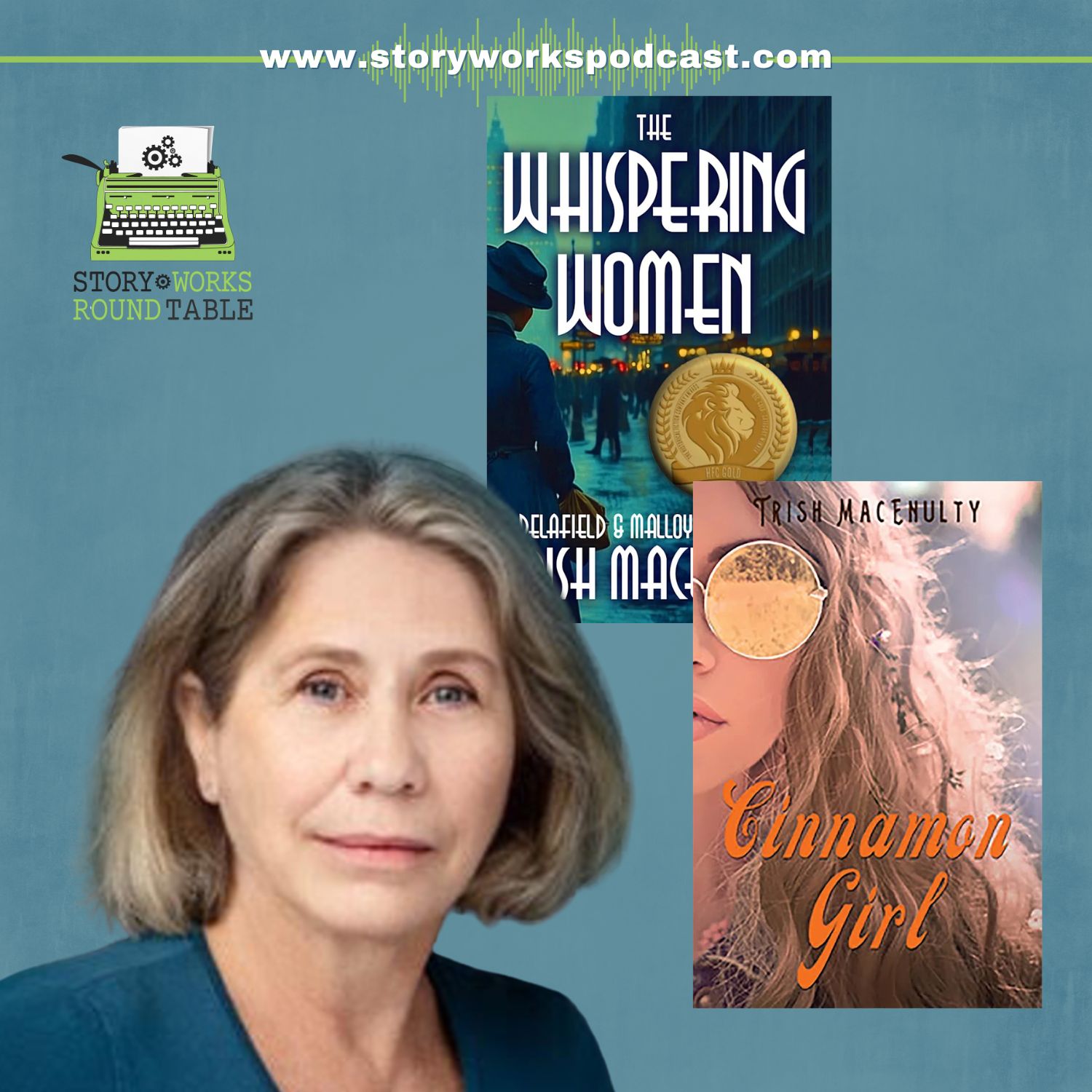
Trish MacEnulty has written novels, short stories, journalism, children’s play, and memoirs. Like her great grandmother and her protagonist Louisa Delafield, she once even wrote a society column. A former professor of English at Johnson and Wales University in Charlotte, North Carolina, Trish now lives in Tallahassee with her husband, dog, and cat, and teaches for the School of Journalism at Florida A&M University. She currently writes book reviews and features for the Historical Novel Review. Some of her publications appear under the name “Pat MacEnulty.” She is the proud mama of a recent law school graduate and criminal justice advocate. When not writing, teaching, reading, or walking her dog, she might be found gathering chanterelle mushrooms, cooking, or going out with her husband to hear her stepson’s jazz and old-time performances.
TRANSCRIPT
This transcript is AI generated. If you notice any inconsistencies or errors, blame the bot.
Alida Winternheimer: Hello and welcome to this week’s Story Works Round Table. Today, Catherine and I are delighted to be joined by Trish MacEnulty. Trish is the author of the award winning historical coming of age novel, Cinnamon Girls, as well as the Amazon best selling historical mystery series, Delafield and Molloy Investigations. She’s also written two memoirs, short stories, essays and children’s plays. She lives in Tallahassee, Florida with her husband and book publishing partner and she teaches a class in magazine writing at Florida A and M University. Welcome, Trish.
Trish MacEnulty: Thank you. It’s so good to be here with you, Alida. Yeah, Catherine.
Alida Winternheimer: Yeah, we are excited. Yeah. So we wanted to talk about the importance of voice in fiction. And you know, I like to open with sort of a general question. So why this topic? Why is this worthy of a podcast episode, Voice and Fiction?
Trish MacEnulty: well, it’s my. One of my favorite topics when I talk about writing. Because a good voice, if you get that voice right, it can write a short story for you. It can, it just can pull you along. And sometimes it’s hard to find the voice though, you know, and sometimes we think we have the voice and then we lose it. but I’m sure you know that in your own reading that those books that really pull you and keep you up late at night, which happened to me just a couple of nights ago where I couldn’t stop reading till I finished the book and, and I was miserable the next day. But it was this character’s voice. so. And I think especially now because there’s so much out there, there are so many people putting books out there. And you have to be somehow. You somehow have to stand out. You have to be singular. You have to be something. You have to give them something, give your readers something that they haven’t encountered before. And that’s usually the voice.
Alida Winternheimer: Yeah, definitely. So how do you define voice then? You know, I think everybody understands the idea of the character’s voice because we have speaking voices. But when you’re thinking of writing and shaping the voice of a piece, so often we’re referring to the narrative voice, and then that gets kind of amorphous for people, I think, right?
Trish MacEnulty: Oh, it does. And then it gets confused with point of view. It. Third person, is it first person, is it omniscient? but I think that rather than a definition, I can give you four qualities of a memorable voice. One of them is that it is individual. It is an, an individual. I’m a teacher. Right. So I’m teaching a magazine writing class. And sometimes my students have been. So I’m, Brainwashed isn’t the right word. But they’ve been conditioned by English teachers to speak in this. To write in this very academic way. And they. Each one sounds just like the other. Or it’s also, you know, this is. I’m teaching in a journalism school. And so if they’re writing a news story, who, what, when and where they. Again, they could. They’ll all sound exactly alike. And so a, voice, the quality of a memorable voice, is one that is individual. It doesn’t sound like every other voice. It’s also informed. It has to be knowledgeable about its particular world, and it has to have a personality. I will. I am very forgiving as a teacher if I get a paper. And there is a personality behind that, you know, so it has to have a personality. And then I think the most important thing is that it has to have something to say. So that voice has the. The. You want a sense of urgency. I have a story to tell. I’ve got to tell you right now. It can’t wait. We. We have to. We have. I have to tell you the story right now. And, I think those are the four qualities. Individual, informed, personality, and something to say.
Alida Winternheimer: M. Beautiful. I love that. Yeah, that Could. We could just end the show right now because that covers it, right? Wow. so, okay. Not like everyone else. Is that the individuality piece? What if there are some listeners, maybe some younger or newer writers who are thinking, well, if I just write, I am an individual, therefore my voice must be individual. It must be unique to me because it’s mine. And yet, we more experienced writers know that we work at voice, don’t we? We hone it. We think about it. We shape it to the individual piece, even though it’s us writing. You know, I know my historical work does not sound the same as my mystery work, does not sound the same as my essay work, even though it’s all me. So I’d love to dig into that a bit.
Trish MacEnulty: One of, the. I give my students, and when I teach workshops, I also give this exercise. I ask them to think of all of the different people they have in their head. So you have your little girl self or your little boy self. You have your mother self. You have your professor self. You have a sexy beast self. you have these various selves, these various people inside your head. And one of the, I think techniques of being a writer is to pull. Pull them out and. And let Them speak. Because we’re so busy censoring ourselves. I think that’s one of the main things we have to do is turn off the sensors. so I always recommend just in this. I’m not. This is something I think every writer does or recommends. And that’s just doing those free rights where you let it come out and you do not censor yourself and you don’t worry about how it sounds. And that’s. And just doing that as practice. It’s like, okay, this is practice not putting the pressure on yourself that the first time I put something down, it’s got to be perfect. So that is, I think one way to find that, that individuality and to realize that, yeah, you do have different voices. And I’m, I totally agree with you. Because when I write a book review, I sound very different from when I’m writing from the point of view of, a, ah, 19th century woman in Hell’s Kitchen. Okay. Those are two very distinct voices.
Kathryn Arnold: Can we talk? Tools that make those different voices, like I’m thinking in my brain as I’m hearing this, I’m thinking, you know, what, what makes up my personality? What kind of word choice or what kind of experiences I have that change the way that I would explain something or maybe, sorry, like cadence of words or rhythm. Like what sort of tools do we have in our tool bag to affect that voice and to make it more individual or reflect our personality?
Trish MacEnulty: That is brilliant. That is such a great question. and they’re exactly the ones you mentioned. Cadence. I often, suggest just writing poetry, reading poetry, going to poetry readings. I think actually that’s one of the best tools. One of the exercises I give my students is to write a repetition poem where they might start off with a word or they might start off with a phrase, or just, just to get that idea of rhythm. So, yeah, rhythm, dialect, of course, you want to be careful with dialect because it can become, it can interfere with a reader understanding what they’re trying to read. so you want to be careful with dialect, but syntax, we speak in, we speak differently from one another. I’m, I’m sorry, I’m gonna have to. Let me, let me start that one again. I’m losing myself. repetition, cadence, and just imagination. Quite honestly, imagination is your greatest tool.
Trish MacEnulty: Sometimes. Well, I wrote an essay for a magazine a couple years ago that was personifying success. So personification, Persona, voices. there’s a wonderful poetry anthology called the Spoon River Anthology. And in it I think his name’s Edgar Lee Masters. I believe he goes in a cemetery. And actually this is another great exercise. I’ve taken students to a cemetery before and said pick out somebody and tell their story. And so that’s always fun. especially some of those crazy names on the tombstones in the cemetery. so I think that there are a lot of tools. What are some tools that you come up with that you can think of?
Kathryn Arnold: Yeah, I mean, that’s what I was saying, like word choice. I kind of feel like as you’re developing, like you had mentioned character voice before and I imagine as you’re developing each, each individual story, you’re probably coming up with kind of a set of rules or a set of maybe guidelines for yourself for how this book sounds. What sort of things I’m avoiding. Does my character sound educated? Does they, do they sound not educated? Like, is that sort of the kind of tools that you’re thinking with voice or is that more character development and not voice?
Trish MacEnulty: Oh, it’s absolutely voice. You’re absolutely right. And diction especially it is. So I wrote a book called Cinema Girl and it is in the voice of a 15 year old girl. And of course I want to have her be able to be expressive. So I have to make sure that she’s a smart 15 year old girl and that she’s read a lot. but then there are limits to how sophisticated her language is going to be. There are limits to how sophisticated her vocabulary is going to be. So, you, and you’ll go through and suddenly go, oh no, she would never say that. Get rid of that. and that’s why also you want to have readers, you want to have people giving you feedback. Because, in fact this just recently happened in one of my writing workshops with one of my friends that she was writing from the point of view of a 12 year old and she absolutely went into the 32 year old. And I said, I don’t think so, you know, so that’s why it’s very helpful to have somebody reading your work and giving kind of feedback when you
Kathryn Arnold: do that with like that difference between the 12 year old or the 14 year old and, and yourself. But there is a, like, there’s that extra layer, like Alita was talking earlier with the narrative voice. Right. So there’s that difference between what my character would say voice wise or how she would sound and then how the narrative as a whole sounds. Or did you kind of just integrate the two? Was your character also acting as your narrator?
Trish MacEnulty: That’s, that is a great question. sometimes I think when you’re writing in first person, you quite often will stay in that voice the whole. Now it can get tricky because you can be a 40 year old looking back on your 15 year old self, right? And, and then every once in a while that 40 year old slips in and, and that’s okay. And says something to the effect of back then I didn’t know. Coming next. You know, and I think that’s fine. It’s still your voice, it’s still your character’s voice. You know, our voices might not change as much as we think they do. Now.
Alida Winternheimer: In my current work in Project, my narrative voice shifts a little bit depending on whose point of view I’m in, because I’ve got characters in very different stratas of, of economics and educations. And so, you know, depending on what’s happening and how closely aligned the narrative is with that character’s perspective, I do notice shifts. And I think, you know, of course, as, as artists, as craftspeople, we go back to our writing and we refine it and we make everything smooth and create continuity. But I think our inner ear plays a, big part in shaping the voice of our writing. You know, if I’m in the river ravine with my dirt poor characters, my narrative takes on a little bit of that tone of their existence, of their perspective. Whereas if I’m in a hospital with an administrator and a doctor, the narrative takes on a little different tone there as well. That sort of suits the environment. And I think it’s. I don’t know if other writers notice this as well. I think, I haven’t necessarily experienced it in other projects because I haven’t had such great fluctuations in setting and in characters. And you, Trish, you write different types of stories across different genres. What sort of play have you noticed in your narrative voice, either from piece to piece or even within a piece?
Trish MacEnulty: I tend to write a really close thread, third person. So not with Cinnamon Girl. Cinnamon Girl was first person. And that’s easy because you’re just in this one character’s point of view and you’re in their head and you’re in their world and it, it becomes, it really is pretty easy. And I think that’s one reason why so many people, so much contemporary fiction is written in the first person because you don’t have that back and forth and that, you know, where. Whose point of view? What am I doing? Where are we? so I think that makes it easier and and like I said, in my Delafield and Malloy investigations, I write a very close third person. So I don’t, I don’t pull out. I don’t do a Jane Austen very often, you know, where she pulls out and she’s looking down on her characters and she’s rearranging their world. I don’t do. That’s, that’s not something that I do very often. And I admire people who can do it. So if you’re doing that, I admire you very much for, pulling that off. but like in my Delafield and Malloy investigations, I have one woman who is from New York. She’s a New Yorker, which is kind of funny because I’m from, the south and I do have a southern accent and I say fix and to and y’, all and you know, this is the way I talk. But Louisa Delafield is a New Yorker from an upper upper class blue blood family who has fallen on hard times. The other character is an Irish immigrant who’s not particularly well educated. but she’s, she’s very, spicy. You know, she’s, she’s, she’s got a lot of spirit. And so it’s kind of fun to go back and forth between these two voices. but as you’re, as you’re saying, if I’m in Louise’s chapter, there’s a more elevated. The, the whole chapter is just a little more elevated. If I’m in, When I’m in Ellen’s chapter. Yeah. Yes. Actually, you know, the dialogue will definitely have her strong voice. I mean, she might say it’s a we, you know, the we child or whatever. she doesn’t say top of the morning. Say that once. I had to do it.
Alida Winternheimer: How could you not?
Trish MacEnulty: but, but the, But the whole chapter will feel a little bit more in that cadence.
Trish MacEnulty: And I think it’s because you just, you have it in your head and that’s the way it’s going to come out. So it makes sense that narrative would shift from one set of characters to another setting and another set of characters to me.
Alida Winternheimer: Yeah. I wonder if there’s a musical analogy to be made here. You know, it’s like when I’m immersed in the set of characters in the hollow in the river ravine, the entire scene, the world, everything happening in my head and through my writing process has a different feel to it. And I think if I put a soundtrack to it, it would be very different from the soundtrack that Goes that plays in some of my other worlds within this story.
Trish MacEnulty: I love that idea. And you know, it is sort of like characters that have their own motif. So in my, in my research for the book that I’m doing right now, I just rewatched Dr. Zhivago. And you remember. I don’t know if you’ve seen it or if you’ve seen it recently. Have you not seen Dr. Zhivago?
Alida Winternheimer: I don’t think I’ve ever watched that. And I should.
Trish MacEnulty: It’s classic. You have to see it. But there’s. The whole movie and book revolves around Lara’s theme. And so whenever Lara comes in the picture, you have this. So yeah, that’s. It’s a theme, I guess would be the right musical comparison.
Alida Winternheimer: Yeah. So what about personality, Something to say, sense of urgency. Do those two qualities apply to the narrative voice equally as they apply to a character’s voice? And if we’re not in first person. Right. If we’re in third or something. Would you describe the narrative with the same four qualities?
Trish MacEnulty: I absolutely would. I mean, think Jane Austin. Another great example is A Gentleman from Moscow or A Gentleman in Moscow. Any that wonderful book. It’s probably my favorite historical fiction. So you would think I would know what the preposition is. But I just, I just love it. And that voice. He is looking. He’s not first person. He’s looking down on his character and he’s so witty and so there’s just this, the subtle sarcasm and it’s, it, it’s just transportive. and I think that. Yes, so yes, definitely personality. And you think of Jane Austen, her opening line. And Pride and Prejudice. Definitely that, that person. That. There’s a reason that line is so famous. It’s because it’s, you know, it’s Jane Austen talking to you, you know, about her world. and I think that having something to tell you. Is this the. That’s the crux of the matter, isn’t it? That’s the thing that makes us keep reading. And it is as it’s plot. It is the plot. But. And I think that it means that the story has to. Something has to be happening in that story immediately. Like the book I just finished that kept me up the other night. It’s a contemporary. I usually read historical fiction, but this was a contemporary book. It’s. And it was called, Ginny Cooper has a Secret. her name is Joy Fielding. It’s. It’s a very popular sort of mass. Popular Book. but she starts off right up, right in the very beginning. This woman is walking through a memory care unit and someone says, I’ve got a secret. And that is, that’s gonna, you’re gonna be like, okay, what? And that’s gonna pull you through. There’s the urgency. I’ve got. I’ve got to tell you my secret. Yeah.
Alida Winternheimer: Yeah, I like that. I think our, our narrators, even if they’re invisible, authorial, you never think about them as a reader. I think the narrator needs to have a purpose, you know, so you’re, you’re telling a story and it’s a good yarn. But beyond that, I often talk to writers about the gift they give the reader. So when you close the book, the reader can walk away feeling like they’ve just received something. And maybe it’s a very simple something, like the warm fuzzy feeling of having just enjoyed a romance. Right. And everything turning out happy at the end. Or maybe it’s feeling knowledgeable. Or maybe it’s something to go contemplate and ruminate over that’s deep and is going to stick with you. Like whatever that is, whether it’s head or heart or, you know, God, wherever it lands with us, it means something. Right. We need to have that throughout the entire narrative to carry the reader through. The urgency, the purpose, the meaning.
Trish MacEnulty: M. Yeah, I absolutely agree with you. I, I’ve phrased that in a different way. Is that you start off with a question. At the end, that question is answered. and I think some of some, you know, in the olden days. So I, I’ve studied a lot of 19th century literature and I love it. But it does quite often start off with page after page of description of the, the, the moors or whatever. And readers today are not as patient as readers were back then. And I think that the urgency becomes even more so. and I, I just started a book last night where the woman. It’s. It’s called, alchemizing or something to. It’s a fantasy and she’s blind and she’s being tortured, like from sentence one. And so, there’s definitely a sense of urgency there. M. That, Yes, I think urgency having something I gotta tell you and I need you to put your phone away. I need to get off social media because I got something really important to tell you.
Alida Winternheimer: Yeah.
Trish MacEnulty: And that’s feeling that that voice has to have. Mm.
Kathryn Arnold: All right. I have a question that maybe will zoom us out a little bit because you write in multiple genres and multiple kind of different formats of writing. Right. Do you feel like you have a unified voice that would like, carry people across? Like I love her voice, the author’s voice, and then that would carry readers across from different genres? Or do you feel like it is so different between your different things that it doesn’t really have that connection?
Trish MacEnulty: That’s, ah, another good question. And I think that probably my voice is very different. I would. So I wrote a memoir called, the Hummingbird Kiss. and I first published it as a novel because I was like, I can’t tell people. I can’t. I can’t tell people. This is true. But it was about my years of addiction. And that is a very gritty voice. and in fact, I had a. It was turned into an audiobook and the young woman who did the narration was absolutely perfect.
Trish MacEnulty: She had the voice. She was able to just tell you some really horrific stuff in a very dry way. Because I think that when you’re. When you’re dealing with things that are, more difficult, sometimes you want a more detached voice. Hm. I think it makes it more powerful. And that then that was the first book that I wrote and the first. I was published originally, like I said, as a novel by, publisher in England. And then years later, after it was out of print, my husband and I published it ourselves as a memoir. And yeah, that is, a very different voice than Delafield and Malloy Investigations, which is, more I like to have. Well, I guess I would say something that would probably go across all of my writing would be a little thread of humor that is in there. So I don’t know of that many people who’ve read me across my genres. There are the people who love my. My two memoirs, absolutely love them. And then they’re the people who love the mystery series. And I’m not sure that they crossed. They might. There may be a few.
Alida Winternheimer: Yeah. Catherine, I’m curious if there was something specific behind the question, if you were.
Kathryn Arnold: Well, I just, I know some authors, I will read anything they put out because to me it will leave me with similar. Maybe like we were talking about, with those, like something to say or their personalities or like you talked about the threat of humor. Like, I know that the voice that I’m going to get is going to tell me a story that I want to hear, based on whether, you know, no matter what genre that they’re telling. And I was just wondering if that was something cultivated in voice or If I’m just finding somebody who hits on all my right thematic buttons or whatnot. But, I feel like sometimes it’s, it’s a consistency of maybe the personality of the author that continues to draw me back into what they’re writing.
Alida Winternheimer: I think it is certainly something about voice, and I think there are writers who are more consistently themselves in their narrative voice, and then there are writers who shift more piece to piece. Just like you see with actors. Like there are certain actors where no matter what role they’re in, it’s that, ah, actor, right? It’s like that actor put on a different costume and is saying different lines in a different world with different supporting characters or whatever, but it’s that actor. And then there are actors where they just transform and every performance is a totally different experience of that actor behind the character. And I, I’m guessing it’s probably you’re. You’re having me theorize on the spot, Catherine. But I would think it’s the same with writers where there are those writers where you’re always going to get that thing that creates the continuity, the same feeling or the same sense of humor or the same whatever, even across genres, you know, And I suspect I might be more like Trish, where someone who reads my mysteries might read a Stone’s throw, but probably not historical. My historical stuff. Right. Like, I think it kind of depends on how different the stories are, what I do with the narrative. But I don’t know, I would need readers to report back on that. Right?
Trish MacEnulty: Same, same. But it’s funny that you say that because interestingly, before we even had got on this podcast and I was thinking about voice, and I was thinking, yeah, it is like being an, actor, you are putting on a Persona and maybe that Persona. Now I will say that my characters, Louisa and Ellen, as different as they are, they are both absolutely pulled out of me. but you are definitely able, you are definitely putting on these Personas. And you know, what about the people who write from the point of view of the, you know, the murderer and, or the sociopath? Like, I hope that they’re not really pulling from themselves, but maybe, you know, maybe, maybe they’re pulling from your shadow. but, yeah, I think that’s an interesting thing. There are definitely readers or writers who I will read every one of their books because I am expecting sort of this because I’m coming to it with an expectation. but there are those of us who are, you know, going to get something different.
Alida Winternheimer: Yeah. So what about getting a Little more crafty here. You said something interesting about, using a more removed or dispassionate voice when writing about something intense. And I think we could talk about the way we craft the voice and can even shift it within a book, scene to scene, you know, within the parameters we’ve set for that story in order to create different effects, to have the best effect, emotional or dramatic in other ways for our story and our readers.
Trish MacEnulty: I had a wonderful teacher named Jerry Stern. and if you, if you’re looking for a great writing book, his book Making Shapely Fiction has all kinds of really cool techniques. But that was one of the things that he stressed is when you have a scene that is very gripping and maybe a little scary for your reader to enter, to slow down and stay as, concrete and specific as you can so that the reader is seeing and hearing what is going on. And this is the absolute, you know, the old show Don’t Tell, I think in that case is when you really want to pull out the show Don’t Tell. Let the car, let the reader feel it for themselves. And that doesn’t, you know, later you can have feelings, but really, and, and slowing it down, you know, I tend to, if it’s a little uncomfortable, you know, I’ll tend to like, I want to rush through a scene. It’s like, oh, I’m, I’m not comfortable here. But in order for it to have its real impact, you need to slow down, you need to spend a minute or more giving us, Giving us the details.
Alida Winternheimer: Yeah.
Trish MacEnulty: Yeah.
Alida Winternheimer: You know, the, the example of the audiobook narration, I think is a really good one because we can hear what that means, you know, if a narrator is reading something. The car sped along the road, the driver, you know, pumped the brakes to no effect. The stop sign loomed in front of. We get the words, we know what’s coming, right? We, you can create the effect of acceleration, but it’s very different than the car hurdle toward the cliff. And it was so we, we can vocalize effects, right? But then as a writer, we want the reader to have a specific experience through the voice. But we’re only giving them words on a page. We’re only giving them black and white ink and paper. And so then how do we shift the voice through those tools like syntax and repetition and, you know, cadence when we aren’t using audio, when that’s not available to us, when it’s just words. I think that’s one of the cool, coolest things about writing and being a writer. By the way, just as an aside, like shaping words to create these effects.
Trish MacEnulty: Yeah, I think you’re right. yeah, I don’t think I can add anything to that.
Kathryn Arnold: Well, I really like. So Trish, you said that you slow down and you focus on concrete details. And I feel like depending on how your voice is kind of coming across in other areas, maybe that does shift the voice all of a sudden. You know, maybe they speak in a way that is very, you know, focused on imagery or, you know, comparisons and all these things. And all of a sudden you’re just backing it out into concrete and it changes the feel of it to allow for that more maybe dry delivery or, emotionless delivery to change the voice. So I think that’s a really cool set of tools.
Alida Winternheimer: I think breaking your pattern too can be really effective. You know, if you’ve got a narrator that’s very on the ground, embodied, sensory. And then you get something super intense and you pull back into maybe metaphor, and kind of just shift what you do, what you share with the reader on the page. It can create that, that, I don’t know, element of expansion or contraction or withdrawal that you need just by mixing it up.
Trish MacEnulty: And.
Alida Winternheimer: Yeah, I think it’s really interesting to. When you read and start paying attention and notice what’s happening and how it’s being affected.
Kathryn Arnold: Yeah, well, and it can indicate for the reader that something, something’s happening here without them really understanding. Right. It’s like almost a subconscious cue, like, oh, wait, something has shifted, something has changed and I need to pay closer attention.
Trish MacEnulty: That’s absolutely right. Yeah, I think it’s, Yeah, we give these little cues to the readers that I don’t even think we realize we’re giving to them. but there’s a gift. There’s a gift for them.
Alida Winternheimer: There is, yeah. So you write historical fiction and you’re writing historical mysteries. Right. So you’ve got a very popular genre with a lot of. That makes a lot of demands on us, Mystery. Right. You’re crafting the mystery and everything. You’ve also got historical fiction. So what are you thinking about consciously or unconsciously, if you can name it, when you create the voice of these historical mysteries, how much do you try to evoke an era not just with dialogue, but with narrative? Or do you, you know, kind of sidestep that? And how do you handle that in terms of voice?
Trish MacEnulty: I. Well, that’s. That’s interesting. One of the things I loved to do is, is to read Contemporary literature. By that I mean reading literature that was written at the time. So for instance, I’m writing a book that’s taking place in 1917 and turns out that, Edith Wharton has a book published. Had a book published in 1917 that I never read. And so just to kind of immerse myself in the world, I’m reading that book. And now I’m not going to write like Edith Wharton because I think today’s readers don’t have the kind of patience that her readers have. But it does help, I think very much to just get into their world. And, so I have a book coming out from History of Press. I don’t know the publication date yet. I hope it’s 2026, but it might be early 2027. And it is historical, fiction. It’s not a mystery. It is a book about. Inspired by the life of Theda Bara, who was the most famous woman in the world in 1915. And you might not have heard of her. She was a silent film star and she created the character of the vamp. Do you know this character? The vamp? She was the woman. Vamp is short for vampire.
Trish MacEnulty: She was the woman who would suck the life essence from men through her sexuality. And so she had this reputation of being this wicked, evil creature. I mean, the movie she starred in like the Devil’s Daughter, you know, so that, that was her character. But she was an incredibly refined, well educated, well read woman. And she was actually, she was not all she was. She made 40 films in four years.
Alida Winternheimer: Wow.
Trish MacEnulty: So she was not, out there going crazy. She was not out there doing the drugs and the parties. she was working all the time. And And so in that situation, it was so important to have her voice. And what I did was I actually had an unpublished memoir. I flew to Cincinnati and where was it? Cleveland. I flew to a city in Ohio and I went to the library and was, able to read these pages that she had written. M. And to absorb her voice. And the other cool thing is I was actually able to hear a YouTube video of her speaking. And she spoke very. She was erudite and her addiction was just perfect. the way those old movie stars that we hear from the 30s and 40s were. and so in that situation, it was so important to have her voice and M. Create her voice. and I, I fell in love with her and I fell in love with her voice. so I think that I don’t remember what your original question was.
Alida Winternheimer: Me not there, but, I’M just fascinated by the Vera. She sounds incredible.
Trish MacEnulty: You know, they had this whole story created for her that she’d been born in the shadow of the Sphinx when she was a nice Jewish girl from Cincinnati. And anyway, it was ah, very. So I, I think that what you do is you just immerse yourself in the world. So it kind of goes back to the question that you asked earlier, Catherine, because right after or right before I wrote that book, I wrote this book that I have. Hasn’t found a home yet, but it’s. I’m. I’ve still been playing with it. from a 19th century woman in Hell’s Kitchen. She was the queen of Hell’s Kitchen. I mean she was a gangster. And so to go from these two extremes, a little whiplash, but also a lot of fun. I do think. I do think it’s probably a lot like acting. Yeah, you get a completely different character.
Alida Winternheimer: Definitely. You’ve mentioned a couple of times that readers today don’t necessarily want or have the patience for the voice of literature from past eras. So when you are bringing to life a past era, and especially with that Theda Barra book where you’re trying to capture her very specific voice, how do you then balance that with constraints of a modern readership? You know, in my historical fiction, I would never write those characters in that world into the kind of narrative I use for my mysteries because it would clash. So I need my narrative to still evoke the feel of that era, even though of course I can’t write like an author of that time, nor would I try to.
Trish MacEnulty: Yeah, I think that, that I actually struggled with that, to be honest with you, with, with the theater bar book. Because, I thought, wow, are ah, people really going to care about these different. I mean she’s four years when she’s just working, she’s not having love affairs, you know. So I put a really good hot love affair in the beginning because she’s right. And then a very sweet and wonderful love affair. Well, in the end, so it is a matter. It’s a little. It was a little tricky to be honest with you. and I think it comes into dealing more with the interpersonal. What’s going on interpersonally that will compel the reader to stay with me and don’t go. I promise there’s going to be more love. It’s just. Don’t leave me.
Alida Winternheimer: Yeah. It is hard, isn’t is.
Trish MacEnulty: It is. But you got to realize, you know, you think about ourselves and Just the interpersonal stuff that we have constantly going on and the fears and the insecurities and realizing they had those as well. And how do I find those? How do I pull them out?
Alida Winternheimer: Right.
Trish MacEnulty: Let me ask a question.
Alida Winternheimer: Yes, please do.
Trish MacEnulty: Favorite voice driven book.
Kathryn Arnold: Oh, gosh.
Alida Winternheimer: Voice driven. well, okay, two come to mind readily because I. I teach them, so I keep them kind of in my repertoire of things I read and things I discuss. so Katherine will have heard about both of these in the past, but one is Poisonwood Bible by Barbara Kingsolver. Because you’ve got five first person narrators. And this book blows me away because the characters, the five narrators, we’ve got, four sisters and a mother’s got a few chapters in there. So same era, same socioeconomic circumstances, same family, same religious background, and yet every voice is distinct. You know whose point of view you are in when you begin reading a chapter without looking at the name at the top. You know, the name is there if you want to be kind of lazy about it. But Kingsolver does the work of making them all distinct. So that is a great study of voice. and then Edith Wharton’s Ethan Frome. The story just evokes moods so powerfully. The way the setting comes to life. You can feel the cold of that environment while you’re reading the book. Even if it’s July where you are so m. Powerful.
Kathryn Arnold: M. Oh man, you put me on the spot. I’m not even able to think of anything specific. But I will say that you mentioned a couple of times how the older literature doesn’t hold. And I feel like that’s where I always found the most powerful voices was in things written 50 plus years ago. We’ll just go 50. Because I’m. I know I’m anyway, but I. I loved studying. For instance, I love studying Russian literature when I was in college. And I feel like that is so voice heavy. so there you go. A non specific example.
Alida Winternheimer: No, that’s a great example. So. Well, and I want your, your, your best books too, Trish. But I think I also want to go to the question of our writers today not focusing on voice as much as they could, as much as they should. Is literature losing something if writers are letting this idea of voice slip away from what they do?
Trish MacEnulty: I don’t think so. I think that there’s. I think that voice is becoming more and more important. Colleen Hoover, I mean, she just, she’s got a voice and it’ll just take you right through, you know, whatever you feel about her writing. That voice can take you through. so I think especially with the more popular, like with the fantasy, the romance, the romantasy, I think those books are very dependent on a strong, powerful voice, to pull the readers through because readers want that.
Trish MacEnulty: I think that that’s one of the keys. One of the keys to reaching readers is to have that powerful voice.
Alida Winternheimer: Yeah. So I would. Yeah, I agree. So then, follow up question. Do you think that with so many writers today writing in first person, maybe what we’re seeing is less of the kind of narrative voice that we would get through the Russians or through an Edith Wharton, and more of the characteristics narrator in first person or extremely close third person narrative. Right. I wonder if that’s a shift we’re seeing.
Trish MacEnulty: I do think so, yes. And Catherine, I’m like you. I love that. Older literature, Crime and Punishment is my favorite book of all.
Alida Winternheimer: Such a good book.
Trish MacEnulty: I just love that. And the, the Brothers Karamatzov, I. I love that stuff. And I love Jane Austen. and you know, I’m also a big Hemingway fan, so not as a person, but
Alida Winternheimer: you could say that about a lot of artists in any, any art form.
Trish MacEnulty: That’s true. That’s true.
Kathryn Arnold: Yeah.
Alida Winternheimer: So do you have a favorite book that epitomizes voice for you, Trish?
Trish MacEnulty: Oh, I think the epitome is Catcher in the Rye. M. Yeah, hands down. I think. Think that’s the. Well, that and I guess and Pride and Prejudice, they’re both. They just nail it.
Trish MacEnulty: Hm. But you know, Jane Eyre, Wuthering Heights, all of those, books are such, have such strong voices. You know, there was probably a lot of. There was a lot of schlock written back then and we just don’t have them. We. They’re not around. We don’t hear about that, so we don’t know about it.
Alida Winternheimer: That’s true.
Trish MacEnulty: But I think, yeah, I think Catcher in the Rye is the one. I read it, you know, when I was what, 16 or something. And I’ve. I haven’t read the whole book again. And I understand that there’s a lot of stuff going on in there that I probably missed, but I’ll never forget that voice. I will never forget that wise, cracking little teenage boy and his voice. Never.
Alida Winternheimer: Yeah, we read that was it a year ago, two years ago, Catherine, we did a podcast episode where we had a conversation about Catcher in the Rye.
Trish MacEnulty: Really? I should read it again? Yeah, no, there’s a lot of stuff that was going on that I wasn’t picking up on.
Alida Winternheimer: It’s a different experience as an adult. And I think that’s the pleasure in having that, you know, that read again moment because we’re different people. It’s like you can’t step in the same river twice kind of experience.
Kathryn Arnold: Yeah, for sure.
Alida Winternheimer: Yeah. Wow. Any final thoughts, on voice? Anything we didn’t cover that we need to get into the episode here.
Trish MacEnulty: Oh, I told you in the beginning about this little exercise that I do with my students where they think of all their different selves and they write them down in a list and then they pick one and they one that a self that maybe they haven’t allowed to come out in a while and they circle that and then they let I, call the exercise witness stand. So it’s as if they’re on the witness stand and they get to tell their side of the story. And so this might be your playful self, it might be your rageful self, it might be, your, your studious self, whatever, whatever self that you’ve been kind of tamping down and saying, shut up, shut up, I don’t want you, you know, your party girl self. Bring them out, put them on the witness stand and let them, let them tell you everything they need to. And I find that every single time I do this exercise, something new comes out.
Trish MacEnulty: And it’s always a surprise. You never know what’s going to happen. I’m a big believer in practice writing just to keep, keep the wheels turning, keep yourself going. and, and I have some, some prompts for that which are. Oh, honey, the things I could tell you. Do you want to know a secret? Or I remember or I’m not really a bad person.
Trish MacEnulty: Or damn it, shut up and listen to me. And so I give those to you to have fun with and enjoy your writing practice.
Alida Winternheimer: M thank you. That is a great, great exercise. I love that I know how I’ll be starting my writing session tomorrow. So, Trish, where can listeners find you and your books?
Trish MacEnulty: They can find me on my website, trishmacenulty.com and I have links to all my books and I’m also on Instagram a lot just Trish MacEnulty, author. I’m on Instagram, I’m on threads. I don’t do what used to be Twitter. I don’t do that anymore. I do have an author page on Facebook. And I like to post book recommendations or film recommendations. My latest film recommendation is Death by Lightning. I mean film. It’s a series on Netflix anyway, so yeah, Facebook, Trish McInalty, writer. And Instagram, Trish McAnalty, author. And then my website has links to all my books or you can go on the Evil Empire and find them.
Alida Winternheimer: Great. Well, and we will definitely have links in the show notes as well in case anyone missed that or isn’t sure how to spell Trish MacEnulty, head over to storyworkspodcast.com and click a button. We’ll take you over to Trish. So this has been so much fun. What a great conversation. And I love voice as a topic. It’s.
Alida Winternheimer: Yeah, totally one of my favorites. So thank you, Trish.
Trish MacEnulty: Talk about it all day.
Alida Winternheimer: We could.
Kathryn Arnold: Yeah.
Alida Winternheimer: yes. Awesome.
About Your Hosts
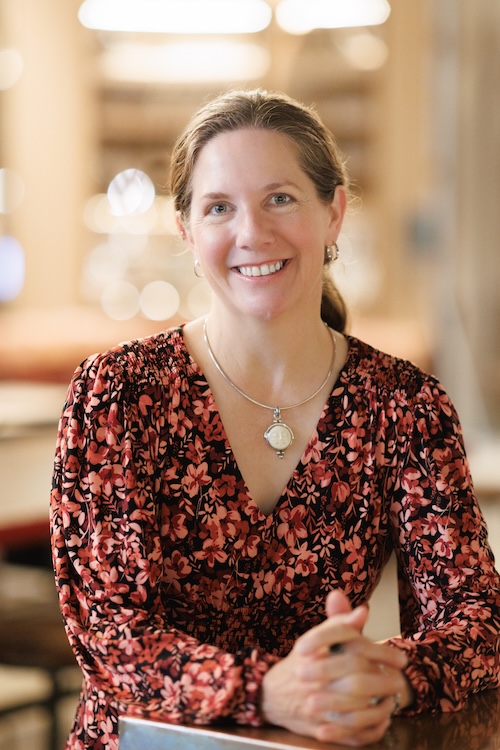
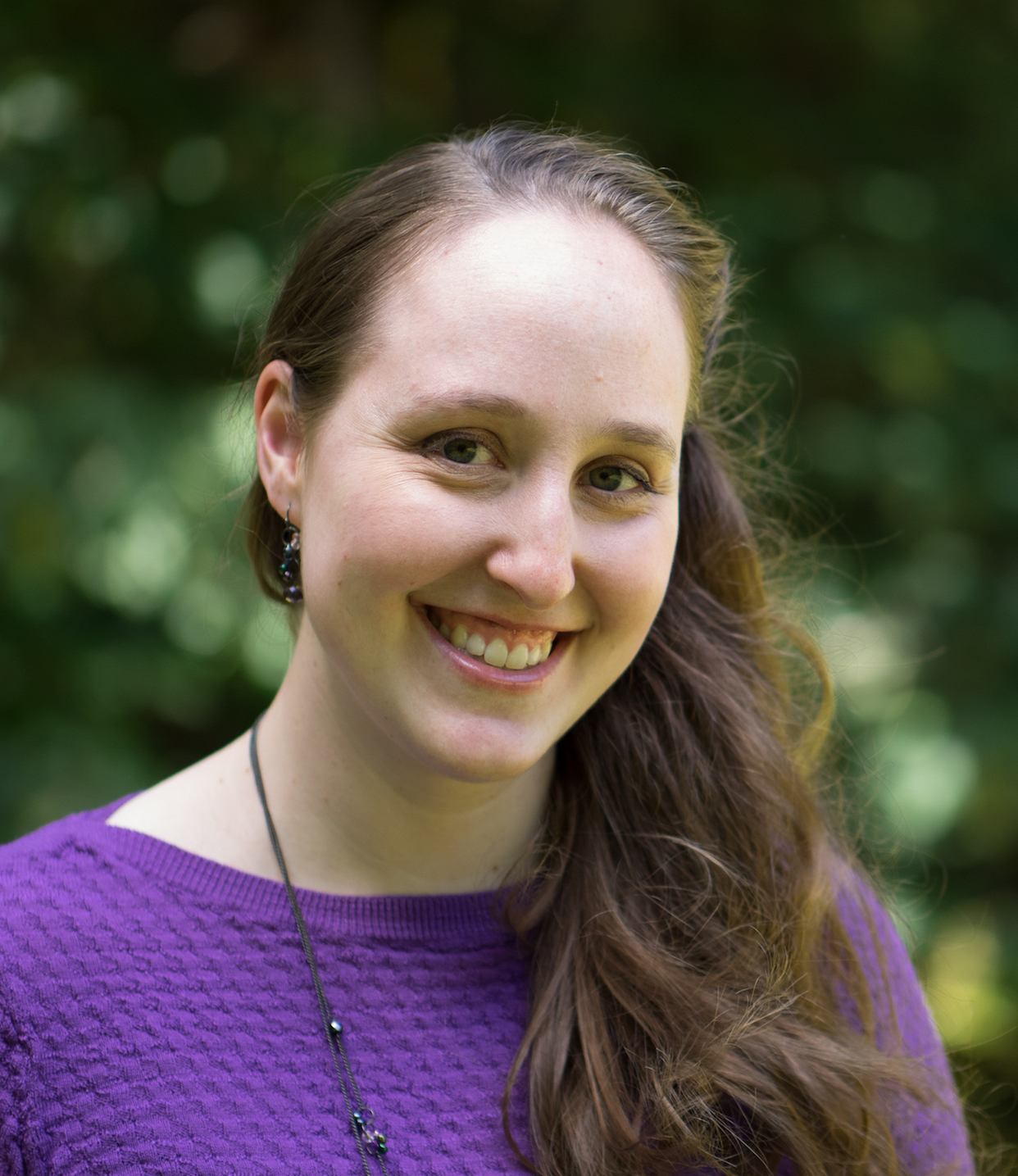
Kathryn Arnold writes fantasy and anything else that sparks her creativity from her home in Kingston, Washington. She currently earns her living as an insurance underwriting assistant, where she also creates marketing and web copy. When not writing, she plays (and teaches) piano and keyboard in a band (or two), and is working on starting a ministry team with her husband. You can find Kathryn at www.skyfirewords.com.