
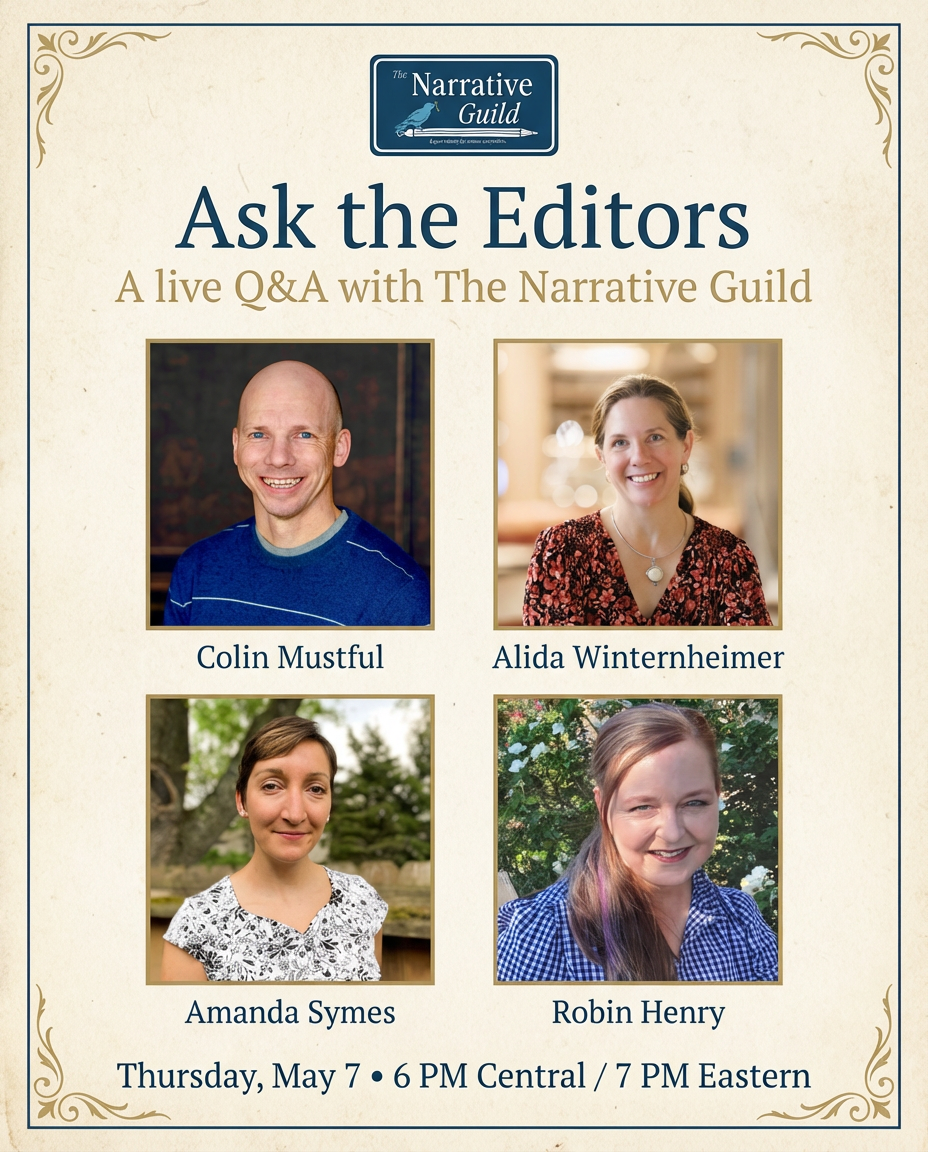
Ask the Editor
Ask the Editors is a candid, practical panel hosted by The Narrative Guild featuring Colin Mustful, Alida Winternheimer, Amanda Symes, and Robin Henry.
Designed for fiction writers at any stage, this conversation will demystify the editorial process and help authors better understand what editors do, when it makes sense to hire one, how to choose the right editorial fit, and how to respond productively to feedback.
Through guided questions and live audience discussion, attendees will gain a clearer understanding of the different types of editing, the realities behind editorial pricing, the timeline writers can expect, and the many ways an editor can strengthen both a manuscript and a writer’s confidence. Grounded in collaboration rather than correction, this panel invites writers to see editing not as a judgment on their work, but as a thoughtful partnership in bringing a story to its fullest potential.
In this week’s episode of Story Works Round Table, Alida Winternheimer and Kathryn Arnold welcome acclaimed author, broadcaster, and musician Antonio Michael Downing. They delve into his novel, Black Cherokee, which tells the poignant coming-of-age story of a mixed-race girl navigating her identity amidst the complexities of her heritage. Antonio shares the inspiration behind the book, the extensive research he undertook, and the importance of honoring the characters and their histories. Join us for a rich discussion that explores the intersections of race, culture, and the power of storytelling!
AUDIO
Antonio Michael Downing is a Trinidad-born, Canada-based writer, musician, and creative force. Named one of Canada’s best emerging authors by the 2018 RBC Taylor Prize, his acclaimed memoir Saga Boy was called “the triumph of Blackness everywhere” by Giller Prize winner Ian Williams. The book was nominated for both the Toronto Book Award and the Speaker’s Book Award in 2021.
His debut novel Black Cherokee will be published by Simon & Schuster in 2025. Antonio also performs and records music as John Orpheus, blending Afro-Caribbean rhythms, soul, and storytelling into genre-bending sound.
Whether he’s writing books, making music, or honouring the legacy of his grandmother, Antonio is always telling stories that search for identity, belonging, and joy.
TRANSCRIPT
This transcript is AI generated. If you notice any inconsistencies or errors, blame the bot.
Alida Winternheimer: Welcome to this week’s StoryWorks roundtable. Today, Katherine and I are thrilled to be joined by Antonio Michael Downing. Antonio Michael is an acclaimed author, broadcaster and musician. His memoir Saga Boy was praised as singularly dazzling and his novel Black Cherokee has been called a triumph. His works have been nominated for several awards, including the Speaker’s Book Prize and the Toronto Book Awards. As a broadcaster, he hosts Canada’s internationally recognized book show the Next Chapter on CBC Radio where he engages with celebrated authors, literary critics and cultural figures about must read books while elevating diverse voices in publishing. Welcome, Antonio Michael.
Antonio Michael Downing: Hey, thank you for having me. Alida. Catherine, I’m so happy to be here.
Alida Winternheimer: Yeah, we are excited to talk with you about your novel Black Cherokee. And I know this is going to be a wider ranging conversations. We’ll see where it goes and then maybe throw some topics into the intro before it comes out. But before we get talking, why don’t you set us up for the conversation, tell us a little bit about black Cherokee and give our listeners context.
Antonio Michael Downing: Absolutely. So Black Cherokee is fundamentally a novel about a mixed race girl who is both black and Cherokee and is kind of rejected by both of those communities. the black folks are like, why are you praying to the river? And the Cherokee folks are like, why is your hair so curly? And so the novel follows her coming of age, having to figure this out. and she, you know, the one note is that there’s an odd vein of history that’s kind of lost to most people of American history. Where the five so called civilized tribes that lived in the Southeast before Andrew Jackson’s Indian Removal act, forced the Trail of Tears migration to Oklahoma, a lot of them owned slaves, a lot of the most, the elite in each of those tribes. And so those folks 200 years later are black racially, but culturally Cherokee or Chickasaw Creek, Choctaw or Seminole. And there’s a struggle for them to be recognized. And so Ophelia’s struggle is a reflection of that specific history, but also the contemporary world where basically a lot of our political debates are who gets included and who gets excluded. So Olivia. sorry. Ophelia’s struggle is really all our struggles.
Alida Winternheimer: Yeah. So I want to know about the inspiration or the very first idea you had that eventually became Ophelia’s story. But I also want to get into that history you were talking about in some of the research you did. I think that’s fascinating. And you’re right. I mean I’m an American and I think I’d heard the phrase black Cherokee here and there over time, but I don’t really. I don’t know anything about it, really, so. And I’ll just kind of bundle those two things together, inspiration and research, and let you run with it.
Antonio Michael Downing: Yeah, well, inspiration. You know, you guys speak to a lot of authors, and. And of course, you speak to a lot of authors, and of course, authors, when you ask them about inspiration, they always have these very clear intentions, and they speak of it as if, you know, it was a very clear line between, intention and realization. When I kind of see that as, like, explaining why you fell in love with someone, you always have these very rational reasons after the fact. But in actual fact, it’s kind of a moment of overwhelming thoughts and emotion and sensation. And I kind of look at the book as a visitation, a mysterious visitation that comes to you all in one moment. And then the writing of the book is solving the mystery of that visit. Visitation. So m. So that visitation for me came when I was traveling all throughout the south, for BlackBerry, in my old. In the old days when I was a young corporate dude. And I just fell in love with the landscape, and I fell in love with the way history seemed to be haunting the present. and, you know, the way I was in Rock Hill, South Carolina. And I write this. I actually take this, and I. And the words on the plaque I put almost verbatim. There is a house on a hill on white street where the white family lived. And it’s called the white house. And it has a plaque in front of it that says, this is where, soldiers, Southern, soldiers during the civil War would come for convalescence while, while fighting, you know, for enslaving the ancestors of half of the people who still live in Rock Hill, South Carolina. And so I was just amazed by how the past and even the present and the future seemed to be colliding in the lives of everyone. And the visitation that came to me was, first of all, the landscape, the rural vibe, the trees, the river at, the bend in the river and the cabin. And then this grandmother and her granddaughter, Grandma Blue and Ophelia Blue and their relationship. And I knew they were Afro indigenous. And all of that came to me all in one shot. And then d d again. Solving the mystery is why I wrote the book. Now, in terms of research, I think, you know, once I figured out that, hey, if they’re Afro indigenous, it’s probably one of these tribes. And then I started reading that history, and then you realize just how absolutely mental a lot of that history is, but also foundational to America. I mean, these are. The mingling of these three peoples is what created America. And so I. The more I read about it, the more I thought about that history that I had encountered in South Carolina and how it kind of haunts us, right? How the past haunts us and shapes our lives. And then I said, okay, well, they’ve got a. If it’s Afro indigenous, it’s one of these tribes. I chose the Cherokee because the Cherokee actually was one of the tribes that managed to leave us successfully stay on this side of the Trail of Tears, through a series of events. And that really inspired me for this idea of Etsy, this place that was a reservation through a trick, they ended up staying and not getting removed and all that history, they’ve been living there. And we meet them at this crucial time in their history where they’ve voted to not be a reservation anymore and just privatize all the land, for everyone. And we. Ophelia is born in the middle of this, and. And she has to cope with it. so research wise, I mean, there’s so many aspects. Look, there’s only. These people are collectively called the Black Freedmen. And there’s only about 10 to 12 scholars who are real experts in this. I emailed or chatted with at least half of them, six of them, Tia Miles, who is a, you know, recipient of the. The MacArthur Genius Fellowship, you know, professor at Harvard. I kind of emailed her. I said, could you help me? I’m trying to do this thing. And she sent me. And she basically sent me, my reading list. She was like, you should read these books. You should talk to these people.
Alida Winternheimer: Wow.
Antonio Michael Downing: That kind of started it. And so I did extensive research, but then none of those people were Cherokee. And so I also spent a lot of time, studying sort of Cherokee language. the Eastern Band of Cherokee, at the foot of the Great Smoky Mountains, have, a lot of great language material. And so I spent time, you know, confirming the rituals and the language, reading a lot of Cherokee mythology, and just really out of a love and a passion and also a desire to get it right, because I didn’t want it to feel like this was another thing being carried taken away. I wanted to feel like it was a gift being given. Yeah. And so, yeah, that’s inspiration and research, I believe.
Alida Winternheimer: Yeah, that’s amazing. I love everything. and I want to go back to the inspiration piece. I Love what you said about the visitation. And then we have this journey through from, you know, you have that visitation or inspiration, and you develop your intention to pursue this process of writing a book. And then there’s this whole immense journey to get to the point of realizing that vision as an actual book. And I like to say that our stories come to us, that we are gifted with these stories that want to be told through us. And it is our honor, but also our responsibility to the story itself to, tell it and to do. To do it justice in the best way we possibly can. So I got really excited when you started talking about that.
Antonio Michael Downing: I was like, yeah, well, I got. I got excited. I got excited when you said that because that’s pretty much how I think about my creative process. I think of it like. I think of it like gardening. Like, you. You know, you don’t grow the plant. You don’t force it to grow or make it grow. You create the conditions that is, to help it grow. You create the conditions in which it will grow. And so I feel similarly. The book is a living, organic thing, and we are sort of a doorway by which it enters the world. And our job is to listen carefully and honor what it wants to be. As opposed to, you know, when Saga Boy was done, as you read those quotes at the top of the show, you know, I had Casey Lehman and Kinesia Lubrin and all of these, like, writers I really respect, praising it. Like, you know, dazzling is like, as. As great. You know, if a stranger said that, it would be amazing. But a great writer, I look up to saying it. Wow, like, you couldn’t ask for anything more. So then I go to write Black Cherokee, and I feel this great pressure that, oh, all these people think I a really good writer. Oh, now I gotta prove I’m a really good writer on every page and paragraph and sentence. And that is a very poor approach to writing. So. So I had to come to this place where I was like, you know, I just felt like Thich Nhat, Hanh, the great Buddhist monk, he says, when I think I know I dig my heels in. I defend my point of view. I fight for my ideas. When I think I don’t know, I listen deeply, I ask better questions, and I’m way more receptive to the answers I get. I’m, way more willing to change my mind. And I felt like I was operating in the first mindset and I needed to switch to the second, which is more, very much about. There is a living, organic Thing that I am in conversation with, and I need to honor and respect it. And I think that’s a very different approach to writing. It took all the pressure of my writer ego wanting to make the bucket to things and. And prove how good a writer I was. it took a lot of the productivity stress out of it, like, kind of being like, oh, I got to write a certain amount every day. And I thought, well, no, if it were a garden, I wouldn’t come in and go, oh, only two tomatoes. Oh, man, I’m so stressed. You know, you would never think like that. So it really reshaped how I approach creativity and, for the better. For the better. I think it’s very. I’ve just finished a draft, and I’m about to do a final polish of a new novel, and I’m applying a lot of those, principles. And it’s just so pleasurable to write now. There’s no stress, there’s no anxiety. If I write a paragraph, I’m happy. If I write a page, I’m happy. If I write 10 pages, awesome. But there’s no pressure. All of that is taken away because it’s not my job. It’s not my job to make the book grow. It’s my job to show up and be available, to listen to what the book needs and provide that. And so it’s just, you know, I feel like you could say, yeah, but it results in the same thing. And maybe that’s a bit esoteric, but it feels very concrete to me. Like, it is. It feels very real. because it’s a real flip of perspective.
Alida Winternheimer: Yeah.
Antonio Michael Downing: Ah, you know, like as. As simple as Thich Nhat Hanh says. Like, we know the difference, right? When we think we know versus when we don’t know. It’s. Oh, yeah, yeah. It’s.
Alida Winternheimer: Yeah, yeah. The worst writing days are when I’m grinding at it, trying to get the scene to take shape for me by my will. And the best writing days are, when it’s like I’m just being receptive and I’m doing the work of getting the words on the page, but it’s an act of listening, listening to the narrative, listening to the characters voices, listening to the shape of the scene that is coming through instead of, you know, pounding the scene into a shape. So, yeah.
Antonio Michael Downing: Yeah. Deep. This concept of deep listening, I think, is one of the most valuable I’ve ever had in an artistic practice. Like a very deep, patient, present listening. And I think that’s kind of where it all comes From. I think that’s where imagination begins.
Alida Winternheimer: I think. Yeah, I agree. So I want to talk about, piggybacking on the idea of research and also our responsibility to our story. You live in Canada, you wrote a story set in the South. Right. And you mentioned that our country was built on this mingling of these three peoples, native, black and white. And so, you know, as writers, we have our own stories, our own roots, our own personal lenses and worldviews and histories. Right. But then we take on our duty to our characters, whoever they are, wherever they come from, whatever their stories are. And so I’d like to hear what you have to say about the blend of experience and our own, what we bring to it as people and research and that responsibility to your characters, especially because black Cherokee has that complicated richness.
Antonio Michael Downing: Yeah. I feel. Well, in brief, you don’t write what you know, right? Like, I don’t know, that’s, that’s sort of the MFA dogma that you write what you know. And I’m like, well, gee, if we all wrote books that were direct exact duplication of ourselves and all the characters reflected exact duplication of ourselves, it’d be pretty boring. And obviously that’s not what any great story has ever been. So I think, but you know, yes, I’m Canadian writing about Americans. I am a man writing a book where almost everyone speaking is a woman. I am m. Not Cherokee writing about indigenous people and indigenous experience. so for me, and I’m glad, I love the way you framed it, Alita, that it’s about honoring the characters and it’s about, hey, if this were an actual person, I need to treat them with the same respect and honesty that I would if I knew them. Which means I need to make them real. Which means I need to actually do the work to understand what real means to that person. And you know, and that’s, that’s just how it is. You have to, you got to go do the work. I mean, the Internet is, is amazing because you can get, you can pretty much get almost anyone speaking, any type of person you can think of, you can find them speaking about their experience in their language and sharing who they are. And you know, a lot of reading and also a lot of just going out and speaking to people and just being with people. And you know, I think as a writer you’re always collecting anyway, like everything you’ve ever experienced, everyone you’ve ever met, every room you’ve ever been in, every problem you’ve ever had, all of this is the grist for the mill to serve the book and serve the character. But, yeah, often we take on something like this, you know, and that’s one of the first things about Let the book be what it wants to be. If it were up to me, I would be like, man, I don’t want to write. you know, there are way easier books I could have thought of to write, but for some reason, this was the one that I fell in love with. This was the mystery that haunted me, and I had to honor that. And, yes, you have to do. I think those are the two elements of it is. Number one, you have to treat your characters as though they were actual people and you. And that means you have. They have to be 360 degrees full personhood. And I think if you do that and you actually do the work to do that. Like, I’ve had Cherokee people read the book, indigenous people from other tribes, actual black Cherokee read the book, and everyone. Women read the book, and everyone comes back and says, yeah, like, it’s not even an issue. They talk about the story and the characters, which means the characters and story felt real to them. And that’s the most gratifying part of it. but, yeah, you know, it’s. It takes a lot of work. Like, I spent a lot of time and. And I probably did 10 times the research required to actually write the book, but mostly because that’s why I write. I write because I want to learn the things that it takes to write the book. And writing the book is kind of a downstream benefit of getting to learn, you know, so all those incredible Cherokee folk stories, which. Only one of which I share in the book, but there I have hundreds of them running around my head. and this amazing history that even a lot of Cherokee folks did not know, and a lot of American folks in general have forgotten these stories or forgot or didn’t even know that they happened. And so, which is why we should be thankful that even though none of them are Black freedmen, those 12 scholars are actually helping keeping that flame going so that other black freedmen can learn their own history from people who don’t share that heritage. And, isn’t that a miraculous thing that art and writing can do and books can do? I think it’s magnificent. M. And so that’s why I’m here. And, of course, the biggest, most. Profound thing that I think makes art work is that the things that make us similar are more profound and more plentiful than the things that make us different from each other. That’s why art works. That’s why we can read something from 600 years ago by someone completely removed from any kind of modern life and still see ourselves in it. And see, you know, Wuthering Heights is like a number one box office movie. I mean, despite how you feel about how faithful they are to the book, it’s that world and those characters. And I’m like, wow, how is that even possible? And, and it’s because humanity and our human nature endures and it’s universal, you know.
Alida Winternheimer: Right.
Antonio Michael Downing: So and so that, that underpins the m. The magic, I think, of summoning to life characters that really are different on the surface from who I am.
Alida Winternheimer: Absolutely. Yeah. And I want to hear also how our roots shape our identities. You know, when I was reading Black Cherokee, one of the things that struck me multiple times was that it was set in the 90s, but because of this setting in the cabin on the river and even when she goes into town and we’re in the town of Etsy, it felt timeless to me. I felt like we could have been in the 1920s or the 1940s or 50s. And every so often I’d have like a moment where I’d go, oh yeah, it’s the 90s. Like, so you’ve got, you know, we’ve got, racial and ethnic identities, but then also rural and town identities. We’ve got culture, we’ve got class, we’ve got, you know, landscape and all. And then history. Right. That our ancestors and some of the things we get are gifts and some are burdens when we look at our lineage. So I would love for you just to reflect a bit on how roots shape us and how that played into Ophelia’s journey and you know, all of these elements that come into play.
Alida Winternheimer: How what shapes us, our roots, our
Alida Winternheimer: heritage, our, you know.
Antonio Michael Downing: yeah, it’s, yeah, it’s. Thank you for noticing. That sort of out of timeness of. Is especially the first act. But, but, but also the whole thing I wanted to have. And I think part of that is one of the underlying themes of Black Cherokee is the sense of a collapse of temporality. Like time is kind of dissolved into this space where the past haunts you. Like Grandma Blue is literally talking to her dead husband, talking to her dead father, reflecting on her grandmother and all while raising this little girl in the present. And Jacques Derrida, the French philosopher, has this idea he calls hauntology. And the idea is that, the past haunts us, even past that never happened. Haunt us because we used to think about it. And so we created this space for it. And even though it never occurred, we still think about it and it still walks through our lives. like I have conversations with my grandmother where I’m not remembering things she said. I’m actually talking to her about things that are happening now. And I can close my eyes and I can hear her, her, in her own voice talk about those things today. And even our future selves, like the cells that we hope to be, the cells, lots of cells that we may never be, we live with them, every day. And so there’s this kind of sense of the collapse of time, past and present, where there is just now and in now, everything that ever was is. Is haunting us. Everything that ever will be is haunting us. It’s kind of like the metaphor of the Etsy river, which is very prominent throughout the book. You know, a river is like it came from somewhere, it’s going to somewhere, but it’s here right now, and it’s always moving through those, cycling through those three realities all at once. And so, yeah, and I think in terms of how our roots affect us, it’s because we are that river, right? We are the product of what came before. I mean, you know, Ophelia has the same name as Grandma Blue, the same like, government name. And then she was named after her grandmother. And so there’s this sense of nothing’s changed because it’s the same person and they’re here and they’re not the same, but, but they, but this is how we are. Like all of us are born into our, the, the lineage of our bodies and what that gives us our DNA and what that tells us and what we’re allowed to do, how tall, short or color of hair or what have you. And then we’re born into the lineage of our family and that can be really complex and into the history of our, our, our town, our region, our nation, and all of humanity. All of these things have historical lineages that whether or not we understand them, and Ophelia struggles to understand them throughout the book, they affect us and they shape our lives, they shape our choices, they shape, they set the table of our hearts and minds, and in so doing they create us, whether or not we are conscious of it or want them to. And I feel Ophelia is always in a sense of trying to. She’s always in a state of confusion about these lineages and trying to understand them and also trying to self determine while still caught in these. In These currents that she can’t, she, she doesn’t even understand, she didn’t create, she can’t even spell it out. But there she is, stuck in things, in things that, that came before.
Alida Winternheimer: Yeah. Yeah. Okay. You’re the first. It’s m. Like there’s like so much to dig into here.
Antonio Michael Downing: I’m from a family of preachers. We, my, our dialect is sermon, so.
Alida Winternheimer: Awesome.
Antonio Michael Downing: You’re welcome.
Alida Winternheimer: Yeah. Thank you. Okay. The first line of your memoir’s epilogue is, you can only become the person you always were. And it seems to me that that’s what Ophelia is doing too, you know, and as you’re talking about the Etsy river and how there’s the past and the future and they’re always in flow and you know, they’re connected to the now. And then Ophelia, it’s a coming of age story. So naturally that’s a journey, of self discovery and trying to determine your identity, who you are in the world and where you fit in. And then at the end, she’s back at the beginning, right? But the wheel has turned. So she’s back at the cabin, but her place in life has changed. So do you think we get to choose and shape our identities for ourselves? Or are we always coming back to where we started, who we always were?
Antonio Michael Downing: I would say that those lineages exert a very potent influence over us. And even when we’re fighting against them or trying to avoid them, they are still deciding the agenda. And so I would say, I would. I don’t know if you can escape. I think you can certainly exert more autonomy if you can. If you can turn corners that people before you never turned. And I think that’s always a possibility. But I think fundamentally, I mean, so much of who we are is. And this is, you know, we live in a world where there are, it’s a billion dollar billions and billions of dollar industry, around self improvement. And so it’s a very unpopular idea to say that the obvious, which is that, okay, well your genetics determine a huge amount of what’s possible for your life and no one has any control over that. And even the things that happen to us nurture wise. Well, childhood psychologists tell us, well, you know, I think it’s the famous adage is if show me the child when they’re six and I’ll show you the person when they’re 66. Right. And so even the things that can change, they happen to us before we are aware enough to change them. And so the Truth of it is that a lot of who we become come is set much earlier than, you know, we’re 27. And when now we’re trying to, you know, like, like m. Get this breakthrough. And it’s like, well, man, that wiring was set when you were 7. And then when you hit 30, you know, we know that the brain, kind of locks in. Right. It kind of sets the myelin that coats the. It coats the neural pathways that we use the most. It kind of coats it. And that’s kind of like the rubber insulator on an electrical wire which keeps the current, from losing any energy. So it makes us efficient, but it makes us efficient at whatever we happen to have developed to that point point. So it’s a scary thought, but yeah, a lot of, you know, we live in a world where everyone’s like, go to therapy. It’ll change you forever. And we live in a world actually where a lot of the things about who we become happen to us very early. And even when we’re saying, well, you know what, I don’t like who my dad was, so I’m never going to be like my dad. That’s something I always say. But then the example of who my dad was is still determining the things I’m doing because I’m doing them to not be like him. So there’s this kind of, There’s a vibe of, you know, I don’t want to say determinism because I do believe we can turn corners that our people before never did. And I think Ophelia does. I think she turns a corner that no one, none of the people of her family we meet in the book has managed to turn, which is she internalized a kind of a locus of control. And she has the smarts and the determination and the desire that she’s going to determine her own way without losing herself. Because her aunt belongs to. Is really smart. And she uses her smarts to basically go to Paris, France and become, in her own words, Parisienne. She becomes like the, like more Parisian than the Parisians because she’s so ashamed of where she came from. Right. And I think Shango and Ayana and Belle, Grandma Blue’s, kids, they’re all studies in running away from yourself. And kind of. And kind of never figuring it out. And, and they’re the ones who teach Ophelia what to do when she’s young. But eventually she decides actually she finds another way. And so, so I think that it’s possible to turn those corners. I’m not saying it’s impossible. What I’m saying is those, they’re very hard won and very fragile victories when we do win them, and I think that makes them even more special and even more precious. and even more worth fighting for.
Alida Winternheimer: Yeah. When you were writing this book, did you at any time think Ophelia might escape Etsy, go to college, live a different kind of life? Or did you always know that her version of success, her resolution to this coming of age story, would be a return to the cabin on the river?
Antonio Michael Downing: Yeah, I. Hm. What a question. Okay. Well, what I can say is that until very late in the writing of the book, the ending that happened was not the ending that happened. She did sort of go to college and do that and I felt that that wasn’t honoring her because I wanted that for her. And when you’re reading the book, I think there’s a kind of a, no, Ophelia, don’t do that. You know, and so I think I wanted that for her. I want. I was, I was on a book club with, with a group of, black women who were, you know, lawyers. And one was a, ah, very high level executive for Microsoft Canada. And like, so it was very empowered women and they were absolutely offended about how the book ended. They were absolutely offended. but I like that though. I feel like number one, I wanted to be true to Ophelia and what she would choose in that moment. And I felt that if I had forced a happy ending into it or, or what I perceived as a happy ending, that would be me as a writer doing. Being a writer.
Alida Winternheimer: Yes.
Antonio Michael Downing: Whereas as we discussed honoring her intention, like what I felt was this person who I’d come to know, who I’d spent all this time with writing her, listening to her, talking to her. I’m like, no, you know what, what she wants is all those things is what we want for her. And all those things is what everyone in her life wants for her because it serves something in them. And if there was one thing Ophelia wanted was to just decide what she wanted for her. And I think that’s what she ultimately does. And of course it’s. She’s 19 when we leave, so there’s no, there’s no, you know, it’s not like her life is over. You know, it’s not like we know how it’s going to work out. All we know is that these are the choices she’s made and here is why. And, and I feel the Ophelia that we meet at the end, is her own person.
Alida Winternheimer: Yeah. I think if she had gone to college, that would have been the conventional choice. You know, as you say, it’s what readers. What we expect people to want for her because it’s the conventionally better path to a more comfortable, seemingly successful life. But. And I think it would have worked if you had opened the book with her in town, living with her aunt. But you gave us that first part where she’s a girl and we get those formative years with Grandma Blue, with the river, with the Cherokee community, you know, and so for her to then have taken the opportunities and run, it would have been, kind of a rejection of the first part of the book, of the story that we experience, you know.
Antonio Michael Downing: Yeah. And she. And it would have been doing exactly what her friend, father and her aunties had done. They. They left and they didn’t want anything to do with that. And I think Ophelia appreciated what was valuable about this place that, you know, all three of them didn’t even want to admit they were from. And I think that’s what’s special about her. She found a way to choose a future that doesn’t reject the past.
Alida Winternheimer: Yes. Catherine, I’ve been like, jumping on the mic here. You got. I gotta.
Kathryn Arnold: Yeah, I kind of want to. I want to jump on that idea of the family and creating Ophelia as this character who, like you said, you want her to have. She wants to create, Create her own life. But I also think there’s this thread that runs through, of family and of desiring that place to belong that is part of your heritage and part of your, you know, your whole. She understands Grandma Blue. She has that empathy in the beginning. And then she wants to create a family with her aunt and her cousins. And then she wants to please her Aunt Bell. And you know, even with the church, she’s like looking for a family. But she always seems to kind of understand people’s motivations in a way that’s very. It transcends her own desires. Right. Like where she understands why Grandma Blue is angry. She understands the motivation that Aunt Belle had to go and get her education and all of these things. So when she comes back and in the end we see her with her whole family on the floor of the cabin. Like, I feel like without a character as empathetic and understanding and compassionate as Ophelia, as she’s moving through this, we wouldn’t have had that journey to creating this, her own identity, which is so rooted in family.
Antonio Michael Downing: So, yeah, I think vulnerability, if you can survive it, makes you wise and empathetic. M. And that’s her journey because she’s constantly observing everyone because she really wants to fit in, and she really wants to belong. And. And also. But also, she doesn’t have agency. She has to fight for every little scrap of agency that she gets. And really, that arc of her coming to the point where she can hold her own agency and make her own decision is really. Because I think you’re right. I think she really gets obsessed with her aunties and Grandma Blue and even her dad, who’s not there all the time, but she’s really obsessed with all these people because she wants to. She wants to belong where they belong. And in the end, you know, to your earlier question, Lita, she realizes that, oh, I have a place. I belong already, and I have a family, and I have people. I just. I just haven’t really seen. Always seen it. And I think sometimes this idea, I think of, You know, when we think about maturity, we think, oh, you become this new person that’s just wiser and holds themselves in a different way. But I really believe that maturity is actually being comfortable with the person you always were. And I think that’s where, Ophelia comes to, where she’s like, hey, you know what? Like, actually, I do belong, and actually, it’s okay. I. I don’t have to choose. Right? That’s the real. The big thing. Like, we. If, you know, when we are growing up, as we watch Ophelia grow up, we have to. When it comes to identity, we have an experience, an internal experience, and then we have an external compromise we make with the world, where we choose things, rich or poor, you know, like black or white, you know, all of these categories, gay or straight. but our experience is actually, as we know, on a spectrum. All you need to do is send your DNA to one of those, places that measures DNA and tells you your ancestry, and suddenly it’s not so black and white, is it? And so. So Ophelia is someone who is. Who refuses to amputate a part of herself to become. To be accepted. And that comes with a heavy price, right? When we choose one thing and excommunicate the other thing, but actually, who we are contains both. We are paying a really heavy price for that choice. And like you said, Alida, a lot of times, it’s because it’s the most secure option. It’s the most. It’s the one that gives us the most ease in our lives. Not the one that gives us the most sort of fulfillment internally. and I think what’s different about Ophelia is to everyone else in her family is that she refuses to pay that price. Ultimately it takes her a while to get there, but when she actually goes, wait a minute, I have urgency. She’s like, I’m not going to amputate a part of myself just to fit in. And that’s the corner she turns that none of the rest of her family ever. It.
Alida Winternheimer: Right. Catherine, Anise,
Kathryn Arnold: I am gonna have to pop off here, so I really do appreciate the conversation that we’ve been having and I know you guys will continue, but I, just want to say thank you because this is awesome.
Antonio Michael Downing: Thank you. You’re awesome. I appreciate your question. Bye, Catherine.
Alida Winternheimer: So why the matriarchal? Is it a matriarchal story? Why did this have to be a story of women? You know, we were talking at the beginning about how the stories come to us and it’s our duty and honor to write them. So why was this story centered on the women in this family?
Antonio Michael Downing: Yeah, I think, I mean, the easy obvious answer is that indigenous societies are matriarchal. And, and, and so that’s. It is in honoring of that. But also I think, women are, are the holders, like that lineage we’re talking about that, that flowing from past to present to future. Women are very much the holders of that. The birthers of life, of that new life that passes down the DNA, the literal DNA lineage. And also very often the ones who teach the previous lineage. Lineage, as Grandma Blue is teaching Ophelia. And so I felt that was important. And I also felt, I also felt about Ophelia that she needed to be vulnerable. And I felt that if she had men around her that were worth anything, then they would protect her or shield her from a lot of the storms that she weathers. And so, there was a big. So I wanted the men to be in absentia m almost so that she could be, you know, who’s more vulnerable than a little black Cherokee girl in America. And so I wanted her to be, vulnerable for that reason. I felt like any men who were, you know, again, any men worth their salt would be like, oh no, you poor thing. Let me, let me shield you. Let me protect you. Let me. And the truth of it is, and this is something we didn’t say about the ending as well, like, you know, poor racialized girls don’t often choose the wise or obviously, beneficial, the strategic option.
Alida Winternheimer: Right.
Antonio Michael Downing: And and, and they don’t often have fathers around to take care and protect them. And so that, that’s part of it too. That’s who she is and that’s part of honoring her, her like what her mindset would actually be as opposed to, hey, you know, it’d be nice if I had a happy ending. And yeah. So anyway, yeah, those are my thoughts on that. To be honest. You can hear me struggling to explain it. And to be honest, it was a very intuitive understanding, of this congress of women taking care of her and raising her up. So those reasons are really, those are the very m. Intentional, after the fact, rational reasons. But this is the way it felt, to me, you know, the story felt.
Alida Winternheimer: Yeah. And I think a lot of our choices as we’re writing occur that way because it’s what the story dictates, it’s what feels right, it’s how we hear it. But as you were speaking, I was thinking, okay, we’ve got biology, archetypes and reality all coming to play in this fact that it’s a, you know, a women centric story.
Antonio Michael Downing: Absolutely. Absolutely. It’s a convergence. Yeah. And, and this is, you know, I often, I like to make intuitive choices and then interrogate them rationally after the fact. And what I find is many of them will blossom with meaning after the fact. When you’re looking back on him and you’re like. Which is why the intuitive approach is so powerful because you know, the universe is way smarter than we are. So, so it’s way better, I think it’s way better to tune in and pull these intuitions that have powerful resonance, bring them into the world world. And yeah, you’ll figure out what they mean eventually. And to a large extent I feel writing the book is figuring out, what the things actually mean. I mean the novel I’m finishing, I’m finishing now I started six years ago and I don’t think I ever really understood a lot of the choices that I made that for years I thought that’s just crazy. Why are you doing, doing something so random? As the book started to come together, it was suddenly like, oh, wow, that was the only choice you could have made. Right. And so maybe it’s a self fulfilling prophecy. But also, I think you have to honor your intuitions because I think I’ve found that really if it’s not working, it’s probably because you haven’t figured out why it works. Works yet.
Alida Winternheimer: Right, right, yeah.
Antonio Michael Downing: Which is a, which is a no. You know, this Is not. They don’t teach this at MFA school. They’re like. They’re like, look, if it ain’t working, they test out five different options on your focus group readers and. And decide and choose whatever they choose. I just. Yeah, I don’t think that’s the way. I,
Alida Winternheimer: Don’t think that’s the way. Yeah, I agree. I heard. So, years. Years and years ago, I saw an interview with Amy Tan on TV talking about the Joy Luck Club. And it’s just this moment of that interview always stuck with me. Somebody wrote their term paper or thesis or whatever on the Joy Luck Club and then sent it to her. And this paper was all about her use of this number. I don’t know if it was 7 or 13 or whatever, but it appears over and over and over in the book. And, you know, the mahjong and the. The family, the women. And she said, I had no idea. Look how smart I am. Right? It’s like, yeah, that’s the.
Antonio Michael Downing: Yeah. She does do a lot of, divination as well. I’ve heard her talk about it. And. Yeah, I just feel we are. We could do with. I feel a little bit of humility, as writers can unlock so much magic into the world. And I find all creativity. I’ve essentially lived my whole life as a creative person, and all the best creativity feels like it’s just coming through through you. M. It’s never like, oh, I think I’m gonna do this thing in this way, and this is exactly how I’ll do it. And. And we can do that. There’s nothing like we’re all. We’re capable of it. But I don’t feel like those are the things that have the deepest resonances. I think to hit these deep pockets of human resonance where it can resonate with people across the board, but also resonate, in several different ways at the same time. I think designing that over 350 pages is really difficult. but if you cultivate a kind of an intuitive connection with. Based on the work you’ve done, understanding the characters in the book and just trying to honor that and always coming back to honoring that first principle. Stanley Kubrick says this is the hardest thing about making films, is staying true to that original seed, that egg that germinated the first idea. But if we can do that, we can and match it with our skills, you know, which, of course, there’s craft, and it does matter. but we’re not doing craft for craft sakes. We’re doing craft because it’s the tool that the book requires of us in that particular time. And if we can do that, I think we open doorways to things that greatly transcend what our rational minds can, can count out or lay out on a spreadsheet. I mean, sometimes a spreadsheet might be helpful to your intuition, but. But we should never be following the spreadsheet. The spreadsheet is. It should be serving the story.
Alida Winternheimer: Absolutely. okay, so the. Let’s stick with archetypes. Stone Dress, you researched many folk tales, you said, and only one of them made it into this book. And it’s the tale of Stone Dress which. So I want to hear why that one tale made it in, what it means to you, to the story and why Ophelia loves it so much, much why that, that figure resonates for her.
Antonio Michael Downing: Yeah, I, I was reading, I think I have four or five books of Cherokee, folk tales, mythologies, and I was reading them and research is weird. Like it’s like waiting through a forest looking for something, but you don’t know what you’re looking for until you find it and then you’re like, oh, there it is. And when I read Stone Dress, I was like, yeah, this is it. So she is, an ogre who, an ogress who can take the shape of any form she wants to. Often she disguises herself as an old woman and she, but she likes. And she kind of preys on the people that are around the forest. So she’ll. Someone will leave the house and she’ll disguise herself as them and act as if she’s coming back so she can like eat the livers of the people in the house. So it’s very, it’s very grotesque. And I just felt like at first I was just like, yeah, this Ophelia loves this story. And I just, just from hanging out with Ophelia I just felt this is the kind of thing she would really love. And I love how kids often like things that we think are too vulgar or too grotesque or too something for them, but they love it. They’re just like, ah, she eats their livers. This is awesome. and then I realized and, and a lot of young Ophelia, the vibes I got and part of, you know, doing the work to understand what that felt like was reading stories to my six year old niece who at the time was six, seven. And so MacKenzie, and she’s really, she’s really an interesting kid and she reminded me of myself at that age. And so I think there’s some of those vibes in Ophelia. but. And she just loves story time. She really loves story time. And she never loved the stories that you think a kid would like. You’re just like, really? like that’s what you like. Really? And. And then of course, I think with Ophelia, the deep wisdom is that she sees the only person she knows is Grandma Blue, an old woman who’s kind of grouchy and crotchety and has a stone finger like Stone Dress that if she, you know, she has a stick, but it’s like it’s made of stone and she won’t mind hit. She doesn’t mind whacking you with it. And just like Stone Dress has this antagonistic relationship with the people living around her Forest Grandma Blue has this antagonistic relationship with the people in Etsy. And so, so Ophelia loves the story, but she doesn’t even realize that she loves it because she loves Grandma Blue. And she knows that Grandma Blue is only grouchy because she, she has a lot of love, but she doesn’t know how to say things or how to communicate it. So that’s why she’s grouchy. And, and people misunderstand her. And so she sees and see Stone Dress someone that people misunderstand because they’re always trying to get Stone Dress and in the end they always get her. But Ophelia makes up her own, ending. She’s like, no, no, they don’t get her. She’s. She, she. She takes her family away to a forest far away and they live happily ever after. so she attaches to her because Stone Dress reminds her of Grandma Blue. And then as, and then as her life goes on, she realizes that in a more serious way, Stone Dress is what happens to. Has happened to all the women in her family that they’ve all kind of turned to stone a little bit.
Alida Winternheimer: Yeah.
Antonio Michael Downing: M. And, and so, and, and she realized why. Because things are happening to her where she’s like, oh my goodness, like I am. this is what happens. This is how they became. How they became.
Antonio Michael Downing: And yes, it’s happening to me, but I’m not gonna let it take away the things that are important to me. And that’s kind of, that’s kind of the corner she turns. That’s different because they’ve all. This is all happened to them and they don’t see it, but she sees it. It partially because she’s obsessed with the story. And so she has this, this story gives her a metaphor to Explain what is happening to the women in the family and what’s happening to her. And it kind of stays with her. It stays with her. It never really leaves. So yeah.
Alida Winternheimer: So does Ophelia, does she have the antidote to becoming a stone dress figure through her, her sense of identity, her choices? Where she is at the end of the book? Is that, is that the hope you think we readers should carry forward? That she’s, you know.
Antonio Michael Downing: Well, I think. I don’t. I think where I. The book asks those questions, but I don’t think it provides. Provides hard answers to those questions. It says, well, is becoming stone dress a good thing or a bad thing? It’s asking, is it? Can you become stone dress but still keep your softness? Can you turn the stone but still keep your softness? Can they coexist or can you. Can you turn the stone when you need it and, and then. And be soft the rest of the time? Then it’s a superpower. So I don’t know. I think the book asks those questions, but I don’t think. I think she does. I think she finds a way to be stone dress M. Because from the beginning she understood that stone dress was just protective. Those that she loved.
Alida Winternheimer: Yeah.
Antonio Michael Downing: And, and so the foundation of stone dress was love. Just like. And she understood it because Grandma blue. She understood that Grandma blue what didn’t mean it when she was angry or grumpy with her. She, she’s actually, it’s because she loves her and she doesn’t know how to say it. And, and, and so, and she’s protecting her. So I think Ophelia understood that stone dress is not all stone at all. And because of that, I think she figures out how to be stone dress in a real human and healing way where it’s like you protect the things you love and the people you love, but also you never lose that love. You don’t become so hard that your heart can’t beat and anymore. And, and that’s kind of what she’s doing at the end, I think.
Alida Winternheimer: Yeah. Yeah. I think that is really epitomized in the moment when Christopher comes to the cabin and asks to be a part of her life and she’s stony. But then she allows him to hug her, turns her back and he hugs her and she feels the warmth. So we’re left in that. That state of possibility without knowing which way it will go ultimately, you know, but we’ve got the protection of the stoniness, but then also the feeling through that stoniness that she’s experiencing.
Antonio Michael Downing: And she, again, she doesn’t feel she needs to get rid of one to experience the other. And, and I think that’s, that’s really the antidote is that, is that you don’t have to cut off a part of yourself.
Alida Winternheimer: Yeah.
Antonio Michael Downing: To. To have the opposite of that part. Right. You can, you can have a lot of love. and because of that love you can be stony towards anything that threatens it. you can be black and you can be church. You can be, you can be both. Right. You can tell him. No, it’s like I don’t want you to be like come back and just be forgiven. But also I kind of, I have empathy for you too. I think she really understands and she gets, she understands him finally at the end and, and it’s kind of. But she also, you know, when they met, they were both children and she experienced him as a vulnerable child. And I think by the end she realizes, oh, you too are still a vulnerable child.
Alida Winternheimer: So do they. You, you reference Romeo and Juliet. I think twice in the story. Story. So do you view them as Romeo and Juliet? Figures. What is that connection for you and to what extent should readers make something of it?
Antonio Michael Downing: Yeah, well, I mean, it does, you know, two houses, both alike in state and dignity and fair Etsy, where we lay our seed. Yeah, I, I think there is, They do fit. Fit the bill because they really come from two families from different sides of the tract and they’re the young ones in those families and they do fall in love. But actually their families are very much at war with each other because Grandma Blue is the heart of the lawsuit against the Beauregard farm that he is going. That Christopher is going to inherit. So really it’s a very Romeo and Juliet situation. you know, without all the poisoning and death. Right. Or maybe they haven’t gotten there yet, but we don’t see that in the book. But yeah, I think they definitely have that. Have that feeling. I think the part of it that I really like love is how. How improbable love can be and you know, where it’s. And how our humanity kind of transcends the categories we. We put people in sudden. Like Grandma Blue is not supposed to marry Chief Trout Hands because there’s a rule you’re not supposed to do that, you know. But life had other ideas and I think Grandma Blue would have preferred. I think everyone would have preferred, including Christopher’ if the two of them had kind of stayed away from each other. But life had other ideas. And so I think that’s the essence of Romeo and Juliet that they carry. But really that’s the essence of all young love, I think. It doesn’t really respect the boundaries.
Alida Winternheimer: Yeah, that’s true. When, when, they were on the dance floor and in the treehouse scenes, I was hoping for things to work out. They were very sweet together and you made me hope. And even though, you know.
Antonio Michael Downing: Yep.
Alida Winternheimer: I know how stories work. I know how these things go. I know how, you know, traumas develop. But I was like, oh, I really like them. Yeah, look at that. Look at that young love. That is so sweet. So,
Antonio Michael Downing: yeah, but we. It’s. It’s funny how we, we hope for that, but at the same time, we know how young love works out almost every time, which is. It doesn’t.
Alida Winternheimer: Right? Yes.
Antonio Michael Downing: So. So it’s an Is. So it feels. It’s. You know, I don’t know what the feeling is of reading it for the first time, but for me it was like. It was like I wanted them. Me too. I wanted them to succeed. But I also was like, yeah, but actually here’s who these people are and here’s who their families are. And. And that’s this sort of Romeo and Juliet truth of it. Right. Where, you know, where we’re caught up in these lineages of our family and even when we don’t want them to, they end up shaping large parts of our lives. But, you know, we don’t know where it ends for them. And there’s a lot of. I thought very deeply about that ending. In fact, I rewrote it many times. And my m. Worry of Chris to Fur coming back would be again that it would steal that agency of, Ophelia where she’s made a decision. And for better or worse, it’s the first decision. It’s hers first major thing in her life that she’s the one who said, this is what I’m gonna do and I’m gonna stand by it. And I feel like Christopher coming back to kind of all the. The way in would kind of tarnish that a bit. Because. Because, yeah, I. I guess Ophelia is. Is very stubborn. Like, I really wanted it to be like, oh, this is gonna be happy and it’s gonna be great. And. But then I was like, well, what is the lesson? What are we saying then? And it just didn’t feel right for Ophelia. It didn’t feel right for Ophelia, and it didn’t feel right for, you know, she’s just gonna. He totally betrays her and she’s gonna be like, hey, come on back. It’s all good.
Alida Winternheimer: Yes.
Antonio Michael Downing: To me, that’s way more toxic than her saying, you know what, Like, I’m good.
Alida Winternheimer: Mm,
Antonio Michael Downing: Yeah, I’m good. Yeah.
Alida Winternheimer: So, yeah, no, I think it ended well. your use of, multiple points of view is interesting. And as I was reading it, I. I felt like we would leave Ophelia’s point of view and go into these other ones in such a way that you were saying, hey, for you to understand Ophelia’s story and get the entirety, the breadth and depth of it, you need to know these other things too. And like, the Christopher thread is a good example. When things in their romance are coming to a head, we switch. And I think at the opening of the chapter was Christopher’s point of view, but it was really narrative telling us about his parents and the home he grew up in. And we were getting a glimpse of his roots and how they were shaping him, his choices, his behaviors. And I’d love for you to, reflect a bit that. Multiple POVs.
Antonio Michael Downing: I love that. That section especially, of giving. You know, there’s a moment, this device. I think Toni Morrison is probably the best example. There’s a moment in the Bluest Eye where she says, there’s a kind of girl who grows up in Georgia or in the countryside in Louisiana, and she grows into a Bible female family. And she grows up drinking sweet tea and swinging on the swing. And then she goes to church. And she has a sense of, perfection. She just wants everything to be neat, tidy, perfect. She despises the stench, the rot that can creep into things. And so she marries a man at the church who she thinks has that same sense of cleanliness. But. Oh. And so she goes into the story and she tells you this whole pages of this backstory of this woman and her son and how she became bitter in life. Also that this woman, who she starts off as a girl but now is a fully grown woman, can do probably one of the meanest acts ever committed to page in American literature. She slaps, the. The protagonist, the little girl in the blue eye, and she says, get out of my house, you dirty black. But. But. And then you realize that Toni Morrison has just given you this entire person’s life. So that when she does this one act, you can understand her in a way. She just wanted this act to be complicated and rich and. And fully realized. And I think something Toni Morrison does a lot is she’s like, I don’t want to feel like the author has taken sides. And so by giving you her backstory, you kind of empathize with her while she’s doing one of the meanest things I’ve ever read to this little girl. And. And she gives you the whole story. And so that was the two lessons I learned with that device, where I was kind of like, okay, number one, we don’t take sides. We faithfully. We faithfully render the characters and bring them to life. You decide how you feel about it. And secondly, sometimes to understand one single act, you have to understand everything that came before, or you have to fit it into a narrative or arc, as opposed to, well, she just slapped that little girl, for no reason. Then it becomes an act of, like, you’re. You’re just going to dismiss that character and say, oh, well, she’s evil. But by giving you the backstory, you have to have a way more complicated interrogation of that moment. And that’s how I feel. I feel like, his father and his mother and their relationship in the final scene by having this arc of how Christopher. And Christopher also, like, how did he come to be who he is, and how did his mom come to be, and how does his father come to be? Oh, and now them together, and, And what were. Where were they at when Christopher was born? And how did. Was Christopher raised? How did he come to be this kid who really likes to be black a little too much? You know, how did he become that kid? And. And then, you see. And. And then I may. I think it makes it a lot harder to judge Christopher and a lot harder to judge Cornelia, his mother, who. Who really has had this kind of, like, this kind of really, you know, in her own way, you know, she’s an alcoholic, and she’s. You know, but she’s come by it. She came from this very mean family where she was kind of the pretty one. And so her sisters would beat her up because they’re like, you know, you’re. You’re just a little too pretty. And how the family had fallen on hard times. And so she wanted to marry money. And then. But he doesn’t really care. But he doesn’t care about anything except for money. And so suddenly you have this full picture. So in that final scene, when Ophelia’s there and they’re all sitting there, you feel like you know them in a way that’s bigger than just that moment. And that’s why I wanted that, because ultimately, I want you to Decide for yourself. I want. I would like you to decide for yourself. Is Christopher a bad person? Or is he not just a kid who had a rough life? Is. Is Cornelia a bad person? Or is she just, you know, if we grew up like her, would we be the same as she? So that’s kind of how I prefer. that’s what I think the job of a writer is, is to just render the truth and ask the question and let. Let the reader decide what they think. And I think there are people that I’ve heard, people I’ve, you know, I’ve done a lot of readings now where people are like, oh, poor Christopher. And, you know, that’s so hard. And then some people say, oh, my goodness, you. You. You let him off so easy. You know, you let them off so easy at the end. And so. And what I realize is, you know, by doing it that way and by giving that backstory, what I’m doing is I’m letting the reader bring more of themselves to the book. And those are the books I love where, those are the books that stay with me. Those are the books I can read ten years later, and it feels like a different book because I’m different.
Alida Winternheimer: Right.
Antonio Michael Downing: And so rather than spelling out what you should feel, I want to create a space where you can decide what you feel, and then you can wrestle with those feelings and say, m. Well, what does that say about me?
Alida Winternheimer: Right.
Antonio Michael Downing: Yeah. And that is the gift of literature, I think, you know. Yeah, I think so. The books I like anyway, and, you know, like, I could never be super prescriptive. Like, here. This is what you’re supposed to feel about this person. So. And I. At, the heart of it, I think, is that if you understand anyone’s story, you will have some degree of empathy for them.
Alida Winternheimer: Right.
Antonio Michael Downing: I think that’s how that works.
Alida Winternheimer: Yeah. Yeah, I agree. So the last thing I want to talk to you about or pick your brain on is, voice. You’re a musician. You’ve got an interesting background yourself. You’re writing the story. We’ve talked about the multicultural elements, the different kind of characters in here. And of course, there’s narrative voice, and then there’s also the voice of the characters through interiority and dialogue. And I think your musicality probably plays a part in how you approach voice.
Antonio Michael Downing: Yeah. Yeah, I feel like. And P.S. i don’t know, your last, the last episode I listened to of your podcast, the woman that talked about Voice, I thought she nailed it. And Voice is so critical for me, Because I don’t feel I understand the book until I understand the narrator’s voice. And I don’t feel I understand the character until I understand their voice. And, and by that I mean not what they say, but how they say it. I feel like if you understand how a person speaks, you understand demographic, wealth, what kind of work they do, gender, age, attitude, disposition. Like, I feel like you get so much out of just how a person speaks. And so for me, that’s the thing that unlocks the book. That’s the thing that unlocks the book for me is, is how do they speak? How does the book speak? And until I know that, I don’t really have the book.
Alida Winternheimer: How does your experience, how has your experience shaped your understanding of voice? Because when I was looking at your memoir, I was noticing that you’ve got like passage passages of dialogue, exchanges with family members, and then there’s more of a dialect to the language. Then you’ve got your narrative voice and you’re, you know, you’ve, you’ve played with different bands and been to England and all the, the things I could glean just from looking at your memoir. Not everyone who’s writing books and trying to capture voice has such diversity of experience. You know, I’ve traveled a bit, but I’m a native Minnesotan. Right. There’s. So it’s very different.
Antonio Michael Downing: Well, I, I think that it’s, I guess how I would think of it is the type of writer I am is I’m very rooted in the sensual. And I think. And you know, in Black Cherokee, Ophelia has a kind of synesthesia and, and that causes her, that lends itself to the way I write. Because, there, you know, and you know, people teach this for immersive writing is, you know, you can’t just write what you see. You have to write what you hear, what you touch, what, what, what you taste, what you smell. And that’s what makes a thing immersive. Because all the senses are activated. Well, for me, and yes, being a musician, certainly, but I think I’m a musician because I hear the way people speak and there’s a music to the way people speak. And it actually doesn’t matter if you’ve traveled because there’s music to enrich rhythm and syntax and cadence to the way everyone speaks. And, and, and it’s different even, you know, in the same family. You can find different, ways of speaking. And I’m a big fan of James Joyce, who’s also, you know, a, a really Big musician. Like, he was a great, player of instruments and. And a really fabulous tenor, apparently. And I recently had this experience, last year, where, you know, Ulysses by James Joyce is one of those books everyone talks about, but no one’s read or. No one. Everyone’s tried to read it. Some people have tried, but most have failed. And what I realized, and a friend of mine told me this, they said, well, look, Joyce was a musician, and so if you really want to read Ulysses, read it out loud. And so. So I started a reading group, and we read Ulysses to each other. So instead of showing up, having read the book, we showed up and we just read the book to each other and. And we finished it. Right. And so which. Which all of us combined had probably 10 attempts at, starting it but not finishing. And suddenly we could finish it because we could hear. And that attempt. I feel like the way people speak is music. There’s rhythm, there’s cadence, there’s melody, there’s harmony, there’s dissonance. all of that is going on. And. Yeah, and so when I write, I think I write that I write the music and rhythm that people speak. And, you know, it can get annoying if you. If you were to write exactly the way an accent, you know, but you don’t need to write it exactly. I think you just need to be consistent in how you write it. And all it takes is. Are a few suggestions, and. And it kind of takes the reader into a space where they can imagine what. What you don’t put. But it gives each character their voice, their own voice. And that’s important to me because that’s how I experience life as a series of, as music. I think all ways of speaking are their own music, like genres of music. And there’s a Midwestern, North Midwestern music to the way people speak.
Alida Winternheimer: I agree. I agree. Although, you know, the movie Fargo did us. Did us a disservice in that regard. We do not all talk like that.
Antonio Michael Downing: Thank m. Goodness.
Alida Winternheimer: Yeah. Thank goodness. So, okay, how is your narrative voice in your memoir, which is you telling your story, different from your narrative voice in Black Cherokee, which is invisible authorial narrative, but still you as the storyteller, right?
Antonio Michael Downing: Yeah. Ah, well, I think the narrators are different because I think, yeah, I think maybe they are the same guy, but they are the same person. But I think in Black Cherokee, there’s a sense of, the length of memory this person holds all of it. Whereas in my memoir, there’s a sense that I hold little pieces. It would be the difference of writing black Cherokee as Ophelia’s first person perspective. I feel like my memoir is more like that. Whereas black Cherokee is more the voice, a voice that kind of holds all the understanding and all the knowledge and all the history and. And all. And sees everything. It’s the all seeing eye. and I think that that’s the difference. I think there’s a way of doing sentences that is different. I think my memoir, the sentences are often short. there’s not a lot of commas in use. whereas I think black Cherokee is more lyrical. I think there’s more of a. There’s more of an elongated cadence. And whereas I feel like with, my memoir, it’s very much, shot into small pieces and there’s very much. I, I really didn’t use a lot of commas. And, you know, I felt like that’s kind of. That’s how, you know, that’s how you would speak if you were. If I were telling the story, sort of me telling the story. Whereas black. Black Cherokee, I feel like the lyrical and the flow of it is almost a mimic of the river, which is. Which is the central metaphor of the book. And I feel it just like that flow and that. That, like, it’s like, you know, it just fe. There. There’s places where it just starts to. It just feels like it’s expanding and it’s soaking you in and. And that’s. Yeah, I feel like that sort of, musically speaking, those are the differences. I would. I would say.
Alida Winternheimer: Wow. well, I could talk writing with you all day, obviously, but I just saw the clock and my goodness, I should let you go. This has been so much fun. Antonio, Michael, thank you very much for joining us today.
Antonio Michael Downing: Thank you. Alida. This has been a lot of fun. this is the kind of conversation I love having. and it’s really. It’s special that you’ve given these characters and this book the benefit and the honor of your attention. and your reading and your learning and your process as a writer as well. I think it feels very luxurious to have that attention paid to it. So thank you for that.
Alida Winternheimer: Thank you. That’s an honor. It’s an honor to read the book and to have this conversation with you, the author. And thank you. I appreciate that. Thank you.
About Your Hosts
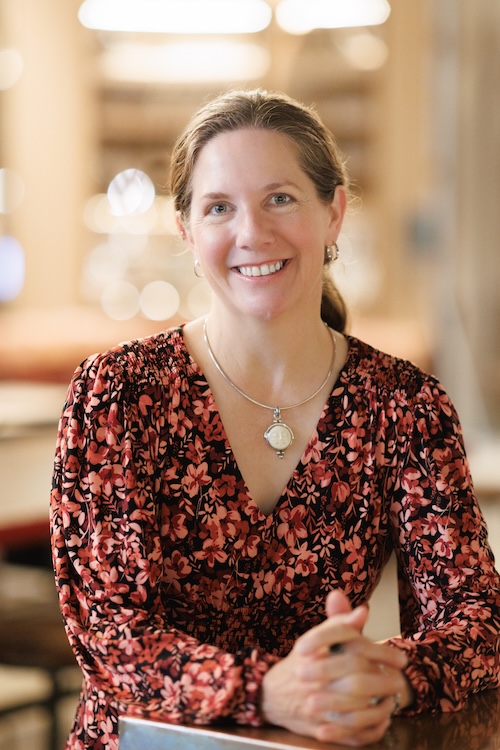
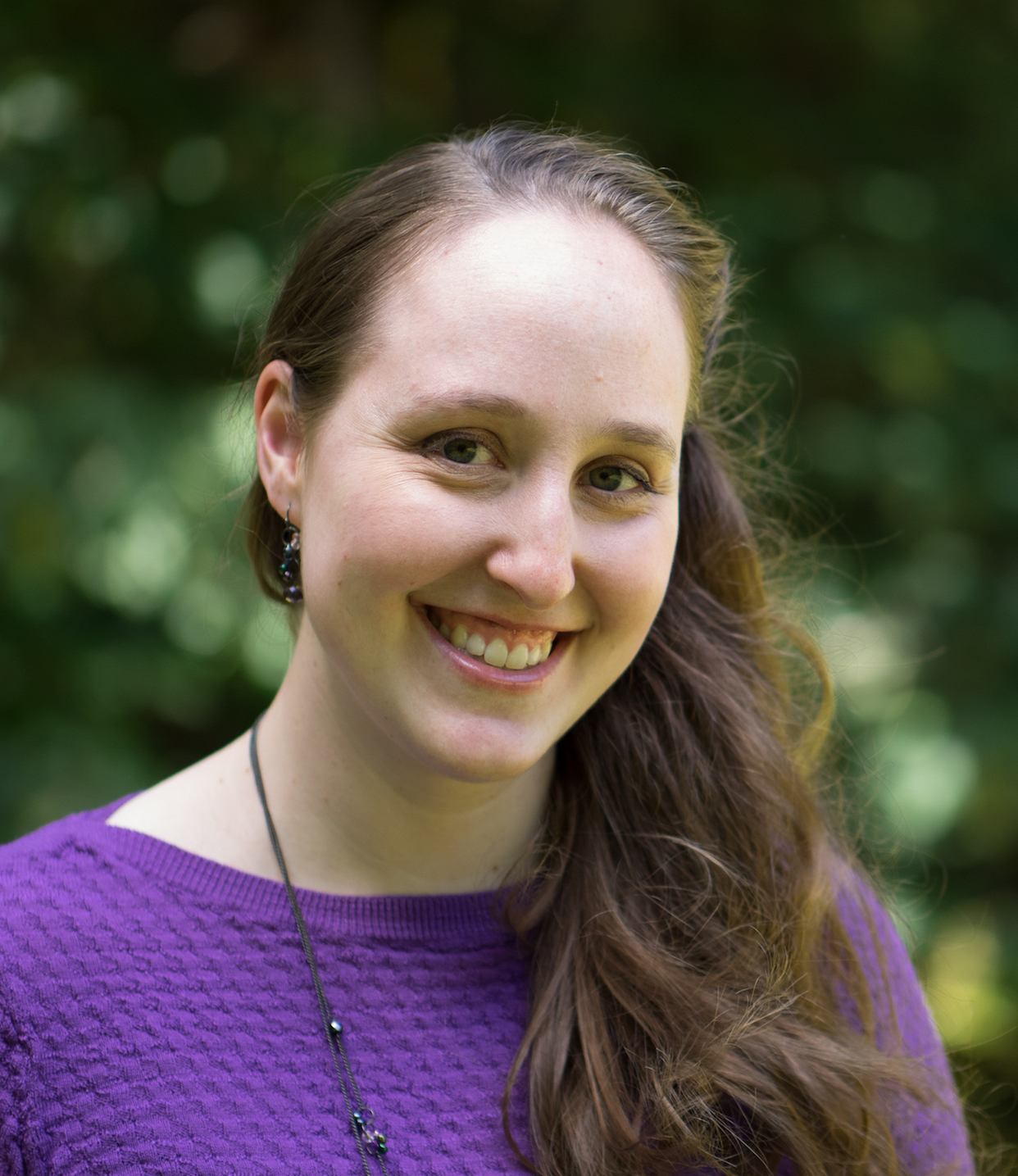
Kathryn Arnold writes fantasy and anything else that sparks her creativity from her home in Kingston, Washington. She currently earns her living as an insurance underwriting assistant, where she also creates marketing and web copy. When not writing, she plays (and teaches) piano and keyboard in a band (or two), and is working on starting a ministry team with her husband. You can find Kathryn at www.skyfirewords.com.