Strengthen Your Storytelling, Grow Your Craft
If you want to be the first to know about my writing workshops, coaching offers, and the occasional craft tip-sheet, join my Notices and Tips list.
No newsletter. No noise. Just your next writing workshop.
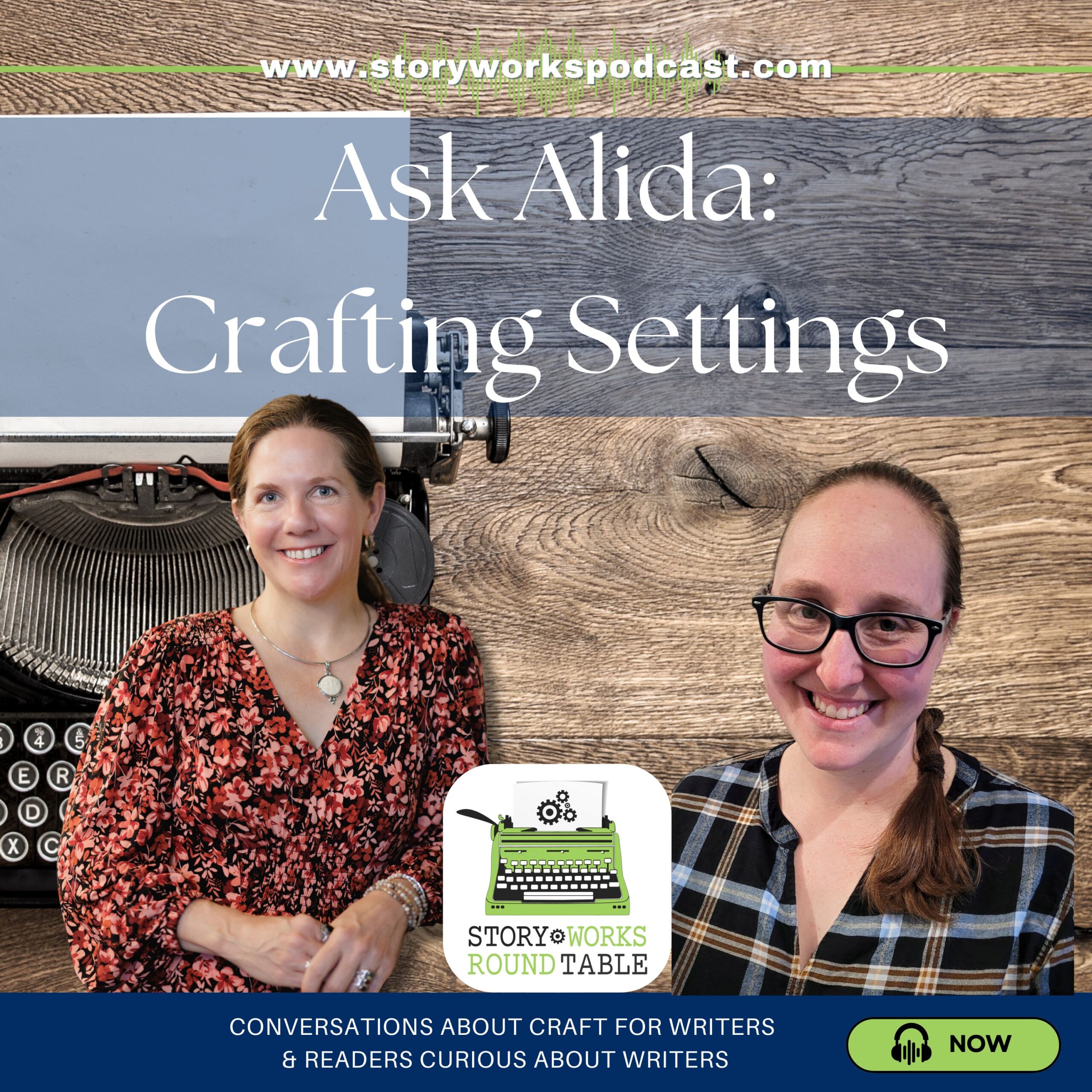
In this week’s episode of the Story Works Round Table, we are bringing you a discussion from our monthly live Q&A Ask Alida. In this episode, we talk about creating key settings, how to create touchstones for your readers as well as addressing common setting problems.
AUDIO
TRANSCRIPT
This transcript is AI generated. If you notice any inconsistencies or errors, blame the bot.
Kathryn Arnold: I have an opening question to start with and then we’ll dive into a little bit of a craft topic. As Alida said at the top, anytime anyone has a question or comment wants to join the conversation, drop it in chat. We’d love to hear from you. so my opening question today is, what is one aspect of Storycraft that you personally have struggled with and how have you either worked on it or overcome it?
Alida: Me? Struggle? Oh, man. what have I struggled with and when? How long ago? Let me draw a blank. I know that’s a little embarrassing, isn’t it? What do I struggle with? I can tell you currently, which maybe isn’t quite the question you were asking for.
Kathryn Arnold: Open to interpretation.
Alida: Okay, good. Good. Yeah. So my current work in progress, as many people have heard, is omniscient. And so I find it interesting when I’m going into a non primary character’s point of view, when I’m dipping in because I want to reveal something specific in just this scene. It’s a very short term point of view really. You know, a little bit of their perspective lens, but more narrative exposition, but in their point of view. And so sometimes the character just clicks and I know what they sound like and I know how to describe them. Right. And that’s easy. But often I don’t. So I know from, my technical vantage point as author why I want to use this point of view, what I want to expose about the story, about the world, about history, through this momentary point of view. But then I find I’m not connecting with the character as person. So if there’s a takeaway for other people here, I think it’s, highlighting that when we’re going to put a character on the page for the reader and they aren’t just an extra walking through a scene, when they’re actually serving a function in the story and in our protagonist’s life, we still have to find that connection. We still have to find the specific details that make them memorable, even if they’re ultimately kind of a disposable character, you know? so I think, I think that’s interesting. That’s something I was thinking about this morning when I was in a couple of points of view that are rather transient in the story.
Alida: Yeah, yeah. What else?
Kathryn Arnold: That’s great. Yeah. Giving them their, their full due, even though they’re minor. That’s good. Okay.
Alida: Yeah. I feel like I didn’t really give you a good answer to your question.
Kathryn Arnold: No.
Alida: that’s great.
Kathryn Arnold: Well, I think it’s important, you know, even with all of your experience, there’s still things that you will sit with and we’ll say, okay, this, I need to focus more on this, or I need to work on this. Because it’s. We’re always learning and growing. Right. And we’re always discovering things or stretching our craft. And you’ve talked about that before, about giving yourself a challenge. And this is your challenge of the moment, is using this on pov. So.
Alida: Yeah, yeah. And I think, you know, when we come up upon craft challenges in our writing, we work through them, we move past them. but we’re doing it in the context of a specific writing project. So that doesn’t mean we aren’t going to come up against that challenge in the next project. Right. But because we’ve solved it once, we can solve it again. We’ve got a history with that challenge, but it’s going to look different, it’s going to take a different shape. At least I hope it is. Because, I like writing. That’s always expanding me as an author. You know, if I could just sort of like drop something in and keep moving, I would get tired of writing. I would find that.
Kathryn Arnold: Oh, yeah.
Alida: Tedious, ultimately, definitely.
Kathryn Arnold: All right, I like that answer. Okay, so I’m gonna drop into our topic for today, but again, if anyone has any questions that you brought, or comments, feel free to drop them in chat and we will get to them as quickly as I see them. which hopefully is quickly. okay. So we recorded, an episode of storyworks where we touched on setting this week. And as part of that conversation, it got me thinking about things that I would love to ask Alida during this time. So we’re going to talk a little bit about hopefully crafting what I’m calling memorable settings. I have had the privilege of reading Skoghall series, as well as A Stone’s Throw from Alita. So I’m going to reference some of your settings and kind of use those as touchstones for moving forward with this conversation. So in your books, you have created some pretty memorable settings and use settings as kind of centerpieces. I’m thinking of the house in Skog hall or in A Stone’s Throw. The, I think it’s the women’s center with the mural. Right. Where we’re kind of. Those are key moments. Do you think that all stories kind of have a central setting or if that. Is that a necessary piece to build into a story, or is that something that only certain stories need?
Alida: That’s a really good question. my immediate answer is yes, I think we do need setting to be. To be specific, to be real, to be more than a backdrop to our characters movements through a scene. You know, and you’re referencing, excuse me, very specific places within the novels. And. And so those particular examples are, the places I developed especially well. Right. Because they’re serving a role in the story as more than physical location.
Kathryn Arnold: Correct.
Alida: There are, places where key moments in the story happens where I really want the reader to be able to track my character’s movements through the world without me dropping into, like, nitty gritty exposition. So you’re in that place multiple times, many times over the course of the story. And so each time you’re there, your familiarity with it grows so that you know, when these major things are happening, you just feel like you’re in that place and you know it and you can see it without a lot of explanation. So that I can focus on the character in the action instead of on the setting, the environment the action is in. And I think if a writer tries to write a story without one or two of those key locations, then you’re going to find yourself needing to do more of that world building or leaving the reader in kind of an abstract story where your sense of place is minimal, where you’re leaving it up to the reader to fill in blanks, where you just reference something. You know, I’ve had writers show me scenes where the action is happening in a kitchen or Something I say, well, the kitchen that I see in my head might not look anything like the kitchen. You see your characters moving through. Right. And do you really want to leave all of that up to the reader’s imagination? And we don’t need everything. Right. We don’t need the kitchen sink. Ha, ha, ha. But we need enough detail, enough description to ground the reader in that environment so that things aren’t just sort of popping out of thin air or, you know, left to, to random devices. And then it’s.
Kathryn Arnold: Yeah.
Alida: As with character development, you can kind of think of your settings in stratas or tiers, like, where is important action happening? Where are we just moving through? So sometimes you can use a broad brush stroke. Sometimes you need to really get in there, you know, and do the fine detail work.
Kathryn Arnold: Yeah, that makes sense. I read a book very recently that was interesting with setting in this situation where they were moving the whole way, like the whole book was a journey. But I felt like the author did a very good job of creating kind of their camp as their keystone setting. Right. Where it’s like we knew, you know, which tent was where and what the tents looked like and who was next to whom. So I feel like having that was in there, but it was in there in, a different way. Right. Where you’re crafting something for the reader to hold on to, even as you’re moving through different landscapes. Yeah. So I feel like having that centering was important, but it was different. It was done differently than having, like, you have the house or, like, I have an apartment in my story that’s very central that she keeps coming back to. So.
Alida: Yeah. Uh-huh.
Kathryn Arnold: Interesting.
Alida: Yeah.
Kathryn Arnold: Yeah.
Alida: And I think the key is not leaving the reader with. I call it green screen writing, where we feel like our characters are just in front of a big blank backdrop. And if you do have that kind of travel, you might think more about props. Like, what is my character bringing with her through these changes of environment? Think that then gives us a sense of connection or belonging or importance. Right. You know, I mean, we do so much with our setting. If you think of, your character’s primary space, let’s say it’s a bedroom. How does she. Or her apartment. How does she decorate it? What does it look like? Something that’s very, you know, ultra modern, black and white, sleek, is going to be different than something with a bunch of boho blankets and, you know, floral curtains. And that communicates details to the reader. So then if we put her on a train. Right. What is in her bag, what is on her body, what is meaningful to us? Or you know, going back to like the women’s center. You mentioned in a stone’s throw what that building is intended to be and what my protagonist is doing there. With painting the mural carries a lot of thematic weight in addition to the fact that key action happens in that setting.
Kathryn Arnold: Right, yeah. And I had that, as one of my questions here about if all stories need one or a few maybe central settings to hang on, how do you choose with, you know, how you have your setting be central to the story’s theme or plot? You know, whether you, you said you’ve got like central actions that are happening there, but also thematic weight. So how did you develop that in concert with the theme and with the plot?
Alida: Yeah. I mean, that’s a bit of a chicken or an egg question, right? I mean, I think if you know what your story is about, then these things are going to present themselves to you as you’re developing your story. So I knew that Simone is an artist. I knew that women she’s painting were going to come to life and interact with her. And so I decided, well, I want them to be life size, not like they’re, you know, on a canvas and then step out and blow up or they’re miniature or something. So it had to be a mural. So for a mural you need a big wall. And this is a, a story all about women’s relationships and mothers and daughters and questions of motherhood and such. And so it makes sense for it to be a women’s center. And then, you know, it’s set in Minneapolis and I like historic buildings. So I was thinking about what kind of building which you get to paint this mural in. And so I went with a fictional version of a grain exchange building. So a very masculine industry. And after it was a grain exchange, it was a bank. And then, you know, when the story opens, it’s vacant and it’s been purchased through grants and public funds and such to become a women’s resource center. So then I’m just combining like what I know about the sister city and our history and such with the thematic elements of my story, along with what I need for my character to do, which is paint life size women who come to life. Right. So that I just kind of watch you, walked you through the journey of creating that setting. Because it isn’t, I mean, I guess it could be a one and done. Right. But we, we make our choices based on the story. We want to Tell the needs of our story, the needs of our protagonist. well, and I think that’s
Kathryn Arnold: important to walk through because it’s so easy to just be like, oh, I just picked this spot because she needed dot, dot, dot. And it’s like realistically it was more. There were more factors involved. Right. And I think, I did a similar thing with her, with my protagonist in her apartment. Like what does she need, character wise in order to be able to live in this world? So that’s. That’s cool. Walking through that process.
Alida: Yeah. Let’s say hi to Kristen and Anna. And of course, if you have questions or comments, throw them in the chat.
Kathryn Arnold: Yeah, we’re talking about crafting memorable settings, but of course you can talk about whatever you would like. Okay. what level of detail, or maybe even I was thinking like repetition of detail do you use in order to create cement a setting into a reader’s mind? Like you talked about familiarity and creating a familiarity where the reader can feel themselves in that space. What kind of details or like I said, repetition do you use?
Alida: mm, yeah. I mean it, it depends a bit on the location and how it’s functioning in the story, you know. So for the Women’s Resource center, the first time it appears on the page, Simona’s friend Hannah, who was on the. Who’s connected to it, right. Who’s got keys, takes her to the center to let her know, to announce that you, you got the job. You were commissioned to paint this mural. And so we’re seeing it through Simona’s lens. It’s being introduced to her at the same time it’s being introduced to the reader. So I’m able to put in that sense of wow and newness and really taking it all in. Like, where’s the wall I’m going to paint? What’s the, this thing over here? What’s the history of the building? You know, the, the big front doors have like, I don’t know if they’re bronze or whatever. I made them like sheaves of wheat as these decorative door handles as a nod to, to history and such. and you know, I did a similar thing in a stone in Murder in Skoghall because it’s a haunted house. But Jess, my protagonist, has just bought it, so she’s moving into it. So there’s kind of that walk through it new thing with Simona’s apartment. It’s much more casual. Like she comes in, she puts the coat up, it’s a loft, there’s a sliding, you Know, kind of industrial door. So you get the lay of the land as she inhabits it, instead of that, kind of touristy, ooh, let’s check it out. What’s over here? What’s over there? Experience. and then as for repetition, I think you want to avoid being too on the nose about things, you know, And I, I think way back to the first draft of Murder in Skoghall, I think I was a little bit on the nose in my, in my narrative because I was writing it for myself as well. You know, I’m looking at the floor plan of, the old house I found, and I’m thinking, okay, you move here and, and the pantry connects the dining room and the kitchen, and the flow of movement is this way, you know, and then I revised down for that because I wanted the reader to know the house, right? So when things are happening, I don’t have to explain the mechanics of it. But, you know, I also had to be aware of, like, oh, too much. Take the narrative back. Don’t. Don’t describe every little detail. and then you let repetition occur naturally. Right? So if your character is in the living room and the fireplace is over there between two windows, you can, you can use the action, you can use the character’s gaze when she looks out the window. You can use whatever, whatever you need to do to just have it occur organically. Hm. Right. If you think you might be writing on the nose and overdoing it, you probably are.
Kathryn Arnold: Makes sense.
Alida: Yeah.
Kathryn Arnold: All right. Kristin has a comment here. She says, I recently experimented with a short story about a locomotive engineer going through an emotional upheaval set in the channeled scablands of western Washington. That worked pretty well, though. Maybe too obvious.
Alida: Yeah, I don’t know. I can’t picture the setting. So, you can give us more info, But if we were to Riff on the idea of too obvious. I think again you kind of. No, right. Like, like what would be too obvious?
Kathryn Arnold: I don’t know.
Alida: I mean setting sets mood. It’s, it does give us a lot of great material for metaphors. you know, if you want someone to feel closed in, you’re going to put them in a dense forest, not out on the plains. Right where you can see the horizon, like forever kind of a thing. yeah, I don’t know. It sounds like a cool landscape. I still don’t know. I think I had a comment on the question.
Kathryn Arnold: Yeah, like how you said, if we’re talking about memorable settings, I feel like if you describe that, well, that would be a very memorable setting and something that would be striking in contrast to the train going across it. So that’s.
Alida: Pretty cool. Yeah, it is definitely a balance.
Alida: Yeah.
Kathryn Arnold: And I see you mentioned.
Alida: Oh, I was just gonna say it makes, it reminds me that we also need to keep in mind our readers, you know. So Kristen is mentioning a place that I’ve never heard of, so I can’t picture it. So the only sense of it I would have is based on whatever on the page. in my critique group recently a writer gave us a, ah, nonfiction piece, an essay in which as a kid he was playing on the ice with a friend and he fell through and instead of trying to get back up out of the ice, he went down and he walked along the bottom and walked out of it. And I’m in minnesotan land of 10,000 legs. I’m like, are you kidding me? Never mind the cold. What about like the silt coming up on the bottom? You wouldn’t see anything. And you know, if you’re under ice, it’s so disorienting and people don’t know how to get back to the hole. And what are you, like technical, you know, concerns all over the place. And then he’s like, oh yeah, it was a quarry, so it was just a rock bottom, there’s no dirt in there. And yeah, the ice wasn’t totally solid so I was walking under ice chunks and I’ well, okay, which is just a note for all of us to remember that the reader doesn’t know what we know. And so we’ve got to think about readers, reasonable objections. Right. Like somebody who knows frozen lakes isn’t going to accept the description he had on the page. At that stage of drafting, of drafting, it needed more detail and more specificity so that we wouldn’t be pulled out of the story.
Kathryn Arnold: Right.
Alida: For sure.
Kathryn Arnold: Just got a recommendation. Train Dreams by Dennis Johnson. Fascinating integration of setting and plot.
Alida: Nice look for that. I have not read that one. Well.
Kathryn Arnold: And I do think sometimes we discount how much setting can be affecting our plot. We just think of it as the set and not so much as. As a direct player, but it is definitely a large component. It can be, I should say.
Alida: Yeah, Yeah. I might go so far as to say it should be. Mm, You know, I would agree.
Kathryn Arnold: Okay. I want to have you just riff on some common problems that you see with settings and people’s work and maybe some ways for them to identify and fix them.
Alida: Okay, well, the one I just mentioned with remembering that the reader’s nodding your head. And I think we can take things for granted as being obvious when we know a setting when it’s very familiar to us, because we aren’t doing any discovery as we’re writing it. Right. And if, if it’s where we live or grew up, then everyone around us can take it for granted as well. And so we can forget that we’re painting the picture for somebody else. so awareness of the reader and then also that idea of the green screen writing. And you, know, people can kind of get caught up in the characters and the action and so what are they doing? And somebody drinks coffee or, you know, goes upstairs or gets in the car or whatever, and those movements just sort of happen. Which, that’s okay when it’s just a little bit here and there, but when you’ve got a string of movements like that, there comes a point where a reader’s gonna go, wait a minute, like, where. Where are we? Where’s this happening? What does that look like? And as a reader, I can go with it for, for so long, you know, maybe a third to a half of a page. And then I’m just like, whoa, bring me back into this world. Because I’m losing touch with it. And the, the characters start feeling like they’re disembodied, you know, they’re kind of talking heads, or just there’s a head and a pair of hands and something happens now and then, but I don’t have a sense of physicality, you know, and we need that. and setting also is a major component of our narrative exposition. Right. And so you get these scenes that look more like scripts, the novels or short stories because of the green screen, because of the disembodied character, and the setting falling off of the page. But then as a result, you Also lose touch with your narrative voice. It just kind of disappears. And the reader, the writer might only pop the narrative back in when they want to go into the character’s head for a thought or something. But you’re leaving the reader with a very limited experience of your story. When you deny the reader exposition, that is the storytelling. Right. And I’m sure I’ve said this on the podcast, I don’t know if I’ve said it on an ask later, but when you think about narrative exposition and what it is, think of ex words like expose, explain, expand, expound upon. Right. So it isn’t just to describe a building or just to say somebody walked across this room. It’s so much more than that. And that is the story, it is the voice. Right. So don’t neglect your narrative exposition. And setting is a, is a big piece of that. Absolutely, yeah. Awesome.
Kathryn Arnold: All right, I have a closing question that’s a little bit more fun, but still about setting. So if you are, if you could travel to any setting in any book that you have read, what setting would you pick and why? Oh, like a, ah, pick your, pick your place. You would go,
Alida: dang. Well, I’m in the Great Gatsby because right now I’m writing a, story set in the twenties. And so to go back and to party and ride in the cars and you know, be on the coast and be in the city and the clothing, like, that would be awesome. All right, where would you go, Catherine?
Kathryn Arnold: Oh, see, I had to think about this because there’s your like, yeah, Pat answers. Like, I mean, I would love to visit Middle Earth, but that’s like, of course. I mean, Tolkien was a master of creating a crazy world, but I, I kind of went with nostalgia. And if I could visit any setting and this is totally a fake made up one. I love the Mercedes Lackey books growing up and she has a whole universe of like a hundred books in it. And I was like, I want to go to Valdemar. That’s where I want to go. So I think when you have lived in a setting for so long through so many books, you sort of begin to picture what it would be like to be there. And so there was a lot of nostalgia there for me.
Alida: Yeah, great answer.
Kathryn Arnold: Yeah.
Alida: Yes.
Kathryn Arnold: Yeah.
Alida: You know, it’s funny you say nostalgia and I, I want a time machine whenever I’m writing historical fiction. Right. So I’m like, well, of course I want to go back to Victorian times and, and I do have a big fondness for those antiques. Kind of late 19th, early 20th century and such. And, you know, you go through any, any city and see these beautiful homes and think, I wonder what they were like in their heyday, when.
Kathryn Arnold: Right.
Alida: You know, the garage out back was a stable and carriages were going under the carports and everything. yeah. And so nostalgic reading. It would be Little House on the Prairie and Anne of Green Gate Horse.
Kathryn Arnold: Yes, totally. And then you go, I probably wouldn’t want to actually live there, but if I could visit, that would be awesome.
Alida: I. I could live there as long as I wasn’t poor. Like, I would never want to be the factory worker. But that’s, true.
Kathryn Arnold: Right.
Alida: You know, if I could go back and have some money, it could be awfully fun.
Kathryn Arnold: Oh, man. Awesome. M cool. Well, that wraps up my questions on settings and see, setting is powerful here. We just love to go and visit them. So if anyone has any other questions or settings that you would visit if you had the chance, we’d, love to hear that.
Alida: What setting would you visit?
About Your Hosts