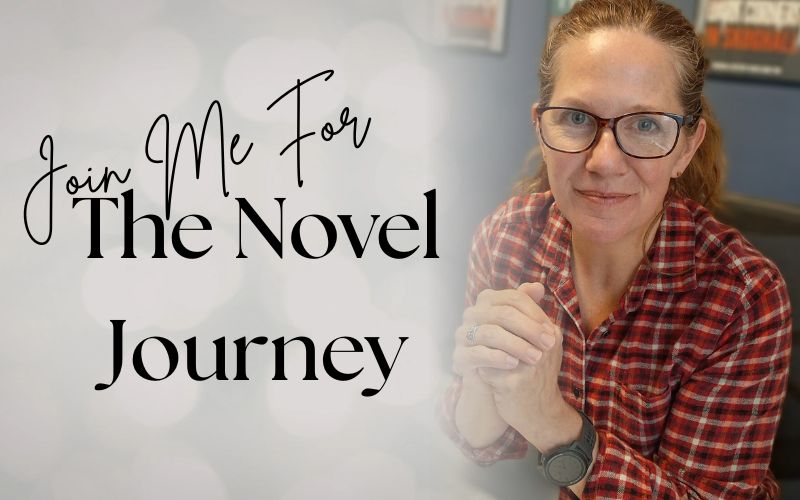
The Novel Journey
Discover How to Write a Novel You’re Really Proud of in One Year
The Novel Journey is a year-long novel-writing and author-development experience that takes writers from page one to “the end.”
Write your novel while growing as a writer without impossible word count goals, bending your story into someone else’s plot formula, or sacrificing your voice or vision for genre expectations.
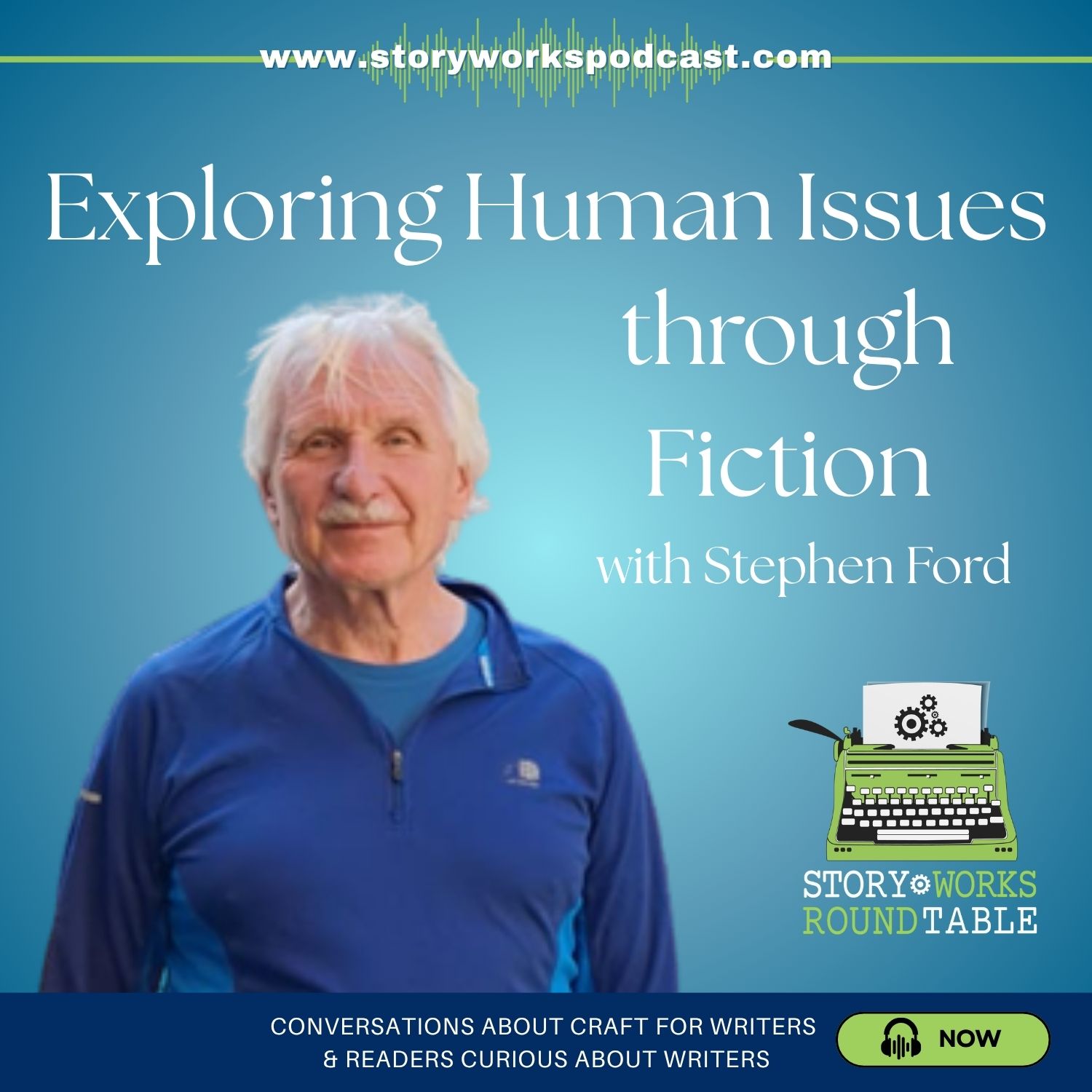
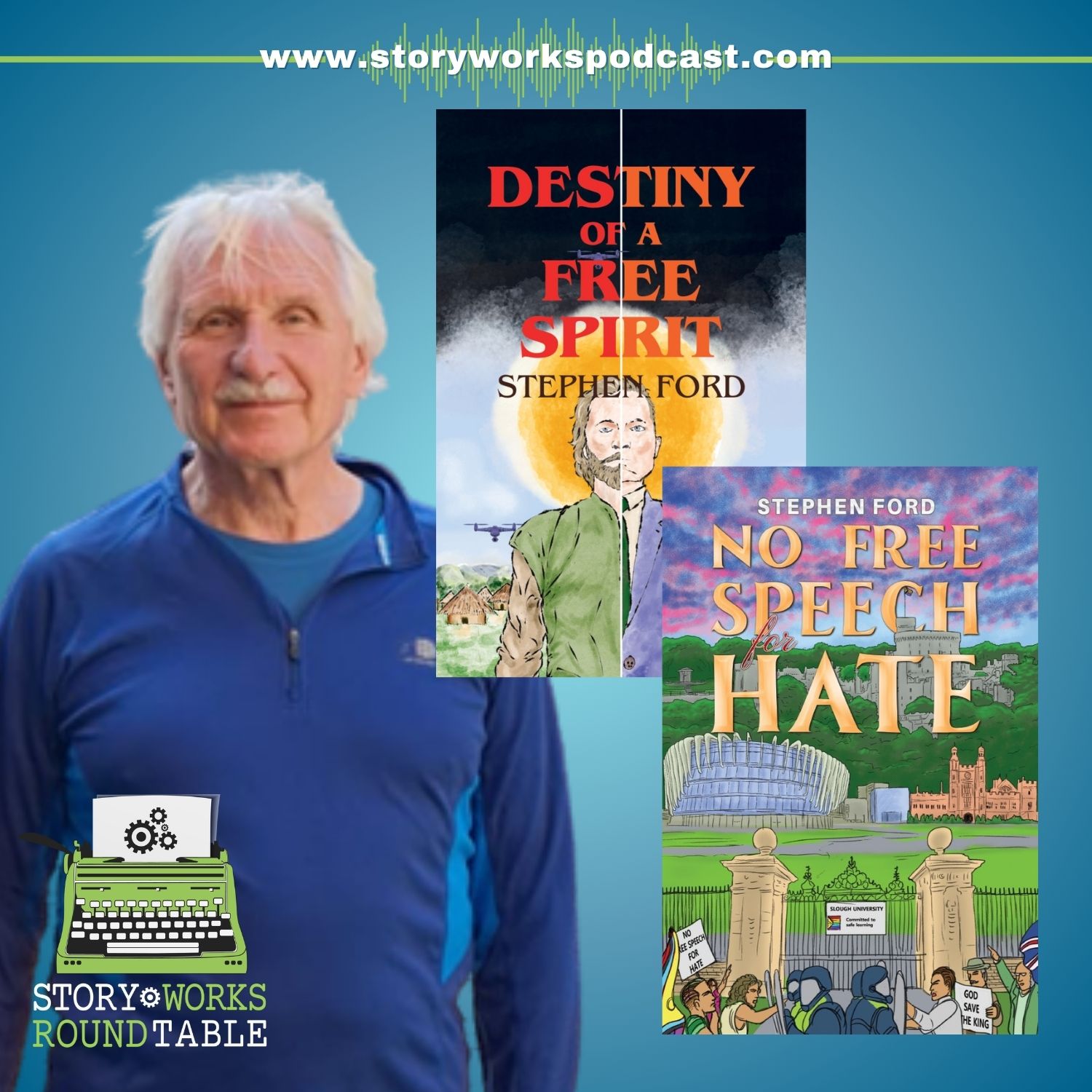
In this week’s episode of the Story Works Round Table, Alida and Kathryn are joined by Stephen Ford to talk about exploring hard human issues through fiction. Stephen’s use of speculative fiction and satire opens the discussion about what it means to be human, or how we encounter the issues of the day. We talk about crafting characters that are real people, representing a variety of viewpoints, how to get those viewpoints on the page, and how to keep it open for readers to be a part of the conversation happening in the book.
AUDIO
TRANSCRIPT
This transcript is AI generated. If you notice any inconsistencies or errors, blame the bot.
Alida Winternheimer: Hello and welcome to this week’s Story Works Round Table. Today, Catherine and I are delighted to be joined by Stephen Ford. After retiring from a four decade career in information technology, Stephen began writing provocative novels that use satire and speculative fiction to examine some of the most urgent and unsettling questions of our time. Free speech versus intolerance, AI and human agency, political extremism, nuclear anxiety, and what it truly means to be human. So welcome Steven. We’re excited to dig into some of these big topics with you.
Stephen Ford: M. Okay, I’m excited too.
Alida Winternheimer: Excellent. So speculative fiction and satire, when you started writing, did you know those were the genres that you wanted to explore? How did you get started with those?
Stephen Ford: Okay, I, I guess the thing, the thing that really motivated me to get into writing seriously was the terrible things that are happening in the world. The, the chaos that we see around the place. And I was thinking I can’t just sit here and throw things at the television set. I need to sort of get into it and explore it and pull it apart and actually convey my feeling in an effective way. So that’s where I was starting from. so I wanted to dig into some of the most fundamental things like why are we like this? Why are we, why, why are humans like this? Why are we behaving this way? what is it that, that, that makes the world the way it is? and I guess in my, my first book, the Destiny of a Free Spirit, what I was exploring there is, is are, are we really in our natural environment? As humans today we have a developed, highly technological complicated world. And that isn’t the world that humans evolved in. We evolved to live in the African savannah, among the wild beasts. As another wild beast. We’re no different from the other animals really. and all our instincts, ah, and our behaviors and our social structures, are geared to, adapted for that purpose. And yet here we are in a completely different environment and are we really suited for that? So what is more natural for humans to be in? So in the book I kind of contrived a situation where the world had been split into two environments. I’ve called them ecologia, which is the natural primitive environment, if you like, and economica, which is the developed environment complete with robots and every high technology you could think of. and what has happened in the book is something I’ve called the commission has divided the world into these two environments. So I think I’ve contrived A quite a plausible mechanism for how this came about it. It’s obviously where I wanted to end up because the protagonist in the book, has illicitly found a way from Economica, where he starts into Ecclesia, the natural world where, ah, there are humans there, but they’re primitive, Stone Age people who live alongside wild beasts which have been introduced. So mammoths and saber cats and things like that have re. Established themselves in this environment. and he has a dual existence between the two. And at the end of the book, and I won’t say which way he goes, he has to choose between those two environments because the portal is used to travel between the two is about to be closed. So that’s the basic thrust of the book. Along the way I’m covering things like, artificial intelligence. what. What is really controlling this new world? and religion, because there’s religion in, in the Stone Age environment as well as in the. In. In the modern world and what that religion looks like. And, And a load of other things that, you know. what, why. Yeah. What motivated the. This, the individual. Uh-huh. To get into that situation.
Alida Winternheimer: That’s interesting. So when you write, are you writing to explore the question and see where your character takes you in terms of a conclusion, or do you already have an answer to the question you’re posing and you’re writing in order to express and develop that answer, to communicate your ideas with readers?
Stephen Ford: Okay, well, I think you have to have a framework to start with. You can’t style a book without having some kind of concept about the shape of it. however, at the same time, the characters drive it as well and the situation drives it as you write. So it’ll never quite end up where you think it’s going to end up. I’m constantly having to reshape and revisit earlier chapters in my books as I write them. So it’s a combination of, having a framework, having some sort of plan, but then also being flexible enough to allow the characters and the situation to modify the direction it goes in. So no, I don’t know in advance every detail about it’s going to shape up, but I hope I have the general shape of it.
Alida Winternheimer: Yeah. Do you think that does the book at the end, when the character makes his choice which world to live in, does that communicate to readers an answer to that question you’re posing like AI versus human agency and some of these big theme, big with a capital B issues You’re Delving into,
Stephen Ford: I think those, some of those kind of reveal themselves as the book goes along. Hopefully, I keep the reader in suspense until near the end. so I’m not spelling it all the way out. It’s not until right at the end, it’s kind of spelled out. And I don’t present the reader with a definite answer either. In none of my books do I do that. I don’t say this is how I. What I think the answer is. I, I let the reader draw their own. Own conclusions to a degree. And the choice made in the story is the ch. Choice made by the lead character. It, it’s, it’s. That isn’t necessarily what everybody else would have chosen. just how his particular circumstances took him. and, I leave it open right to the end, as to which way he’s going to go.
Alida Winternheimer: Yeah. Yeah. So, you know, when we think about writing story with message or story going through these, exploring these big issues, there’s always the risk of becoming didactic. I think if the writer directs the story too much or through the story directs the readers thinking about these questions too much. Is that something you were thinking about while you were developing your story and kind of managing as you wrote it?
Stephen Ford: I definitely want to avoid writing a polemic, and I think I’ve been successful in that because the people who reviewed my books have all said I present the thing from the multiple facets and the reader has to make their own choice. and hopefully I’m not going to, rule out readers who come to a different conclusion to what I would have come to. For example, and I could leave openings, but, you know, people have different points of view. the main thing is to make the reader think about the issues, and to have been exposed to all the thinking. and so the proponents of various points of view are characters in the book. so I’ll present the different points of view through the eyes of different people involved. And I’m not going to say which one I agree with. in fact, even ones I might vehemently disagree with, I make sure I put a cogent argument, for their point of view.
Alida Winternheimer: Did you study debate? You were in school? You know, I don’t know if you have debate teams over there the way high schools do here.
Stephen Ford: Yeah, we had, we had debates. Yes. Yeah. yeah, I did. Did a fair bit of, debating issues, in my youth. Yes.
Alida Winternheimer: Yeah. Yeah. I mean, I think it’s a, a skill many people do not have. You know, at least, where I went to school. And I think typically here, debate is something that’s optional. It’s more of an extracurricular activity like the debate club. Right. But to be able to think through an argument that’s reasonable and sound to the person who holds that argument when it’s not your own argument, you know, your stance on an issue is so valuable in life, but then critical for us as writers because we need to develop characters who populate a story world and they can’t all be our friends, right?
Stephen Ford: No, absolutely not. No. In fact, I find some of the characters I have to write, the most interesting ones are the ones who, I’m opposed to in terms of my own kind of politics and way, I think, because I’m fascinated to think, why do they think like that? And so I read a lot about what those people say. you know, watch their little snippets online and their Twitter accounts and things like that, and get their arguments and get their point of view and make sure that I present that point of view in my books, even though it’s one that at start, my starting point is, oh, my God, you know, I really hate that. I think it’s important to show, to actually show honestly, what their thinking is and how they got to that point of view. And it was an important, learning for me to sit, to get into those characters and to, really get under the skin of why they think like that.
Kathryn Arnold: As you were doing this research and looking into all of these big issues and ideas, did your thinking change or did the way that you approach, approach the problem change because of all of that?
Stephen Ford: yes, I think, I think, I think so. I, I, I’m open to persuasion and, and also I don’t think there’s any one right or wrong, view on things. You know, I, I might have a point of view, but, you, can talk to, I’m quite happy to talk to other people who have a different point of view, as long as they’re reasonable and not insulting.
Alida Winternheimer: Right.
Stephen Ford: Which is often the case, unfortunately.
Kathryn Arnold: Well, I imagine that it developed a sort of compassion and empathy as you’re developing these characters. You can sort of get, see where they come from and it changes the way that you interact with that narrative. Maybe.
Stephen Ford: Definitely. Yes. Because, I think that we all learn by talking to people and understanding where they’re coming from. Even if you think what they think is nonsense, at least, you know, you understand how they got to think that nonsense. so, getting into that thinking process I think is, is important.
Alida Winternheimer: Yeah. So what what advice would you give writers about this process of developing characters you disagree with? How much development did you do? Did you figure out backstories for them even if they aren’t point of view characters, so that when you gave them dialogue it made sense and felt organic? You know what, what sort of techniques or process did you put into this?
Stephen Ford: well, one source of course is models of real people in real life. So that Both people in the public domain who you see, plus some friends and colleagues and people you, you know, you can. You come across. Ah. And you. And I love the quirks, I love the people’s little quirks and sort of remembering a draw on my memory a lot, you know, in terms of conversations I’ve had in the past maybe 20 years ago with somebody and suddenly thought God, that was an interesting conversation I had back then. Maybe not even a pleasant conversation, but it was something that stuck with me about people’s behavior and The little quirks people have. So I can put those into the characters. and definitely I want to make sure there’s a strong character in every case that puts forward every valid point of view that there is. and puts it in a cogent and sympathetic way so that, so that Even if it’s a point of view I’m not. Not one that I’m advocating personally. at least some of the reader when they read comes across as genuine and something that’s real. So Developing the characters, I think I want to project a model trying to understand, get the picture of that person. So I mean literally that. Find an actual picture so I can describe. I think in terms of putting descriptions in the book of what people are like. and it’s something I didn’t do initially but I do now is I find a photograph of ah, real person or maybe a AI generated one. but it’s It’s a real, real somebody’s real face. You know, dress in a particular way and that sort of thing. And then I can say, I can say okay, that that picture is that person. Then then when I describe little things about them in the book, I’ve got that to draw on. And then I just sort of put jottings down as to their backstory, what their role in the story is, little, little descriptive notes and then, then when I Come and kind of write the main, the main story. I just draw, draw from that, that file I’ve got on each character and I make myself a little word document for every character, to support that. so it takes quite a bit of preparation to get to the point where, you know, you, you can actually write, write something in the book. But I think you, if you don’t do that. The characters are cardboard cutouts. Yeah. They don’t have that depth that they should have.
Alida Winternheimer: Yeah, yeah, that’s true.
Kathryn Arnold: I like that using a visual of an actual person, even if you describe them differently or whatever in the book, it gives you that kind of concrete reminder. This is a person, a full bodied character rather than just whatever three sentences you came up with for their role in the story or whatnot.
Alida Winternheimer: Mm, Yeah. How many Point of View characters do you have in this book?
Stephen Ford: what destiny of a free spirit trying to think. I haven’t counted them but I were probably about 10, I should think. 8 or 10. Something like that.
Alida Winternheimer: That’s a lot of work.
Kathryn Arnold: We’re in a lot of people’s heads.
Stephen Ford: Well, I mean, I’m not saying I write it from that because it’s actually written in first person. So the point of view is this. Just the one person. which is interesting. I kind of evolved into doing that. It’s not a very fashionable thing to do these days, writing first person, but I started writing in third person and then I got sort of partway through and I thought actually this will be much more powerful and direct if I make it first person because it’s really a. I don’t know, it does make a big difference actually. It does limit you because it means that you can’t, you can’t hop from one person to another. so, so when the alternative points of view, the other characters come, I have to get, I have to do it from dialogue, I have to do it from what they’re saying, description of what they look like, the descriptions of their reactions and that sort of thing. So it’s an observational thing rather than getting in their heads directly.
Alida Winternheimer: Right. Okay, so then it’s one. It’s a single POV novel with the one first person protagonist. Exactly 10 characters. Whose, whose contributes a lot of clues you were bringing to the page.
Stephen Ford: Yeah.
Alida Winternheimer: So great. And the reason I asked the question is because I would love to talk a little bit about how we bring these attitudes to bear on a specific story when it’s not the Point of View character. Right. When we can’t just go inside their head and show what they think and feel in every moment of the story. And especially in this kind of story where those perspectives matters so much because that is what you’re exploring. That’s the meat of the story. So.
Stephen Ford: But it’s the. It’s the main character protagonist who’s doing the exploring. So by interacting with these people, in various ways. Ah. And encountering them and being challenged by them and everything else, the main character is then affected by their point of view which I hope comes across fairly strongly in the book. And I think that works fairly well. I found that recently effective. M. The main thing is, you can’t put anything in there that the main character doesn’t know. So it does sort of limit what you can do going into first person. It sort of narrows it down. But I found in practice it didn’t limit me very much. because I started off third person, then went back, changed it to first person. There wasn’t much I had to cut out or alter to huge degree. so it. So it kind of worked okay.
Kathryn Arnold: So then when you developed this main character, then you really had to focus on their motivation and the way that they interacted with the world to be really curious and open like there. It sounds like they’re investigating the world into terms of trying to figure out their own stance on it. Is that.
Stephen Ford: Yeah, it’s kind of. It was slightly autobiography autobiographical in in the sense that. That I I’ve explored the world, you know, in that way. You know, by being exposed to other people and what their points of view are. So My main character starts off confused about things and Takes some wrong turns, does some stupid things and Gets corrected. And And it’s. It’s. It’s these other characters. Encounters that sort of channels him in a particular direction. So. So Ah. So I allow that. I allow that all these other influences to come to bear that way.
Alida Winternheimer: So Catherine, how do you write characters? How do you express a character’s worldview on the page when they are not a point of view character?
Kathryn Arnold: Oh man.
Alida Winternheimer: On the spot. Well, no, I like.
Kathryn Arnold: I like what Steven was saying about your m. Main character is interacting with it. And so it’s. I think that interplay needs to be strong. The, the. Either the tension there, the fact that they’re disagreeing or the fact that they are agreeing needs to be part of the main conflict of whatever is happening in the scene in order for that worldview. To come across, I think otherwise it gets buried in the background. And then if it needs to be the main thing, it needs to be part of the action needs to be wrapped up, the theme needs to be wrapped up in whatever is happening in that scene or in that moment. involving the main character.
Alida Winternheimer: Mm, Yeah, I agree.
Kathryn Arnold: Yeah.
Alida Winternheimer: Part of my mind is going, I can watch it because you can see it. You know me so well. Yeah. So, Stephen, my current work in progress is a historical fiction novel and it’s omniscient. But of course I don’t enter every character’s head on the page. But I’ve got a character institutionalized. it’s based on the eugenics movement in America in the interwar years in the 1920s and 1930s. And so this. Exploring big questions, especially questions a lot of people are. A lot of people are interested in them. A lot of people don’t want to look at them because they’re dark and depressing. But also people already have predetermined opinions today. And I see this a lot doing, doing research online and seeing what comes up. And then I might follow a link and you know, it’ll be somebody writing their commentary on something. But I know because I’ve been doing research for five years that their opinion is not accounting for all of the facts. They don’t have all of the facts. And so I’m writing, you know, many characters with attitudes. Right. That are, that are. Yeah. It’s like I don’t even want to judge them in this moment because they’re so complex and there’s such a spectrum from the darkest motivation of the dark to really well intentioned but misguided by the attitudes and of the day, what was considered the science and the politics and very significant of the day. So with that whole spectrum, Right. Of beliefs in the era that affect my characters, my job as writer is to try to present them as honestly and accurately as I can. Which is not to make them all villains, not to make them all malignant. Right. They, It’s a whole spectrum. So I think this is a really interesting question.
Kathryn Arnold: Yes, absolutely.
Alida Winternheimer: Yeah.
Stephen Ford: I particularly try not to have villains in, in, in my, my stories. yeah. I try to make them real people with real motivations. They may have points of view and do things that I don’t approve of or that people in general wouldn’t approve of. but I try to sort of tease them out as real people with to make it understandable about how they arrived at that position.
Alida Winternheimer: yeah. So I think with your two worlds, Ecologia and Economica. Ah, right. A reader could see that premise and think, okay, I know Economica is bad, Eologia is good and our character is going to end up over there. So given that, I hope that.
Stephen Ford: I hope they don’t. Don’t think that you don’t think they’re
Alida Winternheimer: gonna just, based on the premise, have that preconceived notion you’re going to take.
Stephen Ford: They might do. but, but I hope that they, they. I’m trying to keep it as, as open and, and not as clear cut as that.
Alida Winternheimer: Yeah, well, and I think once we as readers, right, you, you take in a premise, you see a cover, you read a blurb, whatever, and you think, okay, it’s basically this. But then as you start getting into. Opens up, it’s something wider and bigger and then you get to explore and play. but what, what do you do? Developing your story and writing it to keep the reader surprised or engaged and not settling into that. This is going where I expect it to. Or, you know,
Stephen Ford: how do I maintain the suspense?
Alida Winternheimer: Partly. Yeah. But yeah, I mean, when we’re dealing with a big issue like this. Right, so you’ve got characters who can’t just be pinned down. you’ve got two worlds. Neither one is wholly good nor wholly bad. So you’re kind of dealing with this scale. And as the novel progresses, your protagonist needs to make a choice. So I’m just wondering, does it become obvious as we get closer and closer to that decision point? Do you keep us guessing? What are your. Yeah, tell me.
Stephen Ford: I like to think I’ve, I’d like to think I’ve kept people guessing right till the end the last chapter, on this one. because I build up a lot of, things which are going on with the character in Economica as well as in Ecologia, like forthcoming marriage, is it successful in business. All sorts of things are going on that are positive about Economica. and Echolasia isn’t all good either. You know, it’s pretty rough, brutal environment involving a lot of killing and nature ready in two, some floor and so on. So, and superstitious religion and all sorts of things there. So it’s not, it’s. It. I, I’m definitely not painting one as being all wonderful and the other as being, you know, all bad. I’m trying to sort of portray positives and negatives of both.
Kathryn Arnold: yeah, not the utopia dystopia type situation.
Stephen Ford: No, no. I mean neither is a, neither. Neither of those apply to either environment. M. Which I think is realistic. I don’t, I don’t think, you know, there’s always trade offs.
Alida Winternheimer: Right.
Stephen Ford: You know, there’s no such thing as a utopia or indeed a. Well, probably come quite close to dystopia sometimes, but
Kathryn Arnold: yeah, maybe.
Alida Winternheimer: Yeah. So what attracts you to writing about questions society doesn’t want to ask?
Stephen Ford: I think that it’s all too easy to jump into fashionable assumptions or to adhere to some tribe, of a fashionable opinion, on either extreme of politics or anything else. and then, not really think things through. You just sort of assemble. All your argument is assembling all the things which are pro. Your point of view and dismissing everything that’s not, supporting your point of view. So you come up with a sort of echo chamber mentality. and I think I want to. What I’m trying to do in my writing is to break out of that and to open people’s minds that you know, these things, these subjects are complex. and you’ve got to look at all angles, and be prepared to engage with people you don’t agree with. because they’ve got valid things to say, you know. yeah. And you need to understand what, why they, why they think like that.
Alida Winternheimer: M. Yeah. So do you find readers are. I guess. Why, why is speculative fiction especially good for doing that? And do you think readers would be receptive to this type of exploration and what you’re describing if it weren’t in speculative fiction, if it were realistic and contemporary?
Stephen Ford: I try to make sure that, although the things I write about are true to life in a sense that they relate to what’s going on in the world today. I make sure that they are clearly fictional. that’s why they kind of. Everything I’ve written is to a degree futuristic in the sense it hasn’t happened yet. This is what might happen. so, I can be free to write what I want to write and not be tied down to a historical context where it has to be historically accurate. and that way I can explore a hypothetical world, a hypothetical framework, which can then expose where the issues, where the issues are. You know, what, what if you take this point of view, what is the logical conclusion? If you take that to its extreme, and look at, and take a look at that. Because I think that’s, that’s that’s important. I suppose it comes from my IT background to an extent, because in IT systems it’s the edge cases, it’s the extreme, the things that shouldn’t happen very often. but we’re going to break the system. so you need to make sure, if you want to make sure your system’s resilient, it’s going to stand up. you’ve got to say, well, what happens if someone does this very strange, off the wall thing that people in their everyday life wouldn’t normally do? will the system break? and I think you can take that into, you know, just, just general, general affairs and politics and everything else as well.
Alida Winternheimer: Yeah, yeah. It’s interesting. Catherine, do you think this would work as well in non speculative fiction, this kind of exploration?
Kathryn Arnold: Well, I’m, I’m actually, I think I’m, I have lots of thoughts.
Alida Winternheimer: Oh, good. All right, bring them on.
Kathryn Arnold: I don’t read enough contemporary fiction, but I think that literary fiction also struggles, with things like this in a way that is equally thought provoking and deep. like, I don’t think your contemporary genre fiction necessarily would have the same sort of intrinsic idea of like, hey, let’s push this and let’s see where this goes. But I think you do have genres like literary fiction that do push the envelope a little bit. and then Alita, even like going historical, like you, I mean, basically can extrapolate on that theme to the present, right? Like, is this still happening? And if it is, where is it? And can I identify it now that I’ve seen it in the past? and I think anytime that you can remove yourself from your current situation and immerse yourself in the life of a character that is not your own, in a story, in a world that is not your own, whether that be in a contemporary timeframe or not, you have that opportunity to explore something at a level in a depth that you do not when you are, like you said, Steven, in that echo chamber. Because it’s really easy in your current everyday world, in your current everyday circumstances to stay in, in that echo chamber. And literature allows you to escape and break out of that in a way that you might not even know you’re doing. When you look at a book blurb, you know, like, oh, that’s fascinating, you know, and then it turns into something so much more, so much deeper. So, yeah, there’s my 10 cents.
Alida Winternheimer: Yeah, no, I think that’s awesome. And I think your, the point about the echo chamber is really important because we, we all know the way Algorithms function and how that affects us and that the echo chambers are just getting like smaller and smaller and smaller. The numbers of voices might be expanding but the ideas and the You know it’s so limiting to the way we think. So I think having fiction and you know, I’m sure other forms of art as well that pushes us to expand the way we think. The kind of people we connect with, the sort of experiences we are living vicariously through these various outlets, is critical.
Stephen Ford: I think I explore this in one of my other books, no Free Speech for Hate which is set in a university, in a British futuristic university. where the main character is a professor. and the professor is trying to think freely and debate and everything else but it’s all been closed down by the extreme If you like woke kind of framework that exists within the thinking in the academic world which we’re seeing these days and people being sort of ostracized and canceled and dismissed from their jobs and that sort of thing because they don’t subscribe to the you know, the latest thinking on genders or whatever it might be. so. And in the background to this, outside the walls of the university, and I literally have walls, the society is kind of breaking down and they have to have security guards around the campus to sort of keep out the rabble. and outside of it the uneducated masses if you like what I’ve called the educationally unsuitable in my book. They’re rising up and they have a, A demagogue sort of populist leader who’s winding them up and they rebel and they overthrow the sort of if you like liberal left government that exists at the time with a right wing, but not traditionally right wing but the Tyler populist right wing we’re seeing these days. And ah. So it’s quite contemporary. You know. We’re seeing this in real life.
Alida Winternheimer: Yeah.
Stephen Ford: And I wanted to, I wanted to. But I wanted to write about that. So I wanted to get into the characters who from both points of view and also emphasize that these wall between the two worlds. And They don’t talk to each other, they don’t communicate, they just shout at each other. So the, the. The. The The. The sort of if you like the, the uneducated rabble outside, they’re shouting insults and. And slogans and things that the people inside and people inside are shouting slogans back from their point of view and there’s no meeting of minds whatsoever. And I think we’re seeing that, I think this is, we’re seeing that in real life. So, So in that book, yeah, it’s all about the buildup to the. If you like the revolution that happens when the rabble outside, the dispossessed, if you like overthrow what was evolved into a sort of tyranny of the educated class. And I’m not saying who’s right. You know, I like to think I wanted to again keep that, not take sides from that point. Just sort of put a focus, put a focus on it and Look at it through the main character who’s a, who’s the professor who’s. Who’s just trying to be reasonable, but struggling because you can’t be reasonable in that kind of situation.
Alida Winternheimer: M. Yeah, it’s a very familiar scenario today, unfortunately.
Kathryn Arnold: And I think going back to the previous point about using fiction to kind of drive this, that I like that idea of both the meeting of the minds and this idea of being reasonable. I think most humans would like to consider themselves reasonable. And I think that option of being able to explore that in fiction, like you said, have, have a character that represents sort of that meeting of the, of the minds right where he’s, he’s straddling that wall. That is a literal divide. I like that. you know, the ability to express, explore stuff like that I think exists like you said Alita, in art in general. But I mean as a writer, that’s our vehicle, you know, our ability to be able to say, okay, you know, here is reasonable, here is the meeting in the middle and allow people to explore in a way that’s maybe not as threatening.
Alida Winternheimer: Yes. Yeah. So do you think that readers are receptive to the idea of fiction that makes them think?
Stephen Ford: yeah. I think that I’ve got quite a good reaction from people who’ve read my books. not having. Not a huge number of people yet, but those who have. And I’ve, I’ve discussed things with and, and got feedback from, they’re very open to it. I think, think that They, they sort of what I get, the reaction I get is my God, that book made me think, you know, and, and, and open my mind to, to ideas, that maybe I hadn’t considered, which is our whole intention.
Alida Winternheimer: Yeah, that’s great. That’s. Yeah, that makes me hopeful.
Kathryn Arnold: I think if you are a reader, I think you are open to information because I, I think reader, when you go to read something I think you go for a purpose. And so I think you know, maybe not all readers are going to fiction to explore new ideas. But I think that just the act of being a reader means that you are exploring things. And so I, I, I’m Imagine that even if that’s not what they’re looking for, that somebody who is willing to immerse themselves in a new world, someone who is willing to feel for a character that is not outside of themselves, someone who is willing to have these journeys and to appreciate them, would then naturally be more open to exploring things like this.
Stephen Ford: I think you have to hold the reader to the end of the book though. That’s the thing. From that point of view it’s very important to be entertaining.
Stephen Ford: So I think because we all got a bit serious so far in this discussion. I think I’m very conscious ah of the need to put in a little bit of satire, exaggerate things for the sake of effect. to make people smile, the sort of quirky reactions that people have. I want to build all that kind of humor into it. I think that that’s that’s really important because you don’t do that, you’ll lose them after the first chapter. So, so, so, so I think And people read for amusement, they read for entertainment. So it’s, it’s really important to remember we’re in the entertainment industry here. not, not the lecturing academic, tell them what it is industry. because you know you’re not going to have any readers if you do that. and the other thing is I try to do is to try to make each chapter a little story in its own right. So each chapter should be a self contained thing. You could read on its own. Although it all contributes to the overall story. So I think that’s quite important as well to get that sort of bite sized piece. so that, so that you can hold people through a chapter. They don’t, they want it, they won’t, don’t want to put it down until got the, got to the end of the chapter and then there’s enough loose ends that they want to go on to the next chapter and see what happens. So so I think that whole thing about deciding when you tell people thing, when you tell the, the the reader certain things is really important. When are they going to get this information? and very often it’s as late as possible. I don’t want to tell them too much, early on, so keep them guessing. give them hints obviously, but
Stephen Ford: Keep them there.
Stephen Ford: And the whole. I think there’s a whole. I build a sort of. A big sort of chart of events in the story and which chapter it’s going to appear in and why. And it’s quite a lot to get head around because you’ve got to get the continuity right. You know, things have to be in the right sequence and you can’t tell. Mention something that hasn’t happened yet that side of things. So, But at the same time you, you, you don’t want to. I think the temptation for novice writers is to. Is to just spell everything out, right from the beginning. And I think you, you’ve got to actually when you get to. To know what writing a book’s about. It’s actually. No, no, they shouldn’t know that then. Chapter four is too early for them to know that.
Alida Winternheimer: Right, yeah. So you mentioned satire and humor and exaggeration. So for people who maybe don’t have a strong handle on satire, how would you define it and how do you use it in your novels?
Stephen Ford: Well, I think We see in real life certain Behaviors that might be ah, A little bit
Stephen Ford: Extreme or Quirky in certain ways and They can be quite funny if you, if you If you write them. Right. I think.
Stephen Ford: So I quite like to sort of, sort of make. Make the. The absurdities that people say kind of make it humorous. I mean I’m a. Quite a fan of PG Woodhouse actually. I don’t know if you, you know the, the Worcester, Jeeves and Worcester books. Because He can, he can sort of. He’s really great at making. Bringing out the absurdities of situations and I think so if you could use that kind of. Kind of technique and, and Some of the descriptions of things as well. You know, the way, Jeeves explains things.
Stephen Ford: Dim witted, Employer. They’re quite You know, the terms of phrase are quite funny I think sometimes. So I try to build. Build a bit of that into. Into. Into the. Into the narrative.
Alida Winternheimer: Yeah. So does it primarily apply to characterization in your writing? Is that where you use satire in the depiction of the characters or other things as well?
Stephen Ford: Yeah, primarily, I would say so, yes. Yes. I mean it can come out in the chaos of a situation as well. If you’ve got a scene that can get a bit farcical. Because everything goes wrong and you know.
Stephen Ford: Yeah, so the sort of the scenarios and the Like on a fast on stage play, you know, where everyone’s dashing in and out and dropping their trousers or whatever they’re doing. That That. That M. That that can also bring out a little bit of humor into it as well.
Alida Winternheimer: Catherine, what questions do you have percolating in there?
Kathryn Arnold: I’m good. I’ve been enjoying this discussion. That’s good.
Alida Winternheimer: All right, Stephen, what haven’t we talked about about avoiding didacticism writing questions. Society avoids using speculative fiction and satire in our writing to make people think. Is there anything we haven’t covered yet that would be a great addition to this conversation?
Stephen Ford: no, I can’t think of anything. I think we covered the. Covered the ground fairly well actually. Yeah, yeah, yeah, yeah, yeah.
Alida Winternheimer: Well this is.
Stephen Ford: I explore. I suppose one thing we haven’t talked about is beliefs. And we talked about beliefs to a degree. But, but I Also quite, quite like exploring kind of religion and, and Spiritualism and that side of things as well. Which filters into more than one of my books. so I think that’s, that’s, that’s. That’s a, an angle that. That I like to kind of speculate about and, and make people imagine. And I’m not saying whether I believe in, in those things or not. I think they, they’re part of human. What would it take makes us to be human and that it’s definitely worth. Yeah. Having those threads in the book.
Alida Winternheimer: Yeah, definitely. So how would you contrast the religious or spiritual belief system and ecologia from Economica?
Stephen Ford: well, in ecolog, in there’s this thing called the commission that, that runs everything and nobody quite knows what it is. and in Echolasia, the, the commission is, is a God, it’s a deity. and you have to worship it and do what it tells you to do and that kind of thing. So it’s a traditional, you know, Old Testament type deity. whereas in the, in, in Economica, ah, it’s an annoying bureaucracy that gets in the way and, and stops people doing what they want to do. so, so that’s sort of how I deal with that there. The religion. in Economica I haven’t sort of gone a lot into religion because it’s more traditional Christianity and those, those kind of things. and they’re kind of actually the main religion in Economica. Is, you know, is economics. It’s, it’s. Yeah. Money. Mammon has taken over, which I think is probably reflects current modern society to a large degree.
Alida Winternheimer: Interesting.
Kathryn Arnold: I think pushing those spiritual boundaries is important whenever you’re talking about human nature and like exploring those ideas of human, Human nature because like you said at the beginning, you said, you know, the humans are just one of the wild beasts. But what makes us human is that desire for more. What is after, what is beyond. you know, that’s something the beasts don’t care about. Yeah, humans do and we’re always pursuing that. That’s always something that is, you know, a motivator or a, Or a, Something that people are pursuing in their lives. So I think that’s. Yeah, if you don’t have that piece of. Even if it’s money, even if it’s, you know, power, there’s always something deeper which is important.
Stephen Ford: I explore that in, in another of my books which is the Glastonbury Triangle, which I don’t know if you know Glastonbury in the, in. In England. it’s It’s a place full of kind of myths and legends and these days hippies and alternative lifestyles and that kind of thing. But it’s, it’s supposedly where King Arthur and Queen Guinevere were buried. And people think that ley lines go through it and if you go there, people are always selling you crystals and strange things.
Stephen Ford: So, so I had great fun with that book exploring all the sort of weird cults and. And strange belief systems that there. And how they clash with, if you like traditional Christianity and Because there There’s Glastonbury Abbey, which is a ruined abbey. and in the book, sort of the sort of hippie, wicker ah, witchcraft type people have a ceremony in the Abbey Abbey grounds and then the, the. The Christian community are very cross about it and want to prevent. Stop them doing that. so it’s that kind of clash between traditional religion and. And You know, the, the. The. The new, new, New world, New age type type religion. So I had quite a lot of fun with that.
Alida Winternheimer: Oh yeah, yeah, yeah. Everything that motivates us, has roots in our belief system, whatever that may be, however it’s formed, you know, however narrow or broad we think of those things. It’s interesting. Yeah, I’m glad you mentioned that Steven, because we’ve been talking mostly I think about things on kind of the societal level, you know, but then that’s always connected to both our cultural beliefs or cultural relationship to religion. What dominates what, you know, but then individually, what’s driving our perspective on all of these other issues. And that’s certainly an important element to layer in. Yeah. lots of good food for thought today.
Kathryn Arnold: Definitely.
Stephen Ford: Yes.
Alida Winternheimer: Well, thank you so much for joining us, Stephen. This has been fun. And where can our listeners find you and your books?
Stephen Ford: well, m. The best place to look is, stephenford.co.uk that’s my website, Stephen Ford, or one word with Stephen with a phone. yeah. And you’ll find everything there, all my books, on the website and take, it from there.
Kathryn Arnold: Awesome.
Alida Winternheimer: Well, thank you.
About Your Hosts