
Memory • Emotion • Body
Writing begins with ourselves,
our unique memories, emotions, and embodied experiences.
In this immersive weekend workshop and retreat, we will work with our memory, emotion, and body to explore what it means to bring the power of our unique experience to life in our writing. Held in a private, virtual room, this retreat is a safe space to explore the story you need to tell.
In this week’s episode of the Story Works Round Table, Alida and Kathryn explore the transformative power of journaling with Marcy Sproull. Join us as Marcy shares her journey into journaling, its therapeutic benefits, and how it can enhance creativity for writers. Discover practical journaling techniques, including the art of dialogue with your thoughts and characters, and learn how to use journaling as a tool for self-discovery and problem-solving. Don’t miss this insightful conversation that promises to inspire your own writing journey!
AUDIO
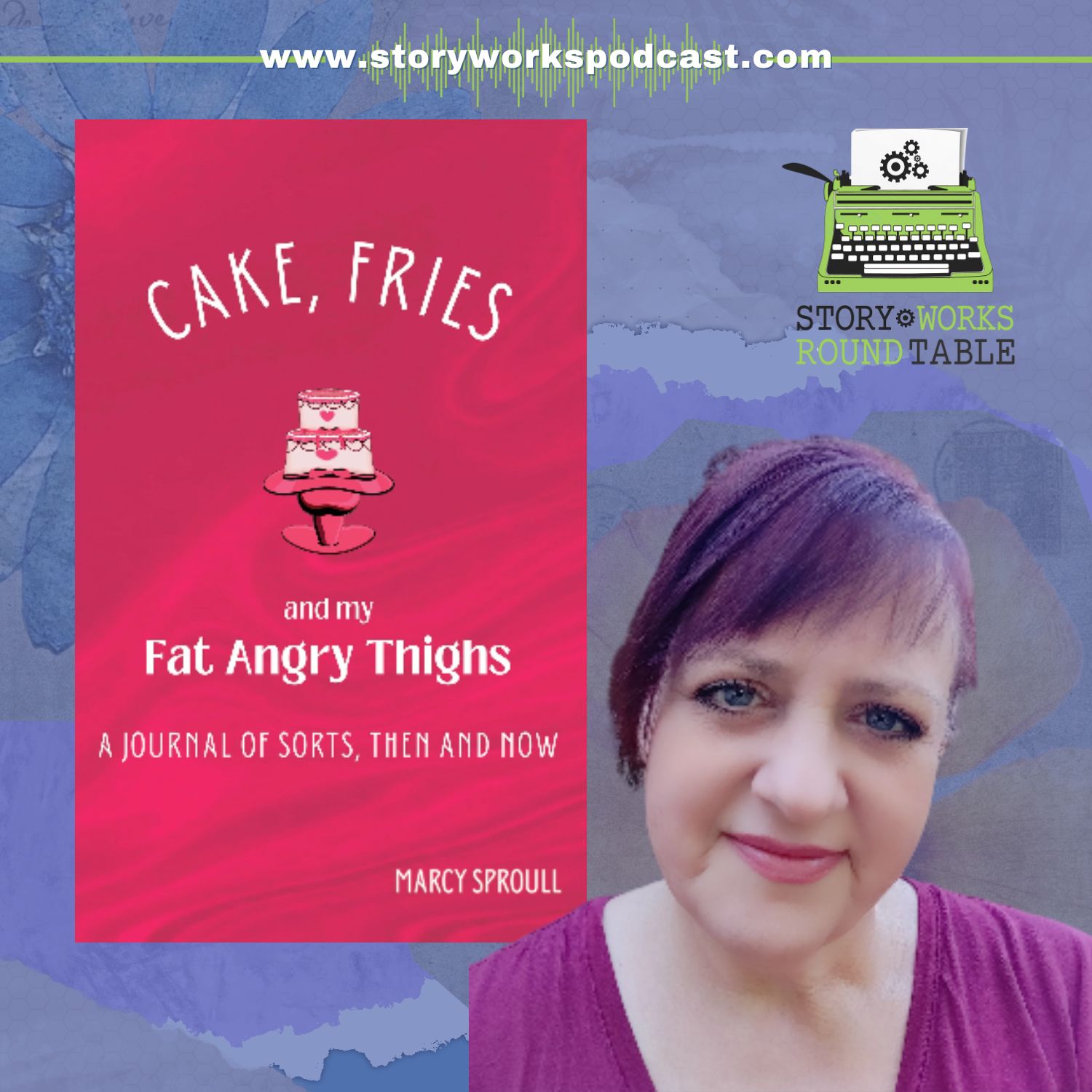
Marcy Sproull is a journal geek through and through. She’s also a writer, and a spoken-word artist creating work that focuses on healing and personal growth. She shares the Journal to the Self, a journaling workshop that teaches 18 different techniques designed for personal growth, life management, and creative expression. She is the author of the journal-style memoir Cake, Fries, and my Fat Angry Thighs.
TRANSCRIPT
This transcript is AI generated. If you notice any inconsistencies or errors, blame the bot.
Alida Winternheimer: Hello and welcome to this week’s StoryWorks roundtable. Today, Katherine and I are thrilled to be joined by Mercy Sproul. Marcy’s here to talk with us about the power of a journaling practice. She is a writer, spoken word artist, and motivational poet. She’s the author of Cake Fries and My Fat Angry Thighs. A, journal of sorts Then and Now, A collection of journal style entries that explore the intersection of diets, weight issues, body image, self acceptance, anxiety, and emotional eating. Her work as an acupuncturist in mental health and substance use disorder programs has informed her writing and she is the creator of the YouTube channel so spoken word remedies offering poetic meditations for healing and renewal. As a certified journal to the self instructor, Marcy teaches journaling workshops and creates journal guides that help people learn the art of reflective writing.
Marcy Sproull: Welcome.
Alida Winternheimer: Marcie, I’m so excited you’re here with us.
Marcy Sproull: Thank you. I’m glad to be here. Thank you.
Alida Winternheimer: I love the title of your book, Cake Fries in My Fat Angry Thighs. It, right away signals to me I’m going to enjoy it. So tell us a little bit about your journey into journaling and becoming a journaling practitioner. Writing a book that’s journal style. Give us a little bit of your background.
Marcy Sproull: Okay, so it’s a little bit all over the place. when I was in college 30 years ago, I carried like the little two by three notebooks everywhere I went. And I was just always like writing little notes, writing funny things, drawing. I went to a open to an open mic in Hollywood called the Poet’s Jazz House in 2004 and there were so many amazing spoken word artists that I was just like completely blown away and motivated to do something. And, the next morning I was walking in the park and I had all these like little stories start in my head and they were just little vignettes. I met someone there who introduced me to the artist’s way. And so I started doing my morning pages, three pages every morning. And I was really a devout morning pager for a long time. And, so at the same time I was kind of, like, doing that and then working on the book. I tend to just be a minimalist when I write. so the. The little journal entries kind of were like a perfect fit for me. I published the book in 2016, and then I didn’t do anything with it. like, I barely told people that I had written a book. And then like a few months later, I had a stroke and it affected my visual, my vision. And, so I started working with a therapist. I found an online therapist. And the way it worked was that I was emailing him throughout the week, and we met twice a month for like 30 minutes each time. So I don’t think he realized what he was getting into was somebody who journaled, he, you know, the morning pages all the time. so I was constantly texting or writing him, journaling everything. We talked about about my anxiety, and. And I was like, really, I was really focused, you know, with.
Kathryn Arnold: With our work.
Marcy Sproull: And then I would write and. And I think it got to the point where I was just sending him messages about, okay, so I figured this out, so this is why I’m having this anxiety. And so I think here’s what I need to do. So it was just like, it became a process where I was just kind of figuring things out and having my own insights because of that long process that I was doing every day. And then I immediately started looking at journaling as therapy.
Kathryn Arnold: What.
Marcy Sproull: What is that? Is that a thing? And I found Kathleen Adams, journal to the self curriculum, 18 different journaling techniques. And so then I went back to the book and, ah, started reworking it and rewriting it and looking at all the pieces that maybe were a little too raw and kind of hearing some of those pieces down and kind of taking some of the journaling techniques that I’ve learned and then added to the book. So.
Alida Winternheimer: Interesting. So is the book a. So it says a journal of sorts. So do you mean that in the sense of memoir in the shape of journal entries, or do you mean the person who gets your book can then use it as a sort of journal for herself and do her own journaling alongside, your reflections or your pieces?
Marcy Sproull: So it is a, memoir couched in journal entries. and with this version, I did create a journal guide that took some of the themes from the book that people can use, for journaling. So I did create that piece.
Alida Winternheimer: you said, you know, before we started the episode, that journaling can help us tap into our inner wisdom and support our creative pursuits. And our listeners are writers also, sometimes readers who want to learn about what writers do and how we create the books we write. But I’m curious how we can use journaling as a tool to support our creativity and to help us tap into, you know, our, our sources, be it the psyche, the muse, the higher self, however people want to think of it.
Marcy Sproull: I think that there’s a few different ways to look at it. one of the things I think that Julia Cameron talks about in the artist way is kind of using the morning pages as a way to just get away or to get all of the things that are in the front of our minds, the worries, the day to day stuff, and just like, throw it on the page. I have a friend who calls it the, the morning dump. it’s okay if you edit that out, it’s all good. But, you know, like, kind of just getting all that stuff out and on the page so it’s, it’s out of your brain and so then that kind of opens up. Okay, so I took care of all of that stuff that is just life. And now I can, I’ve dealt with it and so now I can be open to more creative writing. I always tell people journaling is not, ah, for anyone else, it’s for you. but it can be a way of allowing creative expression. I use journaling as a problem solving tool all the time. And so it’s not just, okay, I’m going to write about my feelings and how everything sucks. It’s like, what’s next?
Alida Winternheimer: What’s.
Marcy Sproull: What’s the next thing? For me, I think of journaling as like an ongoing conversation with myself. So, when I have those ideas, one of my favorite journaling techniques is the dialogue exercise. And so I. In that one, you’re writing both parts of a conversation.
Alida Winternheimer: Yeah, I like that. So many writers journal conversations with their characters or they’ll interview the characters. Catherine and I are both big fans of journals. We keep journals and talk about them quite a bit on the podcast. So I’m curious, when you dialogue with your book or with a project, do you ever think about who or what is having the other side of the conversation with you? I mean, I think for writers there can be a tendency to kind of separate the character out. So even though you’re inventing the character. And it’s part of your psyche. Writers are like, oh, no, she’s her own person and she’s talking to me. Right. And I’ve never thought about having a dialogue with the book itself. And it feels like that would create a kind of a shift I would need to make to see it as, you know, something I’m able to be in dialogue with. So can you talk about the process, the psychology, the energetics, the spirit, whatever works of that?
Marcy Sproull: So, I’ll give you an example. In one of my workshops, I. We were kind of just looking at an emotional. Not emotional, just an everyday stressor. Something that’s not a trauma, but something that just like, stresses you out on a daily basis. And one of the. One of the participants chose clutter. Some. Some clutter in their house that they just couldn’t, you know, that it was just always there. And she did a dialogue with the clutter first. We made the clutter first. We made whatever problem we were writing about as a character. So we were creating a character, so imagining. So if clutter was some kind of being, what would it look like? You know, is it a physical person? Could. It could be an entity? and so that’s one of the entries or the, techniques that we use is a character sketch. So we’re just kind of creating this character, seeing it as a person, and then having this dialogue. And what she came up with was that first she told me, like, okay, I thought this exercise was really dumb. And I’ve gotten that several times in my workshops. Like, yeah, I thought this exercise was stupid. And then, she said. And then I realized that the clutter is connected to my sister who passed away last year. And I haven’t wanted to get rid of the clutter because there’s some connection, some. Some stuff that she had or, Clearing the clutter would have been like, kind of like moving on from her sister’s death. And, so it’s interesting because I. I always think of it as. It’s really my inner wisdom that is giving the other character voice. so even if I’m imagining that it’s another person or a character outside of myself, I think it still always is, like a part of me, that part of me that knows looking at something from a different perspective just allows you to have that shift and then that insight, if that, makes sense. No, it does.
Alida Winternheimer: It makes total sense. And I can see how powerful that can be in thinking of myself and some of my own clutter that has been you know, weighing me down. When you. When you started to talk about putting it in the shape of a character, I. I had this flash of imagination of, like, you know, the movie Labyrinth, Jim Henson’s movie. like a big creature, one of those giant puppets, like, all, boo. Like, oh, Lord. Okay. And I think if you can externalize the thing you’re writing about into that character, then you can have a relationship with it, instead of just going like, I don’t want to look at that corner of the house. I don’t want to. You know, I don’t have time to deal with it right now, or whatever. Whatever that thing is. And it’s such an imaginative process, too. I think when you hear the word journaling, you can think of recording your thoughts and feelings and what happened to you. And it’s almost diary writing. But then as a writer, I use it for problem solving. That’s the first thing I turn to when I’m stuck in a story or want to figure out where the story’s going next or what a character is doing. it makes sense that writers would be attracted to a workshop on journaling. So I’m curious if you’ve had writers come in and you kind of say, okay, what does everyone want out of this workshop? Or, why are you here? And then at the end say, what they got out of it or what surprised them about it. So I’m wondering what kind of you’ve seen in terms of, what’s desired and then what actually happens, or the transformation or the surprise that people take away from working with these different journaling techniques.
Marcy Sproull: I hate to say the biggest surprise is the surprises, but it’s just going to be fun. And I think some of the insights that they have, I think are the biggest surprises. Just like the writer saying, this was really relaxing. I didn’t realize that, or I forgot that it could be fun. I forgot that this is, like a stress relief. I think it’s for those writers who are not writing and they know that they want to be. I hate to say should, but, like, they know they should be writing because that’s important to them and they’re not. this is a nice way of kind of bringing them back. And. And I’ve had people come into the workshops where, you know, one person just started crying because she was like, this is what I need to be doing. I haven’t been doing it. I have all these goals and all of these things that have just been neglected. And I think it just reminds them that, oh, I’m a writer, I like to do this.
Alida Winternheimer: Yeah. So I’m wondering what is the power of journaling? How can it help us? You know, what can it do for us?
Marcy Sproull: I think I said this before, but I like to think of it as an ongoing conversation with myself. It allows me to. It’s like a, vehicle for the ideas. I know, I don’t know how to say this. I remember reading and I’ve been trying to find the study. I was listening to a doctor talk about how you could journal something and six months later you could have an insight connected to that journaling experience. And so I think it really is the practice, not just, oh, I’m going to sit and write about my feelings or try to, you know, get some creative juices. I think it’s that practice of every day sitting down, getting to know myself. So kind of a, a greater self awareness. and I know for me, I always have too many ideas and the journaling has been really helpful in helping me to separate everything and figure out, okay, what is an idea that I really want to pursue and is something that I really want to do versus just oh, this is a great idea. But it may not be time, it may not like have any legs. And I have a lot of those. And journaling has been just the, thing that kind of gives me some grounding, you know.
Alida Winternheimer: Right. yeah, it makes sense. It does. I certainly use journaling that way. I’ve got a journal just for dumping ideas. And then the ones that kind of stick, they gain momentum. They’re kind of like that snowball. I keep adding thoughts into that journal space until the idea becomes an urge. It’s like I’m being pushed to go deeper into that project and start the process of researching and, and writing.
Kathryn Arnold: I really like what you said, Marci. About different perspectives and sort of like allowing yourself to have that. I don’t know, like my mom used to describe it, the inner wisdom as like a zoom out lens. Like you could zoom out from a problem and examine it from all the different sides. And I feel like journaling the way you described it right there with the perspectives kind of hit it on the head for me where it was like, I’m able to zoom out and view it from a different perspective, which then changes the problem from something that’s maybe super intimate or really hard for me to look at inside of myself to something tangible that I can manipulate and turn around and look at from a different way or a different. And then that causes a different way of compassion or empathy. Right. Or a different way of me looking at something. Something. So I really appreciate that, you know, use of different perspective and creating it as a character and just changing the way you’re looking at something rather than keeping it all in your head where maybe you’re too close to it or you’re too emotionally involved to be able to examine it properly.
Alida Winternheimer: Yeah.
Marcy Sproull: I’ve had a lot of people tell me I don’t need to journal because I have it all in my head. I’m like, I don’t know that I can help you.
Kathryn Arnold: Oh gosh, I don’t know if I could keep everything in my head like that. I love that. That brain dump idea is totally something I’ve used all the time. It just, if I get it out onto paper, I can look at it, you know, I can’t think about it. I don’t need to be thinking about it all the time.
Alida Winternheimer: Isn’t that interesting how just the act of putting something into words that become tangible because they’re recorded, because they aren’t just thought or spoken, but they’re actually written down. And then that creates physical space, but also mental and emotional space for us to do what you were talking about, Katherine, and step back and look at it and turn it around.
Marcy Sproull: yeah, I mean, I think in
Kathryn Arnold: words a lot, but I know that they’re not always fully formed words or ideas, so. And maybe Marcy, you can talk to this too. But it’s like if I put it in words, then I’ve concreted it, right? Like so it’s not just something I’m messing around with. It’s like there’s the actual thing, you know, maybe I don’t fully understand it yet, but at least there’s. That’s what I’m mulling around with. Or Dealing with.
Marcy Sproull: I remember I wrote about my ideal day and I had it all written down from, you know, sunup to when I went to bed and I went back and I read it and I was like, I don’t want to do any of that. Like, that’s not, that’s not it at all. And so it’s like, yeah, seeing it actually written down, it doesn’t mean that it has to be true or happen. But seeing it written down, you can judge it and like, oh yeah, that’s not, that’s not the path. And I really think that a lot of the journaling is kind of for writers doing your own inner work so that you’re clearing the space for the creative work. M. And maybe not everyone has a lot of inner work to do, but for those who do, I think journaling is that thing that, you know, it’s like I journal and then I go for a walk. And then as I’m walking there’s all these downloads of oh yeah, and this and this. Okay, here’s how I can do that. And so it wasn’t even while I was journaling. But it’s just knowing that that’s my practice, that’s the, that’s the thing that kind of opens things up.
Alida Winternheimer: Yeah. I find in personal journaling, not writerly journaling, I go in phases and it kind of depends on how much is happening in my life. You know, if something is happening, it’s like I have to get it down. I have to put the experience on paper. I’ve got to get all of those feelings written out. It’s a compulsion. And I don’t know like why, what the benefit is. It’s just what I do. But then when life is calm and just more sort of rote, day to day stuff, I could not touch my journal for weeks because I would just look at it and go like, yeah, I mean, you know, I’m not feeling any especially deep thoughts right now. I don’t think there’s anything I need to put on paper for posterity’s sake. My kid’s not going to care to read that kind of a thing. but what would you say about making journaling a practice versus kind of coming and going? Is the practice piece of it important? And if so, why? What are the benefits to being consistent with it?
Marcy Sproull: I think it allows you to see over time how you’ve grown or how things have evolved in your life. And I remember going back through one of my journals and I was reading And I was surprised. I was like, wow, I am, in such a different place. And I think it’s only because I kind of kept it. Kept it up regularly. I could see the progress. I could see the change. And I think it’s. It’s important for me because I know that that is a door for me. So I may not always have ideas on, one day, but I know that, that creating that practice regularly, like, I’m sitting in the chair with my pen and I’m ready. I think that that just also just builds some trust in myself as. Okay. I can trust that I will follow through. And so when I’m working on a book, you know, okay, I know that I can stay with it until it’s finished. I know that I’m going to be committed to that. So for me, it’s like I’m committing to my writing in general, but then just also committing to myself. there are plenty of days where I’m fine, everything is great. And so there. There’s nothing that I need to, like, sit down and write. That’s heavy. but I do have those things I do regular, regularly, no matter what, just to kind of keep the. Keep the flow.
Alida Winternheimer: Yeah. So are the morning pages journaling, or are the morning pages like that kind of brain dump that clears the way for journaling? Because I could imagine sitting down with my journal and telling myself I have to fill three pages. And I could imagine myself sitting down with loose leaf writing for three pages and going, yep, okay, that’s done. Now I can get real and be present with my journal. So
Marcy Sproull: I think it’s all of the above. I know that Julia Cameron talked about, like, so if you don’t know what to say, then just say that, like, I don’t know what to write about. And then you just fill the page with that. And I’ve actually done that a couple of times. Yeah, I think that the morning pages were kind of meant to be the morning dump. And then you. Now it’s time for your. The real writing. M. Because she talked about don’t go back and read them, which, with how I’m journaling, I have all my journals, like, sitting next to me here because they all have some ideas that I want to follow up with. so I’m kind of one of those people that just. It’s. It’s not all or nothing. It’s just that’s I may journal and everything in my journal is just for me, and nobody else is going to ever see it. And Then some days I’ll. I’ll just be writing on, you know, what’s the next book? Or what is. What is something I want to follow up or some poetry. I don’t have a lot of rules.
Alida Winternheimer: Yeah.
Marcy Sproull: Which you shouldn’t have rules with journaling.
Alida Winternheimer: No, I agree. It’s kind of like free writing, only without, you know, like, with a little bit of a different purpose or without the prompt kind of thing. Yeah. I’m wondering if there’s a technique or two that you could share with us that would be great for writers, you know, to help us take our journaling to a new level or explore it in a new way.
Marcy Sproull: One of the techniques that we do is a list of 100. And I find that most people who aren’t writers don’t want to do this. And it’s any type of list. It could be, you know, what’s my bucket list for the rest of my life? And it’s a hundred things or a hundred things I hate or 100 things I love. It can be a variety of things. And what’s interesting is you can repeat certain things or you can repeat whatever you want. So if something comes up to you again, that was already at number five, and you’re at 78, and it comes to you again, you can write it down. And so, way that Kathleen Adams talked about was like, so the first 30, the first third, it’s just kind of like things off the top of your head, general life, things that are kind of current. The next 30, you’re getting into, more subconscious ideas. And then the last 3:30, you’re going even deeper. And those are things that are really important to you. and depending on what. What it is. and I know this isn’t a typical journaling exercise, but then you go and you make categories of each. You look at the list and look at what are the general categories that I’m seeing. so if it was something like, here’s a hundred things that I want to do before, you know, I get old, and I’m just don’t feel like doing anything anymore, there might be, like, category of travel, or there would be a category of accomplishments I want to accomplish this thing. and then another thing might be experiences you want to.
Alida Winternheimer: To have.
Marcy Sproull: And so it’s just kind of interesting, and it’s just a practice in, generating ideas because, you know, after. Sometimes after about 45, you’re like, okay, I don’t. I don’t know. So it’s. It’s a fun exercise that just kind of like allows you to look at something in a different way.
Alida Winternheimer: Yeah. That’s interesting. I’m trying to. I’m wondering if I could fill a hundred things on any list I have.
Marcy Sproull: I’ve had people tell me that they’ve finished. I’ve done it a couple of times and, and with some time I can finish it. It’s definitely not something that you can do with the timed 15 minutes. or if you want to challenge yourself, you can, but it does just kind of gets you in that practice of generation of of ideas and what else? What else?
Alida Winternheimer: Right. Yeah. Okay, I’ve got a little story or anecdote that I think connects to that. So for a time I was swapping voice notes with my girlfriends quite a bit. And so something would happen in my life touching on that idea of brain dump and just get it out so then you can clear the way. And I would tell the story in a voice note to a friend and then I’d wanna share it with my, you know, next friend. Like I was doing this with two to four friends at any kind of given, given week. And I’d be like, oh, but I said this in that first voice note. It’s too personal for friend A to give it to friend B. So then I’d start talking to friend B and I’d have to retell the story I wanted. And then by the time I had told the story, which I could do when I was like driving home, you know, it was easy. This was some years ago. I don’t think technology is as. I don’t know. Anyway, some of our features have gone away. But I’d get home and I’d sit down with my journal and I’d go, well, now I don’t want to record this in my journal because I’m tired of telling the story. I’ve already dumped it. I don’t need to write it down. And then I started thinking, okay, this thing that happened, do I want to journal it? Because if I do, I have to journal it before I share it with friends or verbalize it, right? But it’s like that process of the brain dump and clearing the path that’s real. And if you don’t want to journal for some reason, you can do it, you know, record yourself a voice note just to get to that point where you can sit down with the pages, right? With your writing, whatever that looks like. Whether it’s like the morning pages to the journal or the journal to the Book project or the whatever. I think that’s huge. Wow. Well, this has been such a fun conversation. I am a big fan of journaling and I’m glad to hear that there is a journal to the self process so that people can access more techniques and have some guidance and, you know, better connect with their, their self and their creativity. So Marcie, where can our listeners find you in your books?
Marcy Sproull: my book is on Amazon, but the easiest way to go, is to my website, marcyspro.com and on Instagram, marcyspro rcsproul.
Alida Winternheimer: Nice. And how do you spell Sproul?
Marcy Sproull: S, P, R, O, U, L, L. Excellent.
Alida Winternheimer: We will of course have a link in the show notes, as always, pointing you over to Marci’s website. So thank you.
Marcy Sproull: Thank you so much. It’s been nice to talk to you guys.
Alida Winternheimer: So today we’re talking with Marcy Sproul about journaling and she really goes in depth in journaling as a tool for mental health, personal sanity, and also personal development and exploration. And Catherine and I just wanted to make sure that we also discuss journaling as a creative tool that we use in our writing process. And I know we’re both big fans of journaling, aren’t we?
Kathryn Arnold: Oh my gosh, yes. The number of journals on my shelf would attest to that.
Alida Winternheimer: Yes. Yeah. So what do you think the differences between journaling as a tool for our writing projects and just personal journaling?
Kathryn Arnold: Yeah, I would say I have two different journals, right? I have one in which I keep my day to day life and there might be notes about books or things that I think of that comes up through the day because it’s always with me. But then I think I also have a journal, usually kind of per project, in which I sort of organize my thoughts. And even if I never read it again, just the act of writing it down and thinking it through on paper allows me to move forward through whatever tangle I’m trying to solve. so I feel like it’s important for me to have that dedicated space.
Alida Winternheimer: Yeah, yeah, absolutely. I know I’ve talked about doing that on the show before. You know, I also have a journal for every project I’ve got. The one where I just dump all of my random writing ideas and creative thoughts. But then once an idea gets to the point where I’m going to commit to turning it into a book, I start a new journal specifically for that. And I like what you said about, even if you never read it again, I often don’t go back and read my project journals as I’m working on the book. But then I’ll usually hit a point where I start wondering what I’m missing.
Kathryn Arnold: Right.
Alida Winternheimer: Because when I do go back and look, I’ll be like, oh, that’s a good idea. Why didn’t I use that? You know? But I, think our projects take on a life of their own as we get going through them, through that process of developing and writing. And then some of that stuff we put in the journal, it’s acting as a springboard. So it’s not the same as outlining or storyboarding. All of that material doesn’t make it to the next stage of writing. So. Okay, why is that still, valuable?
Kathryn Arnold: Oh man. Yeah. My journal is the free flow thought. My storyboard is the organization of that thought. Right. So oftentimes my journal acts as kind of a, a way to linear lies my thought process. Right. I have to write it down in order as it comes. And then, you know, I’ll ask questions or I’ll answer my own questions in line. And to me that’s a way of taking what might be bouncing around and turning it into the beginning of organization so that I can turn it into an outline or a storyboard and finding those gaps or those ideas that, that are struggling and then realigning them into the story. So I think without that, my storyboard would not function the way that it does because I don’t have the ability to play in the same way. My brain looks at the box on the page that I’m trying to fill and says, what goes in this box? Whereas in the journal I say, well, what if this happened and what if that happened and then I’m allowed to play a little bit more. I think without that it would not, my story would not function in the same way and therefore it would not be as good.
Alida Winternheimer: Yeah, yeah, yeah, absolutely. I definitely ask myself questions in the journal.
Alida Winternheimer: As well. You know, that’s a big part of it, like why is the character doing this? Or what about that? And it lets me kind of mentally go down a path that I might not go down in the story or that the story might not be pointing toward.
Kathryn Arnold: Right.
Alida Winternheimer: So it’s a way to explore whether or not a particular turn would make sense and be worth investigating further through the actual drafting and.
Kathryn Arnold: I like the, what would happen if this. What’s the repercussions? What’s the consequence for her as a character? What’s the consequence for her group, her friends, her family. What would this thing happen ning do to this other part? Right. And if I can’t answer that question in a way that makes sense for the story, then I know I need to go down a different path. So it’s not just, you know, what would she do or what might come next, but the. The deeper motivation questions, the things that might really cause hiccups in the story that I. I want to see coming. Right. Like, how would this derail? Or might m this be the right sort of complication? And those questions I think you can explore in a sentence or two in a journal, or you can start, you know, working them larger into paragraphs and things. But. But you can’t do that in the same way, I don’t think, in other mediums, or at least I haven’t been able to.
Alida Winternheimer: Right. Yeah. And I think that in a sentence or two, thing is key, because if I’m, you know, starting with, like, what if Christine does X? And then that makes Evelyn mad? And then Bernice says this, and then, you know, and I can start seeing the shape of a scene through the character’s emotional reactions and behavior before I start putting it into the world and developing it. And if it doesn’t play out, if it isn’t working, you know, it’s just that sentence or two. It’s just that kind of. And it’s like playing in the sandbox, where if you don’t like what you’re building, you just push it down and move on. And I think things are unconstrained. Right. So if I’m drafting in a scene and I’m thinking about the sentences and the characters already have a shape on the page. Right. And it can be a little bit confining because you’re kind of working within what’s already there. But then in the journal, I think there’s sometimes more room for surprise. And then if it works, you think, okay, what needs to happen on the page to then bring that forward? This new side of this character or this new whatever. Whatever developed on the journal page.
Kathryn Arnold: Absolutely. You can often see my eureka moments in the journal. you know, where I just. You can see, like, question, question, question. Oh, this. And then I go crazy. I feel like in a scene, my surprise comes from description or it comes from a cool piece of dialogue or cool way of describing action. But in terms of surprise for plot or character arcs the scene, I can’t do that. I. I get stuck. I get like, wait, why is this happening? What’s it going to Do I need to have that journaling piece first in order for me to allow the, the scene to become what it is? I can’t just have that surprise happen and see I’m not a discovery writer in that way. It stalls me. Whereas I can do that in my journal and have that moment where I’m like, nope, none of that from before, only this. And this is the thing that I’m going to pursue and allow that to surprise me.
Alida Winternheimer: Yeah. Yeah. Do you use journals for other avenues of creativity or you know, does it, does it support or fulfill your creativity in other ways? Because we’ve just been talking about how we use journals as a tool for our writings specifically. You know, but with mercy, we go much wider than that.
Kathryn Arnold: So yeah, I feel like I’ve always been someone who thinks out loud. Whether that’s verbally, I process things very with words. So whether that’s verbally with people or whether that’s with myself in writing. And if I don’t have the opportunity to explore through that level of communication, then my brain doesn’t necessarily think of all the angles. So I use it for almost all, all aspects of my life. Whether that’s menu planning and grocery shopping and things I want to cook and recipes I want to collect or whether it’s gardening and planning a garden and how, you know, thinking out loud. Well, if I really want this much amount of things out of my garden, then maybe I should plant this and then I’m organizing a garden all of a sudden. But it’s using that journal as an opportunity for my brain to function in the way that it wants to function, which is out loud. and the page to me is out loud. and that’s how I, I enjoy communicating with myself. So I think, yeah, I think I’ve refined it for the writing process for sure and it’s something that is my go to for that. But I think I use it for almost every aspect of my life. What about you?
Alida Winternheimer: Oh, absolutely. Yeah, I definitely am a think on paper person and I’ve always got multiple journals going. I mean I think I’ve got no less than 4 at the moment for different, different kinds of thoughts because they’re containers. Right. So I’ve got my book project writing journal and I’ve got my personal journal for kind of day to day life, whatever’s happening. I have one of those 365. What is it? It’s a five year journal. So you get like one sentence or two or three.
Kathryn Arnold: These are really fun to look back on. Oh my gosh.
Alida Winternheimer: Yeah. So I’m in my third pass through the journal. It’s year three now, and it’s kind of fun to be like, oh, look, a year ago it was this, two years ago it was that. And then I’ve got kind of a self study journal. So my, my reading in that avenue of my thoughts about that go into that journal. And sometimes I think, well, there’s so much overlap. Shouldn’t like that and the day to day journal and the But no, my brain, my mind likes to have the separate containers and likes to kind of.
Kathryn Arnold: I think it inspires you to be in that moment.
Alida Winternheimer: Right.
Kathryn Arnold: If you take that journal and you open it to that section, you’re like, this is what I’m doing right now and I can focus on this. And it, it excludes the rest of whatever you’re thinking about. You’re like, nope, this journal is exclusionary. It’s only about this. You’re not allowed to go crazy. And I think that helps to focus. I mean, I have a very busy mind. So if I can focus on this is the task in front of me. I don’t want this Journal to have 18 other things in it. I just want it to be about this. It changes the dynamic.
Alida Winternheimer: yeah. So true. Yeah. With my self study journal, I like that I can flip back through it and I can see the notes I made from the reading. Right. And what I was thinking about when I made that particular note. And I’m not trying to find things going through pages of other stuff.
Kathryn Arnold: Yeah, definitely.
About Your Hosts
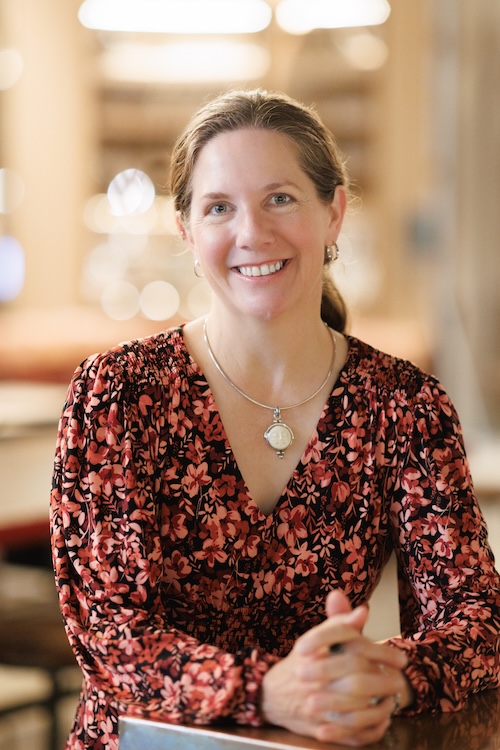
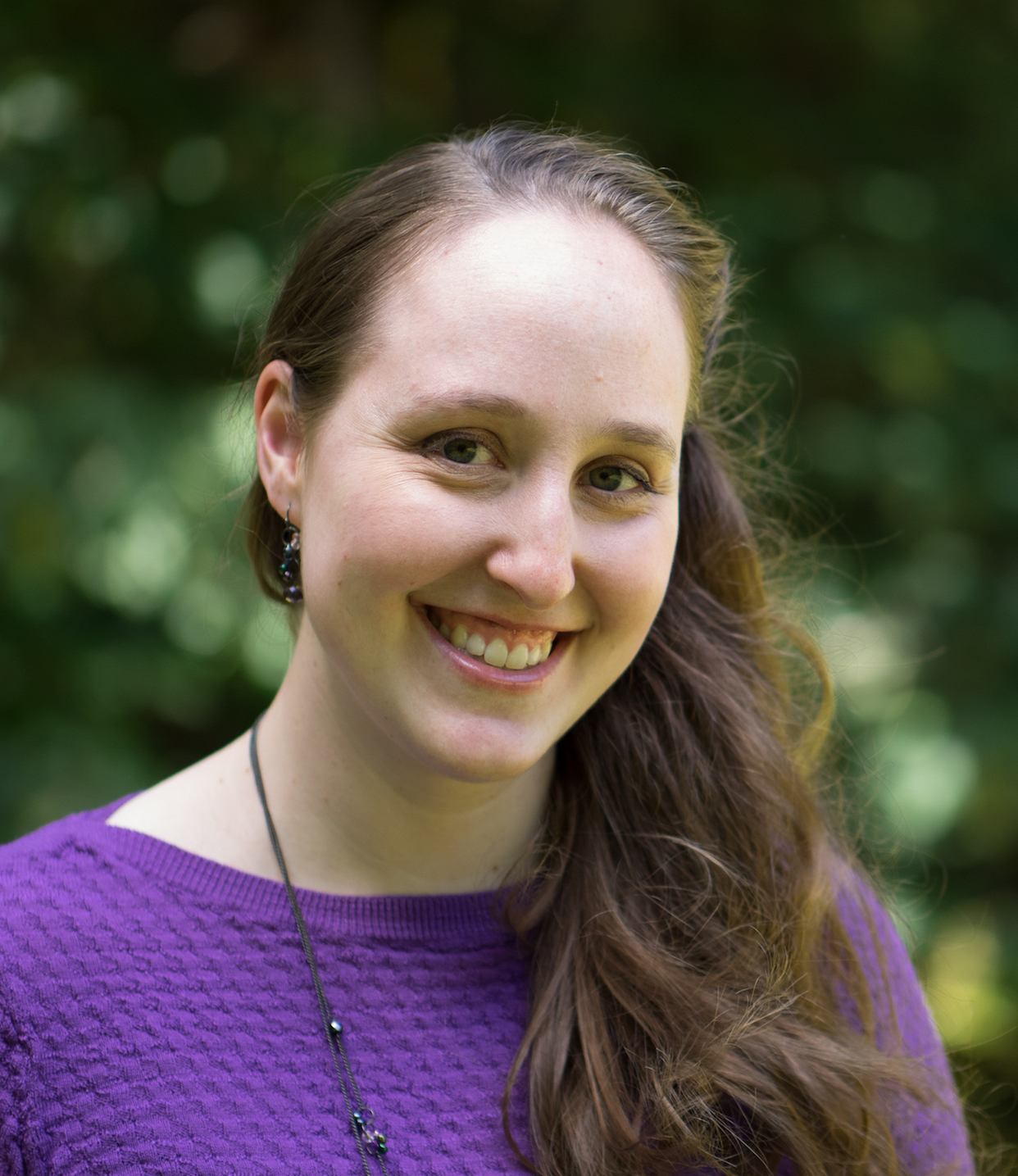
Kathryn Arnold writes fantasy and anything else that sparks her creativity from her home in Kingston, Washington. She currently earns her living as an insurance underwriting assistant, where she also creates marketing and web copy. When not writing, she plays (and teaches) piano and keyboard in a band (or two), and is working on starting a ministry team with her husband. You can find Kathryn at www.skyfirewords.com.