The Novel Journey
Discover How to Write a Novel You’re Really Proud of in One Year
The Novel Journey is a year-long novel-writing and author-development experience that takes writers from page one to “the end.”
Write your novel while growing as a writer without impossible word count goals, bending your story into someone else’s plot formula, or sacrificing your voice or vision for genre expectations.
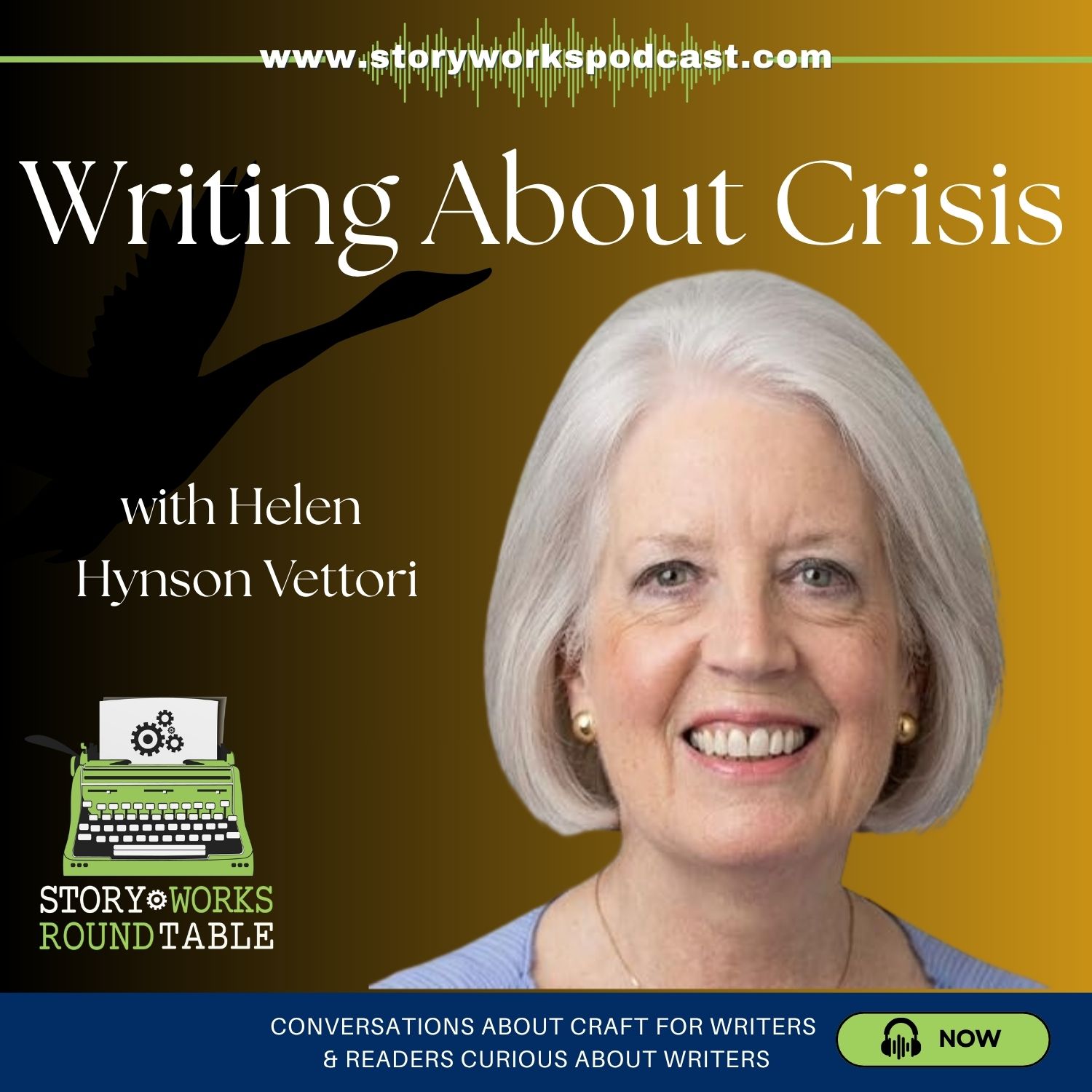
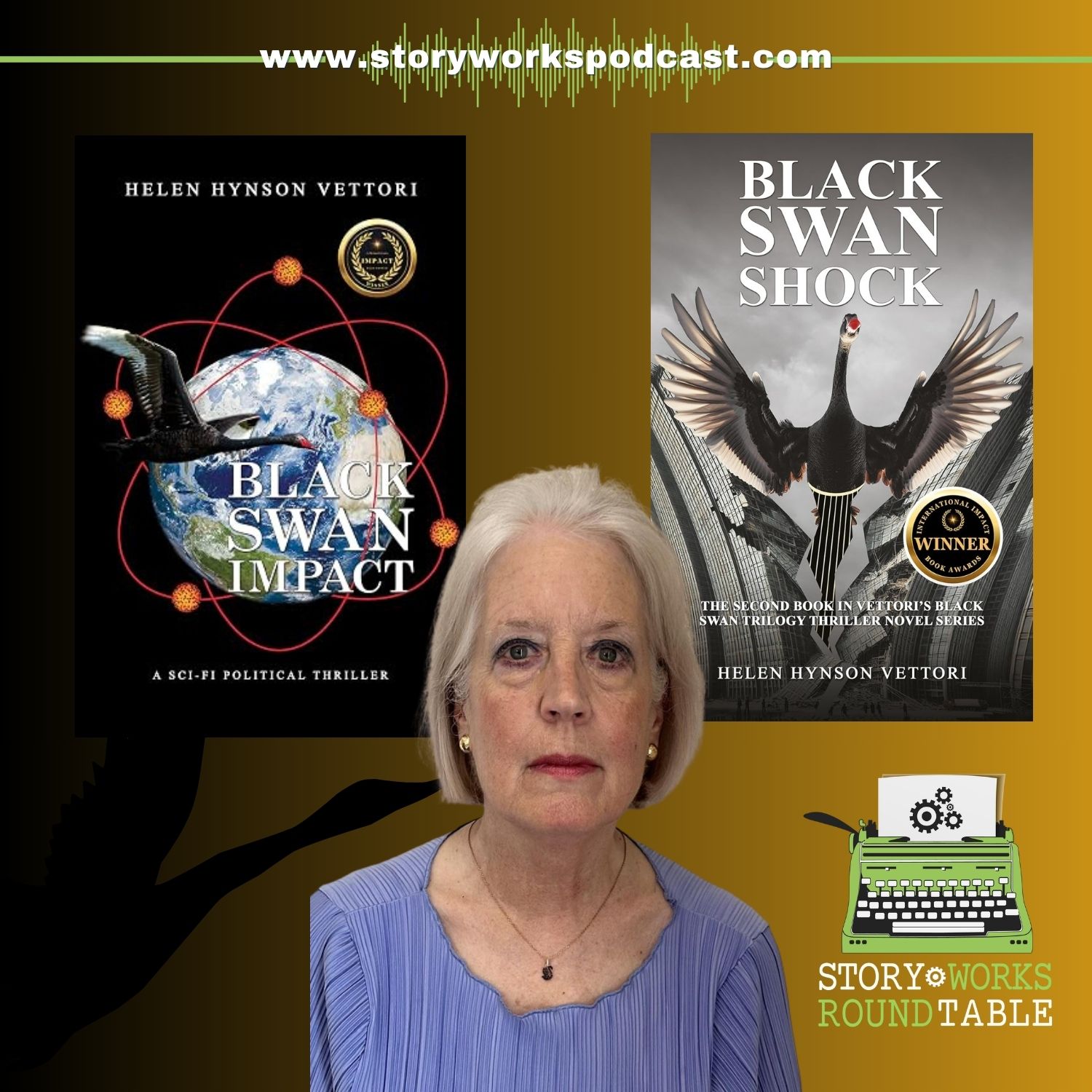
In this episode of the Story Works Round Table, we are joined by Helen Hynson Vettori, a former Department of Homeland Security senior medical intelligence analyst and paramedic, who brings her unique experiences to the world of fiction. Helen discusses her Black Swan trilogy, which explores the themes of catastrophe and human resilience through the lens of a pandemic, an earthquake, and a terrorist attack set in the future. Discover how her technical background informs her storytelling and the importance of emergency preparedness in her narratives. Join us for a thought-provoking conversation that blends thrilling fiction with real-world lessons!
“If every individual did at least a good effort to be ready, that takes away the strain of resources that are already overloaded.” – Helen Hynson Vettori
AUDIO
TRANSCRIPT
This transcript is AI generated. If you notice any inconsistencies or errors, blame the bot.
Alida Winternheimer: Hello and welcome to this week’s StoryWorks roundtable. Today, Katherine and I, are delighted to be joined by Helen Hinson Vittori. Helen is a former Department of Homeland Security senior medical intelligence analyst and former paramedic with the Bethesda, Chevy Chase rescue squad. She brings that Frontline and federal prepared. Preparedness. Federal preparedness experience to her sci fi political thriller series including Black Swan Impact and its second installment, Black Swan Shock. Sparked by her frustration with how years of US biological incident planning, including pandemic playbooks were sidelined, her novels weave unnerving truths into terrifying fiction. From high stakes decision making to the visceral details of emergency response. When she isn’t writing, Helen is reading, painting in her studio or spending time with her family at home and on the road. Welcome Helen.
Helen Hynson Vettori: Thank you for having me. It’s a pleasure to be here.
Alida Winternheimer: Wow, that’s an impressive background and it sounds very technical and a lot of high stress situations. how did you go from that to writing novels?
Helen Hynson Vettori: I really hadn’t intended to do that. It actually was something that just transpired unbeknownst to me. Yes, I had an eclectic and I guess you would say technical background, then changed to something that was, you know, liberal arts type of a focus. The reason, as you said, was I just was taken aback by things that were transpiring. I knew what I knew from my job and I just was perplexed, to say the least, about how things were happened when Covid struck. Not as they happened immediately, but as things progressed. It didn’t seem like it was the right way to go. So I was unnerved. And my sister said to me one day as I was ranting and raving on a zoom call that we all that were on when we were in lockdown. You have a book there? Well, writing is cathartic and so I thought, okay, you know what, she’s, she’s on to something. I don’t know what I’m gonna do, maybe I’m gonna journal. And I sat down and started to write and the book just came alive. Characters jumped out and I hadn’t sat down as I said, to do this, so I had no arc in mind. And all of that was very organic. Of course as I progressed I did have things that I wanted to say, have ah, characters that I wanted to embellish or have go different routes from what I originally thought. But for the most part it was quite organic. And the main focus being a black swan is that it’s a catastrophe. So let me define what a Black Swan event is because many people might not know that term. It was originally developed by a professor of economics to talk about something like a depression, but it has since gotten into other professions to indicate a catastrophe that is so monumental that no one could have foreseen or imagined the devastation that is a product of whatever this disaster, is. So that’s kind of my life, that I dealt with disasters large and small. Yes, but to an individual, even the smallest disaster can be monumental. So I took all of that and my understanding of what I had been doing in my professions, whether it be a paramedic or senior, medical intelligence analyst or an emergency manager. I just had an understanding of what could be. And I love to be imaginative and so it just took root.
Alida Winternheimer: It’s amazing. It sounds like you were uniquely positioned to write this story because of all of your professional experience.
Helen Hynson Vettori: I, I am so grateful to the, and I’m going to say it again, eclectic career that I had. Everything in my life has kind of positioned me to where I am today. I didn’t know it, but you know, it kind of makes sense. And the things that I did in my life were either because I knew that it was what I wanted to do, or suddenly became something that I could take the opportunity. so it was kind of things got interwoven and very happily so.
Alida Winternheimer: So to set up our, our listeners for this conversation, can you give us, kind of a synopsis or overview of the stories? Lay some groundwork for us, please?
Helen Hynson Vettori: Sure. Well, first of all, the series is a trilogy and it’s a Black Swan trilogy. So each with book has some major catastrophe. The first book is called Black Swan Impact and it’s that book that I sat down not really knowing that I was going to write. And I was, as I said, scribbling down to try and be cathartic, to make sense of things that didn’t make sense at the time. so in that book it’s a, ah, pandemic that is threatening all of humanity and how the protagonist has to maneuver, through this and ends up having her own tragedies to have to deal with. Then the second book came about because when I finished that first book, I said the characters still have so much more to say. And so I wasn’t sure what it was that they had to say other than I wanted to give people the opportunity to read about how to react and respond to disasters and ultimately end up, better off. So I was out on one of my Covid walks. And a neighbor of ours named Millie was outside. And Millie has Down syndrome realm. And she just brightened my day. Her smile radiated so that all the worries just floated away. And I, I immediately said, okay, one of the characters has to be similar to Millie. So I developed the character Marla. and as I continued to walk, I thought, well, now what disaster could I have? I mean, there are many disasters that could happen. Hurricanes, tornadoes, cyber attacks, you name it, there are many. But, for some reason, I began to gravitate toward an earthquake, because I just recently read a book, that had to deal with an earthquake. And so I came home quite excited and I started researching the New Madrid fault earthquake that happened in, the 1800s. It was 1811, 1812. And it was so large that the bells in Boston steeples rang. So you can imagine that was huge. Now, there was no such thing as a Richter scale at that time, to my knowledge. so I don’t know what that was, but I certainly could read first hand accounts and I loved to get into everything that I could find about it. First hand accounts, newspaper clippings that were, you know, posted on the Internet. I just gobbled it all up. So some of the story has stories that I read, like the firsthand accounts, but altered to, to suit my fiction or, you know, some of the stories were totally fictionalized, but developed through my knowledge of being first responder and how people react and what things need to be done to rescue and, and help. and then the third book, I just said to myself, well, I’m still not done. The characters need a little bit more Showtime. And so the third book is called Black Swan, a terror. And as you can imagine, it’s a terrorist attack. And it will be on the first ever interstellar Olympic Games on the moon. Now you might say, what the heck? Well, I didn’t tell you that all the stories are in the future. And the reason I chose the future for the first book was I had to separate the time frame. We all were very concerned and stressed out about COVID And if I wrote about something that was a current occurrence, people would be really traumatized. Whereas if I separated the time, then there could be some, you know, insulation so that they could read the story and accept the cautionary tale rather than just turn it off or, or just not read it at all. And so because that was the first time frame, that was 2113. The next one was, several years later. It was actually almost three decades later. And then the third, just a year after that.
Alida Winternheimer: Okay, that’s interesting. So then by putting it, setting this first book in 2113, that’s far enough in advance that we can expect technology has changed significantly. So then you were really writing science fiction.
Helen Hynson Vettori: Yes, but I would also argue that people are people. Whether you’re talking about somebody in the middle Ages being struck by the Black Death, or you’re talking about somebody, being hit in the 22nd, century being hit by pyv. I think people are people. And so we need to understand that we all have the emotions and the, need for assistance and love throughout those times. Troubling or not, right?
Alida Winternheimer: Absolutely. So did you, I mean, looking at, the bio here, it says sci fi political thriller series. So did you lessen the weight of the sci fi, maybe downplay some of the technological advancement we would anticipate and lean more into political thriller? Or how did you handle that? You know, choosing that time gap that far into our future when you were doing your world building?
Helen Hynson Vettori: Of course, you know, originally I did not have a whole lot of sci fi. And my Alpha reader all said, you’ve got to put sci fi in there. And then my editor said, you’ve got to put more sci fi in there. So I added things that I had not originally thought of. a neighbor, one of the alpha readers said, well, Helen, what are people wearing in that time period? And I hadn’t even given that the first thought. So I came up with an idea of a suit that has concentric, ah, camera projectors that people could choose an outfit and it would be displayed. why not? I mean, yeah, who knows what’s gonna be. So I, I kind of let my imagination run wild on things that I have absolutely no knowledge about. None of us does. I mean, how do we know what’s going to be happening 70 years in the future? Right. but we can anticipate that there will be advances. Much like, gee, my grandparents think about what they saw. They went from horse and carriage to the automobile, from writing letters to the Internet. I mean, wow, they saw two world wars and, and they saw somebody land on the moon. I mean, amazing. So I would imagine there will be amazing leaps forward much the same.
Alida Winternheimer: Right. Well. And you know, 100 years from now, maybe that’s how people will be dressing. You know, I mean, we all know that science fiction does have a predictive quality to it. You know, I think about, just Star Trek and the flip phone, like when people were watching the original Star Trek, who would ever have imagined that that would be a thing. And then look at where we are now with these little computers in our pockets. It’s crazy. so I want to dig into what you said about you were writing about a pandemic and crisis response during the pandemic, but you knew you couldn’t set the story in the present day because it would be too difficult for people. People need some distance, some emotional distance from the story. I think that’s such an important point and something all writers have to consider and deal with if we’re handling serious subject matter. So tell, us more.
Helen Hynson Vettori: Well, I didn’t want to pull punches. That’s to begin with. I wanted to be frank and honest and perhaps offer a cautionary tale that would be so dramatic that people would sit up and take notice. I thought about how the current history was transpiring and I applied all my knowledge from my, previous work, the assumptions that we made, the plans that we made, and wove that all together so that I knew in my mind’s eye what was going to happen. And I started to put it on paper. Now I would let my siblings read snippets or whole chapters at a time and they were amazed that what was on the written page occurred weeks, if not months before they actually happened in real time. And so I, I was aware of what I thought would happen, but I wanted to make sure that it wasn’t, so in somebody’s face that they would just be horrified and, and traumatized all the more. I want them to be startled and I want them to take notice of what potential threats there are beyond the black swan, so that we can avoid those foibles and those mistakes that happen when people are not thoughtful. Yeah. So
Alida Winternheimer: have you had readers? What is the response? Are, ah, readers recognizing the story, the meaning. Right. This, what you just said, your message, without that sense of trauma, it seems like a bit of a razor’s edge when you think, okay, I want them to be startled, I don’t want them to be traumatized. I want them to have this recognition and come away from the novel with this meaning. And I want to give them room to enjoy the story even while we’re dealing with all of this recent past, something we’ve all lived through collectively. So what sort of response have you gotten from readers?
Helen Hynson Vettori: Well, if someone doesn’t like the book, I have not heard those thoughts. I think people are too kind to, say anything negative. I’ve a lot of good feedback and a, lot of embracing of what the message happens to be and more so in this book because the first book I hadn’t realized was going to morph into a trilogy. The second book actually is, you could call it kind of an outline of how people might consider their responses. And then in the back in the book club section there’s a question. Well, it’s not really a question. The last number 15 in that book club section is for people to be able to evaluate their readiness and preparedness. And if they feel like maybe they could do better, there are ways that are offered for them to do that. But more than that, the, the story itself has so many aspects that they can, you know, absorb and then put into their own lives. And one example is, I’m sure you all have known that in a crisis the telecommunications becomes overwhelmed. And to be able to make a phone call is next to impossible, if not impossible. But there’s a trick, and that trick is a workaround that almost always works. If you call someone out of the area code, it usually will go through. It’s usually the area code or very local region that is overwhelmed. If you call outside of that, you generally can get to that person. So you know, have a contact aunt so, and so, you know, in Ohio is going to be our contact and everyone call her and let her know you’re okay and where you are and where you plan to be for the next 72 hours. That is one thing that everybody can do very easily at a no cost. And so, you know, I’m kind of being on the, the soapbox telling people you can be prepared and, and have a good plan without spending a whole lot of money and without being the prepper. You know, that’s, that’s gotten such a bad name. but it doesn’t have to be something that’s way out beyond the norms of preparedness. It can be something that allows individuals, families, communities to be able to weather a terrible storm.
Kathryn Arnold: Well, it sounds like, I mean you have a ton of knowledge and m. A ton of experience with navigating things like this. So why fiction as a vehicle to help people? Why choose fiction as a way of giving people this information versus any other avenue?
Helen Hynson Vettori: That’s a great question. I hadn’t set out to do this to begin with and I had so much catharsis first and then enjoyment second that it fulfills me and allows me to express myself artistically. I am rather, right brained. I would say. I’m very right brained. And so it, it Became a joy, it became a passion. And I had done an awful lot of technical writing in my job and you know, when I would get home from that job, what did I turn to? I turned to what I called Nick fiction. I was an avid reader of all the. Well, Mitch Rapp is my absolute favorite character. all the books that I could get a hold of that were just out there and fun and thrilling and exciting. You know, that’s, that’s just what appealed to me. And so this was an opportunity for me to jump in that genre. Yeah. So
Alida Winternheimer: speaking of genre, it’s a sci fi political thriller and we’re talking about something like a global pandemic and an earthquake big event. So are you dealing. Obviously you’ve got a protagonist and that’s individual, but is the story dealing with things at the socio political level with agencies and governments and crisis response teams? Are you really focusing your stories lens on the individual or the family unit dealing with all of this stuff that’s happening?
Helen Hynson Vettori: Let’s say it’s the latter. Although there is the political aspects, the elements are all there. You have politicians, driving one agenda and you have emergency managers trying to establish another. But when it all boils down to it, it’s the characters having to live through the crisis, having to deal with their struggles and their own injuries and so forth. so in the end it really is about people and their ability to rise to an occasion, to be altruistic, and to develop friendships when you didn’t realize that they would be there in such a horrific time.
Kathryn Arnold: So are your characters the ordinary person then? Not. They’re not involved in the, the government structures or.
Helen Hynson Vettori: Well, the. In, in Black Swan Impact, the character is Dr. Saya Case, who happens to be a renowned, world renowned epidemiologist at the National Institutes of Health. And she’s asked to come into White House to help them and advise them for this crisis that seems to be emerging. So there she’s politically engaged and the troubles that she comes across because of that are glaring and upsetting and ultimately cause a great deal of, of trouble. I’ll say. I don’t want to give too much away, in her own life. And by the way, her husband happens to be the White House chief of staff. So there you have another individual coming into the story who has political ties, but his love really was the non political profession that he he loved and, and would constantly think about. So you know, you have characters that are either very, very politically Minded and continue to be so, as in Daniel Piper, the President of the United States, or you have your saya case, who’s kind of pulled in, not, not becoming, I will say, a hero that was not, expecting to be a hero, but a hero who is forced into the position because she knew that was what she had to do. M.
Alida Winternheimer: Yeah. so what is, how much of the story is drawn from your personal experience and expertise, and how much did you need to research and invent in order to put this story together?
Helen Hynson Vettori: Well, the first book, Black Swan Impact is Pandemic, is a catastrophe. And that was my bread and butter for years and years. In 2005, President George W. Bush taxed the federal government to create plans to prepare for a pandemic. And so from then until I walked out the door in 2018, that was my main focus, to plan and prepare for biological threats, including pandemics. And must have done something pretty okay because I was recognized as employee for the year. So, you know, I just had it running through every part of my body, my mind, my soul. Everything was all about pandemics. And so it, it flowed from that. The, that first book. Now the second book has more of my, past as being a paramedic and first responder. So there’s one scene where the, the character, has to, ah, encounter a, ah, shock shooting, incident inside a corporate headquarters. Well, that was all me. I was the first paramedic in, I treated patients, with next to no equipment because as I crawled in, I literally had to shed equipment because I was crawling over glass through small, areas. and I had what I had in my pockets or an over the shoulder pack which was very small. And I had a patient with a sucking chest wound. And nothing to treat that patient with other than I had a few items, including what’s called an electrode patch. And what it is, it’s a circular disc that’s got adhesive all the way around, but in the center is a sterile, gel. And so I slapped that on the bullet hole. And that was something that had never been done before. And it was so embraced by the medical community that it became a secondary protocol if we didn’t, if we paramedics didn’t have the proper, I’ll say proper in quotes, tools, at hand. So I just, that’s something that has always been a part of my memory. and I, I had to put it down on paper.
Alida Winternheimer: Wow, that’s amazing.
Helen Hynson Vettori: Well, I, I have been so grateful and honored to have the positions that I’ve held, and they have meant so much to me personally. And I, I can’t say enough how some of my bosses, you know, really encouraged me to, to do things and, and go ahead with plannings and, and actions that I never would have otherwise had. So kudos to them.
Alida Winternheimer: Yeah. So I, I’m curious, with your experience in preparing for some kind of biological disaster, including a pandemic, did you think that the pandemic would happen? Did you think with all of your experience that this is where we were headed?
Helen Hynson Vettori: No, I absolutely did not. And that’s why to me, Covid was a black swan. Now, pandemics happen cyclically, so they shouldn’t be considered a black swan. But the reason Covid was is because we had just had the H1N1 pandemic just a few years earlier. So to me, walking out the door in 2018 never occurred to me that this could happen. And you know, 2020 really hit hard and it made me sit up and think, wow, you know, maybe there’s no such thing as, as a pandemic being cyclical, which happened to be 30 or plus or minus years. Maybe it could be as short as, you know, a few months or a few years. And that’s really something that, that struck me hard.
Alida Winternheimer: Yeah. So in your book, when you were setting this premise up, with that in mind, do your characters have, okay, there was 2020 and then we had 20 years later, two years later, 30 years later. Did you have that kind of cycle of incidents between what your readers know and what your characters were dealing with?
Helen Hynson Vettori: I did mention the, COVID pandemic in, Black Swan Impact, as a point of reference, but I did not develop any other incidents between Covid and the Pyc. Pyongyang virus. I, I needed to establish a point of reference for people to be able to understand some of the thought processes and actions taken. And so, you know, it was likened to something people would know and that’s why that was there.
Helen Hynson Vettori: Yeah.
Alida Winternheimer: So, okay, you said that, you were writing Black Swan Impact as a cautionary tale and you were giving chapters to your siblings and things they were reading in these chapters would then actually play out in real life. When you were writing the book, did you feel like it was being that prescient that things were actually going to happen in according to what you were imagining? You know, did you have that sense looking at the world and what was happening? Was that factoring into what you were imagining for your story did.
Helen Hynson Vettori: I was fearful of, what I thought could happen. and so to get my fear assuaged, I, I put it down on paper and you might think that’s a little odd, but that’s the way it helped me. The one thing which I don’t want to have a spoiler here, so I won’t say it, that it is, but the one thing that does occur in Black Swan Impact that hasn’t occurred is something that would be extremely devastating for the United States. and I, I hope never to see such an occurrence happen.
Alida Winternheimer: Okay, we’ll have to read the book to find out what that is.
Helen Hynson Vettori: Yes.
Alida Winternheimer: And then what about create the way you created credible crisis?
Alida Winternheimer: Talk about that a little bit.
Helen Hynson Vettori: Okay, well first I’d like to quote Kirkus Reviews. They said for Black Swan Shock that it was an intense futuristic thriller that recalls the best of 1970s disaster cinema. And so I was one of those that went to the see those movies. Earthquake was one of them where there was the surround sound and your whole seat shook. I really enjoyed that. I, I, and I told you that I, I love reading thrillers. So I really wanted to develop a world that I would enjoy if, if I were reading and that’s how it came to be. I would pull from my actual experiences or my knowledge and weave them into the, the story so that it, it excited me and hopefully will excite the reader.
Kathryn Arnold: You’ve got kind of like three categories of crisis here. And you, I mean you’re obviously an authority on the pandemic crisis, but you said you had to do some research on the earthquake one and then the last one was a terrorist threat. So how did you create like this credible disaster happening in each of kind of these very three very different crisis that could occur?
Helen Hynson Vettori: Well, like you say, the first one was my world. So that was pretty self evident I think. The second being an earthquake. I have been in a few earthquakes, but none greater than four point something or other. I’ve forgotten what it is. So nothing like that. But it just was intriguing to me to read those firsthand accounts and then to liken what I’ve read in firsthand accounts to my experiences, particularly as a paramedic, as a first responder. So you know, if, if somebody’s been crushed under a car, that’s not dissimilar to somebody being crushed under a slab of building. and there are several other instances such as that, where I would take my firsthand experience and make it equivalent to what might be happening to the, characters in the case of an earthquake. as for terrorism, we’ve all experienced 9, 11. And my husband actually was, one of the responders to the Pentagon. he also was up in New York. So you know, I, I’ve heard many a tale from, that group. I’ve also worked, in the community, in the intelligence community, so that I can make assumptions and, and you know, realize in my fictional world what could be.
Kathryn Arnold: So would you, if I, as a writer, I don’t have the same sort of experiences as you, would you say, focus on those firsthand, like you’re talking about people who are on the ground, people that you talk to? Reading the firsthand accounts in the earthquake, is that kind of where you would say the most information comes from in terms of making it a more credible crisis or a more reasonable thing to have happening on your pages?
Helen Hynson Vettori: I, in my case, I believe so. However. Well, let me. Before I get to the clause, however, I’ve always understood that the best writing comes from within, from experiences that affect how you think. And yet I heard someone talking, about their book and they said that they believe the best writing comes from without, from pure, ether. not necessarily having experienced any of that, learning about it, whether it’s through books or the Internet or interviews. That author was arguing that that creates the best story. So as an author, you, the author, you get to choose what is best to be representative of what you want to say and what your characters experience. Or if indeed it’s you know, a nonfiction book, certainly all those, references and so forth. Ah, you know, the, the, the quote from Subject Matter Expert Z. You know, those are things that, that really come into play.
Helen Hynson Vettori: Yeah.
Alida Winternheimer: Were there any, was there anything you wrote that was especially challenging? Maybe something that wasn’t already part of your knowledge base and experience?
Helen Hynson Vettori: Yes. The third book, Black Swan Terror, was, I would say, difficult for me to write. The first two flowed absolutely on their own. The third was difficult for many reasons, including the fact that I didn’t have the, the background as complete as I did in those other two books. I had to seek more information. I ah, had to really contemplate things a lot. The other books, they flowed. The arc kind of would change somewhat, but it was all in my mind’s eye. but in this book I wrote and rewrote and wrote again, because I, I didn’t capture it immediately. It was, it was something I had to work on. And I have to say, my alpha reader, the first alpha reader said that she loved it and so I must have gotten something right. I don’t know. We’ll see how the beta readers think of it. But you know, it just was a struggle. And that just to me means that authors don’t always have their answers. They might need to take a minute, they might need to take a break to go on vacation and just see things in a different mindset, and then come back to it. And that’s what I did. I, I took a little break, I went on a lovely trip, and when I came back, I saw things differently and was able to create something that I hadn’t thought of. M. Nice.
Alida Winternheimer: Yeah. Was there anything particular you could identify as being the source of that challenge, like characterization or something about it being set on the moon or, or was it just more globally? The whole, you know, the wheels were just not getting turning.
Helen Hynson Vettori: The latter. I, I was, I was in a place where I just didn’t feel comfortable. I don’t know why it was different than say, being upset about COVID response. It just was a place where, where I wasn’t confident about what I had to say. I, I, I was in a kind of a fog. so I needed to, to clear out the cobwebs and be able to look at it with fresh eyes.
Alida Winternheimer: M. Did you introduce ET or alien characters since this was set on the moon? I mean, why would, why would earthlings have the O on the moon unless we’re like having the event with people from other planets?
Helen Hynson Vettori: Well, I did not introduce alien life forms because, we humans can have a lot of drama alone. But the reason that there is an Olympics on the moon is because the, the humanity in as a total understands that there likely is other life forms. There are other life forms in the universe. And so since the moon was already being, you know, colonized. I’ll say. But it was well established, why not begin an interstellar Olympics? why not just change the name, change the brand slightly and offer it so that when, not if, but when, the new life forms make themselves known, they can be included as well.
Alida Winternheimer: There you go. It makes sense. Makes perfect sense.
Kathryn Arnold: I love it.
Alida Winternheimer: I love it. Well, I mean, if there were ETs, that would be a whole nother element to discuss a different kind of political thriller there. Yes.
Kathryn Arnold: Awesome.
Alida Winternheimer: so why the choice to make this a trilogy with each book set far enough apart in time so Instead of a trilogy with like one continuing arc, one continuing set of characters, all linked, it sounds like the stories are linked by the fact that they deal with a crisis more than a particular set of characters or the timeline. So why that choice as an author?
Helen Hynson Vettori: Well, it does sound like the plot drives the books and certainly it’s crucial to them. But there are characters that start in the beginning and end up in the last. So, the characters really are the bread and butter to the foundation of the story, which is, as I said earlier on, people and you know, we human beings need and want to understand one another, to, to interact with one another, to socialize and empathy and, and love certainly are part of that. So yes, the Black Swans are important, but it’s really the characters that are the stars.
Alida Winternheimer: Yeah. But now I feel sorry for your characters who have to go through all three of these Black Swan events. That’s hard. It is.
Kathryn Arnold: She had to give him a 30 year gap, right?
Helen Hynson Vettori: Exactly, yes.
Alida Winternheimer: Oh man. so what do you hope readers take away from these books?
Helen Hynson Vettori: Well, first and foremost, entertainment and enjoyment, of course. That’s why we read, well, we also read to learn. So that’s the second part. I am really an advocate for emergency preparedness. being an emergency manager means, we really want every individual, every community, every state, every region, every part of the country to be able to, if not withstand, to be able to bridge through, a disaster. And you know, like I said earlier, there are things that are easy to do. Some things do require some money, such as buying a radio that’s a hand crank so that you can listen, to news. but mostly it’s understanding and having a plan. And, and, and the plan also includes your, your animals, your pets. You know, if, if we were to have a disaster, I would be very concerned about our dog just as much as, as myself. So our children are grown. Well, how do we get in touch with them? Well, we have a plan. Right. And so these are, things that I really, I want people to understand, to enjoy and have fun reading, but also to learn how to manage, a disaster that they might have.
Alida Winternheimer: So do you weave these lessons, what we can do, right, as readers? Do you weave them through the story with the character who’s knowledgeable and is doing it right and is helping others? Or do we see characters not knowing, making mistakes, and then we learn, like, what was your approach, knowing that you wanted readers to be able to take this away from the stories? What was your approach to weaving them In.
Helen Hynson Vettori: That’s a good question. it’s a little bit of both that you asked about. There certainly are two or three characters that are the primary educators. I’ll call them at this point through their actions. And then there are those that are stumbling and learning. and basically, you know, there seems to be, a political aspect to it that, you know, politicians, that’s their job. that’s their knowledge base. So when they think, you know, we need to, we need to open up the country, go back to normal before the, the time is right. Well, you know, they don’t understand, they need to be educated. And so if the mistake is made, how do they correct it? If it’s, they accept the, the alternative first, then we learn that this was probably the better avenue. And so like I said, it’s a little of both.
Alida Winternheimer: All right, so a non writing related question, but you told us we should have a phone number that’s outside of our area code. Right. Somebody we can connect with who can spread the word, who’s safe, who’s doing what, where. Three other tips you want people to know about disaster preparedness.
Helen Hynson Vettori: Okay. At a minimum, have in your pantry, in your storage closet, whatever food that can. Non perishable food that can last for a minimum of 72 hours. Now, you don’t have to keep it and it’s under lock and key. You don’t touch it unless the big one happens. No, you can rotate things like let’s say your kids want to have, you know, macaroni and cheese and you grab that box out of the storage area and make it up. Well, go to the store, just put that box back. And it’s good to rotate the foodstuffs anyway so that they don’t end up tasting like cardboard worse than they are. If you happen to have something like that or go bad, non perishables do have a date where they just really shouldn’t be eaten. After what, Twinkies? A hundred years or whatever, but only 100.
Alida Winternheimer: Can I just interject? My brother was in the Navy and he said they actually had cans of coffee from World War II in the back of the galley’s pantry. And sometimes they ran out of coffee and they opened the World War II cans.
Helen Hynson Vettori: I believe it. Now I can imagine that that wasn’t as bad as something like, oh, let’s say canned beans. No, the. After a certain amount of time they will go bad. I don’t know how many items are on the list like that. But you know, that’s why they make cans with those striations or rings. I don’t know if you knew that, because if there’s some bacterial growth in there, they. They, expel gases and it blows out those indentations. And so, you know, immediately, this canned good is bad. Throw it away. So. And so people know who package these things know that they will eventually not be good. look at the. The date. Is it, expired, by this date, or is it. Does it say best if used by? Well, if it’s best if used by, you likely can use it days, months after that date. But if it’s used by, you just toss it out. All right, so we have the food and we have the phone number. We have the crank radio. One other easy suggestion that doesn’t cost anything. but this, you need to have warning. For instance, hurricanes coming at you. Clean out your tub very thoroughly and then fill it up with water. Now, that water might not be potable unless you really clean it well, but at least it would be for hygiene. And, you know, you just don’t know. Will the infrastructure be damaged so that you can’t get water? Well, there’s a whole bathtub full of it. So those are some suggestions.
Alida Winternheimer: Excellent.
Helen Hynson Vettori: Awesome.
Alida Winternheimer: I feel smarter and more ready.
Kathryn Arnold: Things you don’t think about because you don’t have to. And. And it’s important to actually be aware.
Alida Winternheimer: Yes.
Helen Hynson Vettori: Also, you know, if every individual did at least a good effort, attempt to be ready, that takes away the strain of resources that are already overloaded because of the catastrophe, and it allows the whole community to be able to not only respond, but recover better.
Alida Winternheimer: Yeah, so true. this has been such a fun conversation. Thank you for joining us today, Helen.
Helen Hynson Vettori: Well, thank you for having me. And I’m sorry, the alarm just went off. I turned the phone on to silent, and I don’t know, I don’t know, but it’s telling us it’s time.
Alida Winternheimer: Yes, true. Where can listeners find you and your books?
Helen Hynson Vettori: Well, I have a website, helenhynsonvettori.com and there are links that you can press, or you can go to your favorite indie store, or, you know, online, Amazon, Barnes and Noble, what have you. the books are available worldwide in hardback, paperback, ebook, and, currently only Black Swan Impact is audio, but the, the audio version of Black Swan Shock is being recorded even as we speak. and so, you know, I welcome everyone to check out the website and, and see what I might have posted on there. I also have an Instagram account. Helen, H. Helen H. Vittori. So, you know, check it out, see what, see what I’m up to.
Alida Winternheimer: Excellent. Right? Thank you.
Helen Hynson Vettori: Well, thank you so much. It’s been a pleasure, both of you, for having me. Alita and Catherine, I appreciate it very much, and I applaud you for having a wonderful podcast.
Kathryn Arnold: Thank you.
Alida Winternheimer: Thank you.
About Your Hosts